
Results
-
£24.50
Wedding Music (Selections For A Wedding) - Various - Gavin Somerset
With more and more brass bands performing at weddings, having the correct music is essential for the couple's perfect day. With most of the traditional wedding music coming from large overtures & operas etc, this unique pack of music has been specially designed to minimise fuss (all 4 pieces are printed on just one sheet per part) and have just the "famous" bits included. Specially arranged by Gavin Somerset so that the pieces included can be performed from anything ranging from a full brass band to a brass quintet group and with repeats that can be cut or performed to tailor to each event. The pieces areaABRIDAL CHORUS (from Lohengrin) By Richard Wagner"Here comes the bride"aA is the standard march played for the bride's entrance at many formal weddings. The wedding between Elsa and Lohengrin however was almost an immidiate failure!PACHELBEL'S CANON By Johann PachelbelFormally known as the Canon & Gigue in D and originally composed for a string quartet, the Canon part of the composition has become a favorite at weddings, either as an alternative to the Bridal Chorus (above) or used during the signing of the register. The convention in the Baroque era would have been to play a piece of this type in the moderate to fast tempo, however at weddings it has become fashionable to play the work at a slow tempo.WEDDING MARCH (from "A Midsummer Night's Dream") By Felix MendelsshonPopularized by Princess Victoria's wedding to Prince Frederick William of Prussia and coupled with the Bridal Chorus for the entry of the bride, this Wedding March is often for the recessional at the end. Prelude to "Te Deum" By Charpentier Another item now popular in its use during weddings for its bright fanfares. Many composers have written music to the "Te Deum" text (Te Deum being an early Christian hymn of praise, used still regularly in the R.C Church). The prelude by Charpentier is by far one of the most famous
In Stock: Estimated dispatch 1-3 working days
-
£37.50
Brass Monkey's Occasions - Gavin Somerset
Never be caught out again on a concert with this selection that caters for just about every occasion. Your training band will be prepared to perform anything from a Fanfare to the National Anthem and even 'He's A Jolly Good Fellow'. The music included in this publication is used all over the world, all year around. "Land Of Hope & Glory" is also included, in the same key as the popular senior band arrangement (by J. Ord Hume) so your training band can join in with the senor band in a proms concert finale. This release puts well-known, often requested tunes in one publication letting your training band shine, whatever the occasion. Music included isaAFANFARENATIONAL ANTHEM (God Save The Queen/King)ROYAL NAVY HYMN (Melita)HARVEST HYMN (St. George's Windsor)ONWARD CHRISTIAN SOLDIERS (St. Gertrude)DANNY BOY (Londonderry Air)HE'S A JOLLY GOOD FELLOWF.A. CUP THEME (Eventide)LAND OF HOPE & GLORY (Pomp & Circumstance March No.1)
In Stock: Estimated dispatch 1-3 working days
-
£44.50
Brass Monkey's Ensemble Workout - David White
This selection of music is the perfect all-in-one workout for your training band. Each piece contained within the selection serves a definite purpose (all of which are given below and are printed in the score). The "Ensemble Workout" balances musical exercises and pieces of music to ensure that the end result is a better ensemble performance over all. The pieces keep the players entertained whilst ensuring they listen and work with the other players around them. Drum Kit and Percussion parts are also included. The pieces (and their objectives) included areaA UNISON WARM UP & HYMN TUNEA MINOR TUNE - no key or time signature, no dynamics, accidentals for some (sharp)PLODDING ON - time signature but no key signature, no dynamics, accidentals for some (sharp, flat natural) staccato / legato playingLITTLE WALTZ - time signature & key signature, accidentals & dotted minims & ties D.S. al Fine & repeats with 1st & 2nd time bars no dynamicsLAZY LATIN - time & key signature, dynamics & accidentals, staccato / legato playing styles, sectional repeats with 1st & 2nd time barsTHE AIKIN DRUM - 6/8 compound time, March style playing, D.C. al Coda
In Stock: Estimated dispatch 1-3 working days
-
£54.99
Hymnus Antverpiae - Jan Van der Roost
This hymn was commissioned by "Antwerpen 93". And this city, on the banks of the river Schelde has been nominated "Cultural Capital of Europe" for 1993. The work-group "animatie" took the initiative and commissioned a hymn, which -as the finale to a grand open-air event on 27th March- was premiered by hundreds of musicians from all over Europe. Philippe Langlet (France) was the conductor at this majestic occasion.Musically speaking the piece can no doubt be labeled easy. Indeed it is meant to represent a hymn, playable by all in different instrumental combinations. Consequently a variable instrumentation was chosen and a type of music, which by native is easily accessible anduncomplicated.The conductor is free -in the instrumentation- to score this piece according to his own taste. It is perhaps advisable to use the sharp brass in the forte parts, in order to make the range in the sound of the orchestra as colouful as possible. The percussion parts are not absolutely essential, so that the hymn can also be performed without percussion.
Estimated dispatch 5-14 working days
-
 £54.99
Images for Brass - Stephen Bulla
Stephen Bullas highly descriptive work was written to commemorate the 50th anniversary of the Battle of Iwo Jima, which took place between the 19th February and 26th March 1945.Casualties on both the American and Japanese sides were horrendously high before the famous image of the raising of the flag on top of Mount Suribachi signalled the end of one of the most significant and terrifying Pacific conflicts of the SecondWorld War.The work received its first performance by the brass choir of the U.S. Marine Band at the National Cathedral in Washington D.C. and is divided into four programmatic sections.The first portrays the sense of anticipation before conflict (Prologue), before the arduous journey to the scene of the battle (Approach by Sea) is followed by introspection and prayer featuring the hymn tune Melita (Chorale Prayer), andfinally, the hostile confrontation itself (Engagement).There are frequent references to the Marines Hymn and the US National Anthem, particularly in the closing bars, depicting the ultimate raising of the American flag.
Estimated dispatch 5-14 working days
-
 £68.99
Majesty - Thierry Deleruyelle
Majesty is a powerful and spectacular overture. The work opens with a brilliant fanfare before making way for a majestic hymn. The end of the piece repeats the opening fanfare as a monumental finale in the style of an American symphonic march. This composition is dedicated to Queen Elizabeth II.
Estimated dispatch 5-14 working days
-
 £159.99
Omaggio - Philip Sparke
Omaggio was commissioned by Steven Mead in celebration of his 60th birthday and in memory of his father, Rex. He gave the premiere of the brass band version in Rome in March 2022, accompanied by the Italian Brass Band conducted by Filippo Cangiamilla. The concert band premiere took place on 6th July that year as part of the 2022 Spanish International Tuba Euphonium Conference, accompanied by the Banda municipal de musica de Malaga. The concerto is set in 3 continuous movements, which are united by a recurring syncopated interval of a fifth. The first movement, FANTASIA, opens with this motive accompanying an extended monologue for the soloist. This is followed by a lengthy bridge passage by the band (piano), which is eventually joined by the soloist, who guides the music back to the opening soliloquy, leading to an energetic central section. This develops until the opening material again returns to introduce the second movement, BALLAD, which revolves around an expressive melody for the soloist, interspersed by accompanied cadenzas. The third movement, THE KING TRIUMPHANT, pays homage to Steven's late father, Rex, and its title alludes both to Rex's name ('Rex' being Latin for 'king') as well as his love of Eric Ball's Salvationist masterpiece, The Kingdom Triumphant. The finale is an energetic tour-de-force featuring an acrobatic 6/8 melody, which is interrupted twice by the magnificent hymn tune, Helmsley, which Ball uses so effectively in The Kingdom Triumphant. A galloping coda brings the work to a close.
Estimated dispatch 5-14 working days
-
 £50.00
Harry Potter/Goblet of Fire - Patrick Doyle
Harry Potter and The Goblet of Fire is the pivotal fourth novel in the seven-part tale of Harry Potter's training as a wizard and his coming of age. This seven-minute suite for brass band includes thethemes Harry In Winter, The Quidditch World Cup, Hogwarts' Hymn, Hogwarts' March and The Death Of Cedric. Brass Band Grade 4: Advanced Youth and 3rd Section Duration: 7 minutes
Estimated dispatch 5-14 working days
-
 £38.95
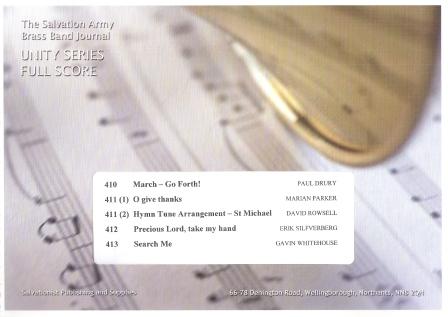
Unity Series Band Journal October 2013 Numbers 410 - 413
No. 410 March - Go Forth! (Paul Drury)This march was written as a tribute to Bandmaster Jack Spowart and the Bo'ness Salvation Army Band. The composer lives in the twon of Bo'ness and has had numerous opportunities to share with the band and the wider corps at various events. This march serves as recognition of the faithful service given in the Lord's name in the town by The Salvation Army for over 100 years. Two tunes are featured, both well-known and instantly recognisable, namely, Forward! be our watchword and We're marching on.No.411 (1) O give thanks (Marian Parker)The composer, Marian Parker, is a new contributor and is the Recruiting Sergeant at Leicester South Corps. This simple, yet rhythmic piece should not pose any technical problems for most bands and features the attractive arrangement of Joanne Pond's contemporary song, 'O give thanks'.No.411 (2) Hymn Tune Arrangement - St Michael (David Rowsell)The hymn tune 'St Michael' was composed in 1551 by French composer Louis Bourgeois and the composer provides a very useful arrangement of this historic hymn.No. 412 Precious Lord, take my hand (Erik Silfverberg O.F.)This well-known Gospel Song is a favourite of many. It has been recorded by many great artists, including Rosetta Tharpe, Elvis Presley and Aretha Franklin. The words were written by Reverend Thomas A. Dorsey, who is often known as the 'Father of Gospel song'.No. 413 Search Me (Gavin Whitehouse)The second new contributor to this journal is Gavin Whitehouse. gavin is the Assistant Music Director for the Greater New York Division and is also the USA Eastern Territorial Songster Leader. This piece combines two songs - one old and one new - which speak of a God who knows us intimately. 'Search me, O God and know my heart today' (associated with the beautiful Maori melody, 'Now is the hour') is woven with a contemporary setting of Psalm 139 by Rebecca St James, the first line of which says, 'You searchme, you know me'.
Estimated dispatch 7-14 working days
-
 £55.00
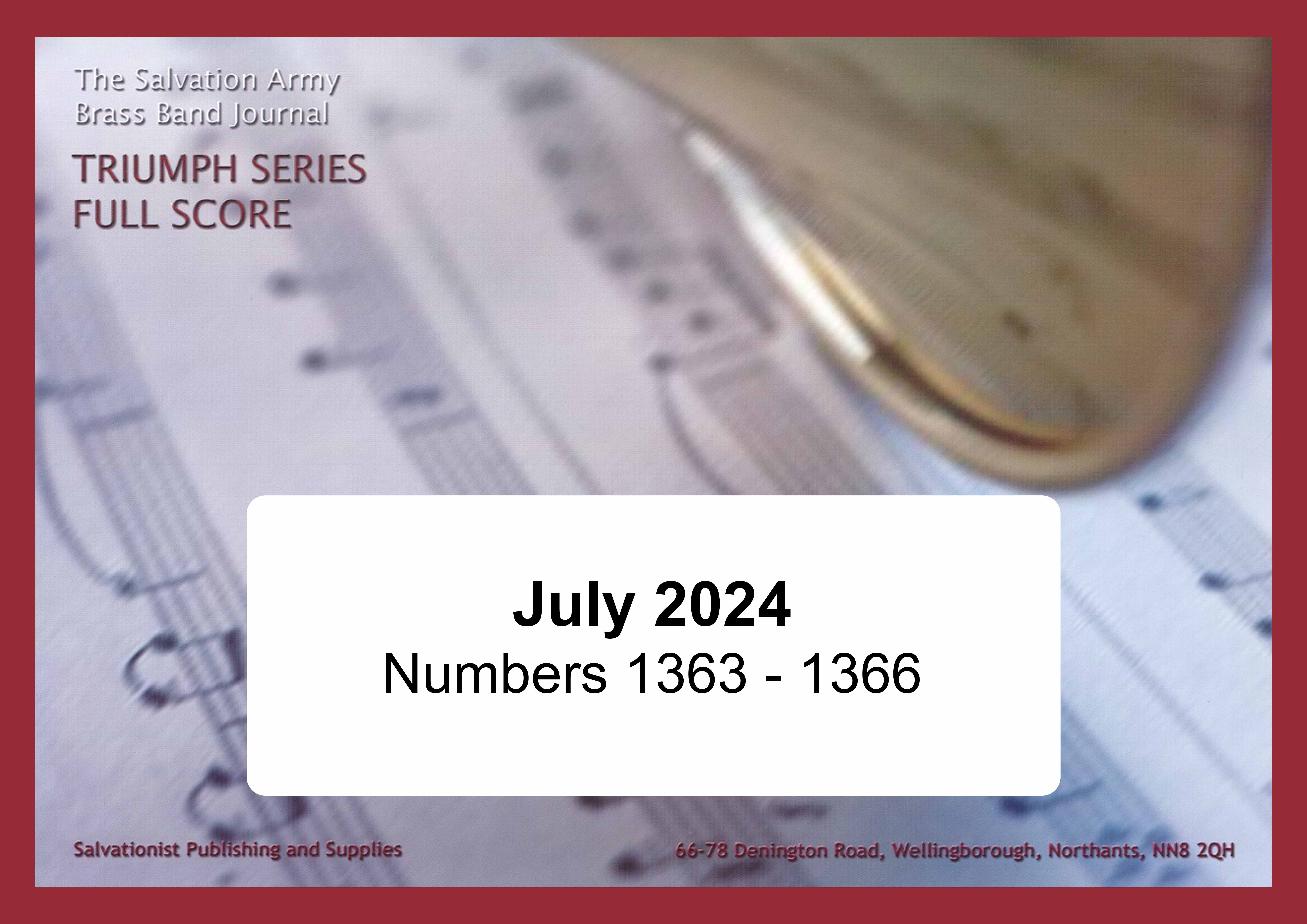
Triumph Series Brass Band Journal, Numbers 1363 - 1366, July 2024
1363: Festival March - Collect the harvest (Anders Beijer)This march is a call to tell others about the salvation we have received and bring people to Jesus. Jesus has bought us with his blood, and we now belong to him and stand under his protection, surrounded by his love and care. After brief references to the melody Bringing in the sheaves (S.A.S.B. 58) (also appearing later in the work in full) and an original melody, we hear the familiar tune Saviour, like a shepherd. This music should be performed with great joy and enthusiasm.1364: O come, Immanuel (Steve Kellner)The text of this beautiful Advent hymn (C.C. 62) dates to the 8th century and its chant-like tune to the 15th century. While the text alludes to Israel's captivity in Babylon and the coming Messiah, it in fact refers to the believer's anticipation of Jesus' second coming. The original chant melody was call and response, so the opening motif serves as the call, returning throughout the arrangement.1365: Our Consecration (Marcus Venables)This arrangement uses the tune St Margaret (T.B. 427) to the beloved hymn by George Matheson, O love that wilt not let me go (S.A.S.B. 616), which highlights the powerful and enduring nature of God's love. The use of the melodic fragment on the word 'go' serves as a subtle question mark, inviting the listener to reflect on the human qualities that may cause doubt in the steadfastness of God's love for us. However, as the piece ends, there is a sense of peace and assurance that we can truly rely on the never-ending love of God in our lives. This powerful and emotive arrangement will leave the listener feeling uplifted and encouraged by the knowledge that they are held securely in the arms of God's love.1366: March - The bell ringer (David Rowsell)The title of this march refers to someone who stands by the iconic Salvation Army Christmas kettle and receives donations from passers-by. They ring a bell to attract attention and subtly invite people to give a donation in support of The Salvation Army's work. This march was written as a tribute to the many volunteers worldwide who support this campaign each year. The music features the choruses from two Christmas carols, Sweet chiming Christmas bells (C.C. 83) and Sweet chiming bells (C.C. 82).
Estimated dispatch 7-14 working days
 View Music