
Results
-
 £29.50
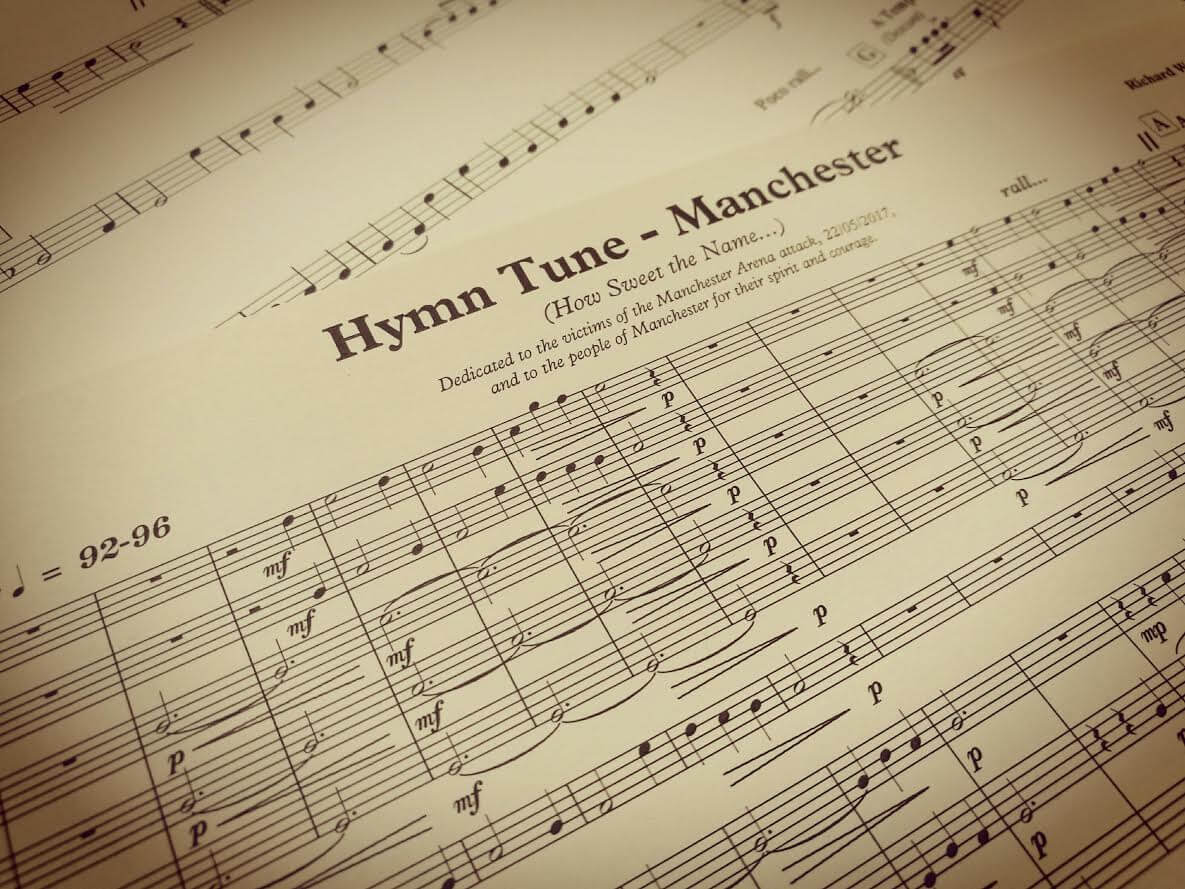
Manchester (Wind Band) - Richard Wainwright - Cook/Clarke
Following the terrible events that took place in the Manchester Arena on 22nd of May 2017, this specially arranged and dedicated setting of the hymn tune, 'Manchester' has been put together as a tribute to all those caught up in the attacks, and as a salute to the people of Manchester for their spirit and courage in the aftermath. �10.00 from every purchase is being donated to the Manchester Evening News fundraising page, to help them achieve their target of �2,000,000. This can be found at https://www.justgiving.com/crowdfunding/westandtogethermanchester.
In Stock: Estimated dispatch 1-3 working days
-
 £24.50
Repton (Dear Lord & Father of Mankind) - Charles Parry - Gavin Somerset
Featured numerous times on BBC 1's "Songs Of Praise", this hymn tune setting by Charles Parry (of Jerusalem fame) has become a nations favourite, heard throughout the country. This arrangement uses all the colours of the brass band to bring out Parry's stunning melody, building all the way though to a big warm climax that will send chills down the spines of your audience. Perfect for church occasions, and as a general concert item.
In Stock: Estimated dispatch 1-3 working days
-
 £24.50
Staff Of Faith - Swiss Traditional - Gavin Somerset
No concert programme is complete these days without a hymn tune being given the treatment that only a brass band sound can deliver. It is therefore refreshing when a lesser known work becomes available for bands to perform. This Swiss traditional melody has grown in popularity over the last decade and is heard in churches across the globe sang to the words 'My Faith It Is An Oaken Staff' by Thomas Lynch. This setting by Gavin Somerset uses the full colours of the brass band spectrum and allows several instrumentalists the chance shine in this warm and entertaining work with a big finish ending.
In Stock: Estimated dispatch 1-3 working days
-
 £29.50
The Deep - Andy Wareham
This stunning work took the title of 'Best Student Composition' at the UniBrass 2016 contest and features a collection of maritime hymn tunes in an unusual setting. Featuring an optional narration at over the opening sequence, the work is scored for quartet (Cornet, Horn, Euphonium & Bass) & band. 'Nearer My God To Thee', 'Melita' and 'Will Your Anchor Hold?' are all featured in this exciting new work as you won't have heard them before and is a great addition to any concert & contest repertoire.
In Stock: Estimated dispatch 1-3 working days
-
£24.50
The Angel Gabriel - Traditional Basque - Zillah Day-Smith
THE ANGEL GABRIELThis ancient hymn works beautifully for this combination of brass instruments. The harmony is sparse, while a drone is passed around the quartet emphasising the haunting qualities of the melody.
In Stock: Estimated dispatch 1-3 working days
-
 £94.95
An Age of Kings (Mezzo-Soprano Solo with Brass Band and optional choir - Score and Parts) - Gregson, Edward
The origins of this work date back to 1988, when I was commissioned by the Royal Shakespeare Company to write the music for The Plantagenets trilogy, directed by Adrian Noble in Stratford-upon-Avon. These plays take us from the death of Henry V to the death of Richard III. Later, in 1991, I wrote the music for Henry IV parts 1 and 2, again in Stratford. All of these plays are concerned with the struggle for the throne, and they portray one of the most turbulent periods in the history of the British monarchy.Much of the music used in these productions was adapted into two large symphonic suites for wind band - The Sword and the Crown (1991) and The Kings Go Forth (1996). An Age of Kings is a new version for brass band incorporating music from both the symphonic suites for wind band. It was specially composed for a recording made by the Black Dyke Band, conducted by Nicholas Childs, in 2004.An Age of Kings is music on a large-scale canvas, scored for augmented brass band, with the addition of harp, piano, mezzo-soprano solo, male chorus, as well as two off-stage trumpets. The music is also organized on a large-scale structure, in three movements, which play without a break - "Church and State", "At the Welsh Court", and "Battle Music and Hymn of Thanksgiving".The first movement, "Church and State", opens with a brief fanfare for two antiphonal trumpets (off-stage), but this only acts as a preface to a Requiem aeternam (the death of Henry V) before changing mood to the English army on the march to France; this subsides into a French victory march, but with the English army music returning in counterpoint. A brief reminder of the Requiem music leads to the triumphal music for Richard Plantagenet, Duke of York, father of Edward IV and Richard III (the opening fanfare transformed). However, the mood changes dramatically once again, with the horrors of war being portrayed in the darkly-drawn Dies Irae and Dance of Death, leading to the final section of the first movement, a funeral march for Henry VI.The second movement, "At the Welsh Court", takes music from the Welsh Court in Henry IV part 1 with a simple Welsh folk tune sung by mezzo-soprano to the inevitable accompaniment of a harp. This love song is interrupted by distant fanfares, forewarning of battles to come. However, the folk song returns with variation in the musical fabric. The movement ends as it began with off-stage horn and gentle percussion.The final movement, "Battle Music and Hymn of Thanksgiving", starts with two sets of antiphonally placed timpani, drums and tam-tam, portraying the 'war machine' and savagery of battle. Trumpet fanfares and horn calls herald an heroic battle theme which, by the end of the movement, transforms itself into a triumphant hymn for Henry IV's defeat of the rebellious forces.- Edward GregsonDuration - 22'00"Optional TTBB available separately.
Estimated dispatch 7-14 working days
-
 £42.95
TWO HYMNS TO THE MOTHER OF GOD (Brass Band) - Tavener, John - Littlemore, Phillip
Two Hymns (A Hymn to the Mother of God (3:00); Hymn for the Dormition of the Mother of God (3:45)) were written in memory of the composer's mother. The first, originally composed for double choir, is a setting of a text from the Liturgy of St. Basil. It speaks of the almost cosmic power attributed to the Mother of God by the Orodox Church. The second comes from the Vigil Service for the Dormition (or falling asleep) of the Mother of God. She invites the apostles to gather together from the ends of the earth to bury her body in Gethsemane, and asks her son to receive her spirit.
Estimated dispatch 7-14 working days
-
 £69.95
Heroes of the North (Brass Band - Score and Parts) - Graham, Peter
Heroes of the North was commissioned by Henning Annundsen for Skodvin Skulemusikk and pays tribute to the development of brass band activity in the Nordhordland region of Norway.The music is a set of character variations based upon personalities long associated with both the band and the region. The opening 5 note motif (C D E F G) might be considered the starting point for beginner brass students, and this mini-theme is developed throughout the work.Five variations follow: Mr Brevik's Galop (representing Tom Brevik, a key figure in Norwegian brass band music); Frode's Dance (with apologies to Edvard Grieg), portraying soprano cornet player Frode Rydland, one of Skodvin Skulemusikk's most famous "old boys"; Mr Bjrge's Walk representing Viggo Bjrge, "Mr Eikanger Bjrsvik Band"; Hymn for Knut-Harald, known as "Mr Skodvin Skulemusikk" having over many years played a central role in the teaching and training of the band, and finally Maestro Snell's Russian Adventure features music with more than a hint of Russian (Khachaturian to be precise) and calls to mind Howard Snell whose arrangements and presence have made such a huge contribution to Norwegian Brass Banding over many years.Heroes of the North is playable by 4th section bands.Duration: 10.00
Estimated dispatch 7-14 working days
-
 £29.95
Heroes of the North (Brass Band - Score only) - Graham, Peter
Heroes of the North was commissioned by Henning Annundsen for Skodvin Skulemusikk and pays tribute to the development of brass band activity in the Nordhordland region of Norway.The music is a set of character variations based upon personalities long associated with both the band and the region. The opening 5 note motif (C D E F G) might be considered the starting point for beginner brass students, and this mini-theme is developed throughout the work.Five variations follow: Mr Brevik's Galop (representing Tom Brevik, a key figure in Norwegian brass band music); Frode's Dance (with apologies to Edvard Grieg), portraying soprano cornet player Frode Rydland, one of Skodvin Skulemusikk's most famous "old boys"; Mr Bjrge's Walk representing Viggo Bjrge, "Mr Eikanger Bjrsvik Band"; Hymn for Knut-Harald, known as "Mr Skodvin Skulemusikk" having over many years played a central role in the teaching and training of the band, and finally Maestro Snell's Russian Adventure features music with more than a hint of Russian (Khachaturian to be precise) and calls to mind Howard Snell whose arrangements and presence have made such a huge contribution to Norwegian Brass Banding over many years.Heroes of the North is playable by 4th section bands.Duration: 10.00
Estimated dispatch 7-14 working days
-
 £34.95
How Can I Keep from Singing (Cornet Solo with Brass Band - Score and Parts) - Wainwright, Andrew
A beautiful arrangement of the traditional hymn for cornet soloist with brass band. Originally arranged for Virtuosi GUS Band & former Principal Cornet of Grimethorpe Colliery Band, James Fountain.
Estimated dispatch 7-14 working days
 View Music
 Listen to MP3