Results
-
£54.99Sour Croute - Peter Martin
Eating is a feast. But you are not yet in a party mood? Then enjoy Sour Croute because that will make you move. This German waltz will certainly put you into the right mood.
Estimated dispatch 5-14 working days
-
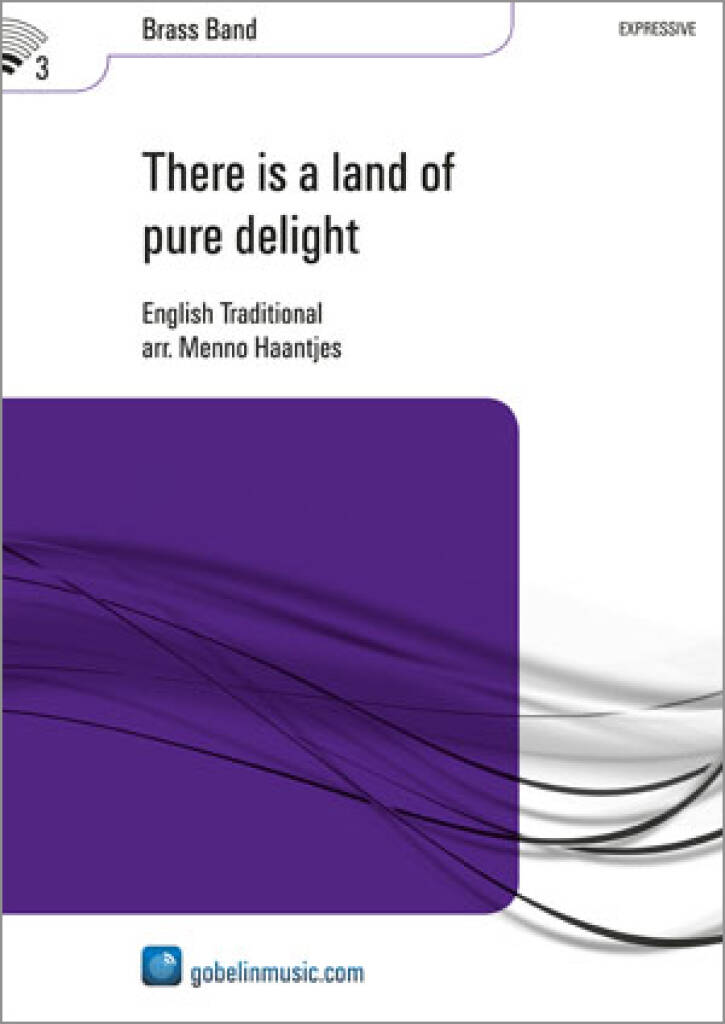
£60.99There is a land of pure delight - Menno Haantjes
Isaac Watts (1674-1748) wrote the lyrics of "There is a land of pure delight" and is known as the "Father of English Hymnody". Watts was for the English hymn as Ambrose was for the medieval Latin hymn and what Martin Luther was for the German chorale. He wrote about 750 songs, and some of them survide the ravahes of time. (Joy To The World, When I survey the wondrous cross, I sing the Mighty Power of God) "There is a Land of Pure Delight" is usually in English-speaking areas sung on Luther Orlando Emerson's melody ('Ascription'). Here is used a traditional English melody ('Mendip'). There is a land of pure delight Wheresaints immortal Reign. Infinite day excludes the night, And pleasures banish pain.
Estimated dispatch 5-14 working days
-
£115.60Stjernen og Rosa - John Philip Haqnnevik
The Star and a Rose is a big-scale Christmas piece for band, featuring four seasonal chorales.The first is a Gregorian-like chant Hodie Christus natus est.In this section of the piece, a soloist can be placed away from the band, maybe on a gallery. The soloist can be a tenor instrument, maybe trombone, or you can feature a vocal soloist.After this, the music leads us on to the old German Christmas chorale Lo, how a rose e'er blooming. This song is given a fairly rhythmical treatment, but make sure that the melody is presented in a cantabile style.An interlude follows, before the piece presents one of the most used and loved Scandinavian Christmas chorales, Mitt hjerte alltid vanker (My Heart will always wander), composed by the Danish bishop Hans Adolph Brorson around 1732. This song is building towards a climax, before the solo horn brings it all down to the Stable view described in the lyrics.Then comes a transition that brings us in to the final section of the piece, which presents the international Christmas Carol Adeste Fideles. As many will notice, I have borrowed a section from David Wilcocks majestic harmonization towards the end.The title of the piece has its background form the lyrics in My heart will always wander, where the text speaks about the stars in the sky. But also in the latin text for Adeste Fideles:Stella duce, Magi, Christum adorantesThe Rose is of course from the lyrics in the chorale Lo, how a Rose.
Estimated dispatch 5-14 working days
-
£60.99Vom Himmel Hoch, O Englein Kommt (Brass Band - Score and Parts) - De Haan, Jan
The German Christmas song Von Himmel hoch, O Englein kommt is one of the oldest known German carols, with the earliest versions, also known as Susani, going back to the 14th century. This exceptional arrangement by Jan de Haan works extremely well for brass band and will make an ideal work for any Christmas concert.Duration: 3:00
Estimated dispatch 7-14 working days
-
£79.95Corineus - Christopher Bond
Corineus, in medieval British legend, was a prodigious warrior, a fighter of giants, and the eponymous founder of Cornwall. The first of the legendary rulers of Cornwall, he is described as a character of strength and power. It is on the medieval ruler that this new work, Corineus, is based, presented in three contrasting sections. The work opens with heraldic fanfares and a sense of jubilance before presenting musical material which changes and develops organically, portraying the journey taken by Corineus, Brutus, and the Trojans from modern-day mainland Europe to Britain. The central section of the work is slower, creating a feeling of longing. Brutus' son, Locrinus, had agreed to marry Corineus' daughter, Gwendolen, but instead fell in love with a German princess. In writing this part of the work, the composer portrays the longing of Gwendolen for her husband, knowing he is in love with somebody else. After Corineus died, Locrinus divorced Gwendolen, who responded by raising an army in Cornwall and making war against her ex-husband. Locrinus was killed in battle, and legend suggests that Gwendolen threw Locrinus' lover into the River Severn. This dramatic battle provides the inspiration for the final part of the work. In writing this work, the composer hopes to flare the imagination of young brass players around the country, in an engaging new take on a firm fixture in British folklore.
Estimated dispatch 10-14 working days
-
£30.00Dresden - Brass Band - Full Score & Parts - LM955
COMPOSER: Alex McGeeThebombing of Dresdenwas aBritish-Americanaerial bombing attackon the city ofDresden, the capital of the Germanstate ofSaxony, duringWorld War II.In four raids between 13th and 15th February 1945, 722 heavy bombers of theBritishRoyal Air Force(RAF) and 527 of theUnited States Army Air Forces(USAAF)dropped more than 3,900 tons ofhigh-explosivebombsandincendiary deviceson the city.The bombing and the resultingfirestormdestroyed more than1,600 acres (6.5km2) of the city centre.An estimated 22,700to 25,000people were killed.Three more USAAF air raids followed, two occurring on 2nd Marchaimed at the city'srailway marshalling yardand one smaller raid on 17th April aimed at industrial areas.
In Stock: Estimated dispatch 3-5 working days
-
£45.00Two Herefordshire Carols (Brass Band - Score and Parts) - Vaughan Williams, Ralph - Hindmarsh, Paul
The two traditional tunes that comprise this straightforward setting were sung to Ralph Vaughan Williams (1872-1958) by Mrs. Esther Smith of Dilwyn, near Hereford, during one of the great composer's folk song collecting tours of England in the early years of the twentieth century. They were included in Twelve Traditional Carols from Herefordshire, edited by E.M. Leather and Vaughan Williams. The words to which Mrs. Smith sung the first tune were probably drawn from eighteenth century evangelical sources. The editors replaced these with six of the 16 verses of a traditional seventeenth century carol text, Joseph and Mary.The second melody, which appears as the centre piece of this arrangement, was sung to a carol that tells of a farmer who ploughed on Christmas Day. It is in fact a translation of a German traditional carol Gelobet seist du Jesu Christ that was published in Goodly Psalmes and Spiritualle Songes (1546) translated by Miles Coverdale. Vaughan Williams used the title Coverdale's Carol.The brass band settings follow the settings made by Vaughan Williams in 1920 for the Oxford Book of Carols. Since his simple harmonic approach is similar in both settings, three verses of his haunting version of Coverdale's Carol have been folded inside four verses of the slightly more animated treatment of Joseph and Mary. The harmonisations of Vaughan Williams have been given some brass band colour, with some verses taken by soloists from the ensemble. The accompaniment figuration that embellishes the second verse of Joseph and Mary has been used to open and close this arrangement and to bind the verses together.- Paul HindmarshDuration: 5.00
Estimated dispatch 7-14 working days
-
£44.95Variations on Was Lebet (Brass Band - Score only) - Wainwright, Andrew
Variations on 'Was Lebet' is based on the German chorale of the same name, the first line of which translates as 'O worship the Lord in the beauty of holiness!'
Estimated dispatch 7-14 working days
-
£89.95Variations on Was Lebet (Brass Band - Score and Parts) - Wainwright, Andrew
Variations on 'Was Lebet' is based on the German chorale of the same name, the first line of which translates as 'O worship the Lord in the beauty of holiness!'
Estimated dispatch 7-14 working days
-
£79.95Corineus (Brass Band - Score and Parts) - Bond, Christopher
Regionals 2024 - 3rd Section test piecePremiered by Cory Band at the 2018 Festival of Brass, Manchester. Selected as the set-work for the Championship Section at the 2019 National Youth Championships of Great Britain.Corineus, in medieval British legend, was a prodigious warrior, a fighter of giants, and the eponymous founder of Cornwall. The first of the legendary rulers of Cornwall, he is described as a character of strength and power. It is on the medieval ruler that this new work, Corineus, is based, presented in three contrasting sections. The work opens with heraldic fanfares and a sense of jubilance before presenting musical material which changes and develops organically, portraying the journey taken by Corineus, Brutus, and the Trojans from modern-day mainland Europe to Britain. The central section of the work is slower, creating a feeling of longing. Brutus' son, Locrinus, had agreed to marry Corineus' daughter, Gwendolen, but instead fell in love with a German princess. In writing this part of the work, the composer portrays the longing of Gwendolen for her husband, knowing he is in love with somebody else. After Corineus died, Locrinus divorced Gwendolen, who responded by raising an army in Cornwall and making war against her ex-husband. Locrinus was killed in battle, and legend suggests that Gwendolen threw Locrinus' lover into the River Severn. This dramatic battle provides the inspiration for the final part of the work. In writing this work, the composer hopes to flare the imagination of young brass players around the country, in an engaging new take on a firm fixture in British folklore.Duration: 11.00
Estimated dispatch 7-14 working days