Searching for Wind Band Music? Visit the Wind Band Music Shop
We've found 18 matches for your search. Order by

Results

  • £89.00

    At the gates of Asgard (Bra) - Stijn Aertgeerts

    A fierce Viking dies in battle and arrives at the gates of Asgard. The theme of the Viking is immediately present at the opening of the piece. He fights till his last breath before ascending to Asgard. In the slower movement, he can see the breath-taking beauty of the landscapes behind the gates, but before entering he has to prove his worth first in trial and combat. In the finale of the piece, the Viking finally gets to enter Asgard and spend his afterlife there.

    Estimated dispatch 7-14 working days

     PDF View Music

  • £59.95

    Beyond Heaven's Gates - Paul Lovatt-Cooper

    Beyond Heaven's Gates was commissioned by Derwent Brass and their Musical Director Keith Leonard to celebrate the bands 25th anniversary. Circa 8:30

    Estimated dispatch 10-14 days
  • £100.00

    Beyond heaven's gates

    Estimated dispatch 7-14 working days
  • £24.95

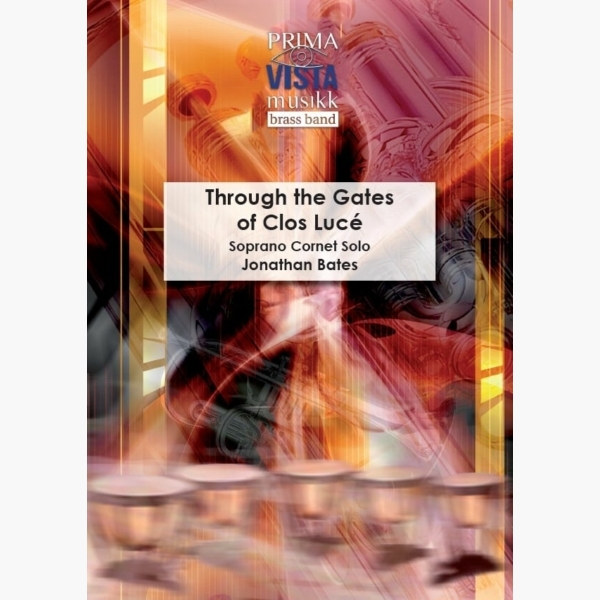
    Through the Gates of Clos Luce - Jonathan Bates

    Clos Luce was the French home of renowned artist, Leonardo Da Vinci. Located in the stunning town of Amboise, deep in the Loire Valley, this would be the place where many of his masterpieces were to be created. Composed for...

    Estimated dispatch 5-7 working days
  • £40.00

    Great Gate of Kiev, The (from Pictures at an Exhibition) (Brass Band - Score and Parts) - Mussorgsky, Modest - Littlemore, Phillip

    Modest Mussorgsky was a close friend of the young artist and architect Victor Hartmann, and his death in 1873 plunged Mossorgsky into a deep depression. The following year a memorial exhibition in St. Petersburg displayed Hartmann's paintings, costumes, architectural designs and sketches. Mussorgsky's visit to it, combined with his desire to write a piece in his friend's memory, inspired him to compose his?Pictures At An Exhibition?for piano. A suite of ten movements, with a recurring Promenade theme, it is one of the composer's most famous works and regarded as a showpiece for virtuoso pianists. It is perhaps the orchestral transcription made by Maurice Ravel in 1922 that is now the most famous version of it. This arrangement opens with a brief excerpt from?The Hut on Fowl's Legs, which was based on a painting of an elaborately carved clock depicting Baba Yaga, a horrible tiny witch that feasts on human bones. The tenth, and final picture in Mussorgsky's masterpiece is commonly referred to as?The Great Gate of Kiev, although it's literal translation is The Bogatyr Gates -- a Bogatyr being a hero figure in medieval East Slavic legend. It features a grand main theme that is interspersed with a more solemn hymn-like secondary theme. The work closes with a grand final rendition of the Promenade theme that almost grinds to a halt at what must be the foot of what were to be magnificent ceremonial gates (although they were never actually built!). Duration: 6:00

    Estimated dispatch 7-14 working days

     PDF View Music

  • £124.95

    Diary of a Madman (Twenty-Fourth February) (Brass Band - Score and Parts) - Clarke, Nigel

    From the beginning of history, warlords, emperors and dictators have risen up, some benign but many of them a scourge on humanity. Names that resonate to this day include Julius Caesar, Caligula, Genghis Khan, Ivan IV (The Terrible), Attila the Hun, Vlad IV (The Impaler), Hitler, Stalin, Mao Zedong, Pol Pot, all of whom were responsible for wanton destruction and the torture and death of millions of victims, either citizens of invaded countries and territories and or indeed, their own peoples.Diary of a Madman starts with a light-hearted march that gives the impression of toy tin soldiers parading in a brightly-coloured ceremonial pageant from a fairy tale, conveying peace and innocence. This spectacle is abruptly interrupted by a 'shock and awe' fanfare-like march, symbolising aggression and war. This theme grinds slowly to a halt, and an atmosphere of introspection, sadness and despair takes over. Rising above the smoky theatre of war, we then hear a distant cornet give a rendition of the Ukrainian Nation Anthem (The glory and freedom of Ukraine has not yet perished. Luck will still smile on us brother-Ukrainians). The solo cornet soon enters a fragile duet with a second cornet accompanied by dark undertones. One by one, we hear short shards of aggressive fanfare-like figures from various instruments in the band. The mood breaks - we hear strident fortissimo whole-tone scales representing pealing church bells, warning of danger. In contrast, we also hear pianissimo whole-tone scales announcing that the enemy's troops are falling back. A counter-offensive soon takes centre stage, and battles and skirmishes are heard, with short quotations from Mussorgsky's `Great Gates of Kyiv' symbolising the defenders' heroic struggle.All sides are victims of the Dictator's ambition! The slow central section offer us moments of melancholic beauty and utilises Henry Purcell's `When I am laid in earth' (`Dido's Lament' from Dido and Aeneas 1688). This music represents the loss of homes, dignity and loved ones. There are occasional hints at better times as the theme of the parading toy tin soldiers is heard from afar, like a distant memory.To announce the final push, we hear a church bell strike and an air raid siren signalling a ferocious musical counter-attack. After one final rendition of the Purcell theme, Diary of a Madman closes with a mood of triumph over tyranny.- Nigel Clarke

    Estimated dispatch 7-14 working days

     PDF View Music

  • £57.95

    Diary of a Madman (Twenty-Fourth February) (Brass Band - Score only) - Clarke, Nigel

    From the beginning of history, warlords, emperors and dictators have risen up, some benign but many of them a scourge on humanity. Names that resonate to this day include Julius Caesar, Caligula, Genghis Khan, Ivan IV (The Terrible), Attila the Hun, Vlad IV (The Impaler), Hitler, Stalin, Mao Zedong, Pol Pot, all of whom were responsible for wanton destruction and the torture and death of millions of victims, either citizens of invaded countries and territories and or indeed, their own peoples.Diary of a Madman starts with a light-hearted march that gives the impression of toy tin soldiers parading in a brightly-coloured ceremonial pageant from a fairy tale, conveying peace and innocence. This spectacle is abruptly interrupted by a 'shock and awe' fanfare-like march, symbolising aggression and war. This theme grinds slowly to a halt, and an atmosphere of introspection, sadness and despair takes over. Rising above the smoky theatre of war, we then hear a distant cornet give a rendition of the Ukrainian Nation Anthem (The glory and freedom of Ukraine has not yet perished. Luck will still smile on us brother-Ukrainians). The solo cornet soon enters a fragile duet with a second cornet accompanied by dark undertones. One by one, we hear short shards of aggressive fanfare-like figures from various instruments in the band. The mood breaks - we hear strident fortissimo whole-tone scales representing pealing church bells, warning of danger. In contrast, we also hear pianissimo whole-tone scales announcing that the enemy's troops are falling back. A counter-offensive soon takes centre stage, and battles and skirmishes are heard, with short quotations from Mussorgsky's `Great Gates of Kyiv' symbolising the defenders' heroic struggle.All sides are victims of the Dictator's ambition! The slow central section offer us moments of melancholic beauty and utilises Henry Purcell's `When I am laid in earth' (`Dido's Lament' from Dido and Aeneas 1688). This music represents the loss of homes, dignity and loved ones. There are occasional hints at better times as the theme of the parading toy tin soldiers is heard from afar, like a distant memory.To announce the final push, we hear a church bell strike and an air raid siren signalling a ferocious musical counter-attack. After one final rendition of the Purcell theme, Diary of a Madman closes with a mood of triumph over tyranny.- Nigel Clarke

    Estimated dispatch 7-14 working days

     PDF View Music

  • £34.95

    Song of the Night Sky (Cornet Solo with Brass Band - Score and Parts) - Bond, Christopher

    Orpheus is known as the most talented music player of the ancient times. It is said that god Apollo was his father, from whom took his extreme talent in music, and the Muse Calliope was his mother. Tragedy struck when his wife, Eurydice stepped on a viper which in turn bit her, injecting its fatal venom. Nothing could stop his cries of anguish and sheer pain and sorrow upon realizing his beautiful Eurydice was dead. Orpheus decided to go into the Underworld to get his wife back. Apollo, his father, would talk to Hades, the god of the Underworld to accept him and hear his plea. And so Orpheus set off into the Underworld and was warned that for no reason must he look back while his wife was still in the dark, for that would undo everything he hoped for. As Orpheus was reaching the exit of the Underworld, he could hear the footfalls of his wife approaching him. As his was approaching the exit, his heart was beating faster and faster. The moment he stepped on the world of the living, he turned his head to hug his wife. Unfortunately, he got only a glimpse of Eurydice before she was once again drawn back into the underworld. When Orpheus turned his head, Eurydice was still in the dark, she hadn't seen the sun and, was drowned back to the dark world of the dead. Waves of anguish and despair swept over him and shuddering with grief he approached the Underworld again but this time, he was denied entry, the gates were standing shut and god Hermes, sent by Zeus, wouldn't let him in. His songs were no more joyful but extremely sad. His only comfort was to lay on a huge rock and feel the caress of the breeze, his only vision were the open skies. Song of the Night Sky was recorded by Tom Hutchinson and the Cory Band in June 2015, featuring on his debut solo album.Duration: 4.15

    Estimated dispatch 7-14 working days
  • £29.95

    War Cry (Brass Band - Score and Parts) - Gates, Dorothy

    This work was written as the opener for the New York Staff Band's 125th anniversary concert in Carnegie Hall in March 2012. Based on the song, 'Ever is the war cry'. the music is quite militant in nature which is a direct reflection of the text. While the composer pays homage to the past in this fitting salute, the overall musical style is decidedly that of the 21st century.

    Estimated dispatch 7-14 working days
  • £14.95

    War Cry (Brass Band - Score only) - Gates, Dorothy

    This work was written as the opener for the New York Staff Band's 125th anniversary concert in Carnegie Hall in March 2012. Based on the song, 'Ever is the war cry'. the music is quite militant in nature which is a direct reflection of the text. While the composer pays homage to the past in this fitting salute, the overall musical style is decidedly that of the 21st century.

    Estimated dispatch 7-14 working days