
Results
-
 £27.50
Russian Rhapsody
An early Rachmaninov piece in a very free arrangement best describes this miscellany of melody and dance.
Estimated dispatch 7-14 working days
-
 £107.95
When Worlds Collide (Score and Parts)
Subtitled: Little Green Men in Intergalactic Spaceships with Ray-Guns and Phasers, A Space Symphony for Brass band. Written for the free choice test piece for Brass Band Buizingen for the Flemish Open Brass Band Championships. When Worlds Collide seeks to recreate the atmosphere and sentiment of the American cult Sci-Fi movies of the 1950's such as Robert Wise's 1951 film 'The day the Earth Stood Still' and 'Invasion of the Body Snatches' directed by Don Siegel in 1956, as well as Rudolph Mate's 1951 film 'When Worlds Collide'. It is programmatic with subtitled sub-sections as follows: Crop Circles; Lights in the Sky; Strange Happenings; Sightings; "We Come in Peace"; Alien Abduction; Analysis of the Earthlings; Teleportation; New Understandings; Visions of Far Off Worlds; Colonisation.
Estimated dispatch 7-14 working days
-
 £49.95
When Worlds Collide (Score Only)
Subtitled: Little Green Men in Intergalactic Spaceships with Ray-Guns and Phasers, A Space Symphony for Brass band. Written for the free choice test piece for Brass Band Buizingen for the Flemish Open Brass Band Championships. When Worlds Collide seeks to recreate the atmosphere and sentiment of the American cult Sci-Fi movies of the 1950's such as Robert Wise's 1951 film 'The day the Earth Stood Still' and 'Invasion of the Body Snatches' directed by Don Siegel in 1956, as well as Rudolph Mate's 1951 film 'When Worlds Collide'. It is programmatic with subtitled sub-sections as follows: Crop Circles; Lights in the Sky; Strange Happenings; Sightings; "We Come in Peace"; Alien Abduction; Analysis of the Earthlings; Teleportation; New Understandings; Visions of Far Off Worlds; Colonisation.
Estimated dispatch 7-14 working days
-
 £19.95
Abide with Me (Brass Band - Score and Parts)
A free treatment of Henry Francis Lytes world-beloved hymn which was written in 1847 at Brixham, Devon, where the author was vicar. As he watched the sunset one evening the words of the hymn, in which he compares life to a single day, came to him. Dogged by persistent ill health, Dr Lye died in the autumn of the same year.
Estimated dispatch 7-14 working days
-
£50.00
Vectis Isle - Broadbent, D
VECTIS ISLE is the Roman name for the Isle of WrightSTATELY OSBORNEOsborne House was the summer residence of Queen Victoria. Music of fanfares and pageantry in 3/4 time, with a central delicate minuet section, before returning to the original fanfares and stately themes.PICTURESQUE CALBOURNECalbourne is a pretty, tiny country village with its feature of an old water mill. The music is pastorale in style. 6/8 rhythms with a free and easy waltz section.THE OLD CHURCH AT GODSHILLThis movement links directly from the second, but may be played on its own if desired. Godshill is a quaint but beautiful village of thatched cottages by an old church.SANDOWN HOLIDAYSThis final movement is intended to portray the happy atmosphere of this pleasant seaside resort, with just a moment or two to laze on the fine beaches under an afternoon sun before the final allegro concludes this suite.Duration 14 and a half mins
In Stock: Estimated dispatch 1-3 working days
-
 £24.95
Lest We Forget - Christopher Bond
Lest We Forget is a phrase added as a final line at the end of the Ode of Remembrance, taken from Laurence Binyon's poem For the Fallen, first published in The Times newspaper in September 1914. Providing the title for this work for brass band, the piece aims to combine both the acoustic nature of the brass band medium alongside narrated passages and pre-recorded extracts to provide a moving tribute. The words originally spoken by Prime Minister Herbert Asquith in 1914 can be narrated in performance. However, a free audio download, manipulated to sound like a 1914 radio broadcast is available from Prima Vista. Lest We Forget received its premiere at The Sage, Gateshead, on November 17th 2014, performed by the Grimethorpe Colliery Band, conducted by Robert Childs. The work opened their winning Brass in Concert programme, and has since been performed by bands all over the world as a fitting tribute to the Great War.
Estimated dispatch 10-14 working days
-
 £45.00
God Put a Smile Upon Your Face
ABOUT THIS PIECE: 'God Put a Smile Upon Your Face' was written by all members of the band Coldplay for their second studio album 'A Rush of Blood to the Head'. Coldplay vocalist Chris Martin said: "The song came out of playing live and wanting to have something with a bit more bounce". The chart was originally released in 2003 to critical acclaim. In 2007 Mark Ronson covered the song on his album 'Version' - it is this version this arrangement is based upon. The following arrangement was devised as a concert opener - written as such to allow different sections of the band to make their way to the stage one at a time. The suggested stage entry directions for this arrangement are: Percussion > Basses > Trombones > Horns & Baritones > Cornets & Euphonium. Kit and percussion parts are written as a guide - please feel free to add and subtract as the MD sees fit. DUE TO COPYRIGHT LAW THIS WORK IS NOT AVAILABLE IN AUSTRALIA OR NEW ZEALAND ENSEMBLE: Standard British Brass Band WHEN YOU BUY THIS PRODUCT, YOU GET: High-quality printed score and parts LEVEL: 2 LISTEN: Click here DURATION: 3-mins 30 secondEXAMPLE SCORE: Click here LEVEL GUIDE: Level 1- Accessible to all Level 2 - c. UK third section and higher Level 3 - c. UK second section and higher Level 4 - c. UK first section and higher Level 5 - c. UK championship section level
Estimated dispatch 5-7 working days
-
 £19.95
As The World Falls Apart... - Jonathan Bates
DURATION: 4 minutes. DIFFICULTY: Moderate. 'As The World Falls Apart' was composed for David Maxted as part of the programme for his BMus Final Recital at the RNCM in May 2017. The work was composed in a time of real political and social divide, with chaos only ever seeming minutes away, and the base of the piece is one of serenity and traniquility amongst the bedlam which is occurring around us all. Originally, the work was planned to be a totally free unaccompanied work for solo horn, however I wanted to make use of the vast space the RNCM concert hall can offer with the surround-sound speakers and decided to utilise a short sound effect track to enhance the feeling of chaos as the music reaches it's peak in dynamic and intensity. AUDIO FILE AVAILABLE FROM COMPOSER - [email protected]. . . .
In Stock: Estimated dispatch 1-3 working days
-
 £30.00
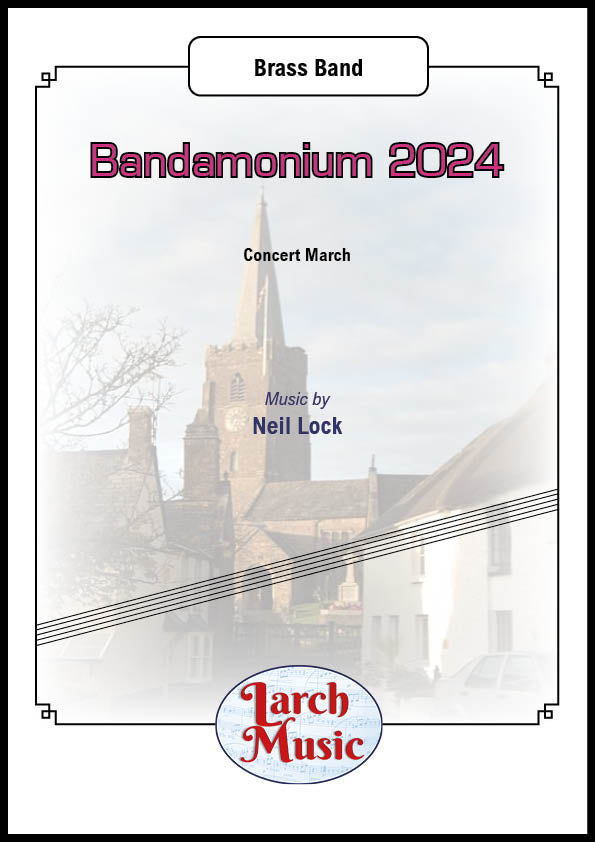
Bandamonium 2024 (Neil Lock) - Brass Band Sheet Music Full Score & Parts - LM541
COMPOSER: Neil LockThis march was submitted to the march composers' competition for "Bandamonium 3"in Hatherleigh, Devon in July 2024. The winning march was played by massed bands at the conclusion of the celebrations on Saturday 27th July 2024. Unfortunately, this march took second place in the competition, behind the march of Paul Pennicotte-Henrie, conductor of Okehampton Silver Band.The march can be played with or without the singing. (Even at the Whit Friday marches, begad!) I suggest that it should be introduced by 3-beat rolls.When played with singing, the "Bandamonium" lyrics (bars 10-13 and 56-57) are to be sung by all players, keeping to their own parts, with appropriate octave adjustment for their individual singing voices. Conductor and percussionists should sing with the main theme (Db and C at bars 10-13, F at 56-57). Listen to the 3rd cornet players!There is an additional part for Singers, in which the trio melody (bars 58 onwards) can be sung by Soprano and Tenor singers at a moderate choir standard. An octave-down option is also provided in the higher bars. This part can be given to "spare" singers within the band, or to singers external to the band if opportunity permits. The lyrics are:We are in Devon,We're in Hatherleigh,Whit Friday heaven,But we're marching free!Now it's past seven,Time to party,At BandamoniumIn Hatherleigh!LM541 - ISMN : 9790570005413
In Stock: Estimated dispatch 3-5 working days
-
 £164.99
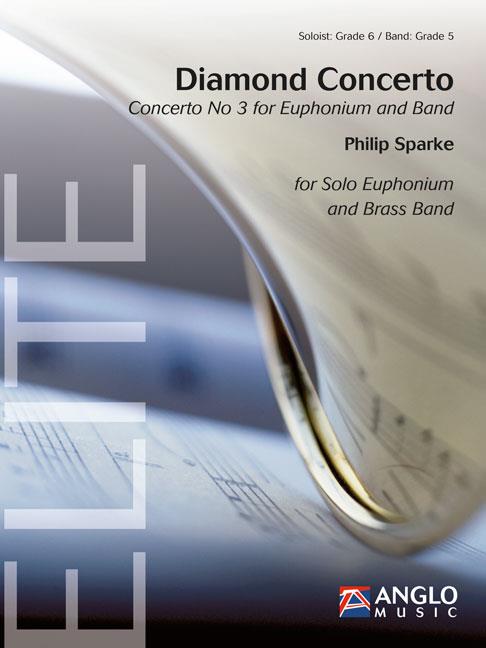
Diamond Concerto (Euphonium Concerto No.3) (Euphonium Solo with Brass Band - Score and Parts) - Sparke, Philip
Diamond Concerto was commissioned by Musikverein Morschied from Germany - Dr. Eric Grandjean, conductor - for a special concert featuring Steven Mead as guest soloist. Together they gave the world premiere on 28th April 2012 in the town theatre of Idar-Oberstein. The commission is a highlight in the 30-year friendship between composer and soloist, which has included many mutual CD projects and concerts and, now, a concerto. Sparke had Steven Mead's special euphonium sound in his head throughout the composition process and made free use of the variety of styles which the world-renowned virtuoso has made his own during his highly successful solo career.The village of Morschied lies to the west of Frankfurt am Main in the area known as the German Road of Precious Stones, which is famous for its thriving gem industry. Because of this it was decided to give the commission a local connection by choosing the title, Diamond Concerto. Each of the three movements is named after a famous diamond:Earth Star is rather stern in mood, opening with a free fantasy for the soloist over a static chord from the band. This leads to an Allegro Moderato in minor mode where small motives are gradually repeated and developed by both band and soloist.Ocean Dream uses a varied quote from the composer's Music for Battle Creek, including a melting slow melody that was originally written with Steven Mead in mind.Blue Heart was written, at Steven Mead's suggestion, in bebop style and takes the form of a jazz waltz. The quasi-improvisatory central section features a call-and-response passage for the soloist and upper woodwinds.Duration: 16:45
Estimated dispatch 7-14 working days
 View Music