
Results
-
 £30.25
Autumn Bacchanale (from The Seasons) - Alexander Glazunov
A lively, joyous item, ideal as a light interlude in any concert and especially appropriate for late season/Christmas themed events with its jaunty, positive sounds. Sue Hopkins has shown great creativity in crafting this arrangement of Glazunov's 'Autumn' movement, a bacchanale from his ballet The Seasons, hence its fondly referenced title of Autumn Bacchanale.Alexander Glazunov (1865 - 1936) was a Russian composer, music teacher and conductor. He was a child prodigy and was taught privately byRimsky-Korsakov, who said Glazunov's musical progress did not increase day by day but hour by hour. He began composing at age eleven and wrote his first symphony at age 16 in 1881 and it was premiered one year later.His ballet The Seasonswas first performed by the Imperial Ballet in St Petersburg on 20 February 1900 and was choreographed by Marius Petipa.It was written in one act and four scenes, and this piece represents the moment when all The Seasons take part in a glorious dance while leaves from autumn trees rain upon their merriment.
In Stock: Estimated dispatch 3-5 working days
-
 £30.00
Buffoon . . . - Lucy Pankhurst
We all need a little buffoonery at times, and this enjoyable creation from Lucy Pankhurst completely hits the mark with its melody being so 'buffoon-like' in its movement and harmonies.Reminiscent of circus-style music, the piece is thinly scored to start and then gradually develops gentle variations of the melody. These are shared throughout the band until a peak of harmonies and tempo leads to a settled return to a more reflective ending.An imaginative development of a simple tune which makes for a versatile light concert item ... it's also likely that the main melody will stay in your mind days after hearing it!
In Stock: Estimated dispatch 3-5 working days
-
 £90.75
De Profundis - john wallace, Tony George
An original composition for massed brass bands and brass quintet devised by John Wallace, Tony George and Svend McEwan-Brown. A cross-genre production work, including scene setting, lighting and the spoken word reciting associated poems, De Profundis was given its world premiere at the East Neuk Festival on 1 July 2017 at The Bowhouse, performed by The Wallace Collection, Tullis Russell Mills Band and friends.If you would like to perform this work, The Wallace Collection are able to provide production consultancy and supply the brass quintet elements of the production - if you would like to discuss potential performances, please contact them direct on [email protected] NotesDe Profundis is a large scale brass band performance piece created by John Wallace and Tony George, based upon an original idea by Svend McEwan-Brown. It was developed in sessions with members of the Tullis Russell Mills Band, commissioned and premiered at East Neuk Festival 2017 at The Bowhouse, St Monans, on 1st July 2017.It was supported by Creative Scotland, Fife Council, Toby and Kate Anstruther, Shields and Carol Henderson, Donald and Louise MacDonald.This project remembers and celebrates the lives and music of miners. It is designed to give brass bands a performance piece that uses elements of improvisation and participation, to offer the players a stimulating and inspiring experience beyondthe normal run of brass band repertoire.All the music is drawn from two settings of the psalm 'Out of the Deep" (De Profundis).Look and Listen (courtesy of Tullis Russell Mills Band and The Wallace Collection at 2017 East Neuk Festival):More InformationMore details about the De Profundis project is available on a dedicated web-page on The Wallace Collection website.
In Stock: Estimated dispatch 3-5 working days
-
 £42.35
The Water of Tyne - Traditional
A delightful setting of a traditional North East melody, arranged in a hauntingly pastorale style with all the skill we have come to expect from Philip Harper. Featuring the euphonium and principal cornet with the melody at first, the piece then builds to a passionate full band rendition which eases back to a tranquil, effective close.A great piece to offer every level of band the opportunity to add some stylish peace to their programme.Also available for Concert Band.
In Stock: Estimated dispatch 3-5 working days
-
Deadwood Stage - Sammy Fain - Len Jenkins
This very well-known piece forms a large part of the musical backdrop to the film 'Calamity Jane', and is offered here in a relatively uncomplicated arrangement which features three trombones as soloists and as a trio. There is a cadenza involving all three near the close. This is another good choice for that Entertainment Contest...
-
Kaiser Bill - Len Jenkins
A jolly march in the German style that combines a characteristic bass motif with a lively melody which quickly has the audience's feet tapping and gives all members of the Band work to do. Total participation! Ideal for fetes, concerts and possibly contests at the 3rd/4th section level.
-
Christmas Turkey Bones - Various - Lennox Rhodes
Think about Christmas; think about carols; think about turkey with all the trimmings and you have it! Featuring the trombones of the band in a jolly hoe-down setting, you will recognise some favourite Christmas carols; Ding Dong Merrily on High, The First Nowell, I Saw 3 Ships, Adeste Fideles and Deck The Halls. So it only remains for you to "pick the 'bones out of that" and make a wish!
-
 £39.95
Sovereign's Escort (Score and Parts) - Roy Douglas
Roy Douglas was not only assistant to Ralph Vaughan Williams, Noel Coward, and a host of others, but a composer in his own right. This short ceremonial march for brass band bears all the hallmarks of the best of the English composers. Duration: 3:45
Estimated dispatch 7-9 working days
-
 £39.95
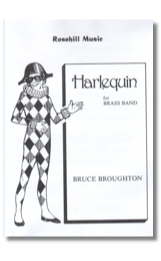
Harlequin (Score and Parts) - Bruce Broughton
Harlequin is the most popular of the comic servant characters from the Italian commedia dell'arte who, although a slow thinker, was acrobatic and nimble - he would never perform a simple action when the addition of a cartwheel or backflip would spice up the movement! These characteristics are aptly portrayed musically in Bruce Broughton's mini concert overture. Originally published for brass band in 1984, this popular work coveys all the hustle, bustle, and agility of the character in a finely crafted musical structure. Ideal as a concert opener or encore it is sure to delight audiences and provide players with an exciting new addition to their repertory. Duration: 2:30
Estimated dispatch 7-9 working days
-
 £58.00
Henry V (Score only) - William Walton
It takes a special ability to compose film scores which serve the images perfectly yet translate into first class concert music. William Walton was such a talent as the continuing popularity of his brilliantly evocative film music shows. Included are the poignant Death of Falstaff, the victorious Agincourt Song and Touch her soft lips and part - one of the most tender miniatures in all music. Winwood Music are delighted to bring this music from Laurence Olivier's classic film to the brass band world in a fabulous arrangement, including optional narrator, by Edward Watson - so idiomatic that you'll think this is the original version! Full Movement Listing: Fanfare Prologue: O For a Muse of Fire Interlude at the Boar's Head Inn The Death of Falstaff Touch Her Soft Lips Fanfare Fanfare The Battle of Agincourt Bailero Interlude at the French Court The Agincourt Song
Estimated dispatch 7-9 working days