
Results
-
 £39.95
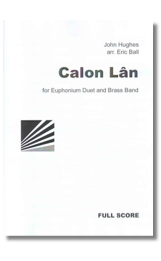
Calon Lan - Eric Ball
Eric Ball originally made this duet arrangement with piano accompaniment for inclusion in our album Czardas (order code 0078) and it was later transcribed for brass band by Eric Wilson (who was named after the composer!). The Welsh tune is handled in turn by the duettists, one embellishing while the other carries the melody. The accompaniment parts are not difficult making this delightful, somewhat nostalgic, piece ideal for bands of all abilities.
Estimated dispatch 7-9 working days
-
 £42.00
Euphonium Music (Score only) - Brian Bowen
Written in 1978, the work is constructed in three movements and is virtually a concerto for euphonium and band. The first movement begins with an unaccompanied motto theme, which uses all twelve notes of the scale but with a tonal feel. The slow second movement is based on an original song melody by the composer - 'The Eyes of God' - and affords lyrical and richly expressive playing that is typically euphonium. Movement three follows without a break - a capricious movement which ends triumphantly. Now available in versions for piano, brass band, wind band, and orchestra, Euphonium Music can be seen as a major contribution to the literature for the instrument. Duration: 15 minutes An orchestral version is available on hire.
Estimated dispatch 7-9 working days
-
 £52.00
Euphonium Music (Parts only) - Brian Bowen
Written in 1978, the work is constructed in three movements and is virtually a concerto for euphonium and band. The first movement begins with an unaccompanied motto theme, which uses all twelve notes of the scale but with a tonal feel. The slow second movement is based on an original song melody by the composer - 'The Eyes of God' - and affords lyrical and richly expressive playing that is typically euphonium. Movement three follows without a break - a capricious movement which ends triumphantly. Now available in versions for piano, brass band, wind band, and orchestra, Euphonium Music can be seen as a major contribution to the literature for the instrument. Duration: 15 minutes An orchestral version is available on hire.
Estimated dispatch 7-9 working days
-
 £39.95
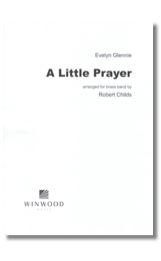
A Little Prayer (Score and Parts) - Evelyn Glennie
Composer Evelyn Glennie writes... "When I wrote the chorale for marimba, A Little Prayer, it expressed my spiritual feelings and displayed a pleasantly relaxed dimension of the instrument. Over the years my exposure to brass bands has filled me with wonder; their musical diversity is considerable. From performing a simple melody to the most complex of test-pieces, they bring brilliance to the music. I had no hesitation in giving A Little Prayer to Robert Childs to bring this little melody to life through brass." A perfect reflective interlude for concert or devotional use by bands of all abilities. This is the only version of this arrangement available for sale to the public.
Estimated dispatch 7-9 working days
-
 £44.95
Triumphant (Brass Band - Score and Parts)
Triumphant was written as the opening work for the 2024 Future All-Stars final concert. Based on the well-known hymn Victory in Jesus (S.A.S.B. 464), the piece reimagines the familiar melody and words with energetic drumline-inspired rhythms and driving Bass groove.O victory in Jesus, my Saviour, for ever!He sought me and bought me with his redeeming blood;He loved me ere I knew him, and all my love is due him -He plunged me to victory beneath the cleansing flood.Musically speaking, the rhythmic pulse should remain confident and consistent throughout, with the percussion establishing the groove and the band locking in with precision. Take time to find a tempo that allows the Bass and Percussion parts to remain clear and accurate. A slightly steadier pace will produce a stronger, more convincing groove. However, a slower tempo can result in the band's playing becoming too heavy. Melodic lines should be played on the longer side, allowing phrases to sing over the rhythmic accompaniment that can be more defined and articulated. As the work builds, be patient and disciplined with dynamics, saving the band's fullest sound for the climactic moments, maximising their impact.
Estimated dispatch 7-14 working days
-
 £77.00
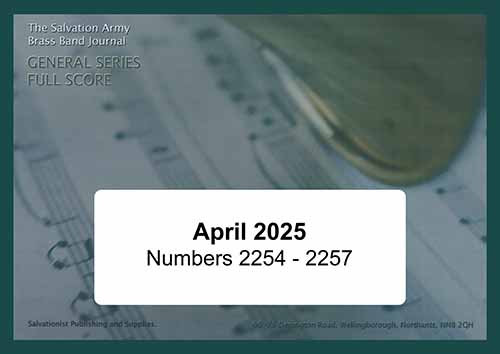
General Series Brass Band Journal, Numbers 2254 - 2257, April 2025
2254: Be glorified today (Martin Cordner)Built around Bob Kilpatrick's song In my life, Lord, be glorified today (S.A.S.B. 593), this concert opener was composed for Cambridge Citadel Band (UK and Ireland Territory) at the request of Bandmaster Simon Fisher. The piece pays homage to the city.2255: Driven by mission (Stephen Bulla)Stephen Bulla wrote this piece to commemorate Willis Howell and his wife's retirement from active officership. Bulla references St. Denio (S.A.S.B. 37), Melita (T.B. 442), For your mission and Men of Harlech (T.B. 756), and the assembling of the tunes and all they represent reflects the masterful artistry that always marks Bulla's works.2256: The Lord's my shepherd (Paul Sharman)This arrangement brings together two settings of Psalm 23; the familiar hymn tune Crimond (T.B. 68) and the more recent melody by Stuart Townend (T.B. 863).2257: Cornet Solo - I love you, Lord (Ian Robinson)Laurie Klein's chorus I love you, Lord (S.A.S.B. 369) has been popular for many years with Salvation Army congregations around the world and this work combines unconventional harmonies with sparse scoring to feature the soloist.
Estimated dispatch 7-14 working days
-
 £44.95
Powerhouse (Brass Band - Score and Parts)
Spirit divine, come as of old. So begins the song by Brindley Boon (S.A.S.B. 311), and that phrase becomes the message of this piece, and an important motif in the music. It appears at the very beginning of the work and recurs at important points during the piece. The theme of the need for spiritual power is further underlined by the use of the hymns Show your power (S.A.S.B. 365), Wonder-working power (S.A.S.B. 451) and the very old chorus Send a new touch of power on my soul, Lord (S.A.S.B. 785).The composer first heard Boon's song Spirit Divine when it was sung by Parkhead Songsters in the Sunday morning meeting at his home Corps of Greenock Citadel. They were visiting for the weekend from Glasgow, and were conducted by Songster Leader Walter Chalmers, himself a beautiful lyric tenor soloist. They sang it in a moving fashion, unaccompanied, and such was the impact that, at the conclusion, many people went to the mercy seat. It made a huge impression on the young composer. It was the first time that Downie discovered the enormous power of music in worship. It also serves as a reminder to us all that young people of a tender age are very capable of grasping deeply significant events happening around them. This music was written for the 2020 UK Territorial Youth Band course.
Estimated dispatch 7-14 working days
-
 £30.00
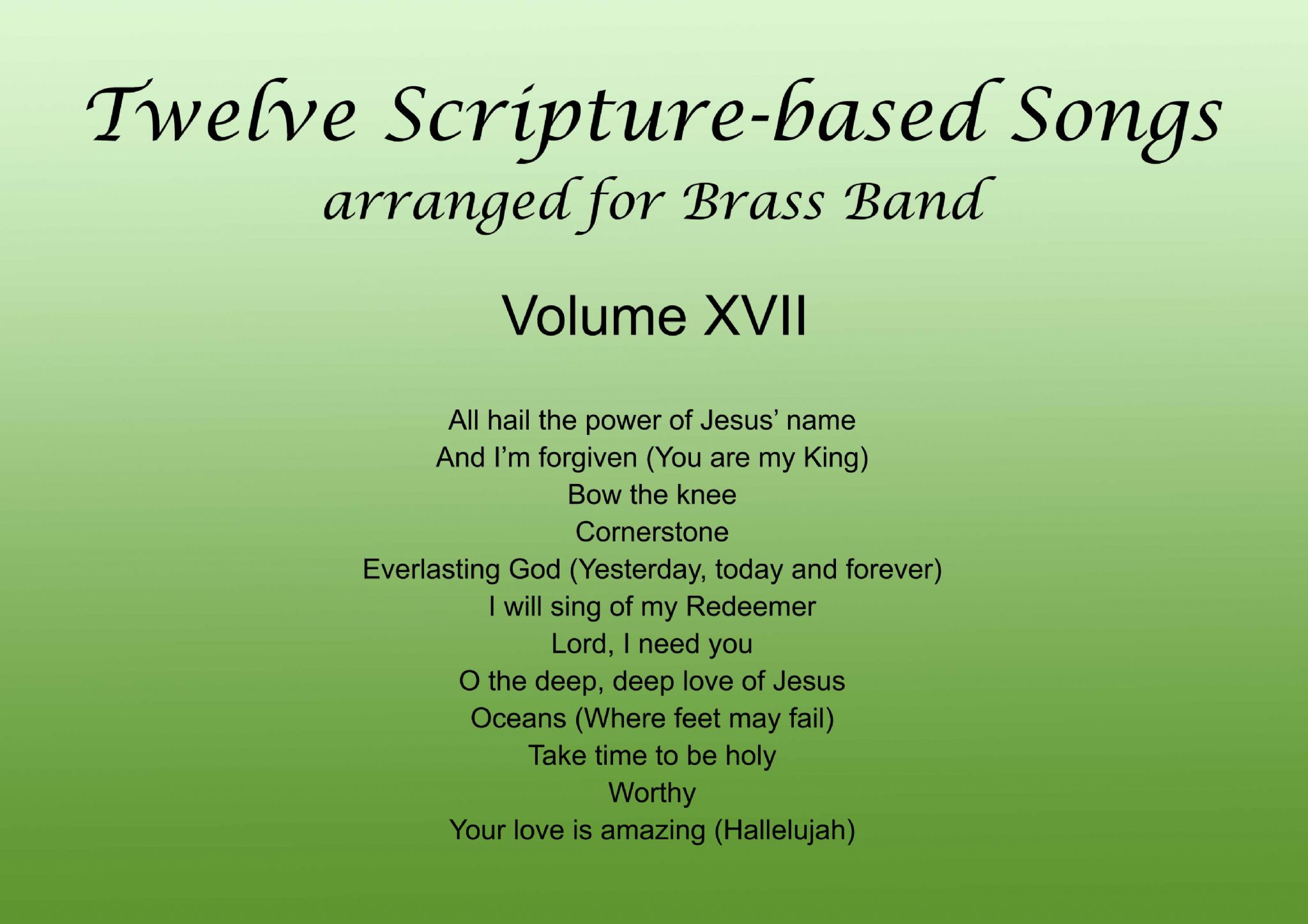
Twelve Scripture-based Songs Volume XVII
Twelve scripture-Based Songs arranged for Brass Band (Volume XVII) are packaged and marketed in complete sets which include a full score and a set of master parts. It is intended that these parts be used as 'masters', for the purpose of photocopying a quantity of parts to accommodate the precise instrumentation needs of the band for which this has been purchased.All hail the power of Jesus' nameAnd I'm forgiven (You are my King)Bow the kneeCornerstoneEverlasting God (Yesterday, today and forever)I will sing of my RedeemerLord, I need youO the deep, deep love of JesusOceans (Where feet may fail)Take time to be holyWorthyYour love is amazing (Hallelujah)
Estimated dispatch 7-14 working days
-
 £34.95
By Trevone Bay (Flugel Horn Solo with Brass Band - Score and Parts))
By Trevone Bay was composed for Flugel Soloist Zoe Hancock and the Black Dyke Band to celebrate both their Double Champion Victory at the British Open and National Championships 2014 and Zoe's unique achievement in winning the Best Soloist Award in both contests - an accomplishment never done before. The world premier was performed by Zoe and the band at Birmingham's Symphony Hall on February 8th 2015.By Trevone Bay is a lovely lyrical slow melody that utilises the full range and colour of the flugel horn. Starting with an atmospheric opening the soloist performs the main theme, which repeats with more colour in the accompanying parts and solo line. After introducing a second theme from the ensemble, the solo cornets perform the main melody with the soloist enjoying a lyrical counter melody. The piece develops with a tranquil middle section from the soloist that builds for the second theme to return, performed by the ensemble while the soloist soars over the top. Ending as it starts, the piece dies away to leave the soloist performing the opening melodic phrase to a tranquil close.As for the title: Trevone Bay is a beautiful tiny bay in Cornwall, close to Zoe's home town of Roche. Its tranquil waters lead out to the Celtic Sea and provide a picturesque landscape. The views there can be enjoyed all year round but they are particularly beautiful at sunset.
Estimated dispatch 7-14 working days
-
 £100.00
Danceries (Set II) (Brass Band - Score and Parts)
Danceries Set II, arranged for brass band, was first commission by Keith Allen for the Birmingham Symphonic Winds. This second set of Danceries continues the format, established in the popular Danceries (Set I), of using tunes and dances from Playfords Dancing Master (17th century) to form the basis of an extended dancesuite. In this set, the melodies have become more abstracted and project only a distant echo of their original forms. As before, each movement is self-contained, colourful and direct, with its own distinct mood. The outer movements " Jennies Bawbee and Peascods Galliarda " share driving percussion with a military air. Tom Tinkers Toye and Hearts Ease (movements two and three) are both settings of original melodies. All movements are more extended than in the first set, with a freer use and approach to the material; melodies now occur in various keys and are supported by a greater variety of harmonic colouring. The result is a richer, even more exhilarating set of dances. Suitable for 1st Section Bands and above. Duration: 15.00
Estimated dispatch 7-14 working days