
Results
-
 £33.62
Metamorphosis on 'Finlandia' (Brass Band - Full Score PDF) Andrew Wainwright
This major work was commissioned by Five Lakes Silver Band and its Musical Director Christopher Ward in February 2024, and is featured on the band's CD Resurget Cineribus. The music is based on the hymn tune by Katharina von Schlegel, Be Still, My Soul, found in Sibelius' famous tone poem Finlandia (Op. 26). While the only source material used in Metamorphosis on 'Finlandia' is the hymn itself as opposed to any of the developmental music found in the tone poem, it does also seek to depict the strife of the Finnish people against the censorship of the Russian Empire. It is therefore both rousing and turbulent at various times. Metamorphosis on 'Finlandia' commences with a quartet playing a full statement of the hymn in its simplest form, featuring a solo flugel. This leads into a sprightly 6/8 section where a fanfare-like figure proclaims the theme. The music in this section is at times unstable and off-kilter as references to the hymn come and go, often in a very chromatic or dissonant form - a reflection of the struggles that the Finnish people went through. Despite this, there is still a sense of optimism. A somewhat reflective slower section follows, featuring another full rendition of the hymn, with a number of solo voices taking up the tune. This is followed by several cadenzas - for cornet, trombone, Eb bass, and Bb bass, which represent different voices speaking out against the oppression of the Finnish people. This leads into an energetic final movement before a resounding proclamation of the hymn in its full glory. A return to the fanfare heard earlier in the work brings the piece to a glorious conclusion. To listen to a recording of Five Lakes Silver Band performing the work please visit www.youtube.com/watch?v=GeJJF6asD2k Duration: Approx. 13.15 minutes Difficulty Level: 1st Section + This PDF download includes the full score. Parts and score available here. Sheet music available here (UK) or https://satradecentral.org (USA) Instrumentation: Soprano Cornet Eb Solo Cornet Bb Repiano Cornet Bb 2nd Cornet Bb 3rd Cornet Bb Flugel Horn Bb Solo Horn Eb 1st Horn Eb 2nd Horn Eb 1st Baritone Bb 2nd Baritone Bb 1st Trombone Bb 2nd Trombone Bb Bass Trombone Euphonium Bb Bass Eb Bass Bb Timpani Percussion 1-3
In Stock: Estimated dispatch 1-3 working days
-
 £33.62
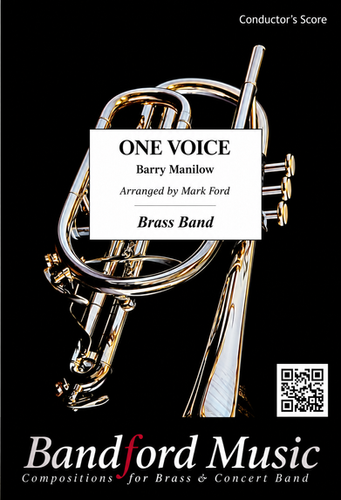
One Voice (Brass Band) Barry Manilow arr. Mark Ford
Originally released in 1979 as the title track of Barry Manilow's sixth studio album, One Voice has become an enduring anthem for unity and social courage. It is a stirring ballad that reminds us how a single, brave voice can ignite a chorus of solidarity and lead the way toward positive change. Expertly crafted for brass band by Mark Ford, this setting captures the intimate, soaring spirit of the original while leveraging the unique textures of the brass band. The piece begins with a delicate, lyrical flugel horn solo, representing the 'single voice' of the title. As the arrangement progresses, the rest of the ensemble joins in, building from a gentle accompaniment into a magnificent, wall-of-sound finale that is sure to leave your audience inspired. To view a rolling score video of the work please visit https://youtu.be/RcQ5xbnyNjs Duration: Approx. 3.15 minutes Difficulty Level: 4th Section + This PDF download includes the full score and parts. Sheet music available at www.brassband.co.uk (UK) or https://satradecentral.org (USA) Instrumentation: Soprano Cornet Eb Solo Cornet Bb Repiano Cornet Bb 2nd Cornet Bb 3rd Cornet Bb Flugel Horn Bb Solo Horn Eb 1st Horn Eb 2nd Horn Eb 1st Baritone Bb 2nd Baritone Bb 1st Trombone Bb 2nd Trombone Bb Bass Trombone Euphonium Bb Bass Eb Bass Bb Timpani Glockenspiel Percussion
In Stock: Estimated dispatch 1-3 working days
-
 £41.09
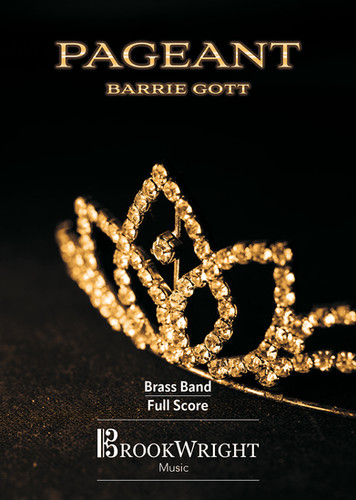
Pageant (Brass Band) Barrie Gott
Born during the isolation of the COVID-19 pandemic, Pageant by Australian composer Barrie Gott transforms the simple interval of a fourth into an engaging, multi-faceted set of variations. Written specifically with 4th Section bands in mind, this work delivers rich textural contrast, clear educational rewards, and a crowd-pleasing arc that moves from regal tradition to high-energy rock. The piece opens with a majestic herald, setting a ceremonial tone as a warm, mellow melody dialogues with bright, fanfare-like brass. From there, the music moves through three distinct stylistic worlds: a delicate, nimble variation inspired by the craft of Eric Ball's A Little Suite for Band; a smooth, lyrical ballad featuring the solo cornet and flugel horn; and a high-energy finale grounded in a driving 6/8 rock groove, bringing the work to a dramatic, cinematic finish. To listen to a recording of Toowoomba Municipal Band performing the work please visit: https://on.soundcloud.com/i9X5JsWQedaAbiWzXf Duration: approx. 6.45 mins Difficulty Level: 4th Section + This PDF download includes the full score and parts. Sheet music available at www.brassband.co.uk (UK) or https://satradecentral.org (USA) Instrumentation: Soprano Cornet Eb Solo Cornet Bb Repiano Cornet Bb 2nd Cornet Bb 3rd Cornet Bb Flugel Horn Bb Solo Horn Eb 1st Horn Eb 2nd Horn Eb 1st Baritone Bb 2nd Baritone Bb 1st Trombone Bb 2nd Trombone Bb Bass Trombone Euphonium Bb Bass Eb Bass Bb Timpani Percussion 1-4
In Stock: Estimated dispatch 1-3 working days
-
 £48.56
Peace in Our Time (Brass Band) Andrew Wainwright
Commissioned by Armonico Consort to mark the 85th anniversary of the Coventry Blitz, Peace in Our Time is a profoundly moving reflection on humanity's enduring quest for reconciliation amidst turmoil. Originally scored for choir, orchestra, and organ, this masterful brass band transcription beautifully captures the emotional weight of John Oxenham's evocative poetry and the timeless plea of Psalm 122. The work opens in hushed reverence, where distant muted cornets, a dark bass pedal, and a fragile, militaristic snare drum set a shadowed, contemplative scene. Out of this delicate landscape emerges a poignant cornet solo that yields to the expressive voice of the solo flugel horn, carrying the opening text with quiet conviction before introducing the solemn reminder: "O pray for peace, peace in Jerusalem." As the piece progresses, the setting turns darker and more restless. Harmonic tension builds through rich brass textures to reflect the fears, divisions, and heavy costs of historical and modern conflict. From this emotional turbulence rises a bold, ceremonial fanfare that marks a dramatic turning point, ushering in a glorious, expansive setting of the poem's final verse. Yet rather than ending in simple triumph, the music gently recedes into a serene and tender stillness. The final bars leave performers and audiences alike with a quiet, lingering echo - a persistent hope for peace that resonates just as deeply today as it did 85 years ago. This substantial work is an extraordinary addition to any brass band library, serving as an ideal centerpiece for Remembrance Sunday, historical commemorations, church services or serious concert programming. To view a multimedia presentation of the piece with audio please visit www.youtube.com/watch?v=Y2BKI_GCegw The multimedia presentation is available on request withe purchase of this work - please email [email protected] to receive a link to download it. To view a video performance of the original work for choir, orchestra and organ please visit www.youtube.com/watch?v=m6o6PJJVKCo Duration: approx. 8.45 minutes Difficulty Level: 2nd Section + This PDF download includes the full score and parts. Sheet music available at www.brassband.co.uk (UK) or https://satradecentral.org (USA) Instrumentation: Soprano Cornet Eb Solo Cornet Bb Repiano Cornet Bb 2nd Cornet Bb 3rd Cornet Bb Flugel Horn Bb Solo Horn Eb 1st Horn Eb 2nd Horn Eb 1st Baritone Bb 2nd Baritone Bb 1st Trombone Bb 2nd Trombone Bb Bass Trombone Euphonium Bb Bass Eb Bass Bb Timpani Percussion 1-2
In Stock: Estimated dispatch 1-3 working days
-
 £33.62
Three for Christmas! (Brass Band) Kenneth Downie
Three for Christmas! is a sparky number by the revered composer Kenneth Downie based on three much-loved carols. The work opens with a bright and joyful rendition of the Sussex Carol, which is quickly followed by a more reflective and tender setting of Away in a Manger, featuring solo cornet, flugel and trombone. The third movement is a lively and upbeat version of Iris, which brings the piece to a triumphant conclusion. To view a rolling score video please visit www.youtube.com/watch?v=4rNZLkAYlAs PDF download includes score and parts. Sheet music available from: UK - www.brassband.co.uk USA - https://satradecentral.org Difficulty Level: 2nd Section + Length: 4.00 minutes Instrumentation: Soprano Cornet Eb Solo Cornet Bb 1st Cornet Bb 2nd Cornet Bb Flugel Horn Bb Solo Horn Eb 1st Horn Eb 2nd Horn Eb 1st Baritone Bb 2nd Baritone Bb 1st Trombone Bb 2nd Trombone Bb Bass Trombone Euphonium Bb Bass Eb Bass Bb Timpani Percussion 1-3
In Stock: Estimated dispatch 1-3 working days
-
 £33.62
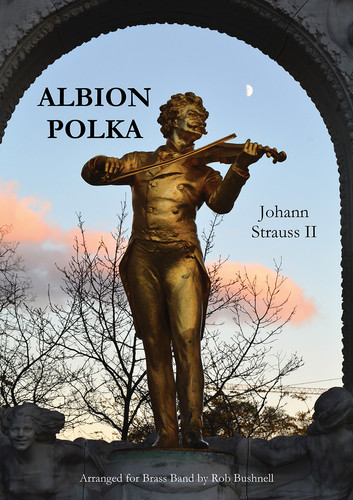
Albion Polka (Brass Band) Johann Strauss II arr. Rob Bushnell
Written in 1851, the Albion Polka was written by Johann Strauss II (or Strauss Junior) and dedicated to Count Albert of Saxe-Coburg-Gotha, husband of Queen Victoria of Great Britain. The work takes its title from the old Roman name for Britain. It is not an unfamiliar addition to the Vienna New Year's Concerts. This arrangement is for the UK-style brass band, with alternative parts for horns in F and bass-clef lower brass. A recording of the original composition can be found here: www.youtube.com/watch?v=KZIC-JhitHU Duration: Approx. 3.00 minutes (without rubato) Difficulty Level: 3rd Section + PDF download includes parts and score. Also includes alternative parts for horns in F and lower brass in bass clef. Instrumentation: Soprano Cornet Eb Solo Cornet Bb Repiano Cornet Bb 2nd Cornet Bb 3rd Cornet Bb Flugel Horn Bb Solo Horn Eb 1st Horn Eb 2nd Horn Eb 1st Baritone Bb 2nd Baritone Bb 1st Trombone Bb 2nd Trombone Bb Bass Trombone Euphonium Bb Bass Eb Bass Bb Timpani Glockenspiel Snare
In Stock: Estimated dispatch 1-3 working days
-
 £37.35
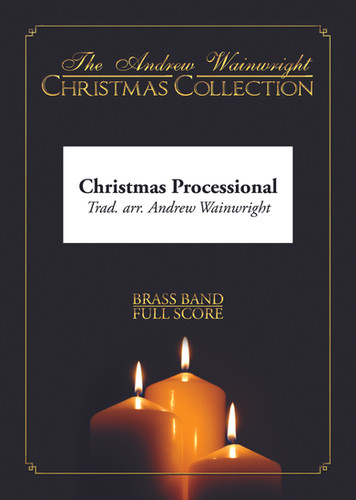
Christmas Processional - Brass Band & opt. Organ (Trad. arr. Andrew Wainwright)
An effective opener to any Christmas concert, based on the French carol, 'Bring a torch, Jeanette, Isabella'. It tells the story of a group of children in medieval Provence, dressed up as shepherds and milkmaids, carrying torches and candles as they proceed to the stable. As they draw closer and their excitement increases, they are constantly reminded by their parents to keep the noise down so that they don't wake up the baby Jesus. The music begins quietly and builds to a majestic conclusion. "If I were still conducting bands regularly, this would certainly be on my list as a Christmas concert opener - it sets the energy and mood most effectively. The scoring is terrific." Paul Hindmarsh, British Bandsman magazine This arrangement also includes optional Organ and Hand bells parts. For a follow-the-score video of Virtuosi GUS Band performing the work, please visit: https://www.youtube.com/watch?v=2GasDfecnyY Sheet music available exclusively from World of Brass - www.worldofbrass.com Includes score and full set of parts. Alternative parts for Horns in F, and Baritones, Trombones, Euphonium and Tubas in Bass Clef are available here. Difficulty Level: 2nd Section + Instrumentation: Soprano Cornet Eb Solo Cornet Bb Repiano Cornet Bb 2nd Cornet Bb 3rd Cornet Bb Flugel Horn Bb Solo Horn Eb 1st Horn Eb 2nd Horn Eb 1st Baritone Bb 2nd Baritone Bb 1st Trombone Bb 2nd Trombone Bb Bass Trombone Euphonium Bb Bass Eb Bass Bb Timpani Percussion 1-3 Organ (optional) Hand bells (optional)
In Stock: Estimated dispatch 1-3 working days
-
 £29.88
Fanfare from La Peri(Brass Band) Dukas arr. Rob Bushnell
La Peri is a one-act ballet by the French composer Paul Dukas, best known for The Sorcerer's Apprentice (L'apprenti sorcier) as in the 1940 Disney film Fantasia. Dukas was commissioned to write La Peri by the Ballets Russes, producing a Poeme danse en un tableau ('dance poem in one scene') in 1911; this become his last published work. With Natalia Trouhanova due to play the Peri and Vaslav Nijinsky to play Iskender (the name of Alexander the Great in Persian, who is scouting around Iran in search of the Flower of Immortality), the production was ultimately cancelled because Serge Diaghilev feel Trouhanova was not a skilled enough dancer to be partnered to Nijinsky. Trouhanova later hired Ivan Clustine to choreograph the music, with the ballet premiering at the Theatre du Chatelet in Paris on 22 April 1912.The brilliant fanfare that precedes the ballet is often performed separately and is the arrangement available here. Arranged for British-style brass band, it has optional percussion parts as well as alternative parts for horns in F and bass-clef lower brass. The piece has been lowered by a tone compared to the original. A recording of the original composition can be found here: www.youtube.com/watch?v=7EDekMos1ok. Duration: Approx. 2 minutes Difficulty Level: 2nd Section + Duration: 4 or 5 minutes (depending on tempo and without any cuts) PDF download includes parts and score. Sheet music available at www.brassband.co.uk (UK) or https://satradecentral.org (USA) Instrumentation: Soprano Cornet Eb Solo Cornet Bb Repiano Cornet Bb 2nd Cornet Bb 3rd Cornet Bb Flugel Horn Bb Solo Horn Eb 1st Horn Eb 2nd Horn Eb 1st Baritone Bb 2nd Baritone Bb 1st Trombone Bb 2nd Trombone Bb Bass Trombone Euphonium Bb Bass Eb Bass Bb Timpani Percussion 1 - Snare Drum Percussion 2 - Bass Drum & Cymbal
In Stock: Estimated dispatch 1-3 working days
-
 £48.56
Finale from Symphony No.3 (Organ Symphony) (Brass Band) Saint-Saens arr. Norbury
Saint-Saens' magnificent Finale from Symphony No.3 (widely known as the 'Organ Symphony') has here been arranged for brass band with optional organ by Kevin Norbury. It was recorded by The International Staff Band on its CD Manuscripts, although this version has been revised in places. Saint-Saens decided to add the organ and piano to his 3rd symphony as a pragmatic orchestration innovation. The composition of this symphony was probably started in 1885 and a first draft was completed in Prague in 1886. Saint-Saens later recalled its eventful genesis: 'The Symphony in C was three-quarters sketched out when I found it impossible to write the finale. I did not know how to resolve this situation, until one night I suddenly woke up and, in a sort of hallucination, I heard the whole finale, which I hastily wrote down in outline, knowing that if I went back to sleep without having put anything on paper, I would have forgotten it all the next day.' The symphony was first performed under the composer's direction at Saint James's Hall in London on May 19, 1886. This arrangement by Kevin Norbury can both function as a stand-alone brass band piece, and be performed with an organ by omitting the notes found in square brackets in the parts and score. To view a rolling score video please visit www.youtube.com/watch?v=OlUd_FppBY8 PDF download includes score and parts. Additional parts (Horn in F and Baritone, Trombone, Euphonium & Tuba in Bass Clef) available here. Sheet music available from: UK - www.brassband.co.uk USA - https://satradecentral.org Difficulty Level: 1st Section + Length: 8.30 minutes Instrumentation: Soprano Cornet Eb Solo Cornet Bb Repiano Cornet Bb 2nd Cornet Bb 3rd Cornet Bb Flugel Horn Bb Solo Horn Eb 1st Horn Eb 2nd Horn Eb 1st Baritone Bb 2nd Baritone Bb 1st Trombone Bb 2nd Trombone Bb Bass Trombone Euphonium Bb Bass Eb Bass Bb Timpani Glockenspiel Percussion Organ (optional)
In Stock: Estimated dispatch 1-3 working days
-
 £29.88
How Shall I Woo Thee (Cornet Solo with Brass Band) Coleridge-Taylor arr.Bushnell
The 7 African Romances, Op. 17 for voice and piano has words by Paul Laurence Dunbar and music by Samuel Coleridge-Taylor. Published in 1897, it comprises of 7 songs, "An African Love Song", "A Prayer", "A Starry Night", "Dawn", "Ballad", "Over the Hills" and "How Shall I Woo Thee?", of which the last is arranged here.This arrangement was requested by Besses o' th' Barn Band for the The Samuel Coleridge-Taylor Festival held in Liverpool on 11 October 2025. The song is wonderfully lilting with moments to indulge in the music.This arrangement is for the UK-style brass band and either solo B-flat cornet, solo E-flat soprano cornet or soprano singer. It also has alternative parts for horns in F and bass-clef lower brass. A recording of the original song can be found here: https://www.youtube.com/watch?v=tglGpaBsWOo Duration: Approx. 3.10 minutes Difficulty Level: 4th Section + This PDF download includes the full score and parts. Includes alternative parts for soloist in Eb, horns in F and lower brass in bass clef. Sheet music available at www.brassband.co.uk (UK) or https://satradecentral.org (USA) Instrumentation: Cornet Soloist Bb Soprano Cornet Eb Solo Cornet Bb Repiano Cornet Bb 2nd Cornet Bb 3rd Cornet Bb Flugel Horn Bb Solo Horn Eb 1st Horn Eb 2nd Horn Eb 1st Baritone Bb 2nd Baritone Bb 1st Trombone Bb 2nd Trombone Bb Bass Trombone Euphonium Bb Bass Eb Bass Bb Timpani Percussion 1-2
In Stock: Estimated dispatch 1-3 working days