
Results
-
£33.00
No. 28 Dance Number - Various
Includes a full band set (no score)Featuring:Little Jack HornerThe Broadway BelleBluebell
In Stock: Estimated dispatch 1-3 working days
-
£33.00
No. 29 Dance Number - Various
Includes a full band set (no score)Featuring:DoloresGaily TrippingSummer Roses
In Stock: Estimated dispatch 1-3 working days
-
£33.00
No. 3 Dance Number - Various
Includes a full band set (no score)Featuring:Fairy Dell by Gerald FraserSweet Repose by George A. FrostSongs of Love by Frank J. Smith
In Stock: Estimated dispatch 1-3 working days
-
£33.00
Angels from the Realms of Glory - Traditional - Barry, D
A concert prelude with a big introduction. The first verse is lightly scored and features the middle of the band. The continuing prelude returns back to the main theme featuring trombones and horns. The piece finishes in a full big chord setting.4th section +
In Stock: Estimated dispatch 1-3 working days
-
£33.00
Christmas Cassation - Barry, D
A Christmas Cassation opens festively with fragments of Carols followed by a slower section featuring flugel and trombones before a scherzando section returning back to the opening music as the piece ends.Features The Infant King, The Holly and The Ivy and Past Three O'Clock.
In Stock: Estimated dispatch 1-3 working days
-
£33.00
Do They Know It's Christmas - Geldof, B - Broadbent, D
Do They Know It's Christmas? is a charity single released in 1984 by the supergroup Band Aid, organized by Bob Geldof and Midge Ure to raise funds for famine relief in Ethiopia.Featuring some of the biggest British and Irish artists of the time it become one of the best-selling singles in UK history.Beyond its chart success, Do They Know It's Christmas? remains a symbol of generosity and unity during the Christmas season. Perfect for any Christmas concert.
In Stock: Estimated dispatch 1-3 working days
-
£40.00
Festive Fusion - Various - Harper, P
This wonderful piece by Philip Harper is perfect for any Christmas event. Featuring:Silent Night We Wish You A Merry Christmas In the Bleak Mid-Winter Jingle Bells One of our top Christmas sellers!
In Stock: Estimated dispatch 1-3 working days
-
£40.00
Yule Dance - Various - Harper, P
Remember the impact of Riverdance? Well, Philip Harper has given the same treatment to this stunning arrangement he's called Yule Dance. Featuring:O Little Town of BethlehemIn Dulci JubiloI Saw Three ShipsSussex CarolAs with Riverdance it develops into a spectacular climax. The one to finish the concert!3rd section +
In Stock: Estimated dispatch 1-3 working days
-
 £69.95
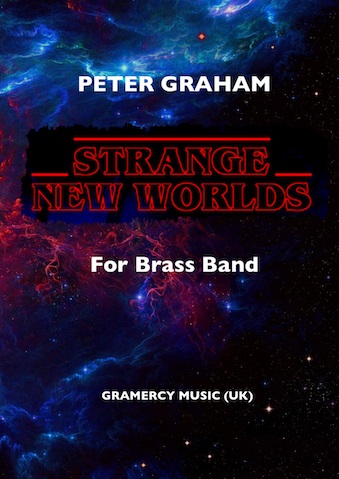
Strange New Worlds (Brass Band - Score and Parts) - Graham, Peter
Strange New Worlds was commissioned by Nicholas Childs for the National Children's Brass Band of Great Britain with funds provided by Arts Council England.The COVID-19 pandemic made it necessary for the 2020 course to transition from residential to virtual and the work was designed to accommodate this change. The participants individually filmed themselves to a click track and the videos were collated to create a "virtual" performance. The premiere was streamed live on YouTube on August 7, 2020.The work is in 5 movements with a narrative dictated by the individual movement titles. Although to me this narrative is clearly defined, multiple scenarios present themselves. Some may interpret the story as being one from the ancients while others might identify with the science-fiction of H.G. Wells. Others still will relate to the recent surge of interest in 1980s culture and the Netflix series Stranger Things (to which the title of my work pays homage). Nor would it be unreasonable to consider the piece an analogy reflecting events in 2020. Listeners will decide the story (or message) for themselves.The five movements are: I. Things to Come; II. Descent to Darkness (featuring Cornets, Trombones and Percussion); III. Resistance (featuring Horns, Baritones, Euphoniums, Basses and Percussion); IV/V. Aftermath/A New HopeDuration: 8.00
Estimated dispatch 7-14 working days
-
 £91.99
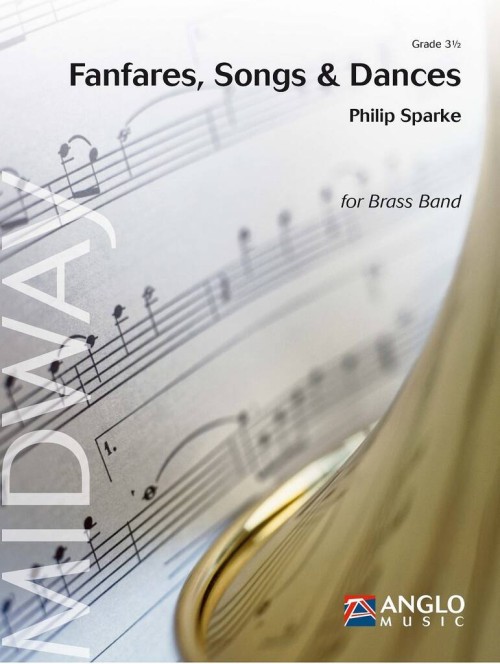
Fanfares, Songs & Dances (Brass Band - Score and Parts) - Sparke, Philip
Fanfares, Songs & Dances was commissioned by Brass Bands England, the Lithuanian Brass Band Association and the Dutch National Brass Band Championships (NBK), and first performed at the 43rd 'NBK' in October 2024.The work is played in three linked movements:FANFARES opens in robust fashion with a sequence of fanfare-like statements, initially featuring the horns, whose modal theme includes a figure that will reappear throughout the work. Euphoniums and then cornets introduce a second theme, which is followed by a third, again initiated by the horns. Baritones then change the mood with a more-lyrical theme, which builds to a climax, eventually leading back to a recall of the initial fanfare theme. This gradually dissolves to introduce the second movement.SONGS continues to relax the fanfare feel with a long introduction to the movement's main theme, first appearing on solo cornet. A change of key introduces a bridge passage which leads to a sonorous chorale, which builds to a triumphal return of the cornet theme. A peaceful coda leads to the final movement of the work.DANCES is a scherzo-like movement based around a series of rhythmic melodies in triple time, which lead to a majestic return of the 2nd movement's chorale theme under cornet figuration. The opening dance theme returns and heralds a joyous coda.Duration: 11.00
Estimated dispatch 7-14 working days
 View Music