
Results
-
 £38.95
Unity Series Band Journal June 2017 Numbers 454 - 457
Festival March Bega 125 (Dean Jones)This Festival March brings the majestic tune 'Miles Lane' as its central theme and is accompanied by the more reflective tune 'St. Bees'.Suite To Bethlehem (Ian Feltwell)Songster Leader Ian Feltwell of Nuneaton has provided a simple yet bright setting of the carols 'How far is it to Bethlehem', 'O little town of Bethlehem' and 'When wise men came seeking'.Carol Arrangement Who is he? (Jonathan Rowsell)This beautiful carol has been given a simple setting which will provide many groups with an accessible and easy to learn piece for the Christmas season.March Dedication (Christchurch) (Charles Craig)Originally dedicated to Major Clive Bishop who was a Salvation Army officer of fine distinction this is a traditional March from a composer who has provided accessible pieces of this nature to the Unity Series for many years.
Estimated dispatch 7-14 working days
-
 £40.00
English Counterpoint (Score and Parts)
The winner of the inaugural RWCMD Cory Composition Prize in 2015, debutant brass band composer Lewis Furber unlocks an original and evoactive soundworld, where the influence of composers such as Vaughan Williams is never far away. Features solos for flugel horn, euphonium and baritone.
Estimated dispatch 7-14 working days
-
 £44.95
Ae Fond Kiss (Tenor Horn Solo with Brass Band - Score and Parts)
Ae Fond Kiss, by the Scottish poet Robert Burns, is widely recognised as being one of the most poignant songs of lost love ever written. A brief affair with a Mrs Agnes Craig McLehose (known to Burns as Nancy) ended with her decision to join her estranged husband in Jamaica. Her parting gift to Burns was a lock of her hair which he had set in a ring. His gift to her included the poem, the first verse of which reflects Burns' feelings of resignation and despair:Ae fond kiss, and then we sever;Ae fareweel, alas, for ever!Deep in heart-wrung tears I'll pledge thee,Warring sighs and groans I'll wage thee!
Estimated dispatch 7-14 working days
-
 £39.99
Four Cornish Dances Op.91 (Brass Band - Score and Parts)
Ray Farr's arrangement of Malcolm Arnold's suite Four Cornish Dances brilliantly retains the atmosphere of the orchestral original with its evocation of Cornish sea-farers, of deserted tin mines, of marching bands, Methodism, May Days and Moody and Sankey hymns.Suitable for 1st Section Bands and aboveDuration: 10.00
Estimated dispatch 7-14 working days
-
 £74.95
Radio City (Trombone Solo with Brass Band)
As youngsters growing up on the west coast of Scotland, my brother and I fell heir to an old valved radiogram which provided us with our first experiences of radio broadcasts. On the short wave signal, and through the static, we could pick up a whole range of programmes from across the Atlantic. I particularly recall the baseball games, the American accents of the announcers providing a window to a evocative world far removed from our small Ayrshire town. These memories form the basis of Radio City.The work is set in three movements, each introduced by a pastiche radio announcer narrative written by Philip Coutts. The first, City Noir, is a nod towards Raymond Chandler's eponymous private eye Philip Marlow and the dark cityscape of 1940s California.Movement two, Cafe Rouge, takes its title from the main restaurant in New York's famous Hotel Pennsylvania. Two of the most famous band leaders of the 1940s, trombonists Glenn Miller and Tommy Dorsey, broadcast live from the cafe on numerous occasions and the movement echoes with a collage of imagined sounds from the period.The finale, Two-Minute Mile, derives from an event dubbed in the USA as "the most exciting two minutes in sport", namely the Kentucky Derby. The virtuoso soloist figurations have their roots in Kentucky bluegrass fiddle music, with the galloping bluegrass clog-dancing rhythms providing the backdrop.- Peter Graham, Cheshire, January 2013
Estimated dispatch 7-14 working days
-
 £34.95
Ave Maria (Cornet Solo with Brass Band - Score and Parts)
An arrangement of Bach/Gounod's popular song, originally performed by ITV's Britain's Got Talent star Faryl Smith. Here it is arranged for solo cornet with brass band accompaniment.
Estimated dispatch 7-14 working days
-
 £34.95
Ave Maria (Vocal with Brass Band - Score and Parts)
An arrangement of Bach/Gounod's popular song, as performed by ITV's Britain's Got Talent star Faryl Smith. Here it is arranged for soprano voice with brass band accompaniment.
Estimated dispatch 7-14 working days
-
 £24.95
Judd: Now is the Hour
This romantic Maori song of farewell was arranged as a cornet solo for David Daws. Within The Salvation Army, the words 'Search me, O God, and know my heart today' are now associated with this beautiful tune.
Estimated dispatch 7-14 working days
-
 £80.00
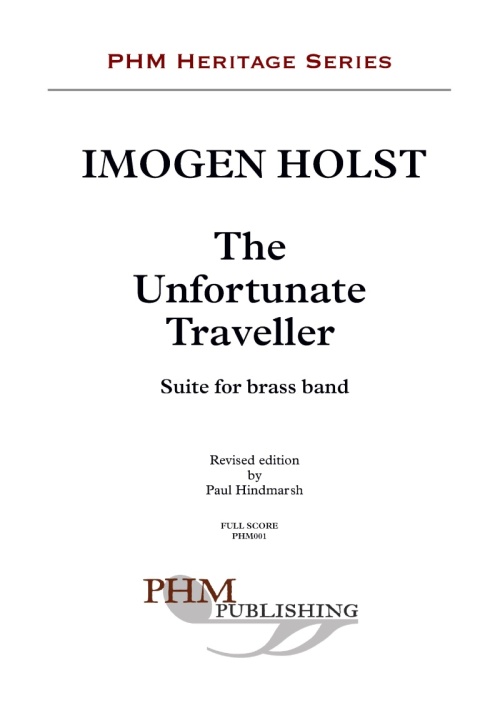
The Unfortunate Traveller (Brass Band - Score and Parts)
Imogen Holst (1907-1984) submitted The Unfortunate Traveller (1929) as her final work as a student portfolio at the Royal College of Music, where her composition teacher was Gordon Jacob. The title was taken from Thomas Nashe's famous 1594 picaresque novel of the same title. The Suite was first performed on 12 February 1933 at her Majesty's Theatre, Carlisle, by the St. Stephen's Band, with the composer conducting. Te concert was given in memory of Holst's uncle, Dr. H.A. Lediard. Holst had been impressed with the band's performance of his A Moorside Suite at the 1928 National Brass Band Championships (The Crystal Palace, South London) and was keen to work with them. Writing in Imogen Holst, a life in music, Christopher Grogan indicates that it was Gustav Holst's suggestion to include his daughter's work in the programme, quoting Imogen Holst's remarks made in interview to The Daily Mail as follows: "....it is the first time, so far as I know, that a woman has conducted a brass band at a public concert....It has been a delight to rehearse the St. Stephen's Band. It was their performance at the Crystal Palace Festival that inspired me to write this Suite, which I have dedicated to them."Imogen Holst accompanied her father to the Crystal Palace in 1928 to hear the performances of A Moorside Suite, and was so excited by the played and, audibly, by her father's music that she decided to write a brass band piece for her final examination. Te result was The Unfortunate Traveller (1929). However, it was not possible for her to present a brass band work for examination. She arranged it for string orchestra so that it could be played before she left the RCM in July 1930. Following the premiere of the original in 1933, the manuscripts did not resurface until 1969 Imogen found them among her late mother's effects. Although she requested score and parts be destroyed, they ended up in the possession of Manchester composer John Golland, who marked up the score presumably with the intention of creating a new performing edition. The original scoring reveals a lack of experience with what can be a tricky medium.With the agreement of the Holst Foundation, a revised edition, with additional percussion, was prepared in 2011 since when the work has been fortunate to travel round the world as a concert and contest piece. The original includes drums in the March only. The title was taken from Tomas Nashe's famous 1594 picaresque novel of the same title. Several Morris Dance tunes are introduced during the course of the four short movements, including Bonnie Green Garters, Shepherd's Hey, The Rose and The Wind Blaws Cauld. Quirky twists and turns of harmony and spirited rhythms that remind us how much Imogen Holst loved tradition English dance music.In September 2025, I made a performing edition of the composer's arrangement for string orchestra. The manuscript lacks the final movement, which I arranged in a similar style, ie. without extending the upper ranges. Making this edition raised some issues regarding the accuracy of my band version and some of the solutions I used to smooth out the voicing. I have used the composer's second thoughts to refine my performing edition and to correct a textual errors.- Paul HindmarshDuration: 10.00
Estimated dispatch 7-14 working days
-
£40.00
The Unfortunate Traveller (Brass Band - Score only)
Imogen Holst (1907-1984) submitted The Unfortunate Traveller (1929) as her final work as a student portfolio at the Royal College of Music, where her composition teacher was Gordon Jacob. The title was taken from Thomas Nashe's famous 1594 picaresque novel of the same title. The Suite was first performed on 12 February 1933 at her Majesty's Theatre, Carlisle, by the St. Stephen's Band, with the composer conducting. Te concert was given in memory of Holst's uncle, Dr. H.A. Lediard. Holst had been impressed with the band's performance of his A Moorside Suite at the 1928 National Brass Band Championships (The Crystal Palace, South London) and was keen to work with them. Writing in Imogen Holst, a life in music, Christopher Grogan indicates that it was Gustav Holst's suggestion to include his daughter's work in the programme, quoting Imogen Holst's remarks made in interview to The Daily Mail as follows: "....it is the first time, so far as I know, that a woman has conducted a brass band at a public concert....It has been a delight to rehearse the St. Stephen's Band. It was their performance at the Crystal Palace Festival that inspired me to write this Suite, which I have dedicated to them."Imogen Holst accompanied her father to the Crystal Palace in 1928 to hear the performances of A Moorside Suite, and was so excited by the played and, audibly, by her father's music that she decided to write a brass band piece for her final examination. Te result was The Unfortunate Traveller (1929). However, it was not possible for her to present a brass band work for examination. She arranged it for string orchestra so that it could be played before she left the RCM in July 1930. Following the premiere of the original in 1933, the manuscripts did not resurface until 1969 Imogen found them among her late mother's effects. Although she requested score and parts be destroyed, they ended up in the possession of Manchester composer John Golland, who marked up the score presumably with the intention of creating a new performing edition. The original scoring reveals a lack of experience with what can be a tricky medium.With the agreement of the Holst Foundation, a revised edition, with additional percussion, was prepared in 2011 since when the work has been fortunate to travel round the world as a concert and contest piece. The original includes drums in the March only. The title was taken from Tomas Nashe's famous 1594 picaresque novel of the same title. Several Morris Dance tunes are introduced during the course of the four short movements, including Bonnie Green Garters, Shepherd's Hey, The Rose and The Wind Blaws Cauld. Quirky twists and turns of harmony and spirited rhythms that remind us how much Imogen Holst loved tradition English dance music.In September 2025, I made a performing edition of the composer's arrangement for string orchestra. The manuscript lacks the final movement, which I arranged in a similar style, ie. without extending the upper ranges. Making this edition raised some issues regarding the accuracy of my band version and some of the solutions I used to smooth out the voicing. I have used the composer's second thoughts to refine my performing edition and to correct a textual errors.- Paul HindmarshDuration: 10.00
Estimated dispatch 7-14 working days