
Results
-
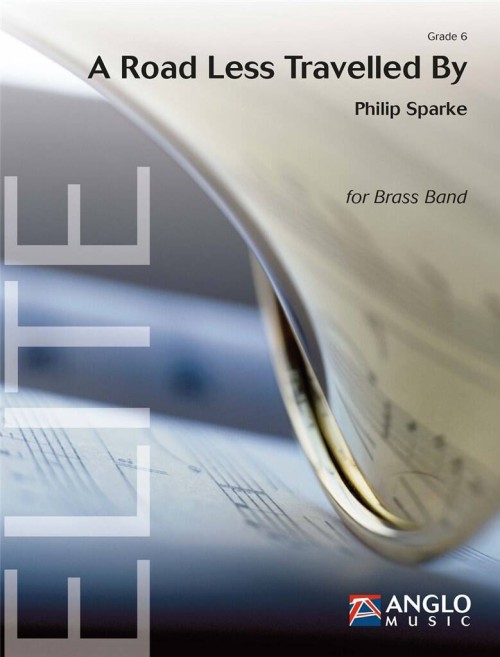
£154.99A Road Less Travelled By (Brass Band - Score and Parts) - Sparke, Philip
A Road Less Travelled By was commissioned by Palangos Orkestras for the Championship Section of the 2020 European Brass Band Championships held in Palanga, Lithuania.The following was written by the composer, Philip Sparke:The title alludes to a poem by American author, Robert Frost, which appeared in his 1916 collection, Mountain Intervals: The Road Not Taken.In common with most of my larger works, this piece in not programmatic, but purely abstract; there is no extrinsic musical story. The choice of title shares my view of how composers can often develop. There can be no 'destination' in a composer's career, but rather a continuing journey to an unknown place. From piece to piece a composer needs to decide his or her next steps, never really knowing where they might lead. As Frost so eloquently describes, these sorts of instinctive decisions guide all our lives.Set in three movements, which play without a break, A Road Less Travelled By opens with a Moto Perpetuo firmly rooted in classical language, form and syntax. A continuous river of semiquavers, veering from melody to accompaniment and back again, adds drive, every and motion. The second movement, Nocturne, is in the form of a free fantasia; solos for vibraphone, flugel horn and euphonium set the stage for a central cornet solo, quietly echoed by the full band. A triumphal climax is reached before the movement dissolves into a Scherzo Finale. Mercurial and quixotic in nature, this third movement starts jovially until trios for trombones and horns darken the atmosphere. A change of mood and meter leads to a reprise of the opening and a return of the cornet melody, this time accompanied by figures derived from the scherzo theme. A brief coda based on earlier material drives the piece to a close.Duration: 15.30
Estimated dispatch 7-14 working days
-
£36.50A Road Less Travelled By (Brass Band - Score only) - Sparke, Philip
A Road Less Travelled By was commissioned by Palangos Orkestras for the Championship Section of the 2020 European Brass Band Championships held in Palanga, Lithuania.The following was written by the composer, Philip Sparke:The title alludes to a poem by American author, Robert Frost, which appeared in his 1916 collection, Mountain Intervals: The Road Not Taken.In common with most of my larger works, this piece in not programmatic, but purely abstract; there is no extrinsic musical story. The choice of title shares my view of how composers can often develop. There can be no 'destination' in a composer's career, but rather a continuing journey to an unknown place. From piece to piece a composer needs to decide his or her next steps, never really knowing where they might lead. As Frost so eloquently describes, these sorts of instinctive decisions guide all our lives.Set in three movements, which play without a break, A Road Less Travelled By opens with a Moto Perpetuo firmly rooted in classical language, form and syntax. A continuous river of semiquavers, veering from melody to accompaniment and back again, adds drive, every and motion. The second movement, Nocturne, is in the form of a free fantasia; solos for vibraphone, flugel horn and euphonium set the stage for a central cornet solo, quietly echoed by the full band. A triumphal climax is reached before the movement dissolves into a Scherzo Finale. Mercurial and quixotic in nature, this third movement starts jovially until trios for trombones and horns darken the atmosphere. A change of mood and meter leads to a reprise of the opening and a return of the cornet melody, this time accompanied by figures derived from the scherzo theme. A brief coda based on earlier material drives the piece to a close.Duration: 15.30
Estimated dispatch 7-14 working days
-
£65.00Second Suite in F - Brass Band Sheet Music Full Score & Parts - LM602 - Gustav Holst
COMPOSER: Gustav HolstTRANSCRIBED : Daniel S. AugustineA brand transcription from Holst's manuscript score for brass band.A very authentic version from the original for Military Band.Can be used as a testpiece in your next own choice contestSuitable for Section 3 bands upwardsSecond Suite in FOp. 28, No. 2 (1922)1. MarchThe "March" of the Second Suite begins with a simple five note motif between the low and high instruments of the band. The first folk tune is heard in the form of a traditional British brass band march using the morris-dance tune "Glorishears". After a brief climax, the second strain begins with a euphonium solo playing the second folk tune in the suite "Swansea Town". The theme is repeated by the full band before the trio. For the trio, Holst modulates to the unconventional subdominant minor of Bb minor and changes the time signature to 6/8, thereby changing the meter. Usually one would modulate to subdominant major in traditional march form. While Sousa, reputably the "king of marches", would sometimes change time signatures for the trio (most notably in "El Capitan"), it was not commonplace. The third theme, called "Claudy Banks",[2] is heard in a low woodwind soli, as is standard march orchestration. Then the first two tunes are repeated da capo.2. Song without Words "I'll Love My Love"Holst places the fourth folk song, "I'll Love My Love" in stark contrast to the first movement. The movement begins with a chord and moves into a solo over a flowing accompaniment. The solo is then repeated, forming an arc of intensity. The climax of the piece is a fermata, followed by a cornet pick-up into the final measures of the piece.3. Song of the BlacksmithAgain, Holst contrasts the slow second movement to the rather upbeat third movement which features the folk song "A Blacksmith Courted Me". There are many time signature changes (4/4 to 3/4) making the movement increasingly difficult because the accompaniment has a pick up on the up-beats of each measure. The band joins in on the melody around the body of the piece and are accompanied with the sound of a blacksmith forging metal with an anvil called for in the score. The final major chord has a glorious, heavenly sound, which opens way to the final movement.This chord works so effectively perhaps because it is unexpected.4. Fantasia on the "Dargason"This movement is not based on any folk songs, but rather has two tunes from Playford's Dancing Master of 1651. The finale of the suite opens with a solo based on the folk tune "Dargason", a 16th-century English dance tune included in the first edition of The Dancing Master. The fantasia continues through several variations encompassing the full capabilities of the band. The final folk tune, "Greensleeves", is cleverly woven into the fantasia by the use of hemiolas, with Dargason being in 6/8 and Greensleeves being in 3/4. At the climax of the movement, the two competing themes are placed in competing sections.As the movement dies down, a duet forms a call back to the beginning of the suite with the competition of low and high registers.The name 'dargason' may perhaps come from an Irish legend that tells of a monster resembling a large bear (although much of the description of the creature has been lost over time), the Dargason tormented the Irish countryside. During the Irish uprising of the late 18th century, the dargason is supposed to have attacked a British camp killing many soldiers. This tale aside, 'dargason' is more likely derived from an Old English word for dwarf or fairy, and the tune has been considered English (or Welsh) since at least the 16th century. It is also known as 'Sedony' (or Sedany) or 'Welsh Sedony'.
In Stock: Estimated dispatch 3-5 working days
