
Results
-
 £50.00
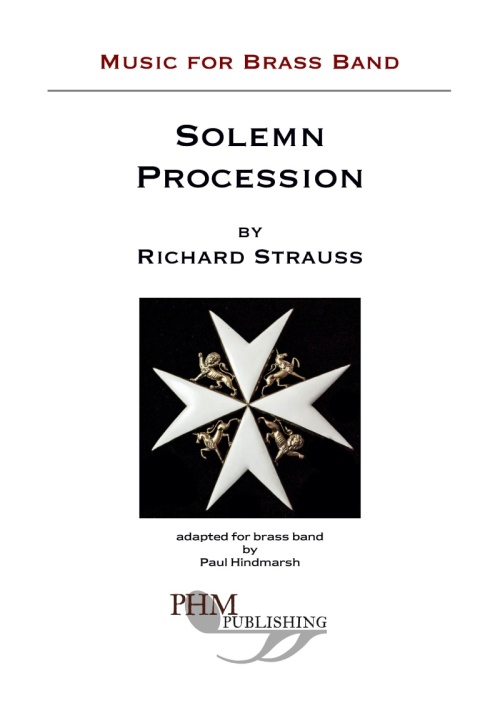
Solemn Procession (Brass Band - Score and Parts)
Richard Strauss (1864 - 1949) was a famous conductor and composer when he wrote Feierlicher Einzug der Ritter des Johanniter-Ordens (Solemn Entrance of the Knights of the Order of Saint John) in 1909. One of only a handful of his works written exclusively for winds, Strauss composed Feierlicher Einzug for the investiture ceremonies of the Order of St. John, a Christian military order that was founded in Jerusalem in 1023 to care for poor, sick, or injured pilgrims journeying to the Holy Land.Strauss scored Feierlicher Einzug (TrV 224) for a large ensemble of fifteen trumpets, four horns, four trombones, two tubas and timpani. He saw enough potential in its stately character and majestic conclusion to produce a version for symphony orchestra with organ and it has been arranged for a variety of brass ensembles with or without organ since then.This version for British style brass band was adapted from the original in 1990 by Paul Hindmarsh for the exclusive use of Besses o' th' Barn Band, of which he was then the musical director. Now that the music of Richard Strauss published in his lifetime is in the public domain, Solemn Procession, as it has been rendered in English, can be enjoyed by all brass bands and their audiences.- Paul HindmarshDuration: 6.00
Estimated dispatch 7-14 working days
-
 £50.00
Greetings to a City (Brass Band - Score and Parts)
Sir Arthur Bliss (1891 - 1975) was a significant composer and pillar of the British musical establishment. Although Born in London, his father was from the United States and both countries were important in his life and career. A pupil of Stanford at the Royal College of Music, Bliss travelled to the United States with his father in 1923, taking a prominent part in Elizabeth Sprague Coolidge's Pittsfield Music Festival, as well as undertaking some teaching and conducting. In 1925 he married Trudy Hoffman and they returned to the UK early in 1926. Bliss's most influential scores were his ballets and film scores. In 1953 Sir Arthur was appointed Master of the Queen's Music, after which he added a steady stream of fanfares and ceremonial works to his list of works. In 1960 he was commissioned by the American Wind Symphony of Pittsburgh, which requested for festive work to feature on an extensive European tour, including a performance in London.Bliss scored Greetings to a City for antiphonal brass, a choir each of 2 trumpets, 2 horns and three trombones, with tuba and percussion. This adaptation for brass band instruments retains an element of antiphony, emphasing the contrast between the fanfare instruments (cornets and trombones) and the horns and tubas. Greetings to a City is cast in three connected sections, with extended fanfare episodes separated by a short lyrical interlude.- Paul HindmarshDuration: 6.00
Estimated dispatch 7-14 working days
-
 £35.00
Postcard to Grimethorpe (Brass Band - Score and Parts)
I composed the original version of Postcard to Grimethorpe in 1993 at the request of Elgar Howarth, for a concert at the Queen Elizabeth Hall, London, given by the Grimethorpe Colliery Band. This was at a time when after the Grimethorpe Colliery pit closed the future of the band was in severe jeopardy. The concert was given in aid of the band, both through publicity and funding.Then in late 2022 Jack Stamp, the American composer, conductor and educator, and at that time international composer-in-association with Grimethorpe, contacted me to say that he had discovered my short piece in the band library, and asked if I might extend it for a recording he was sponsoring for the band - the repertoire to consist entirely of music specially composed for Grimethorpe.I agreed and decided to extend the piece by using the miner's hymn Gresford, as a symbolic gesture of protest at the many thousands of miners in the UK who were made redundant from their jobs. After an angular (quasi-atonal) first section, the hymn enters, softly at first, but with each phrase it becomes more powerful and insistent, ending with the final phrase triumphantly accompanied by melodic percussion (replacing the drums and cymbals of the earlier phrases, as if the band were then on the march). However, this short work ends softly and gently, as if anger has been replaced by quiet resolution and determination, looking to the future with confidence.- Edward GregsonDuration: 3.00
Estimated dispatch 7-14 working days
-
 £96.99
Viking Age (Brass Band - Score and Parts)
The Viking age lasted from the late eighth, to the middle of the eleventh century. During this period, Scandinavian warriors and merchants explored, plundered and left their mark on numerous territories. This work is based on a series of four notes that appear in different forms, consisting of 4 movements: Northern Men, Explorer, Raids and Heritage. It is an impressive and spectacular piece, with lots of interesting and playful parts for all sections. This is a perfect contest piece or an outstanding work for thematic concerts.Duration: 10.40
Estimated dispatch 7-14 working days
-
£15.99
Viking Age (Brass Band - Score Only)
The Viking age lasted from the late eighth, to the middle of the eleventh century. During this period, Scandinavian warriors and merchants explored, plundered and left their mark on numerous territories. This work is based on a series of four notes that appear in different forms, consisting of 4 movements: Northern Men, Explorer, Raids and Heritage. It is an impressive and spectacular piece, with lots of interesting and playful parts for all sections. This is a perfect contest piece or an outstanding work for thematic concerts.Duration: 10.40
Estimated dispatch 7-14 working days
-
 £44.99
A Festive Overture (Brass Band - Score and Parts)
This exuberant overture has busy, colourful outer sections which frame an expansive middle section, where Hesketh introduces a typically broad melody.Suitable for Championship Section BandsDuration: 7.00
Estimated dispatch 7-14 working days
-
 £74.95
Radio City (Trombone Solo with Brass Band)
As youngsters growing up on the west coast of Scotland, my brother and I fell heir to an old valved radiogram which provided us with our first experiences of radio broadcasts. On the short wave signal, and through the static, we could pick up a whole range of programmes from across the Atlantic. I particularly recall the baseball games, the American accents of the announcers providing a window to a evocative world far removed from our small Ayrshire town. These memories form the basis of Radio City.The work is set in three movements, each introduced by a pastiche radio announcer narrative written by Philip Coutts. The first, City Noir, is a nod towards Raymond Chandler's eponymous private eye Philip Marlow and the dark cityscape of 1940s California.Movement two, Cafe Rouge, takes its title from the main restaurant in New York's famous Hotel Pennsylvania. Two of the most famous band leaders of the 1940s, trombonists Glenn Miller and Tommy Dorsey, broadcast live from the cafe on numerous occasions and the movement echoes with a collage of imagined sounds from the period.The finale, Two-Minute Mile, derives from an event dubbed in the USA as "the most exciting two minutes in sport", namely the Kentucky Derby. The virtuoso soloist figurations have their roots in Kentucky bluegrass fiddle music, with the galloping bluegrass clog-dancing rhythms providing the backdrop.- Peter Graham, Cheshire, January 2013
Estimated dispatch 7-14 working days
-
 £44.95
The Red Novae (Euphonium Solo with Brass Band - Score and Parts)
The title of this euphonium solo, The Red Novae, is derived from two sources; the description of a stellar explosion thought to be caused by the merger of two stars, and as a form of anagram of the dedicatee's name (Dave Thornton).The work offers the soloist an opportunity to exploit a variety of sound worlds including the use of optional electronics. (Supplied with treble and bass clef soloist parts).
Estimated dispatch 7-14 working days
-
 £109.99
Introduction and Variations on Dies Irae (Brass Band - Score and Parts)
After the introduction, in which the landscape of Groningen with its beautiful wide views is presented, follows five variations based on the 13th-century Gregorian theme Dies Irae that is attributed to Thomas van Celano. Each variation can be seen as a stage or a scene in the rich history of the village of Grijpskerk, making this work a very exciting and expressive piece of music for a contest or a concert.
Estimated dispatch 7-14 working days
-
 £119.99
Samson (Brass Band - Score and Parts)
Samson takes inspiration from a well-known biblical character from the Old Testament. In its form, it refers to the style of the great 19th Century symphonic poems. The piece expresses different aspects of the main character, resulting in a technical, expressive, colourful and impressive test piece, composed for the European Brass Band Championships.Duration: 11:30
Estimated dispatch 7-14 working days