
Results
-
 £80.00
St. Magnus - Kenneth Downie
Dedicated to Alastair Massey, an inspirational music teacher. Commissioned by the Scottish Brass Band Association for the 2004 European Brass Band Championships in Glasgow. This music is a set of variations on the tune known as St Magnus, which is attributed to Jeremiah Clarke. Most people will associate it with Thomas Kelly's hymn which begins: "The Head that once was crowned with thorns is crowned with glory now". The tune is very simple, consisting of just two, four-bar phrases. Neither is there much in the way of rhythmic variety, every note being a crotchet with the exception of two quavers, and the last note in each phrase. Within such a simple structure, however, lies considerable strength. THEME The listener is given the opportunity of hearing it twice, in full, at the beginning, starting with one player but soon taken up by the full ensemble. It returns in the middle of the music and is stated again near the end. This has been done quite deliberately in the hope that there will be an appreciation of what material is being developed, by the listener as well as by those with access to the score, who are able to see the visual connections. VARIATION 1 This takes the rhythm of the last part of the theme and also uses the shape of the opening as a recurring figure. The mood is whimsical and skittish, with short, teasing rhythmic figures tossed around the band, and quick interplay with percussion, at a fast tempo. An energetic flourish finishes this variation before the Andante espress. VARIATION 2 This commences with chords related to the opening of Variation 1. The cantabile on solo comets establishes a new, lyrical mood and there is scope for expressive playing in a series of short solo passages. The theme works its way unobtrusively into the texture before a reprise of the solo cornet melody and some more lyrical interchanges between Eb bass, euphonium, flugel horn and comets. The variation ends serenely with clear references to the last phrase of the theme. VARIATION 3 The first idea to dominate is clearly linked to the shape of the theme's first phrase. There is a frenetic feel to much of this variation, with considerable energy and instability created by extensive use of cross-rhythms. A thinning-out of the score marks a clear change to development of the start of the second phrase of the theme. This proves to be short-lived however, and the opening material returns leading to a restatement of the theme, "Maestoso," after which a euphonium cadenza links to Variation 4. VARIATION 4 Here we have some solos for euphonium, cornet, trombone and Eb bass set against a background of horns and baritones presenting a pensive statement of the theme's opening. VARIATION 5 This commences Allegro, with lively work for cornet and euphonium spreading to the whole band before attention focuses on the beginning of the second phrase of the theme which is initially presented in diminution, then in regular rhythm, then in inversion. An increase in tempo coupled with a decrease in volume, requires dexterity and control, with several metrical challenges thrown in for good measure. The same fragment of phrase becomes an ostinato which generates a frenzied climax, punctuated by short, dramatic silence, before the opening figure returns and the music gradually winds down. The tubular bells herald the final return of the theme, in augmentation, marking the start of the Finale. FINALE This features the running semiquavers of the previous variation sounding in counterpoint. A fast, furious coda speeds the work to a conclusion while references to the opening of the theme are still trying to break into the texture of the music. Kenneth Downie
Estimated dispatch 5-14 working days
-
 £56.90
Balkan Gipsies - Paul Voet
Gipsies are wizards with the fiddle. Eastern European folk musicians and gipsies are using a lot of brass in their music. Their brass ensembles are very impressive, so the link to brassbands is quickly made. Based on the folk theme of Manea Tsigailor all cornets join the theme in an up tempo 7/8 bar. Gathered around a campfire gipsies are telling stories and making music. When the lower brass is telling their story all others clap hands. All of a sudden a cornet soloist appears. When we return to the basic theme the story ends with some dazzling bars.
Estimated dispatch 5-14 working days
-
 £116.40
The Phoenix - Paul Hertel
This nice composition, commissioned by the Swiss Army Brass Band was arranged for symphonic band at Johann Mosenbichler's request. The legendary bird called 'Phoenix' rises from its ashes as a symbol of optimism and vitality. From a choral with Southeastern European characteristics develops an impressive middle part resulting in a stretto with a compelling finale. Because of its splendid brilliant sounds, this composition is appreciated by musicians of all ages.
Estimated dispatch 5-14 working days
-
£105.20
Marche pour la ceremonie des Turcs - Jean-Baptiste Lully - Haakon Esplo
Jean-Baptiste Lully (1632-1687) moved from Italy to Paris and started as a kitchen boy. Alongside he also composed music and was a dancer and actor. He soon became leader of the court orchestra, and wrote music for the parties at the court. At aconcert in 1687 he hit his foot with his conductor pole, got gangrene in the wound and died three months later. Lully is the first known composer of French baroque operas and had great influence on the development of the European musictowards the end of the 1600s.Turkish march is used in the 1991 movie "All the mornings of the world" (Tous les matins du monde) starring Gerard Depardieu. The action takes place in France in seventeenthcentury where we follow the relationshipbetween the viol player Marin Marais and his mentor Sainte Colombe.
Estimated dispatch 5-14 working days
-
 £105.20
Hymne til gleden - Ludwig van Beethoven - Bjorn Morten Kjaernes
Schiller's text of 1785 was partially used by Beethoven in1824 when he did finish the 4th movement of his 9th Symphony. The melody has later been used in very many contexts. As the anthem of the European Union, a lot of movies (A clockwork Orange, Die Hard, etc.), music to video games, as the anthem of Rhodesia, as rebel song in Chile and by FIFA. Therefore, it can be used in most settings This Young Band arrangement focuses on the main melody. In the original, the B part is repeated in each variation, but to get three variations (out of four), this repetition has been cut. The first variation should be played as soft as possible, but still with a nice sound. Crescendo to forte(f) and going back to pp should be as a surprise.
Estimated dispatch 5-14 working days
-
 £271.60
Aubade - Dawn Songs of the Fabulous Birds - Torstein Aagaard-Nilsen
Commissioned by The Norwegian Band Federation for The European Brass Band Championship 2003, in Bergen, Norway (Third edition) I remember as a kid the very early morning wake-up ceremonies caused by Seagulls having a "party" outside our home. Very few would describe it as beautiful, particularly not at 4:30 in the morning... But by listening carefully to birds I was fascinated by their diversity and musical language: they dont sing tunes or long phrases, they rather make sounds and signals, based on short motives. Aubade is based on musical pictures of the imaginary birds: the creatures with wings that exists only in myths and legends. The whole story starts with aBaritone-cadenza that evoke all the sleeping creatures. Very soon they all start to sing their songs in one way or another. The composition has a burlesque scherzo-character including slow espressive intersections. Traditional elements like melody and harmony is combined with extensive sounds and textural effects created by use of multiple muting, singing and playing at the same time. I am not too concerned about having a program for the piece. I just know that by thinking of the unheard dragon-songs, griffin-songs, the sound of the dodo, my creativity was stimultated. As a piece of music, Aubade follows its own rules based on well-known elements like melodies, arpeggio-figures, harmonies, rhythms, variations and recapitulation of ideas. - Torstein Aagaard-Nilsen
Estimated dispatch 5-14 working days
-
 £60.99
Alpine March - Bertrand Moren
Bertrand Moren composed Alpine March for the Hochwaliser Musikfest in Blatten, Switzerland in 2004. The march opens in a festive 6/8 time with lots of dynamic contrast and characteristic 6/8 rhythms. The Trio-section however is written in 2/4 time and is very lyrical. With a da capo this march, written by the winner of last year's European Brass Band Composition Contest, is brought to a thrilling close.
Estimated dispatch 5-14 working days
-
 £119.99
Thyellene - Kevin Houben
Thyellene depicts of a battle that took place on the 'Tielenheide' - a stretch of moorland near the Belgian village of Tielen in 1597. In that memorable battle Prince Maurice of Nassau, commander of the Dutch army, defeated Count Varax, a general of the Spanish army - with a considerably smaller troop than the enemy. This great heroic subject has been transformed into this equally great work for brass band, which won the third prize at the 2009 European Composers Competition.
Estimated dispatch 5-14 working days
-
 £60.99
Glory Fanfare - Otto M. Schwarz
Glory Fanfare was commissioned by the Brass Band of Upper-Austria for the 2010 European Brass Band Championships in Linz, and was performed as the fi rst piece in the gala concert. The double chorus of cornets is particularly ingenious and itsvirtuosic character adds to all the excitement. Modern elements, such as funky bass lines played along with the drum kit, help drive the festive atmosphere and create a piece that will captivate your audience from the word go!
Estimated dispatch 5-14 working days
-
 £44.99
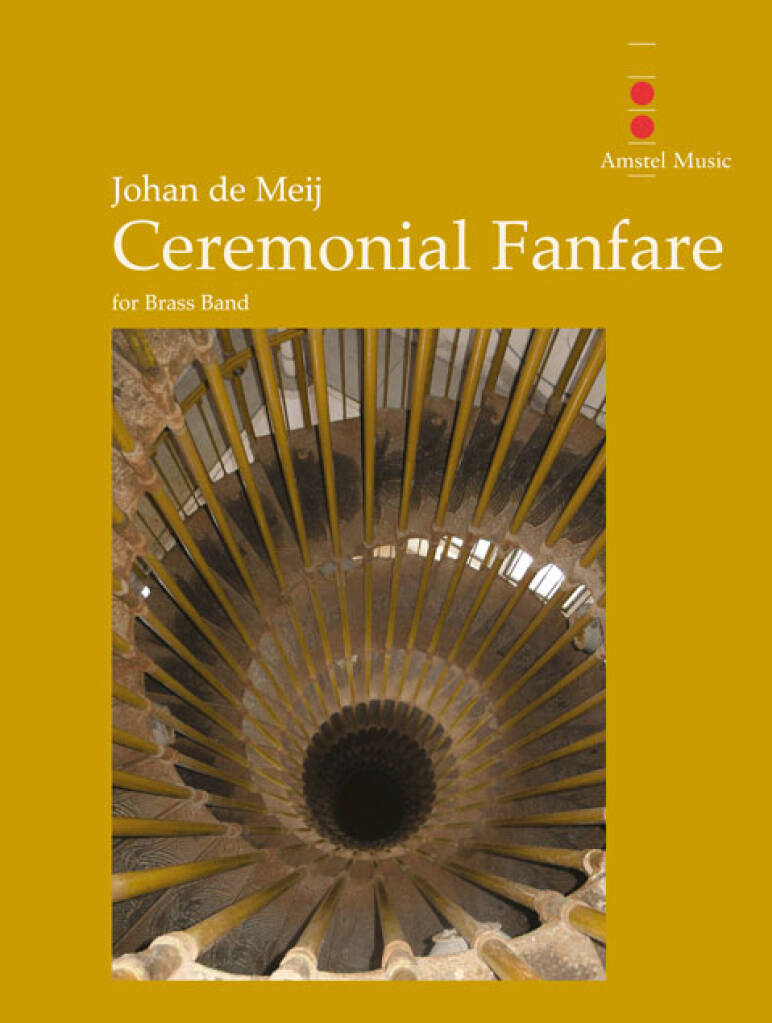
Ceremonial Fanfare - Johan de Meij
The Ceremonial Fanfare was originally written for orchestral brass and percussion, commissioned by The Orchestra Osaka Symphoniker from Osaka, Japan. The world premiere performance took place on April 12, 2005 at The Symphony Hall in Osaka, conducted by maestro Heiichiro Ohyama.In April 2009, the combined brass sections of the New York Philharmonic and the Royal Concertgebouw Orchestra gave an impressive performance in New York City. The concert commemorated the Henry Hudson Quadricentennial and 400 years of friendship between The United States and The Netherlands.This version for brass band was written at the request of EBBC, the European Brass Band Contest 2012in Rotterdam, to serve as the opening fanfare of the festival.
Estimated dispatch 5-14 working days
 View Music