
Results
-
 £29.50
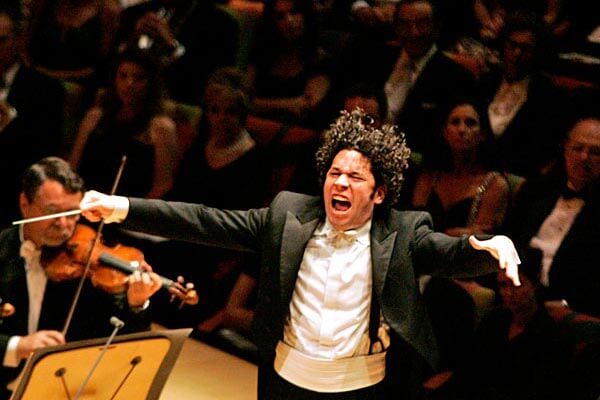
Classical Brass - Various - Gavin Somerset
This medley of famous classical music is the perfect addition to any concert. Beginning with the 'Barber of Seville' before the piece sets off on a journey with tongue placed firmly in cheek! Let your audience here the great classical works of Rossini, Grieg, Liszt, Mendelssohn (& others) as they've never heard them before. The various famous melodies all stay around long enough for your audience to recognize them before being moved off in another direction completely. This work is a musical journey that is perfect for formal proms concerts, yet certainly would not be out of place on a bandstand either. The piece has many opportunities for bands to add their own choreography if desired. A toe tapping, audience pleasing, journey that leaves the audience wanting more. Whilst rehearsals are suspended due to Covid-19, we are making some parts available to download FREE for home use and practice, alongside a downloadable backing track to play along to. To download the Solo Cornet part, please CLICK HERE . To download the Solo Horn part, please CLICK HERE . To download the Solo Euphonium part, please CLICK HERE . To download the playback audio to play along to, please RIGHT CLICK HERE & Save As .
In Stock: Estimated dispatch 1-3 working days
-
 £44.50
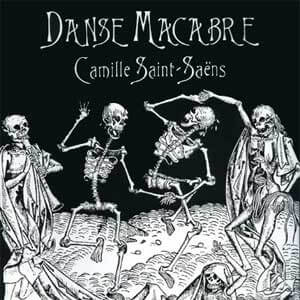
Dance Macabre - Saint-Saens - Gavin Somerset
A full arrangement of the spectacular work by Saint-Saens. Certainly a test for any top section band, both technically and rhythmically. Every section has an important role to play (yes, even Bass Trombone!). The main theme was used in the BBC's drama "Jonathan Creek", letting the audience recognize the piece immediately. Great as an alternative to an overture concert piece, this is one for every player of the band to get their teeth stuck into. To download the Solo Cornet part, please CLICK HERE . To download the Solo Horn part, please CLICK HERE . To download the Solo Euphonium part, please CLICK HERE . To download the playback audio to play along to, please RIGHT CLICK HERE & Save As .
In Stock: Estimated dispatch 1-3 working days
-
 £29.50
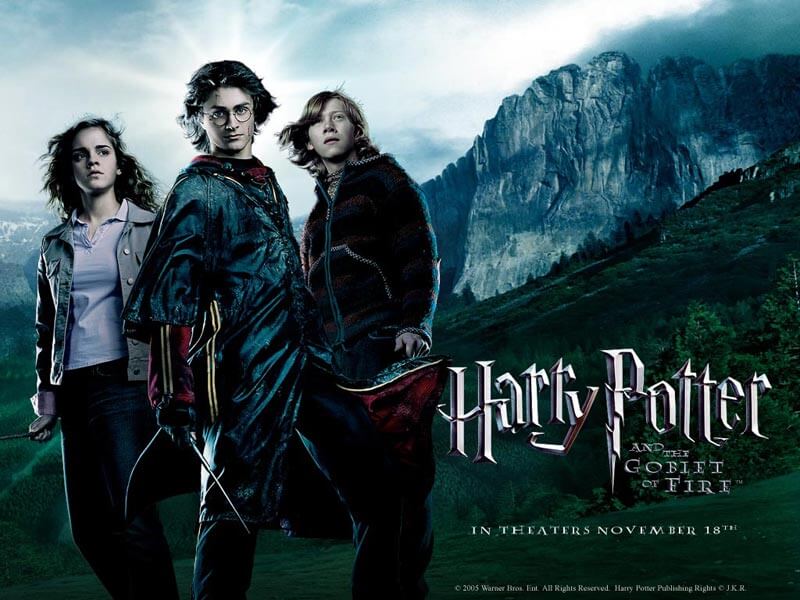
Hogwart's March - Patrick Doyle - George Marshall
From the fourth installation of the Harry Potter series comes 'Harry Potter & The Goblet of Fire'. This was the first of the Harry Potter films not to be scored by John Williams. Instead, Scottish Composer, Patrick Doyle was handed the gauntlet and he produced a gem of a score that lived up to the magic on screen. Although darker than the previous three films, the light-hearted 'Hogwart's March' featured predominantly at the Triwizard tournament. Now available for band, this work is perfect for band's looking to add a little magic to their programme. Instantly recognisable by the younger players and audience, and a different take on the traditional Brass Band march. To download the Solo Cornet part, please CLICK HERE . To download the Solo Horn part, please CLICK HERE . To download the Solo Euphonium part, please CLICK HERE . To download the playback audio to play along to, please RIGHT CLICK HERE & Save As .
In Stock: Estimated dispatch 1-3 working days
-
 £37.50
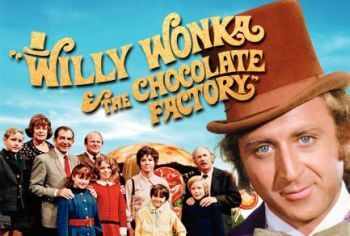
Willy Wonka (Selections From) - Leslie Bricusse & Anthony Newman - Gavin Somerset
Few people have not seen the 1971 film starring Gene Wilder as the eccentric chocolatier, offering tours of his chocolate factory to those lucky enough to find the hidden golden ticket. Whilst initialy a box office failure, the film went on to become a favourite in households across the world, years after its initial release. Now for the first time, your band can enjoy the music from the film in this selection that includes 'Golden Ticket', 'The Candy Man' and of course, the unforgettable 'Pure Imagination'. The music of Leslie Bricusse & Anthony Newley has been a hit for many years and continues to make TV and radio appearances. 'The Candy Man' was perhaps best known when covered by Sammy Davis Jr where it made it to number one in the USA. 'Pure Imagination' has been used countless times in adverts in the media and more recently, recorded by Jamie Callum for his album 'Momentum'. 'Pure Imagination' can also be performed as a stand-alone item. This is truly an all-time classic filled with a feast of musical variety that fits well into just about any concert. A must for all band libraries. To download the Solo Cornet part, please CLICK HERE . To download the Solo Horn part, please CLICK HERE . To download the Solo Euphonium part, please CLICK HERE . To download the playback audio to play along to, please RIGHT CLICK HERE & Save As .
In Stock: Estimated dispatch 1-3 working days
-
 £24.50
W.S.B. March - Gavin Somerset
After performing a number of arrangements by Gavin Somerset, the band commissioned him to compose for them, an original march that would serve as their signature tune for years to come. The march was composed in a light 6/8 time that would get passes by listening and audience's feet tapping along. Composed with a DC, this is optional and the finale of the march has a licence for a Grandioso and accelerando to give the work that flair for its finale. To download the Solo Cornet part, please CLICK HERE . To download the Solo Horn part, please CLICK HERE . To download the Solo Euphonium part, please CLICK HERE . To download the playback audio to play along to, please RIGHT CLICK HERE & Save As .
In Stock: Estimated dispatch 1-3 working days
-
 £29.50
Clarinet Concerto (Adagio): Mozart - W.A. Mozart - Bill Willis
The most popular movement from Mozart's Clarinet Concerto in A is now available as a beautiful solo for Euphonium (with an optional Tenor Horn soloist part also included). The work was originally composed for Anton Stadler and composed in 1791. This arrangement tests the range of the soloist with some large intervals to contend with during the lyrical melodies, utilising the full range of the instrument. The tender accompaniments also require the band to be sympathetic to the soloist as band show off the controlled nature of their playing.
In Stock: Estimated dispatch 1-3 working days
-
 £80.00
St. Magnus - Kenneth Downie
Dedicated to Alastair Massey, an inspirational music teacher. Commissioned by the Scottish Brass Band Association for the 2004 European Brass Band Championships in Glasgow. This music is a set of variations on the tune known as St Magnus, which is attributed to Jeremiah Clarke. Most people will associate it with Thomas Kelly's hymn which begins: "The Head that once was crowned with thorns is crowned with glory now". The tune is very simple, consisting of just two, four-bar phrases. Neither is there much in the way of rhythmic variety, every note being a crotchet with the exception of two quavers, and the last note in each phrase. Within such a simple structure, however, lies considerable strength. THEME The listener is given the opportunity of hearing it twice, in full, at the beginning, starting with one player but soon taken up by the full ensemble. It returns in the middle of the music and is stated again near the end. This has been done quite deliberately in the hope that there will be an appreciation of what material is being developed, by the listener as well as by those with access to the score, who are able to see the visual connections. VARIATION 1 This takes the rhythm of the last part of the theme and also uses the shape of the opening as a recurring figure. The mood is whimsical and skittish, with short, teasing rhythmic figures tossed around the band, and quick interplay with percussion, at a fast tempo. An energetic flourish finishes this variation before the Andante espress. VARIATION 2 This commences with chords related to the opening of Variation 1. The cantabile on solo comets establishes a new, lyrical mood and there is scope for expressive playing in a series of short solo passages. The theme works its way unobtrusively into the texture before a reprise of the solo cornet melody and some more lyrical interchanges between Eb bass, euphonium, flugel horn and comets. The variation ends serenely with clear references to the last phrase of the theme. VARIATION 3 The first idea to dominate is clearly linked to the shape of the theme's first phrase. There is a frenetic feel to much of this variation, with considerable energy and instability created by extensive use of cross-rhythms. A thinning-out of the score marks a clear change to development of the start of the second phrase of the theme. This proves to be short-lived however, and the opening material returns leading to a restatement of the theme, "Maestoso," after which a euphonium cadenza links to Variation 4. VARIATION 4 Here we have some solos for euphonium, cornet, trombone and Eb bass set against a background of horns and baritones presenting a pensive statement of the theme's opening. VARIATION 5 This commences Allegro, with lively work for cornet and euphonium spreading to the whole band before attention focuses on the beginning of the second phrase of the theme which is initially presented in diminution, then in regular rhythm, then in inversion. An increase in tempo coupled with a decrease in volume, requires dexterity and control, with several metrical challenges thrown in for good measure. The same fragment of phrase becomes an ostinato which generates a frenzied climax, punctuated by short, dramatic silence, before the opening figure returns and the music gradually winds down. The tubular bells herald the final return of the theme, in augmentation, marking the start of the Finale. FINALE This features the running semiquavers of the previous variation sounding in counterpoint. A fast, furious coda speeds the work to a conclusion while references to the opening of the theme are still trying to break into the texture of the music. Kenneth Downie
Estimated dispatch 5-14 working days
-
 £115.60
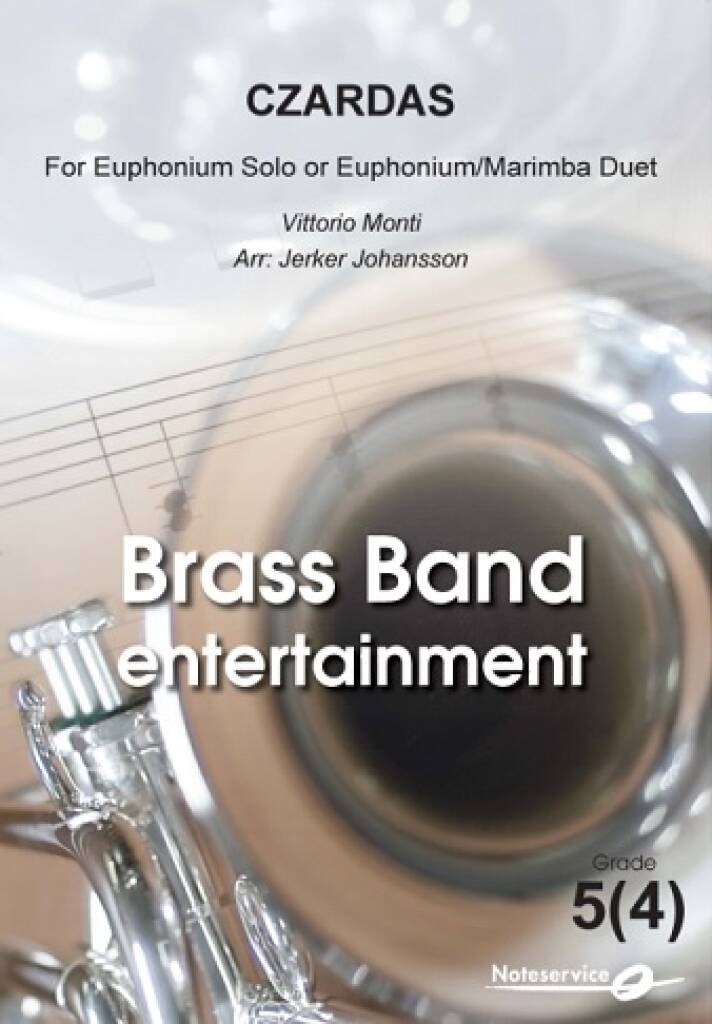
Czardas - Vittorio Monti - Jerker Johansson
There are composers that have gone done in history by just a single composition. One of those is the Italian violinist and composer Vittorio Monti (1868-1922). Around 1904 he wrote "Czardas", which soon became a favourite among violinists inrestaurant and gipsy orchestras. Monti was also conductor of the Lamoureux Orchestra in Paris and wrote music for ballets and operettas.Csardas is originally a Hungarian folk dance with a slow part (lassu) and a fast part (friska). The virtuoso solo in this arrangement for brass band is written for euphonium and marimba.
Estimated dispatch 5-14 working days
-
 £53.50
Mr Cool's Swing - Etienne Crausaz
This piece is in line with the tradition of works by Louis Prima and performances by Benny Goodman. It attempts to reproduce a similar "feel", adapted from the music of these two artists, for brass band. The result is a swing with a sustained tempo and modern harmonies, as well as solo passages highlighting the cornet, the trombone and the euphonium with effervescent riffs. Mr Cool's Swing will absolutely find success with your audience! This music forms part of the musical tale La Malediction d'Aragne (Aragne's Curse), commissioned by the Lyre de Courtion (conductor Dominique Morel) on the occasion of its 100th anniversary.
Estimated dispatch 5-14 working days
-
 £104.99
Sinfonietta No. 4 - Etienne Crausaz
This work was composed for the occasion of the 28. Fete Cantonale des Musiques Vaudoises (28th Music Festival of the Canton Vaud), taking place in the Valley of Joux in June 2018. The music begins with a very simple fanfare consisting of five ascending legato notes which constitute the fundamental framework of the piece. This contrasts with the more cantabile sounding theme we hear after. The following Allegro section uses the sequence in a contrapuntal style reminding us of the Renaissance period, but with more modern day harmonies. Two solo cadenzas played by cornet and euphonium initiate the middle section, in which a theme also based on the sequence builds uptowards the climax of the piece. The sequence in the last section is played in time but gives the feeling of a "one to the bar" beat. Shortly before the festive finale, the music heard in the middle part resumes.
Estimated dispatch 5-14 working days
 View Music