
Results
-
 £76.99
Mixed Bag - Peter Martin
'Mixed Bag' stands midway between a collection and a hotchpotch. It is a colourful compilation of four completely different pieces, each with its own specific character. The first part is called 'Tanguillo' : as its name suggests, this Spanish dance is related to the Tango. In the next part, 'Maybe next time ....' a repeated bass line (Passacaglia) can be heard, first solo, but thereafter gradually the other instruments join in. The third part forms a huge contrast did the former part have a Baroque atmosphere, 'Rock Hard' seems to have come directly from the Rock 'n Roll era, reminding us of stars such as Bill Haley and Elvis Presley. The finale is acheerful, inciting movement called 'Gypsy Dance'.
Estimated dispatch 5-14 working days
-
 £91.99
Fanfares, Songs & Dances - Philip Sparke
Fanfares, Songs & Dances was commissioned by Brass Bands England, the Lithuanian Brass Band Association and the Dutch National Brass Band Championships (NBK), and first performed at the 43rd 'NBK' in October 2024. The work is played in three linked movements: FANFARES opens in robust fashion with a sequence of fanfare-like statements, initially featuring the horns, whose modal theme includes a figure that will reappear throughout the work. Euphoniums and then cornets introduce a second theme, which is followed by a third, again initiated by the horns. Baritones then change the mood with a more-lyrical theme, which builds to a climax, eventually leading back to a recall of the initial fanfare theme. This gradually dissolves to introduce the second movement. SONGS continues to relax the fanfare feel with a long introduction to the movement's main theme, first appearing on solo cornet. A change of key introduces a bridge passage which leads to a sonorous chorale, which builds to a triumphal return of the cornet theme. A peaceful coda leads to the final movement of the work. DANCES is a scherzo-like movement based around a series of rhythmic melodies in triple time, which lead to a majestic return of the 2nd movement's chorale theme under cornet figuration. The opening dance theme returns and heralds a joyous coda.
Estimated dispatch 5-14 working days
-
 £19.95
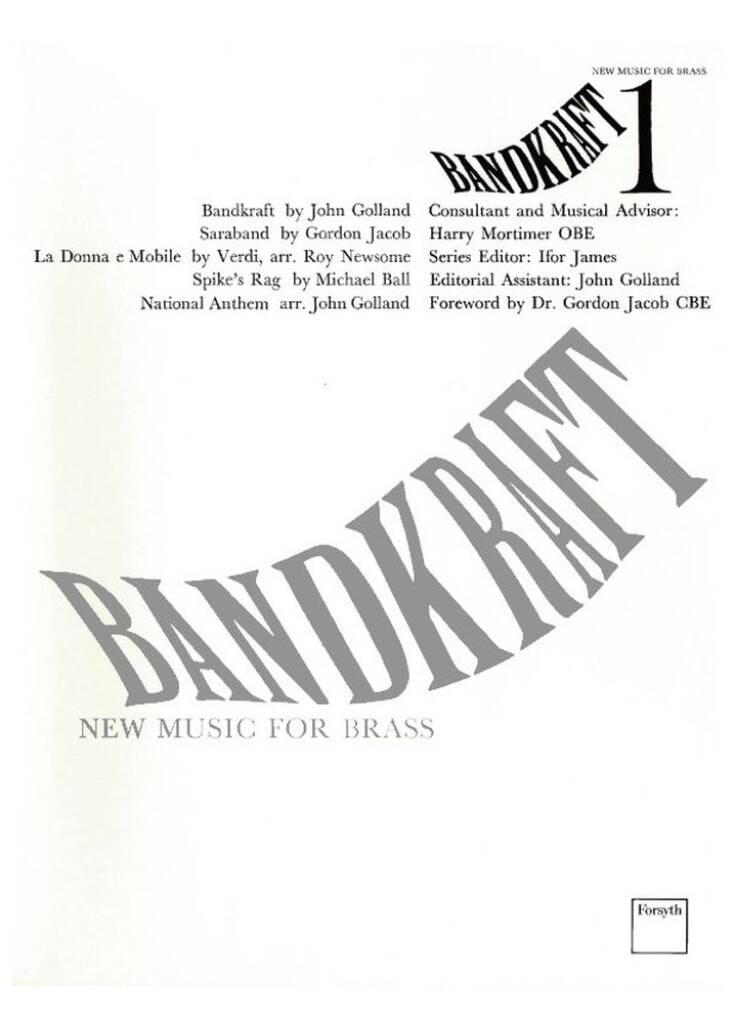
Bandkraft 1
The first of three superb sets of new music and arrangements for brass ensemble, edited by John Golland.1. Bandkraft - John Golland: A substantial piece with an exciting syncopated rhythm introduced in the opening bars and referred to throughout in a fanfare-like manner, to which a hint of dissonance adds extra thrill to the sound.2. Saraband - Gordon Jacob: A stately Elizabethan dance of great beauty, utilising modal harmony in Jacob's characteristic style. Constant speed, full note values and careful playing will achieve a beautiful, delicate effect.3. La Donna E Mobile - Verdi, arr. Roy Newsome: An amusing arrangement of this popular favourite by a conductor and adjudicator of international acclaim. Easy and enjoyable to play and to listen to.4. Spike's Rag - Michael Ball: A skilfully written piece in the true tradition of Scott Joplin, with the ragtime rhythm the backdrop to an unfolding conversation between the sections of the band. Really persuasive entertainment.5. National Anthem - arr. John Golland: A simple first verse setting the scene for the colourful and majestic second, utilising chromatic harmonies and an optional tenor counter melody for added splendour.
Estimated dispatch 5-14 working days
-
£60.99
Cowboy Suite - Alan Laken
In the tripartite 'Cowboy Suite' Alan Laken takes us to the Wild West, the domain of cowboys, indians, trappers and other fortune hunters. Around 1890 the west coast of America was reached, which in effect meant the end of the Wild West. Its stories, however, survived and have been a source of inspiration for many books, films, and, of course, music. Some characters, such as Jesse James, Billy the Kid, and Buffalo Bill are forever linked to these tales. In the 'Cowboy Suite' we first hear the 'Hoedown'. At the end of an exhausting workday the labourers used to lay down their tools, among others the 'hoes' and spontaneously began to play music on the instruments which they then possessed (guitars, fiddles, and banjos) and to dance. After being jolted on the 'Wagon Trail' we reach the third part, the 'Cowboy Roundup'. In this last part it becomes clear that as a cattle driver it is imperative to stay firmly seated in the saddle. As the cattle are rounded up, i.e. driven together, spectacular things happen.
Estimated dispatch 5-14 working days
-
 £54.99
Sumba Samba - Ron Gilmore
The Samba is a Latin American dance, which is mostly associated with parties, as a result of the fast tempo in which it is usually played. 'Sumba Samba' forms an exception to this rule. In order to get this samba to swing it is important to stick to the tempo prescribed. 'Sumba Samba' starts with a motif which will play an important role throughout the piece. This motif can be heard in the first notes of the 'refrain' and, as said before, has been used in the introduction, as well as in the transition after the middle part (letter G). Furthermore, it plays an important role in the middle part itself (letter E), in which the samba has momentarily disappeared and acompletely different atmosphere has been created. At letter H we pick up where we left off with the samba and swing to the end of this composition.
Estimated dispatch 5-14 working days
-
 £104.99
Scottish Dances - Peter Martin - Menno Haantjes
Scottish Dances is based on three Scottish traditionals: Cock of the North, The Bonnie Bank's O'Loch Lomond and Marie's Wedding. I. Cock of the North's name is used for multiple things or events. For example for a locomotive to a famous, it seems, delicious liqueur, and rallies to snowboard competitions. Furthermore is "Cock O' the North " a nickname of a famous Duke. (The 4th Duke of Gordon). In this composition Cock of the North (a Jig) is a traditional Scottish bagpipe tune, regularly played on tattoos by Pipe Bands. Not infrequently the drummers sing the text. Auntie Mary, had a canary, Up the leg of her trousers While she was sleeping Iwas peeping Up the leg of her trousers. II. " The Bonnie Bank's O'Loch Lomond " is about a sad story that took place during an revolt against the British. In 1745 Bonnie Prince Charlie had to retreat. Two of his men were captured. One was convicted and executed, while the other was released. The spirit of the executed soldier would arrive in Scotland via the 'low road' (underworld) before his companion, who had still a long way to go. You'll take the high road And I'll take the low road And I'll be in Scotland afore ye But me and my true love will never meet again On the Bonnie Bonnie Banks of Loch Lomond III. In a Scottish wedding, after the official ceremonies, there is often danced. This is called a ceilidh. For this we use traditional Scottish music such as "Marie's Wedding '. Mid dance we go back to the church, where a lovely song in honor of the couple sounds. Marie's Wedding has been recorded by Van Morrison (among many others). Step we gaely, on we go, heel for heel and toe for toe Arm and arm and on we go, all for Marie's wedding
Estimated dispatch 5-14 working days
-
 £24.95
The M-lisada March - Jim Trott
All proceeds from "The M-lisada March" are donated to Brass for Africa, a charity making a positive change to the lives of disadvantaged children and young people in Africa through brass music and brass music education. The composer, Jim Trott, is the founder of a charity called Brass for Africa and one of the organizations the charity supports and works with is the MLISADA organization located in the slums of Kampala, Uganda. MLISADA is a home for ex-street kids, orphans and vulnerable children and at the heart of the home is music and dance. MLISADA have a junior and senior brass band and the bands earn income to feed the home by playing at functions and marches. Jim has often been with the band as they work up anthems and themes for their various engagements and he thought it would be great for MLISADA to have their own theme. So, he has written this short March for these inspiring young people and is delighted that they love to play it whenever they can.
Estimated dispatch 5-14 working days
-
 £59.99
Hava Nagila - Philip Sparke
Hava Nagila (the title means 'let us rejoice') is perhaps the best known example of a style of Jewish music called 'klezmer'. Klezmer music originated in the 'shtetl' (villages) and the ghettos of Eastern Europe, where itinerant Jewish troubadours, known as 'klezmorim', had performed at celebrations, particularly weddings, since the early Middle Ages.'Klezmer' is a Yiddish term combining the Hebrew words 'kley' (instrument) and 'zemer' (song) and the roots of the style are found in secular melodies, popular dances, Jewish 'hazanut' (cantorial music) and also the 'nigunim', the wordless melodies intoned by the 'Hasidim' (orthodox Jews).Since the 16th century, lyrics hadbeen added to klezmer music, due to the 'badkhn' (the master of ceremony at weddings), to the 'Purimshpil' (the play of Esther at Purim) and to traditions of the Yiddish theatre, but the term gradually became synonymous with instrumental music, particularly featuring the violin and clarinet. The melody of Hava Nagila was adapted from a folk dance from the Romanian district of Bucovina. The commonly used text is taken from Psalm 118 of the Hebrew bible.
Estimated dispatch 5-14 working days
-
 £60.99
Fanfare La Perie - Paul Dukas - Peter Wain
In 1911 the Russian impresario Diaghilev commisioned Paul Dukas to compose music for the famous ballet fairy-tale 'La Perie'by Jean Coralli.Fokine was to make a new choreography, so that the Russian ballet company 'Ballet Russes' would be able to perform the piece in Paris that same year. Due to a quarrel between Diaghilev and Dukas about who should dance the title-part, however, the ballet was not performed by the 'Ballet Russes'but by another company in 1912.The ballet 'La Perie' is Dukas' last symphonic work. In 1911 gaf de Russische impresario Diaghilev Paul Dukas opdracht om muziek te componeren voor het beroemde ballet sprookje 'La Perie' van Jean Coralli. Fokine was gevraagd om een nieuwe choreografie te maken, zodat het Russische balletgezelschap 'Ballet Russes' in staat zou zijn om het stuk in Parijs op te voeren in datzelfde jaar. Door een ruzie tussen Diaghilev en Dukas over de vraag wie de hoofdrol mocht dansen, werd het ballet in 1912 echter niet uitgevoerd door het 'Ballet Russes' maar door een ander gezelschap. Het ballet 'La Perie' is het laatste symfonische werk van Dukas.
Estimated dispatch 5-14 working days
-
 £60.99
Klezmeriana - Jan de Haan
The instrumental music of the Yiddish-speaking Jews, especially those of Eastern Europe, is known as klezmer. This terminology was originally used in Jewish cultural life as the name of a musician who played at weddings. At Jewish weddings, which usually last several days, klezmer musicians played not only dance music but also ceremonial music - for example during the wedding ceremony, and also music that was listened to during the wedding feast. Originally, there was no special term for this style of music. It was simply referred to as 'Jewish wedding music'. In the 1970s, the music - which is actually a fusion of different influences - enjoyed a resurgence in popularity and came to be known as klezmer. This music contains not only the sounds of the Balkans, but also influences of oriental and gypsy music too. Jan de Haan used no original klezmer melodies for Klezmeriana, but composed a series of sound-alike in an instrumentation for brass band.
Estimated dispatch 5-14 working days
 View Music