
Results
-
 £30.00
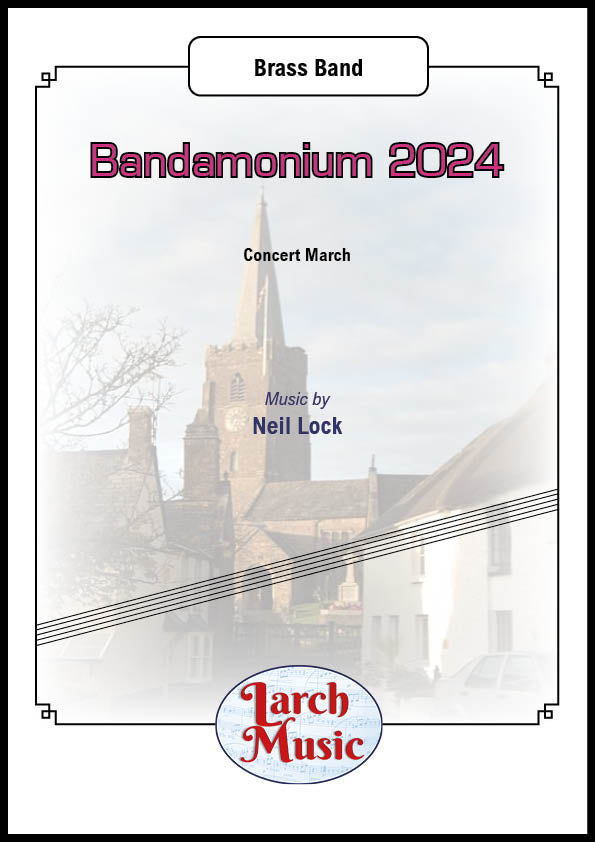
Bandamonium 2024 (Neil Lock) - Brass Band Sheet Music Full Score & Parts - LM541
COMPOSER: Neil LockThis march was submitted to the march composers' competition for "Bandamonium 3"in Hatherleigh, Devon in July 2024. The winning march was played by massed bands at the conclusion of the celebrations on Saturday 27th July 2024. Unfortunately, this march took second place in the competition, behind the march of Paul Pennicotte-Henrie, conductor of Okehampton Silver Band.The march can be played with or without the singing. (Even at the Whit Friday marches, begad!) I suggest that it should be introduced by 3-beat rolls.When played with singing, the "Bandamonium" lyrics (bars 10-13 and 56-57) are to be sung by all players, keeping to their own parts, with appropriate octave adjustment for their individual singing voices. Conductor and percussionists should sing with the main theme (Db and C at bars 10-13, F at 56-57). Listen to the 3rd cornet players!There is an additional part for Singers, in which the trio melody (bars 58 onwards) can be sung by Soprano and Tenor singers at a moderate choir standard. An octave-down option is also provided in the higher bars. This part can be given to "spare" singers within the band, or to singers external to the band if opportunity permits. The lyrics are:We are in Devon,We're in Hatherleigh,Whit Friday heaven,But we're marching free!Now it's past seven,Time to party,At BandamoniumIn Hatherleigh!LM541 - ISMN : 9790570005413
In Stock: Estimated dispatch 3-5 working days
-
 £119.95
The Torchbearer (Symphonic Variations on a Theme by Eric Ball) (Brass Band - Score and Parts) - Graham, Peter
2015 National Championships Regionals - Championship Section. The variations are based upon the first phrase of the trio from Eric Ball's Salvation Army march, Torchbearers. After opening statements of the theme, variation 1 (an energetic allegro brillante utilising fragment A) commences. Cadenza passages for Eb Bass and Euphonium lead to variation 2 (an andante appassionato based upon fragment B) Variation 3 (a vivace featuring C as an ostinato) is followed by variation 4 (the central andante e sciolto molto for solo cornet). The work culminates in a reprise of the cornet solo, now fully metamorphosised and mirroring in music a concept at the centre of Ball's broader philosophy, that of transformation. Eric Ball will be remembered as a composer whose classic works for brass shine through with integrity and sincerity. There has been no less sincere in the composers' efforts to pay musical tribute to the 20th century's most influential composer of brass band music. Duration: 12:30
Estimated dispatch 7-14 working days
-
£37.95
The Torchbearer (Symphonic Variations on a Theme by Eric Ball) (Brass Band - Score only) - Graham, Peter
2015 National Championships Regionals - Championship Section. The variations are based upon the first phrase of the trio from Eric Ball's Salvation Army march, Torchbearers. After opening statements of the theme, variation 1 (an energetic allegro brillante utilising fragment A) commences. Cadenza passages for Eb Bass and Euphonium lead to variation 2 (an andante appassionato based upon fragment B) Variation 3 (a vivace featuring C as an ostinato) is followed by variation 4 (the central andante e sciolto molto for solo cornet). The work culminates in a reprise of the cornet solo, now fully metamorphosised and mirroring in music a concept at the centre of Ball's broader philosophy, that of transformation. Eric Ball will be remembered as a composer whose classic works for brass shine through with integrity and sincerity. There has been no less sincere in the composers' efforts to pay musical tribute to the 20th century's most influential composer of brass band music. Duration: 12:30
Estimated dispatch 7-14 working days
-
 £82.95
The Flowers of the Forest (Brass Band - Score and Parts) - Bennett, Richard Rodney - Hindmarsh, Paul
In a preface to the score, the composer explains that 'the folk song The Flowers of the Forest is believed to date from 1513, the time if the battle of Flodden, in the course of which the archers of the Forest (a part of Scotland) were killed almost to a man'. Bennett had already used the same tune in his Six Scottish Folksongs (1972) for soprano, tenor and piano, and it is the arrangement he made then that forms the starting-point for the brass-band piece. A slow introduction (Poco Adagio) presents the folk song theme three times in succession - on solo cornet, on solo cornets and tenor horns, and on muted ripieno cornets in close harmony - after which the work unfolds through five sections and a coda. Although played without a break, each of these five sections has its own identity, developing elements of the tune somewhat in the manner of variations, but with each arising from and evolving into the next. The first of these sections (Con moto, tranquillo) is marked by an abrupt shift of tonality, and makes much of the slow rises and falls characteristic of the tune itself. The tempo gradually increases, to arrive at a scherzando section (Vivo) which includes the first appearance of the theme in its inverted form. A waltz-like trio is followed by a brief return of the scherzando, leading directly to a second, more extended, scherzo (con brio) based on a lilting figure no longer directly related to the theme. As this fades, a single side drum introduces an element of more overtly martial tension (Alla Marcia) and Bennett says that, from this point on, he was thinking of Debussy's tribute to the memory of an unknown soldier (in the second movement of En Blanc et noir, for two pianos). Bennett's march gradually gathers momentum, eventually culminating in a short-lived elegiac climax (Maestoso) before the music returns full-circle to the subdued melancholy of the opening. The work ends with a haunting pianissimo statement of the original tune.
Estimated dispatch 7-14 working days
-
£44.95
The Flowers of the Forest (Brass Band - Score only) - Bennett, Richard Rodney - Hindmarsh, Paul
In a preface to the score, the composer explains that 'the folk song The Flowers of the Forest is believed to date from 1513, the time if the battle of Flodden, in the course of which the archers of the Forest (a part of Scotland) were killed almost to a man'. Bennett had already used the same tune in his Six Scottish Folksongs (1972) for soprano, tenor and piano, and it is the arrangement he made then that forms the starting-point for the brass-band piece. A slow introduction (Poco Adagio) presents the folk song theme three times in succession - on solo cornet, on solo cornets and tenor horns, and on muted ripieno cornets in close harmony - after which the work unfolds through five sections and a coda. Although played without a break, each of these five sections has its own identity, developing elements of the tune somewhat in the manner of variations, but with each arising from and evolving into the next. The first of these sections (Con moto, tranquillo) is marked by an abrupt shift of tonality, and makes much of the slow rises and falls characteristic of the tune itself. The tempo gradually increases, to arrive at a scherzando section (Vivo) which includes the first appearance of the theme in its inverted form. A waltz-like trio is followed by a brief return of the scherzando, leading directly to a second, more extended, scherzo (con brio) based on a lilting figure no longer directly related to the theme. As this fades, a single side drum introduces an element of more overtly martial tension (Alla Marcia) and Bennett says that, from this point on, he was thinking of Debussy's tribute to the memory of an unknown soldier (in the second movement of En Blanc et noir, for two pianos). Bennett's march gradually gathers momentum, eventually culminating in a short-lived elegiac climax (Maestoso) before the music returns full-circle to the subdued melancholy of the opening. The work ends with a haunting pianissimo statement of the original tune.
Estimated dispatch 7-14 working days
-
 £35.00
BLUES ON THE MARCH (Brass Band) - Barry, Darrol
Traditional marches are great, but sometimes you want something different to kick off your concert. This piece gives your band a chance to get into the 'swing' of things, based on the traditional twelve bar blues it features a contrasting middle section with a trombone trio and a flugel (cornet) obligato. Grade: 4th section +. Duration: 3:50
Estimated dispatch 7-14 working days
-
£24.50
Brandenburg Concerto No. 2 (allegro) - J.S Bach - John Abbott
The "Brandenburg Concertos" were composed and dedicated to Christian Ludwig, Margrave of Brandenburg in 1721, however it seems now they were never actually played for him. This 1st movement has been kilfully arranged as a trio for Soprano Cornet and 2 Bb Cornets (solo cornet, and repiano). This is sure to test the strongest of players, utilising the soprano's high register and making work of the low register on the Bb cornets. As well as keeping the band entertained with running semi-quavers (and some wonderful intervals for the basses!!!) This certainly is a hard piece to perform for the three soloists, but its well worth the challenge.
In Stock: Estimated dispatch 1-3 working days
-
 £39.95
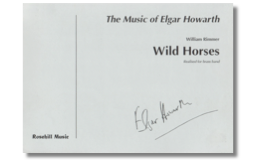
Wild Horses (Score and Parts) - William Rimmer Realised by Elgar Howarth
Taken from William Rimmer's The Artistic Soloist - a volume of character melodies for solo cornet - Elgar Howarth has furnished four of the tunes with full accompaniment for brass band. Wind Horses demands a firm straight delivery of the tongue and a steady tempo with a full sound throughout, although the trio section is more flexible.
Estimated dispatch 7-9 working days
-
£35.00
Blues on the March - Barry, D
Traditional marches are great, but sometimes you want something different to kick off your concert. This piece gives your band a chance to get into the 'swing' of things, based on the traditional twelve bar blues it features a contrasting middle section with a trombone trio and a flugel (cornet) obligato.4th section +Duration 3.50 mins
In Stock: Estimated dispatch 1-3 working days
-
 £35.00
Blues On The March (Score and Parts)
Traditional marches are great, but sometimes you want something different to kick off your concert. This piece gives your band a chance to get into the 'swing' of things, based on the traditional twelve bar blues it features a contrasting middle section with a trombone trio and a flugel (cornet) obligato.
Estimated dispatch 7-14 working days
 View Music