
Results
-
 £99.95
Breath of Souls (Brass Band - Score and Parts)
Breath of Souls was commissioned by Weyland and Yvonne Roberts. It was composed especially for the 100th National Brass band Championships of Great Britain at the Royal Albert hall on October 15th 2011.Weyland has worked in science for many years and has always been fascinated by nature's capacity to grow and rebuild regardless of Mother Nature's catastrophic power. This is evident with the news of tsunami, forest fires, earthquakes and volcanic disasters around the world where animals, plant life and humans have overcome adversity and have demonstrated that unique regenerative quality.Speaking about the piece composer Paul Lovatt-Cooper commented: "With Breath of Souls I wanted to compose a piece of music that was a celebration of life. Not only that, but a piece of music that from the very first notes heard in the percussion and cornets, is bustling with activity, emulating that in life everything that is living has a soul and breathes - nothing stays still and everything keeps moving and growing.Just like life itself Breath of Souls also grows musically with each bar. You will hear many and various motifs and ideas grow and develop as the piece develops."
Estimated dispatch 7-14 working days
-
 £15.00
Breath of Souls (Brass Band - Study Score)
Breath of Souls was commissioned by Weyland and Yvonne Roberts. It was composed especially for the 100th National Brass band Championships of Great Britain at the Royal Albert hall on October 15th 2011.Weyland has worked in science for many years and has always been fascinated by nature's capacity to grow and rebuild regardless of Mother Nature's catastrophic power. This is evident with the news of tsunami, forest fires, earthquakes and volcanic disasters around the world where animals, plant life and humans have overcome adversity and have demonstrated that unique regenerative quality.Speaking about the piece composer Paul Lovatt-Cooper commented: "With Breath of Souls I wanted to compose a piece of music that was a celebration of life. Not only that, but a piece of music that from the very first notes heard in the percussion and cornets, is bustling with activity, emulating that in life everything that is living has a soul and breathes - nothing stays still and everything keeps moving and growing.Just like life itself Breath of Souls also grows musically with each bar. You will hear many and various motifs and ideas grow and develop as the piece develops."
Estimated dispatch 7-14 working days
-
 £67.24
Armistice at Flanders Fields (Brass Band) Dwayne Bloomfield
This poignant and powerful work for brass band by Dwayne Bloomfield describes the day peace was announced to end World War I. The piece was written in 2023 to be played by bands around the world to mark Armistice Day. The composer writes: 'Unless you were there, it's impossible to imagine what it must have been like the day peace was announced ending World War I. The feelings soldiers experienced, who after years of fighting and suffering, to know it was over and they would return home to see family and loved ones again. This piece tries to tell their story. The work begins by approaching the front, distant artillery and battle sounds heard while the carnage and loss of lives was already known to the world. The band builds as we enter the thick of battle, the death and destruction, the conditions faced and the loss of hope of ever surviving. The next section, in 7/8 time, reflects the two sides fighting - both sides attacking and defending with mostly little result, but for the loss of more lives. Two euphoniums then depict the news and hope of peace talks. However, fighting did continue right up to the very end and on the last day there would be another 2,738 casualties. The Canadians were still battling to capture the town of Mons that morning. A song is sung in reflection of the estimated 5.5 million allied soldiers who lost their lives during World War I, then a clock ticks down the final minutes. The last three known casualties are depicted with French soldier Augustin Trebuchon, killed at 10:45am by a single shot as he rushed down the trenches to spread the news of coming peace; Canadian George Lawrence Price killed by a sniper round at 10:58am at the battle of Mons, and lastly a machine gun burst that killed American Henry Gunther, who is believed to have fallen on the 11th hour. Bells then toll ringing around the world announcing the end of the war. After years of war, it must have been jubilation for the families at home knowing their loved ones would be returning to them. The band builds with a hymn for peace as a final tribute to those who fought, before the piece resides with one of the most dreaded sounds at that time, the knock on the door from a telegram delivery boy or better known then as the Angels of Death. It wasn't just the 2,738 families from the casualties of the last day who would receive such a knock, but many more who expected their loved ones to be returning home would instead find out they were instead killed in the last weeks. So close. Driving around the battlefields today one comes across many intersections in the countryside which have cemetery signposts pointing in every direction. While the last post sounds in ceremonies today, this last bugle call instead depicts the horrors, devastation and death the soldiers faced during the war and right up the 11th hour of the 11th day of the 11th month, Armistice at Flanders Fields.' To view a video of Dallas Brass Band performing the work please visit https://www.youtube.com/watch?v=ljfyVz3cMgk Duration: Approx. 15.00 minutes Difficulty Level: 2nd Section + PDF download includes parts and score. Sheet music available from www.brassband.co.uk Instrumentation: Soprano Cornet Eb Solo Cornet Bb Repiano Cornet Bb 2nd Cornet Bb 3rd Cornet Bb Flugel Horn Bb Solo Horn Eb 1st Horn Eb 2nd Horn Eb 1st Baritone Bb 2nd Baritone Bb 1st Trombone Bb 2nd Trombone Bb Bass Trombone Euphonium Bb Bass Eb Bass Bb Percussion 1-3
In Stock: Estimated dispatch 1-3 working days
-
 £82.19
'Odyssey' Variations (Brass Band) Kevin Norbury
'Odyssey' Variations was composed as a result of a commission in May 2020 from Five Lakes Silver Band and its musical director, Christopher Ward. This music is based on an original theme that I first used in an earlier composition, Odyssey, which was the test piece for the European Brass Band Championships, held at Munich, Germany, in April 1999. I distinctly remember getting into my hotel room and turning on the television to be greeted by news coverage of the Columbine High School shooting, so that piece has always held some significance for me, though because of a very sad coincidence. The melody was originally a cornet solo in the central slow section of Odyssey and pitched deliberately to test the soloist. I have, more recently attempted a straightforward choral setting of the melody, and the harmonies I use in the three chorale-style settings at the start of these variations are loosely based on that setting. The melody is a setting of the familiar words of Be Thou My Vision, an old Irish hymn, translated by Mary E. Byrne, and versified by Eleanor H. Hull. The form of the work is as follows: Theme - three presentations Variation 1 - Allegro Variation 2 - Moderato (featuring the horns, baritones, euphoniums and basses) Variation 3 - Maestoso (featuring the cornets, flugel horn, and trombones) Variation 4 - Adagio Variation 5 - Allegretto Variation 6 - Largo - Moderato Variation 7 - Allegro molto Theme - Maestoso e sostenuto Finale - Allegro vivace - Adagio e allargando To view a video of Five Lakes Silver Band performing the work please visit: www.youtube.com/watch?v=vfLnld3bCw8 Sheet music available from: UK - www.brassband.co.uk USA - www.solidbrassmusic.com Difficulty Level: 1st Section + Instrumentation: Soprano Cornet Eb Solo Cornet Bb Repiano Cornet Bb 2nd Cornet Bb 3rd Cornet Bb Flugel Horn Bb Solo Horn Eb 1st Horn Eb 2nd Horn Eb 1st Baritone Bb 2nd Baritone Bb 1st Trombone Bb 2nd Trombone Bb Bass Trombone Euphonium Bb Bass Eb Bass Bb Timpani Percussion 1-3
In Stock: Estimated dispatch 1-3 working days
-
 £33.62
Disinformation! (Brass Band) Joe Galuszka
This atmospheric work by English composer Joe Galuszka is set in three movements: I. Fear II. Hope III. Solidarity (March for Truth) The composer writes: 'All around us is mistrust in the information we receive. Chinese misinformation. Russian disinformation. 'Fake News' in the United States. At every turn we doubt what we hear, what we see. Disinformation was composed in response to the ever-growing and all powerful misinformation campaigns worldwide that reached dizzying levels of influence, coming from some of the most eminent heads of states, during the turn of the 21st century. With division and disillusionment now rife and engrained in Western democracies, the unravelling of the social order is reflected in this short work for brass band. Opening with Fear, Disinformation starts with vast amounts of noise taking over the establishment and paints a world with people coming to terms with the cacophony of sound that is 'false information'. With a retreat to a brief moment of solace, Hope conjures up a calm escapism where on the outside, the brave and the wise look on to what is becoming of our new world. Maybe there is chance to pull together? Ending with a frenzied, brazen climax, the piece concludes with Solidarity - where people and the politicians come to loggerheads in a battle - where those who seek division are called out and the lies are laid bare for all to see, as we enter, once more, the unknown.' To listen to a recording of Solna Brassperforming the work please visit https://open.spotify.com/track/2gvPdCsvmykdWpm2yjz3Uk?si=68cc33805d16449c To view a rolling score video of this work please visit www.youtube.com/watch?v=z-0I47yfvM0 PDF download includes score and parts. Sheet music available from www.brassband.co.uk Difficulty Level: 1st Section + Length: 4.35 minutes Instrumentation: Soprano Cornet Eb Solo Cornet Bb Repiano Cornet Bb 2nd Cornet Bb 3rd Cornet Bb Flugel Horn Bb Solo Horn Eb 1st Horn Eb 2nd Horn Eb 1st Baritone Bb 2nd Baritone Bb 1st Trombone Bb 2nd Trombone Bb Bass Trombone Euphonium Bb Bass Eb Bass Bb Timpani Percussion 1-4 (Part 2 optional)
In Stock: Estimated dispatch 1-3 working days
-
 £41.09
Verklarte Nacht (Brass Band) Arnold Schoenberg arr. Rob Bushnell
Composed in just three weeks in 1899, Verklarte Nacht (Transfigured Night) is a string sextet in one movement by Arnold Schoenberg. Whilst known better for tone rows, his dodecaphonic music and the Second Viennese School, Schoenberg was a master of harmony (writing a number of books on the subject) and, in his early life, was inspired by the music of Brahms and Wagner. This is his best-known tonal work. Its description as a tone poem is not surprising given it takes its inspiration from Richard Dehmel's poem of the same name, as well as Schoenberg's strong feelings towards his future wife, Mathilde Zemlinsky, sister of his teacher, Alexander von Zemlinsky. The work is said to have five sections, one for each of the stanzas in the poem. The poem, from 1896, describes a man and woman walking through a dark forest on a moonlit night. The woman shares a secret with him, that she is pregnant but not with his child. The man reflects upon this before warmly accepting (and forgiving) the news. The work premiered on 18 March 1902 in the Vienna Musikverein by the Rose Quartet. As was normal at the time, Schoenberg produced a string orchestra version that was premiered on 29 November 1916 in Prague, conducted by Zemlinsky, which was later revised in 1943 to better support the soloists, also adding more articulation and tempo markings. Whilst the piece was controversial at the time, both musically and due to the poem's "inappropriate" subject matter, Richard Dehmel himself was impressed, writing "I had intended to follow the motives of my text in your composition, but soon forgot to do so, I was so enthralled by the music." This arrangement is for the British-style brass band, with alternative parts for horns in F and bass-clef lower brass. To view a recording of the original composition please visit www.youtube.com/watch?v=vqODySSxYpc. Difficulty Level: 2nd Section + Duration: approx. 6.40 minutes Sheet music available from www.brassband.co.uk Instrumentation: Soprano Cornet Eb Solo Cornet Bb Repiano Cornet Bb 2nd Cornet Bb 3rd Cornet Bb Flugel Horn Bb Solo Horn Eb 1st Horn Eb 2nd Horn Eb 1st Baritone Bb 2nd Baritone Bb 1st Trombone Bb 2nd Trombone Bb Bass Trombone Euphonium Bb Bass Eb Bass BbTimpani Percussion 1-3
In Stock: Estimated dispatch 1-3 working days
-
 £40.00
Typewriter (Cornet or Xylophone Solo with Brass Band - Score and Parts) - Anderson, Leroy - Duncan, Andrew
A great chance to show off your Cornet or Xylophone soloist an this Leroy Anderson classic.Leroy Anderson has provided a collosal number of popular pieces. The Typewriter, arranged for brass band by Andrew Duncan as a cornet or xylophone solo, is probably most recognised now as the theme tune to the long-running BBC Radio 4 show "The News Quiz".Suitable for Advanced Youth/3rd Section Bands and aboveDuration: 4.00
Estimated dispatch 7-14 working days
-
 £79.95
The Lost Village of Imber (Brass Band - Score and Parts) - Bond, Christopher
The Lost Village of Imber was commissioned by Bratton Silver Band in 2019 in celebration of 160 years of the band; 1859-2019. Structured in three movements, the complete work was premiered by Cory Band at Wiltshire Music Centre in February 2020.The village of Imber on Salisbury Plain had been inhabited for over one thousand years when it was evacuated in 1943 to make way for military training in the Second World War. At the time, with preparations for the Allied invasion of Europe underway, most villagers put up no resistance, despite being upset, with the belief that they'd return once the war had concluded. To this day, Imber and its surrounding land remain a military training ground. The villagers never returned, and just the shell of what was once a community remains.Structured in three movements, it is on this very real story that the work is based, setting out the series of events of 1943 in chronological order.The first movement, On Imber Downe, portrays a sense of jollity and cohesiveness, a community of individuals living and working together before news of the evacuation had broken. Sounds of the village are heard throughout, not least in a series of percussive effects, the anvil of the blacksmith; the cowbell of the cattle and the bells of the church.The second movement, The Church of St. Giles, begins mysteriously and this sonorous, atmospheric opening depicts Imber in its desolate state and the apprehension of residents as they learn they have to leave their homes. Amidst this is the Church, a symbol of hope for villagers who one day wish to return, portrayed with a sweeping melodic passage before the music returns to the apprehension of villagers facing eviction around their sadness at losing their rural way of life.In complete contrast, the third movement, Imemerie Aeternum, portrays the arrival of the military, complete with the sounds of the ammunition, firing and tanks, sounds which were all too familiar to those living in the surround areas. To close, the Church of St. Giles theme returns in a triumphant style, representing the idea that the church has always been, even to this day, a beacon of hope for the villagers and local community, both the centrepiece and pinnacle of a very real story.Duration: 13.30
Estimated dispatch 7-14 working days
-
 £45.00
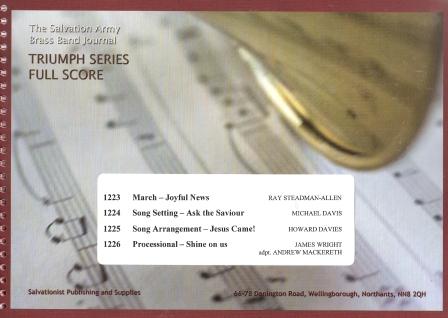
Triumph Series Band Journal March 2012 Numbers 1223-1226
No.1223 March - Joyful News (Ray Steadman-Allen)the composer freeli admits that it was probably 'doodling' on the piano that prompted this march! The title is linked to one of the incorporated tunes, 'My bonnie lies over the ocean' which, in The Salvation Army, is linked to the words, 'God's love is as high as the heavens'. In style, the march has a light swing feel.No.1224 Song Setting - Ask the Saviour (Michael Davis)A setting of the well-known melody, 'Yield not to temptation'.No.1225 Song Arrangement - Jesus Came! (Howard Davis)An arrangement of an old Salvation Army song, 'Jesus came with peace to me, His strong arm was stretched to me, Then my burden took from me - My Saviour'.No.1226 Processional - Shine on us (James Wright adapted by Andrew Mackereth)This bolero-style setting of Michael W Smith's anthem was originally made for s wedding at Sheffield Citadel. It was subsequently adapted for use at the Belfast Temple Music School when players entered the arena in groups, through several entrances, playing from memory.
Estimated dispatch 7-14 working days
-
 £30.00
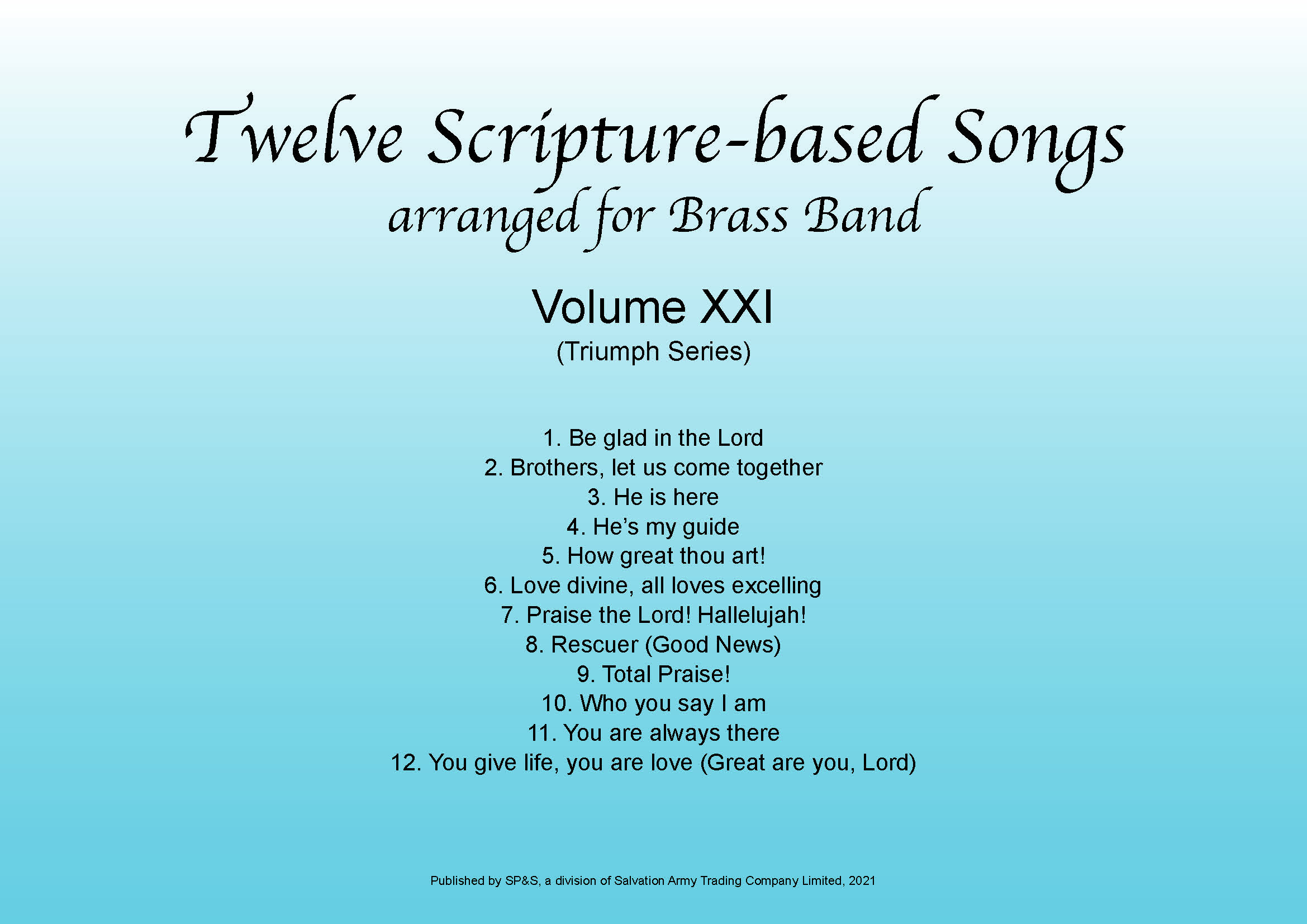
Twelve Scripture-based Songs Volume XXI
Twelve scripture-Based Songs arranged for Brass Band (Volume XXI) are packaged and marketed in complete sets which include a full score and a set of master parts. It is intended that these parts be used as 'masters', for the purpose of photocopying a quantity of parts to accommodate the precise instrumentation needs of the band for which this has been purchased. 1. Be glad in the Lord2. Brothers, let us come together3. He is here4. He's my guide5. How great thou art!6. Love divine, all loves excelling7. Praise the Lord! Hallelujah!8. Rescuer (Good News)9. Total Praise!10. Who you say I am11. You are always there12. You give life, you are love (Great are you, Lord)
Estimated dispatch 7-14 working days