
Results
-
 £37.35
March - The Stewards (Brass Band) Dave Collins
This rousing march by Dave Collins is a dedication to the remarkable group of volunteers - the unsung heroes - who, each year, organise and run the iconic Whit Friday brass band contests. They ensure that the heritage and tradition of this uniquely special event is not lost, preserving its ongoing and continued success. BrookWright is offering a 25% discount for bands who perform this march at the Whit Friday Contest. To claim the discount, please send a scan or photo of your band's adjudication card after the event to [email protected] Whit Friday, 'The Greatest Free Show on Earth', is synonymous with the brass band tradition. Its importance in the annual calendar to the players, supporters and spectators is vital to the Tameside and Saddleworth community. However, this mighty contest simply could not take place without the willing volunteers who dedicate their services year after year to keep this unique banding tradition going.Traditionally, on Whit Friday Morning, Hail! Smiling Morn (Roud #1346), also known as Praise Ye the Lord, is heard across the Saddleworth villages. This is where I have taken my inspiration, and the entire march is built upon quotes and references of this joyous work.The Stewards has many traditional elements drawing on the vast repertory of well-known marches, as well as some untraditional techniques and harmonies. The work aims to be a good test for the bands in its performance, but also fun and entertaining for the players and audiences alike - featuring a cheeky cornet solo, thunderous bass feature, and lyrical euphonium melodies, before concluding with a triumphant quote from the original source material.To you all who perform or hear this work, the stewards of the brass band tradition, HAIL! To view a follow-the-score video featuring Tredegar Town Band performing the work please visit www.youtube.com/watch?v=-CNgqvc534s PDF download includes score and parts, and comes in both A4 size and A5 landscape parts for marching purposes. A single page A5 conductor reduced score is also included. Sheet music available from: UK - www.brassband.co.uk USA - www.solidbrassmusic.com Difficulty Level: 3rd Section + Instrumentation: Soprano Cornet Eb Solo Cornet Bb Repiano Cornet Bb 2nd Cornet Bb 3rd Cornet Bb Flugel Horn Bb Solo Horn Eb 1st Horn Eb 2nd Horn Eb 1st Baritone Bb 2nd Baritone Bb 1st Trombone Bb 2nd Trombone Bb Bass Trombone Euphonium Bb Bass Eb Bass Bb Cymbals Side Drum Bass Drum
In Stock: Estimated dispatch 1-3 working days
-
 £33.62
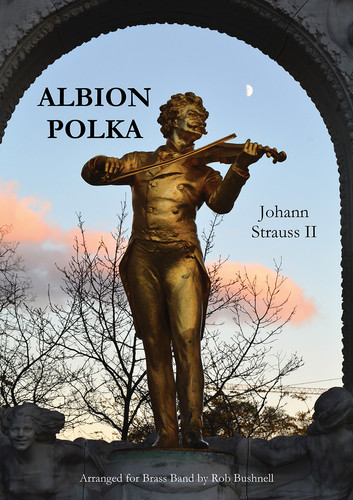
Albion Polka (Brass Band) Johann Strauss II arr. Rob Bushnell
Written in 1851, the Albion Polka was written by Johann Strauss II (or Strauss Junior) and dedicated to Count Albert of Saxe-Coburg-Gotha, husband of Queen Victoria of Great Britain. The work takes its title from the old Roman name for Britain. It is not an unfamiliar addition to the Vienna New Year's Concerts. This arrangement is for the UK-style brass band, with alternative parts for horns in F and bass-clef lower brass. A recording of the original composition can be found here: www.youtube.com/watch?v=KZIC-JhitHU Duration: Approx. 3.00 minutes (without rubato) Difficulty Level: 3rd Section + PDF download includes parts and score. Also includes alternative parts for horns in F and lower brass in bass clef. Instrumentation: Soprano Cornet Eb Solo Cornet Bb Repiano Cornet Bb 2nd Cornet Bb 3rd Cornet Bb Flugel Horn Bb Solo Horn Eb 1st Horn Eb 2nd Horn Eb 1st Baritone Bb 2nd Baritone Bb 1st Trombone Bb 2nd Trombone Bb Bass Trombone Euphonium Bb Bass Eb Bass Bb Timpani Glockenspiel Snare
In Stock: Estimated dispatch 1-3 working days
-
 £74.72
Gothique Fantasy - On a theme by Boellmann (Brass Band) Andrew Wainwright
This magnificent work was commissioned by The Illinois Brass Band for the 2024 North American Brass Band Championships. It is also the title track of the 2026 CD by Black Dyke Band, featuring the music of Andrew Wainwright. Based on Leon Boellmann's epic organ work Suite Gothique, the 3rd movement of which is entitled Priere a Notre-Dame (A Prayer for Notre Dame), it pays tribute to the nearly 700-year-old Notre-Dame de Paris after the fire which did so much damage to this iconic building. Notre-Dame stands out for its three pipe organs (one historic) and its immense church bells, which are referenced at various times in Gothique Fantasy. Two of the other movements from Boellmann's work also provide inspiration for the piece, firstly the Introduction - Choral, and the famous Toccata, snippets of which appear at various times in the piece. Gothique Fantasy opens with the Choral, a solo offstage cornet sounding the opening statement. A quintet, stood to the side of the stage, takes up the Choral, while the rest of the band enters on held muted notes, creating a sustained effect evoking the harmonies spreading across the vast cathedral. Colossal organ-like sounds announce themselves as the full band takes on the theme. A lively Animato follows. Here there are continued references to the Choral, while the famous Toccata motif starts to appear. A Misterioso section ensues, which leads into a poignant Prayer for Notre Dame featuring a euphonium duet, where the music reflects upon the devasting fire and centuries of history and artefacts that were lost. A lone euphonium the sounds, representing the remaining remnants of the cathedral. A chaotic and rhythmic Presto, based on the Toccata, then follows and tests the technique of the band from top to bottom, whilst moving through various time signatures, the pulse lacking any sense of stability. A return to the Choral theme leads into a further reflective section, this time featuring the secondary theme from the Toccata with a flugel and solo horn duet. Next the music arrives at an aleatory section (Senza Misura), which depicts the remnants of the fire, followed by the grand cathedral emerging out of the ashes. Various motifs from earlier in the piece are heard across the band. At this point, various parts enter at different times on the conductor's signal, before building towards a 6/8 Presto. Here the music gathers momentum as it leads to a Grandioso finale featuring the Choral in all its glory. However, to conclude the work, the final strains of the Toccata sound, bringing the work to a glorious conclusion as Notre-Dame rises again! To view a video of The Illinois Brass Band performing the work please visit www.youtube.com/watch?v=xG3JB6Ye5aU Duration: 15.00 minutes approx. Difficulty Level: Championship Section This PDF download includes parts and score. Sheet music available from www.brassband.co.uk Instrumentation: Soprano Cornet Eb Solo Cornet Bb Repiano Cornet Bb 2nd Cornet Bb 3rd Cornet Bb Flugel Horn Bb Solo Horn Eb 1st Horn Eb 2nd Horn Eb 1st Baritone Bb 2nd Baritone Bb 1st Trombone Bb 2nd Trombone Bb Bass Trombone Euphonium Bb Bass Eb Bass Bb Percussion 1-4
In Stock: Estimated dispatch 1-3 working days
-
 £33.62
Les Chasseresses from 'Sylvia' (Brass Band) Delibes arr. Rob Bushnell
Clement Philibert Leo Delibes was a French composer, best known for his ballets and operas, including works such as Lakme (with its famous "Flower Duet"), Coppelia and Sylvia (both key works in the development of modern ballet). The latter started as a play, Aminta, by the Italian poet Torquato Tasso, which Delibes set to music. It was then adapted for the Paris Opera with rehearsals starting in August 1875. The premiere took place on 14 June 1876 and was the first ballet to be shown at the newly-built Opera Garnier. Whilst the scenery and costumes were created by top artists and designers (Cheret and Lacoste), it was Delibes's music that shown thrown, being said to have saved the production, preventing the ballet from drifting into obscurity.Sylvia is said to be one of the first modern ballets, with Tchaikovsky remarking to composer Sergei Taneyev upon its ingenuity: "... the first ballet, where the music constitutes not only the main, but the only interest. What charm, what elegance, what richness of melody, rhythm, harmony." Although Swan Lake, a contemporary to Sylvia, is considered one of the best ballets there is, Tchaikovsky preferred Sylvia to his own work, saying Swan Lake was "poor stuff in comparison". Tchaikovsky said to Taneyev, "I was ashamed. If I had known this music early then, of course, I would not have written Swan Lake". The music to Sylvia, rather than setting only the mood, also sets the action and is noted for its use of leitmotifs - Delibes was an admirer of Wagner - and more dominant use of brass and wind. The most famous piece from this ballet is the Pizzicati in the third act.Act I of the ballet takes place in sacred wood, where creatures are worshipping before Eros when Sylvia arrives with her huntresses to mock the god of love. Aminta, a lowly shepherd and infatuated with Sylvia, protects the deity and Sylvia is wounded by Eros's arrow. The hunter Orion kidnaps Sylvia, whilst Eros revives Aminta. Act II takes place in Orion's Island cave, where Sylvia tries to bribe Orion with jewels and wine. Unsuccessful, she appeals to Eros for help, who arrives and takes her to the temple of Diana (where the final act takes place). Orion and Aminta fight, Sylvia and Orion cause the goddess of the hunt, Diana, to be outraged, smiting Orion and denying the love of Aminta and Sylvia. Eros shows Diana a vision, which changes her mind and the couple finally come together.This brilliant and lively fanfare that introduces the huntresses in the first act is arranged here for the UK-style brass band, with alternative parts for horns in F and bass-clef lower brass. The piece has been lowered by a tone compared to the original. A recording of the original composition can be found here https://youtu.be/6yoGrUH38PI?si=0L0bFa1qXnYNvkR3 Duration: Approx. 3.10 minutes Difficulty Level: 1st Section + This PDF download includes the full score and parts. Includes alternative parts for soloist in Eb, horns in F and lower brass in bass clef. Sheet music available at www.brassband.co.uk (UK) or https://satradecentral.org (USA) Instrumentation: Soprano Cornet Eb Solo Cornet Bb Repiano Cornet Bb 2nd Cornet Bb 3rd Cornet Bb Flugel Horn Bb Solo Horn Eb 1st Horn Eb 2nd Horn Eb 1st Baritone Bb 2nd Baritone Bb 1st Trombone Bb 2nd Trombone Bb Bass Trombone Euphonium Bb Bass Eb Bass Bb Timpani Percussion - Triangle, Cymbal & Bass Drum
In Stock: Estimated dispatch 1-3 working days
-
 £33.62
Prelude in C-sharp Minor (Brass Band) Rachmaninoff arr. Rob Bushnell
One of Sergei Rachmaninoff's most famous compositions, Prelude in C-sharp minor (Op. 3, No. 2) is part of a set of five pieces entitled Morceaux de fantaisie. It was written when Rachmaninoff was only 19 years old and was first performance by the composer on 26 September 1892 at a festival called the Moscow Electrical Exhibition. This arrangement is for the UK-style brass band, with alternative parts for horns in F and bass-clef lower brass. The piece has been transposed from the original (for piano) of C-sharp minor to A minor, which better suits a brass band. There is another arrangement of this piece by Sandy Smith (published by Obrasso) which is designed for more advanced ensembles. A recording of the original composition can be found here: www.youtube.com/watch?v=mXGSfJn3nKQ Duration: Approx. 3.40 minutes Difficulty Level: 3rd Section + PDF download includes parts and score. Also includes alternative parts for horns in F and lower brass in bass clef. Sheet music available from www.brassband.co.uk Instrumentation: Soprano Cornet Eb Solo Cornet Bb Repiano Cornet Bb 2nd Cornet Bb 3rd Cornet Bb Flugel Horn Bb Solo Horn Eb 1st Horn Eb 2nd Horn Eb 1st Baritone Bb 2nd Baritone Bb 1st Trombone Bb 2nd Trombone Bb Bass Trombone Euphonium Bb Bass Eb Bass Bb Percussion 1-3
In Stock: Estimated dispatch 1-3 working days
-
 £67.24
Pyrenean Carol Suite (Brass Band) David Taylor
This attractive suite for brass band by David Taylor features five traditional carols from the Pyrenees region of Spain, as follows: i. Nadal Tindaire (Jingling Christmas) - Occitan traditional This Occitan Christmas song tells of musical instruments used to celebrate the Nativity - 'fifes and trumpets, timpani and pipes, or you, clear little bells, along with the angels' choir.' ii. Gabriel's Message (Birjina Gaztetto Bat Zegoen) - Basque traditional The most widely-known of the chosen carols, honouring Jesus's mother Mary, this is often sung in its English version, but the melody came from the Basque country. The Basque words were adapted from the Mediaeval song Angelus ad Virginem. Here, we feature the flugel horn. This movement was originally written on its own, with organ accompaniment, for the composer's wife, Diane Scott. iii. El Noi de la Mare (The Child of the Mother) - Catalan traditional A beautiful Catalan carol celebrating the birth of Jesus, telling of the tasty gifts that the singer would bring - 'Raisins and figs and nuts and olives; Raisins and figs and honey and mato [a Catalan dessert cheese traditionally served with honey.]' Here we feature the euphonium. The tune was made famous by guitarist Andres Segovia, who used it as a favourite encore, and by John Rutter, who made a widely-used setting for choir. iv. Paure Satan (Poor Satan) - Occitan traditional This rather unusual carol tells of the pain that Satan is put to by the arrival of the infant Jesus. Its mocking and sarcastic tone is reflected here, where the tuba soloist (as Satan) is given musical trouble throughout by the other parts. At first they conflict with the soloist, then the soloist makes overtures of friendship, which are treated with suspicion followed by contempt. The soloist finally gives in to their accompaniment (or do they?). There are plenty of opportunities for little theatrical touches here, if the tuba player is so inclined! The tuba part in this movement is notably more difficult than the rest of the music, and a number of optional changes have been marked to make the part easier to play, if so desired. The player is also welcome to add suitable extra embellishments to taste if they wish, within the character of the music. v. Fum, Fum, Fum! - Catalan traditional A favourite Catalan Christmas song for centuries, this rousing melody provides a fitting way to round off the suite, with its repeated rhythmic refrain of the nonsense title phrase. It tells of the Nativity, and then it tells of the celebratory feasting and good times that the singers look forward to to honour it. Although the suite is intended to be performed whole, it is also intended for usage with a selection of movements on occasions where a shorter piece is wanted. Suggested formats include a single movement alone (2, 3, and 5 are likely most appropriate), a pair of movements (any of the first four, plus 5), and a suite of three or four movements (1 and 5, plus one or two of 2, 3, or 4 in the middle). It is suggested that a good way to design a 'pick-your-own-suite' from the movements is to think of the earlier movements as introductory to the final movement. To view a rolling score video featuring Kidlington Concert Brass please visit www.youtube.com/watch?v=QIGdul-yxxg PDF download includes score and parts. Sheet music available from: UK - www.brassband.co.uk USA - https://satradecentral.org Difficulty Level: 3rd Section + Length: 9.45 minutes Instrumentation: Soprano Cornet Eb Solo Cornet Bb Repiano Cornet Bb 2nd Cornet Bb 3rd Cornet Bb Flugel Horn Bb Solo Horn Eb 1st Horn Eb 2nd Horn Eb 1st Baritone Bb 2nd Baritone Bb 1st Trombone Bb 2nd Trombone Bb Bass Trombone Euphonium Bb Bass Eb Bass Bb Timpani Percussion 1-2
In Stock: Estimated dispatch 1-3 working days
-
 £33.62
The Lord Bless You and Keep You (Brass Band) John Rutter arr. Andrew Wainwright
John Rutter's popular choral benediction is based on Numbers 6:24-26, and has here been arranged for brass band by Andrew Wainwright. It is a setting of a biblical benediction, followed by an extended 'Amen'. Rutter originally scored the piece for four vocal parts (SATB) and organ. He composed it in 1981 for the memorial service of Edward T. Chapman, the director of music at Highgate School, London, with whom he had studied when he attended the school. The arrangement sounds a semi-tone down from the original choral setting although otherwise maintains the same format, so can be performed with choir if they sing down a semi-tone. To view a rolling score video with Wellington Brass performing the work please visit www.youtube.com/watch?v=ijJ2Nir3wRQ PDF download includes score and parts. Additional parts (Horn in F and Baritone, Trombone, Euphonium & Tuba in Bass Clef) available here. Sheet music available from: UK - www.brassband.co.uk USA - https://satradecentral.org Difficulty Level: 4th Section + Length: 2.50 minutes Instrumentation: Soprano Cornet Eb Solo Cornet Bb 1st Cornet Bb 2nd Cornet Bb Flugel Horn Bb Solo Horn Eb 1st Horn Eb 2nd Horn Eb 1st Baritone Bb 2nd Baritone Bb 1st Trombone Bb 2nd Trombone Bb Bass Trombone Euphonium Bb Bass Eb Bass Bb Timpani Percussion
In Stock: Estimated dispatch 1-3 working days
-
 £29.88
Beaufort Fanfare (Brass Band) Friedrich Gattermann
Beaufort Fanfare, by German composer Friedrich Gattermann, is a dynamic and vibrant musical work inspired by the Beaufort scale, a system for estimating wind speeds. Originally composed for brass ensemble and percussion, it was created to showcase Orchestral Tools' Beaufort Brass sample library, recorded at the iconic AIR Studios in London. Here it has been set for brass band. A central element of Beaufort Fanfare is its exploration of musical density. The piece begins with a single motif and gradually builds in complexity and richness, reflecting the increasing strength of the wind. As it progresses, the music intensifies, with the development of density playing a crucial role in conveying the evolving character of the elements. Through intricate brass harmonies and rhythmic drive, Beaufort Fanfare captures both the awe-inspiring beauty and raw power of nature. More than just an auditory experience, this composition takes the listener on a journey through the elements, celebrating the force of wind in all its forms. To view a rolling score video of the work please visit www.youtube.com/watch?v=vdiIIERMSDY Duration: 2.15 minutes approx. Difficulty Level: 1st Section + PDF download includes parts and score. Sheet music available from www.brassband.co.uk Instrumentation: Soprano Cornet Eb Solo Cornet 1-3 Bb Solo Cornet 2-4 Bb Repiano Cornet Bb 2nd Cornet Bb 3rd Cornet Bb Flugel Horn Bb Solo Horn Eb 1st Horn Eb 2nd Horn Eb 1st Baritone Bb 2nd Baritone Bb 1st Trombone Bb 2nd Trombone Bb Bass Trombone Euphonium Bb Bass Eb Bass BbTimpani Percussion 1-3
In Stock: Estimated dispatch 1-3 working days
-
 £29.88
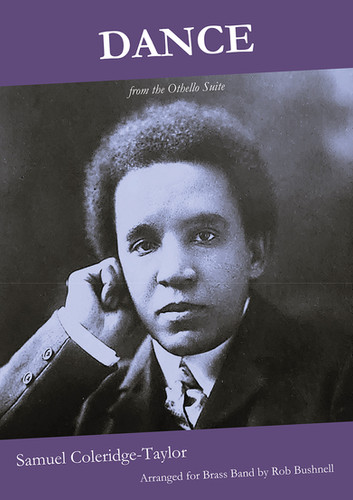
Dance from the Othello Suite (Brass Band) Coleridge-Taylor arr. Bushnell
Samuel Coleridge-Taylor is a British composer, who, from a young age, showed talent on the violin and entered the Royal College of Music, studying with Charles Villers Standford. His music become so popular that his Hiawatha trilogy was the second most performed choral piece (joint with Mendelssohn's Elijah, and only beaten by Handel's Messiah) with choral societies up and down the British Isles. In fact, Hiawatha was arranged by Charles Godfrey as a test-piece for the 1902 National Brass Band Championship of Great Britain, held at Crystal Palace.Commissioned by the theatre impresario Herbert Beerbohm, Coleridge-Taylor composed incidental music for His Majesty's Theatre London production of the Shakespeare play, Othello, in the West End, in 1909. In 1912, the play opened to the public, with a suite of five movements put together soon afterwards. The Dance, arranged here by Rob Bushnell, makes a great concert opener.This arrangement is for the British-style brass band, with alternative parts for horns in F and bass-clef lower brass. A recording of the original composition can be found at www.youtube.com/watch?v=OQeO_Ij9CV8 Duration: approx. 2.30 minutes Difficulty Level: 3rd Section + PDF download includes parts and score. Sheet music available at www.brassband.co.uk (UK) or https://satradecentral.org (USA) Instrumentation: Soprano Cornet Eb Solo Cornet Bb Repiano Cornet Bb 2nd Cornet Bb 3rd Cornet Bb Flugel Horn Bb Solo Horn Eb 1st Horn Eb 2nd Horn Eb 1st Baritone Bb 2nd Baritone Bb 1st Trombone Bb 2nd Trombone Bb Bass Trombone Euphonium Bb Bass Eb Bass Bb Timpani Percussion - Triangle, Cymbal & Bass Drum
In Stock: Estimated dispatch 1-3 working days
-
 £59.77
Diversions on Sine Nomine (Brass Band) Vaughan Williams arr. Mark Ford
Diversions on Sine Nomine is a substantial concert work for brass band, derived entirely from Ralph Vaughan Williams' celebrated hymn tune For All the Saints. Rather than a conventional set of variations, the work unfolds as a sequence of contrasting diversions, each reimagining aspects of the melody's character, harmony, and rhythmic potential. The opening establishes the noble and timeless quality of Sine Nomine before leading into episodes that explore a wide expressive range - from reflective and lyrical writing to passages of rhythmic energy and grandeur. Fragments of the hymn are continually transformed and re-contextualised, allowing the music to progress with clarity and purpose while maintaining a strong sense of structural coherence. Scored specifically with 3rd and 4th Section bands in mind, the work combines musical substance with practical playability. Idiomatic brass writing, transparent textures, and effective use of traditional band colours ensure musical impact without excessive technical demand. The final section brings the work to a broad and affirmative conclusion, reaffirming the dignity and enduring strength of Vaughan Williams' original melody. To view a rolling score video of the work please visit www.youtube.com/watch?v=Sth69ate-Cs Duration: 11.00 minutes Difficulty Level: 4th Section + This PDF download includes the full score and parts. Sheet music available at www.brassband.co.uk (UK) or https://satradecentral.org(USA) Instrumentation: Soprano Cornet Eb Solo Cornet 1&2 Bb Solo Cornet 3&4 Bb Repiano Cornet Bb 2nd Cornet Bb 3rd Cornet Bb Flugel Horn Bb Solo Horn Eb 1st Horn Eb 2nd Horn Eb 1st Baritone Bb 2nd Baritone Bb 1st Trombone Bb 2nd Trombone Bb Bass Trombone Euphonium Bb Bass Eb Bass Bb Timpani Percussion 1-2 Tuned Percussion
In Stock: Estimated dispatch 1-3 working days