
Results
-
 £34.20
When the Saints Go Marching In
Parts included for:Part 1: Bb Trumpet or Bb Cornet and Eb Trumpet or Eb CornetPart 2: Bb Trumpet or Bb CornetPart 3: Bb Trumpet or Bb CornetPart 4: Bb Trumpet or Bb Cornet or Flugel HornPart 5: F Horn or Eb HornPart 6: Trombone (BC) or Trombone (TC)Part 7: Trombone (BC) or Trombone (TC)Part 8: Trombone (BC) or Trombone (TC)Part 9: Bass Trombone (BC) or Bass Trombone (TC)Part 10: C Tuba or Eb Bass or Bb BassPercussion
Estimated dispatch 7-14 working days
-
£34.20
The Forres Cradle Song
Parts included for:Part 1: Bb Trumpet or Bb Cornet and Eb Trumpet or Eb CornetPart 2: Bb Trumpet or Bb CornetPart 3: Bb Trumpet or Bb CornetPart 4: Bb Trumpet or Bb Cornet or Flugel HornPart 5: F Horn or Eb HornPart 6: Trombone (BC) or Trombone (TC)Part 7: Trombone (BC) or Trombone (TC)Part 8: Trombone (BC) or Trombone (TC)Part 9: Bass Trombone (BC) or Bass Trombone (TC)Part 10: C Tuba or Eb Bass or Bb BassPercussion
Estimated dispatch 7-14 working days
-
 £34.20
The Ashokan Farewell (10 Piece Brass Ensemble)
Parts included for:Part 1: Bb Trumpet or Bb Cornet and Eb Trumpet or Eb CornetPart 2: Bb Trumpet or Bb CornetPart 3: Bb Trumpet or Bb CornetPart 4: Bb Trumpet or Bb Cornet or Flugel HornPart 5: F Horn or Eb HornPart 6: Trombone (BC) or Trombone (TC)Part 7: Trombone (BC) or Trombone (TC)Part 8: Trombone (BC) or Trombone (TC)Part 9: Bass Trombone (BC) or Bass Trombone (TC)Part 10: C Tuba or Eb Bass or Bb BassPercussion
Estimated dispatch 7-14 working days
-
 £34.20
I Wish You Love
Parts included for:Part 1: Bb Trumpet or Bb Cornet and Eb Trumpet or Eb CornetPart 2: Bb Trumpet or Bb CornetPart 3: Bb Trumpet or Bb CornetPart 4: Bb Trumpet or Bb Cornet or Flugel HornPart 5: F Horn or Eb HornPart 6: Trombone (BC) or Trombone (TC)Part 7: Trombone (BC) or Trombone (TC)Part 8: Trombone (BC) or Trombone (TC)Part 9: Bass Trombone (BC) or Bass Trombone (TC)Part 10: C Tuba or Eb Bass or Bb BassPercussion
Estimated dispatch 7-14 working days
-
£34.20
Swing Low (10 Piece Brass Ensemble)
Parts included for:Part 1: Bb Trumpet or Bb Cornet and Eb Trumpet or Eb CornetPart 2: Bb Trumpet or Bb CornetPart 3: Bb Trumpet or Bb CornetPart 4: Bb Trumpet or Bb Cornet or Flugel HornPart 5: F Horn or Eb HornPart 6: Trombone (BC) or Trombone (TC)Part 7: Trombone (BC) or Trombone (TC)Part 8: Trombone (BC) or Trombone (TC)Part 9: Bass Trombone (BC) or Bass Trombone (TC)Part 10: C Tuba or Eb Bass or Bb BassPercussion
Estimated dispatch 7-14 working days
-
 £44.95
Meditation (from the Triumph of Time) (Flugel Horn and Baritone Duet with Brass Band)
Meditation is the central theme from The Triumph of Time, a work commissioned for The Black Dyke Band by Music Director Nicholas Childs. The original brief was for a piece which would showcase the talents of the band's many fine soloists, among them Zoe Hancock on Flugel horn and Baritone soloist Katrina Marzella. This extract brings both instruments together in an extended stand-alone arrangement.Although scored for Flugel and Baritone, a number of options can be explored at the discretion of the conductor (eg. Flugel/Cornet and Euphonium/Trombone; two Bb Cornets etc. in which case cued lines in the Solo Horn and Soprano cornet parts may be played).Duration: 05:00
Estimated dispatch 7-14 working days
-
 £96.99
Beecher Variations (Brass Band - Score and Parts)
In this beautiful composition, melodic fragments of the hymn tune Beecher are morphed into a series of variations, showing the melody in various moods from expressive, then quiet and soft, to bright and triumphant in the end. Written as a test piece in the 4th division for the Dutch Brass Band Championships in 2015, the music features challenging solo parts for cornet, soprano cornet, flugelhorn and euphonium. A great work for the concert or contest stage!Duration: 12.00
Estimated dispatch 7-14 working days
-
 £70.00
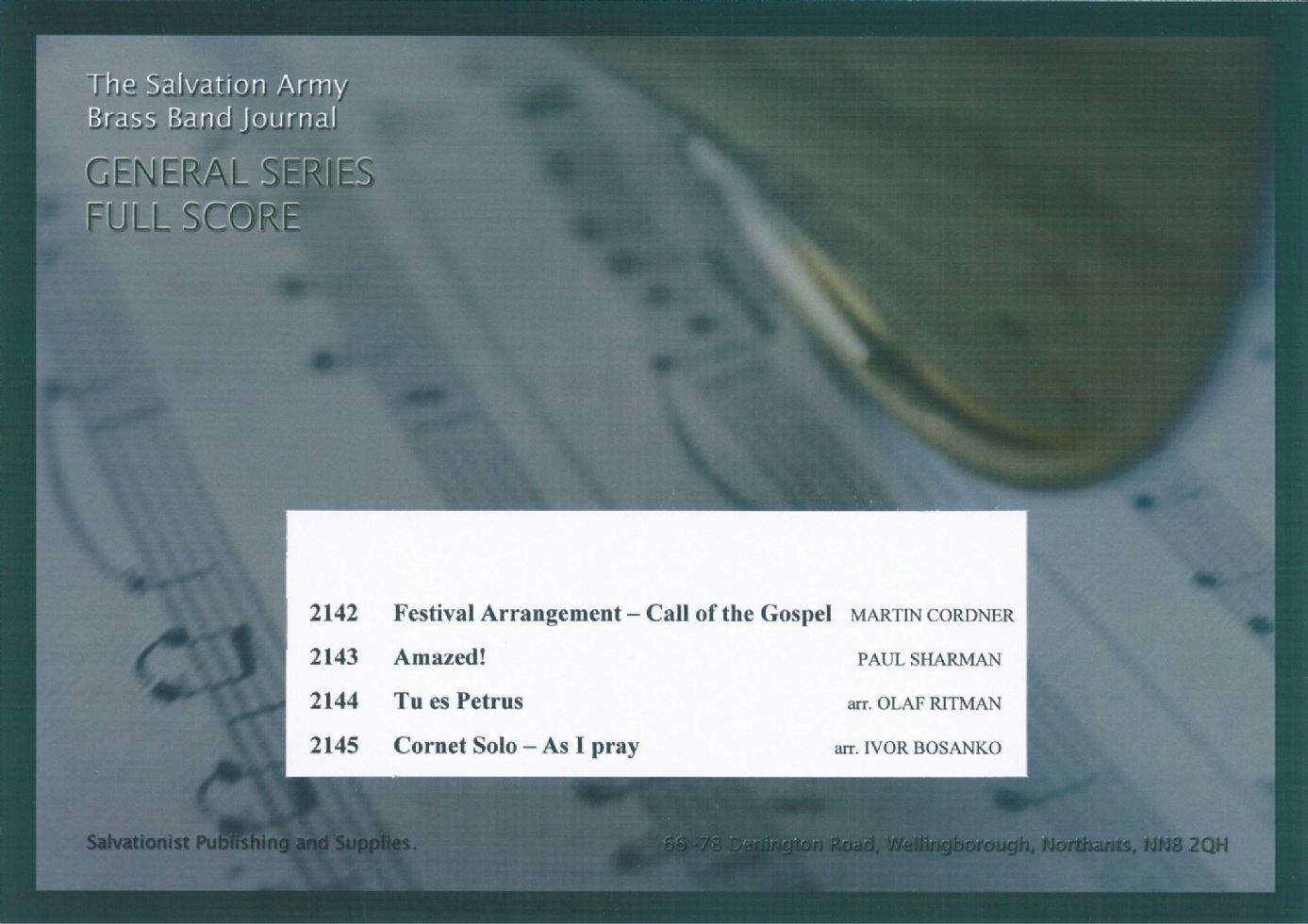
General Series Band Journal April 2015 Numbers 2142-2145
No. 2142 Festival Arrangement - Call of the Gospel (Martin Cordner)Written for the London Central Fellowship band, this foot-tapping festival arrangement treats the chorus, 'We have a gospel' in a bright, showy style.No. 2143 Amazed! (Paul Sharman)A setting of Charles Hutchison Gabriel's song, 'My Saviour's love', to which we sing his words, 'I stand amazed in the presence' (S.A.S.B. 179). Originally written for Birmingham Citadel Band, the piece aims to follow the four verses of text and is mainly up-tempo in style, depicting the amazing fact that God loves us.No. 2144 Tu es Petrus (arr. Olaf Ritman)A setting of a madrigal by Robert Pearsall. Originally entitled 'Lay a garland', the original text was swapped for the religious Latin text, 'Tu es Petrus' (You are Peter).No. 2145 Cornet Solo - As I pray (arr. Ivor Bosanko)Major Joy Webb's song, 'As I pray' (STTL Vol. 2, part 2), is arranged here as a beautiful solo for Cornet.
Estimated dispatch 7-14 working days
-
 £50.00
Triumph Series Band Journal March 2015 Numbers 1259 - 1262
No. 1259 March - Divine Care (Eiliv Herikstad)The message of this march is 'God will take care of you!' The introduction reflects the beginning of the song, God will take care of you (T.B.C.S. 124), which is presented in full at sections C and D.No. 1260 (1) Cornet Solo - Become aware of him (Michael Davis)A setting for Cornet and band of Colonel Robert Redhead's song, Become aware of him, which was originally published in The Musical Salvationist.No. 1260 (2) Hymn Tune Arrangement - St Peter (David Rowsell)An arrangement of the tune, St Peter, associated with the song, In Christ there is no east or west.No. 1261 Song Arrangement - The deep love of Jesus (Andrew Blyth)The strong hymn tune of Ebenezer (T.B. 433) was composed by Welshman, Thomas John Williams (1869-1944), who served as organist and choir director at various churches in and around Llanelli. This arrangement is more relaxed in style than the original and attempts to convey the freedom of the verses mostly associated witht he tune by Samuel T. Francis (1835-1925) O deep, deep love of Jesus, vast, unmeasured, boundless, free.No. 1262 Everybody praise his holy name (Nicholas King)A bright arrangement by Nicholas King of Remco Hakkert's song, Praise his holy name.
Estimated dispatch 7-14 working days
-
 £45.00
Triumph Series Band Journal November 2014 Numbers 1255 - 1258
No. 1255 March - Redemption (Ian Clarke)The words redemption and salvation are synonymous with each other. In theology, the word redemtion is defined as 'delivering from sin' or 'saving from evil'; sentiments that are expressed in some of the words associated with the songs that are featured in this music.No. 1256 Suite - Great Expectations! (Howard Davies)Three songs (written over a period of 25 years) are drawn together in this suite as a reminder of the great expectations rightfully held by every child of God.No. 1257 Cornet Solo - Let me be a light (arr. Mervyn Clarke)A setting for Cornet and band of Major Joy Webb's song, 'Let me be a light'.No. 1258 Meditation - Were you there? (Noel Jones)This meditation on Christ's crucifixion features the song, 'Were you there?', and the chorus, 'He died of a broken heart'.
Estimated dispatch 7-14 working days