
Results
-
 £40.00
The Unfortunate Traveller (Brass Band - Score only) - Holst, Imogen - Hindmarsh, Paul
Imogen Holst (1907-1984) submitted The Unfortunate Traveller (1929) as her final work as a student portfolio at the Royal College of Music, where her composition teacher was Gordon Jacob. The title was taken from Thomas Nashe's famous 1594 picaresque novel of the same title. The Suite was first performed on 12 February 1933 at her Majesty's Theatre, Carlisle, by the St. Stephen's Band, with the composer conducting. Te concert was given in memory of Holst's uncle, Dr. H.A. Lediard. Holst had been impressed with the band's performance of his A Moorside Suite at the 1928 National Brass Band Championships (The Crystal Palace, South London) and was keen to work with them. Writing in Imogen Holst, a life in music, Christopher Grogan indicates that it was Gustav Holst's suggestion to include his daughter's work in the programme, quoting Imogen Holst's remarks made in interview to The Daily Mail as follows: "....it is the first time, so far as I know, that a woman has conducted a brass band at a public concert....It has been a delight to rehearse the St. Stephen's Band. It was their performance at the Crystal Palace Festival that inspired me to write this Suite, which I have dedicated to them."Imogen Holst accompanied her father to the Crystal Palace in 1928 to hear the performances of A Moorside Suite, and was so excited by the played and, audibly, by her father's music that she decided to write a brass band piece for her final examination. Te result was The Unfortunate Traveller (1929). However, it was not possible for her to present a brass band work for examination. She arranged it for string orchestra so that it could be played before she left the RCM in July 1930. Following the premiere of the original in 1933, the manuscripts did not resurface until 1969 Imogen found them among her late mother's effects. Although she requested score and parts be destroyed, they ended up in the possession of Manchester composer John Golland, who marked up the score presumably with the intention of creating a new performing edition. The original scoring reveals a lack of experience with what can be a tricky medium.With the agreement of the Holst Foundation, a revised edition, with additional percussion, was prepared in 2011 since when the work has been fortunate to travel round the world as a concert and contest piece. The original includes drums in the March only. The title was taken from Tomas Nashe's famous 1594 picaresque novel of the same title. Several Morris Dance tunes are introduced during the course of the four short movements, including Bonnie Green Garters, Shepherd's Hey, The Rose and The Wind Blaws Cauld. Quirky twists and turns of harmony and spirited rhythms that remind us how much Imogen Holst loved tradition English dance music.In September 2025, I made a performing edition of the composer's arrangement for string orchestra. The manuscript lacks the final movement, which I arranged in a similar style, ie. without extending the upper ranges. Making this edition raised some issues regarding the accuracy of my band version and some of the solutions I used to smooth out the voicing. I have used the composer's second thoughts to refine my performing edition and to correct a textual errors.- Paul HindmarshDuration: 10.00
Estimated dispatch 7-14 working days
-
 £32.95
Principio (Brass Band - Score and Parts) - Wiffin, Rob
Principio is a vivacious concert opener. The word Principio means start or beginning in both Spanish and Italian and this piece sets out to be just that - an energetic concert opener. Most of the melodic material is derived from the main theme which starts and ends the piece with its slightly lopsided rhythm. The piece is mostly conventional in language though with a touch of crunch here and there.Duration: 3.45
Estimated dispatch 7-14 working days
-
 £25.00
Celebration Fanfare (Brass Band - Score and Parts) - Gregson, Edward
Celebration Fanfare was specially written for the 50th Anniversary concert of the Port Sunlight Lyceum Band. It was a gift from the composer to his cousin, Ralph Peters, co-founder of the band in 1973.The premiere of the Fanfare was given at the band's 50th Anniversary concert on 24 September 2023 at the Gladstone Theatre, Port Sunlight, Wirral, Merseyside, UK.Duration: 1.00
Estimated dispatch 7-14 working days
-
£9.00
Celebration Fanfare (Brass Band - Score only) - Gregson, Edward
Celebration Fanfare was specially written for the 50th Anniversary concert of the Port Sunlight Lyceum Band. It was a gift from the composer to his cousin, Ralph Peters, co-founder of the band in 1973.The premiere of the Fanfare was given at the band's 50th Anniversary concert on 24 September 2023 at the Gladstone Theatre, Port Sunlight, Wirral, Merseyside, UK.Duration: 1.00
Estimated dispatch 7-14 working days
-
 £32.95
Dragon Prelude (Brass Band - Score and Parts) - Wiffin, Rob
This concert prelude is both abridged and expanded from a selection of Welsh songs Here be Dragons which was commissioned by the Band of the Welsh Guards for their Centenary celebrations in 2016. The work was first performed at the Kneller Hall Summer Concert, 20 July 2016. It contains the following:Rhyfelgyrch Gwyr Harlech - Men of HarlechSosban Fach - Little SaucepanAr Lan y Mor - Down by the Sea (plus Suo Gan - Lullaby)Hen Ferchetan - Old MaidHen Wlad fy Nhadau - Land of my FathersDuration: 4.45
Estimated dispatch 7-14 working days
-
 £105.90
Blackbird Special (Brass Band - Score and Parts) - Gilje, Reid
Blackbird Special is a song by American band Dirty Dozen Brass Band.The song is an entertainment piece, a good concert opener or encore. When used as a concert opener one may let the different sections of the band enter the stage one by one playing in order of appearance. Percussion section may play their parts ad lib. The most important is the groove of the piece.
Estimated dispatch 7-14 working days
-
 £68.80
When the Lights Go Down (Brass Band - Score and Parts) - Houben, Kevin
Kevin Houben created with When the Lights Go Down, a wonderful chorale that can be a moment of reflection in any concert program. The resigned, magnificent melodies at the beginning of this composition slowly build up to a highlight with an increasing orchestration. The piece starts with a suggestive Adagio Meditativo, after which the main theme is immediately announced. A central bridge section takes the listener along through the different spheres at which the melodic and rhythmic drums embellish the chorale melodies. Thematic elements from the introduction brings the piece to a quiet and peaceful end. The sheer simplicity with which this work is written, makes it a resplendent, magnificent concert piece. 'When the Lights Go Down', refers to a moment when time stand still for a while, stillness within and around yourself.Duration: 9.00
Estimated dispatch 7-14 working days
-
 £60.99
Citadel's Destiny (Brass Band - Score and Parts) - Deleruyelle, Thierry
Citadel's Destiny is a march that can be performed either in concert or on parade. It was commissioned by the Musique de l'Infanterie de Lille. A special feature is that it adheres to the conventional codes of military marches, albeit with a modern twist. The title refers to the citadel built by Vauban in Lille, "The Queen of Citadels", with which the band shares a destiny. This march is still performed by the Infantry Band as part of their traditional concert repertoire. Duration: 4.15
Estimated dispatch 7-14 working days
-
 £99.99
Sparkling Brass (Brass Band - Score and Parts) - Sparke, Philip
Sparkling Brass was commissioned by Osaka Concert Brass, one of Japan's top brass bands, and premiered by them on 27th December 2018 during a concert which celebrated their 10th Anniversary. The work opens in lively mood with fanfare-style figures from the lower band which are answered by the cornets. This interplay intensifies until the mood calms suddenly to introduce a chorale which leads to a duet-cadenza for cornet and euphonium. The rhythmic mood of the opening soon returns and leads to the main theme of the work, a modal caccia which features various section of the band. A short bridge passage leads to a change of key and a new cantabile theme which is introduced by euphoniums and baritone. This is taken up by the full band after another change of key and leads back to the caccia theme. A transformed version of the opening fanfare returns to close the work.Duration: 5.30
Estimated dispatch 7-14 working days
-
 £109.99
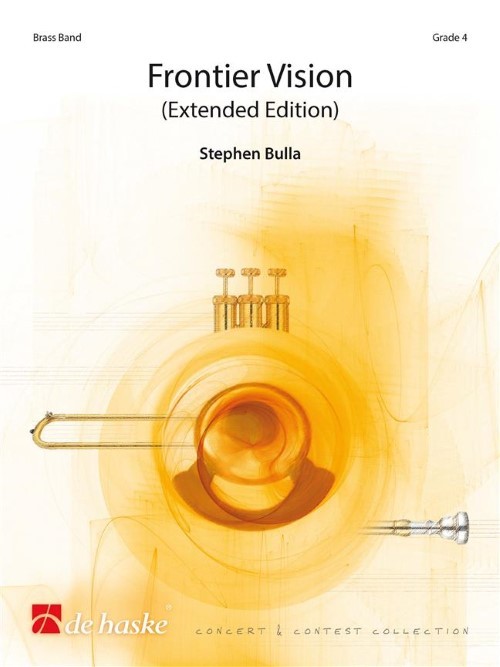
Frontier Vision (Brass Band - Score and Parts) - Bulla, Stephen
Frontier Vision is a concert or contest piece based on three elements: the commemoration of the 500th anniversary of Reformation Day, the Martin Luther melody, A Mighty Fortress Is Our God (Ein Feste Burg ist unser Gott) on which this composition is based, and thirdly the spreading of the evangelical movement in the late 19th century, of which the analogous storyline forms the structural basis of this work. Multi-cultural ethnic influences, along with the driving rhythms that reflect the perseverance and hard work of those mission-minded pioneers, are both important components that make Frontier Vision an outstanding choice for your concert or contest. Frontier Vision was the test piece for the second division in the Dutch National Brass Band Championships 2017. Duration: 12.00
Estimated dispatch 7-14 working days
 View Music