
Results
-
 £57.50
Salsa Brava - Etienne Crausaz
The Salsa Brava is a typical Spanish hot sauce that goes wonderfully well with barbecue or tapas. The Salsa is also a style of music that originated in the Caribbean, combining Cuban, Puerto Rican, and American influences.This composition is completely in keeping with this aesthetic, offering catchy melodies supported by a characteristic rhythmic patterns and highly intricate harmonies. A middle section provides space for soloists (cornet and trombone) to express themselves. The result is music which is festive, lively, and full of energy. A sure bet to charm your audience.This music is part of the musical tale La Malediction d'Aragne, written by Dominique Schweizer and commissioned by the Lyre de Courtion (dir. Dominique Morel) to mark its 100th anniversary.
Estimated dispatch 5-14 working days
-
 £57.50
Superjet - Thierry Deleruyelle
Superjet is an energetic composition written in a jazz style, evoking the effervescence and vitality of a real big band. It is punctuated by three solos that showcase the creativity of each performer. Commissioned by the Orchestre d'Harmonie de Vesoul, this work pays tribute to Jean-Marie Goux, a former band conductor and unconditional jazz fan. Concise, dynamic, and rhythmic, it really makes you want to dance!
Estimated dispatch 5-14 working days
-
 £87.99
Black Gold - Thierry Deleruyelle
Black Gold was commissioned by Musikverein 1891 "Harmonie" Saarwellingen e.V. (Germany) to mark its 130th anniversary. This composition pictures the history of the mining industry in the town of Saarwellingen and its surrounding region, where the life of the miners as well as their families revolved around coal, or black gold, for centuries on end. The piece is based on motifs from the famous song "Gluck auf, Gluck auf, der Steiger kommt..." ("Good luck, good luck, the mining foreman comes"), a veritable anthem for miners the world over.
Estimated dispatch 5-14 working days
-
 £134.99
The Lost Circle - Jan Van der Roost
With the original work, Stonehenge, released in 1992, composer Jan Van der Roost has yet again dedicated a new work to this very special monument - in response to recent research revealing that the middle circle might originate from Wales. A blend of scientific facts, ideas and hypotheses in combination with the composer's creativity has resulted in a varied composition full of imagination.
Estimated dispatch 5-14 working days
-
 £68.99
Majesty - Thierry Deleruyelle
Majesty is a powerful and spectacular overture. The work opens with a brilliant fanfare before making way for a majestic hymn. The end of the piece repeats the opening fanfare as a monumental finale in the style of an American symphonic march. This composition is dedicated to Queen Elizabeth II.
Estimated dispatch 5-14 working days
-
 £105.20
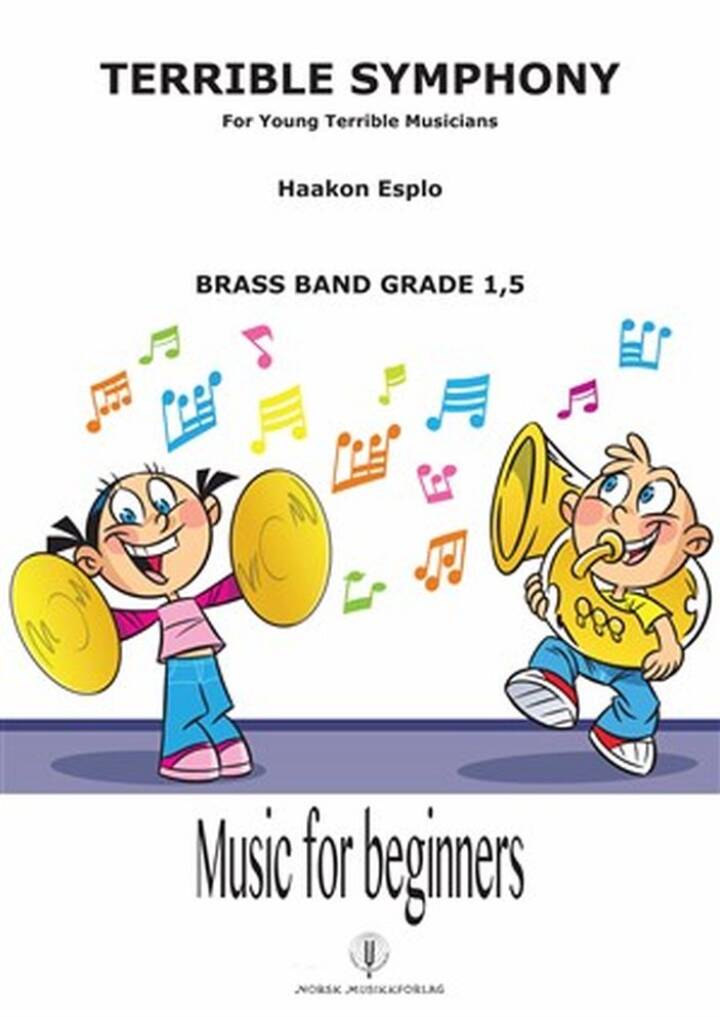
Terrible Symphony - Haakon Esplo
Let us present "Terrible Symphony" - the perfect piece for beginner or junior bands!This fun composition gives young musicians the opportunity to have a great time while driving the conductor crazy. The piece includes well-known themes from great symphonies, along with new music, and not least, lots of silliness and fun. All musicians can join in and come up with more pranks and humorous elements. The audience will laugh out loud and enjoy this crazy and entertaining, yet terrible symphony.Make your concert an unforgettable experience with "Terrible Symphony"!In the score, you will find instructions and suggestions for the conductor as the musicians become increasingly impossible.
Estimated dispatch 5-14 working days
-
 £131.00
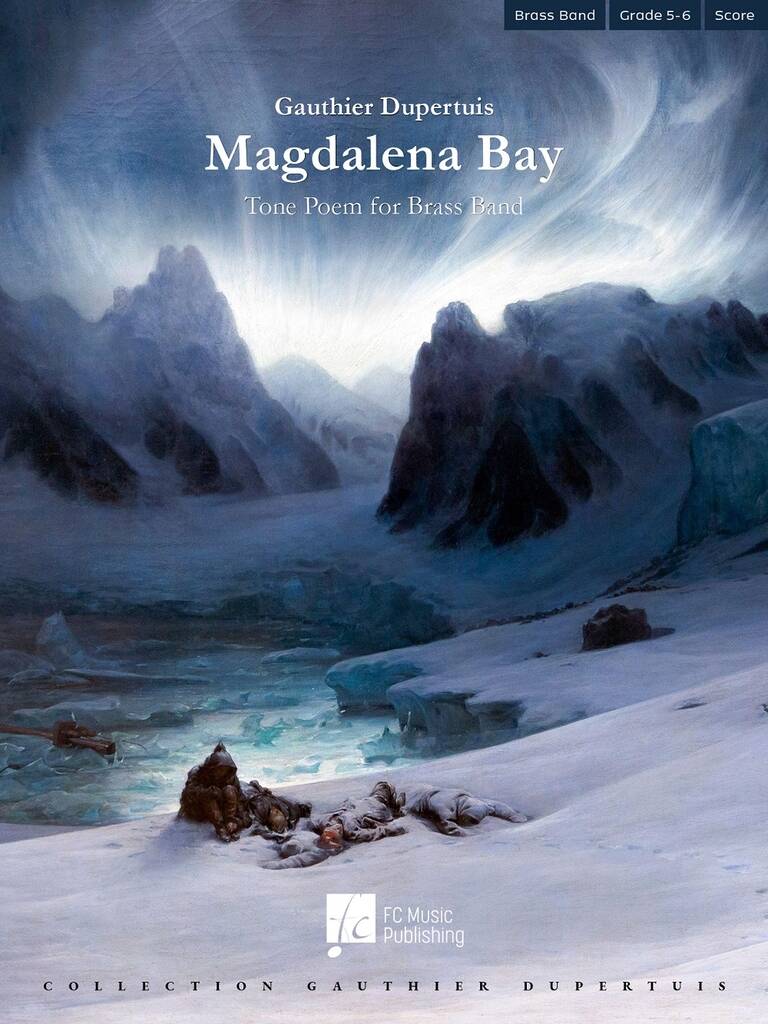
Magdalena Bay - Gauthier Dupertuis
While admiring many masterpieces at the Louvre Museum in Paris, Gauthier Dupertuis' attention was drawn to a less famous painting: Magdalena Bay, by French painter Francois-Auguste Biard (1799-1882).The work depicts a magnificent snowy landscape on the Norwegian island of Spitsbergen. However, in the foreground, the presence of the wreckage of a ship, bodies covered in snow and a visibly dying character make us understand that tragic events took place there. Thus, a strong contrast is formed between death and the sublime, between the desolation of the survivors of the shipwreck and the magnificence of the landscape. When we look in more detail at the painting, we notice that footprints have been made in the snow: so, could someone have gone to get help? This little glimmer of hope makes the picture even more touching. In this work, Gauthier Dupertuis tried to describe the different elements of the painting, using contrasting sections and dissonances (in particular, the conflict between the minor and the major) to convey the duality between death and the sublime. The work also attempts to highlight a wide palette of orchestral colors, from the most shimmering lines to the darkest low brass colours. In 2024, Magdalena Bay was awarded the first Prize as well as the band Prize at the 9th European Composition Competition for Brass Band, which was held in Palanga (LT). It was premiered on May 2, 2024 by The Cory Band, conducted by Philip Harper.
Estimated dispatch 5-14 working days
-
 £114.99
Keystone - Thierry Deleruyelle
Keystone tells the story of the Odeon of Vriezenveen, a town in the Netherlands. Historically speaking, "odeon" (or "odeum") was the name for ancient Greek and Roman buildings used for activities such as singing, music and poetry. This was the name chosen in 1998 by several members of the 'Vriezenveense Harmonie' for the cultural centre they decided to have built. The piece starts slowly with the bass instruments, then speeds up in a counterpoint passage where the main motif moves from one set of instruments to another. After a slower section, the music speeds up again to reach a majestic chorale symbolising the splendid Odeon. This composition has been orchestrated for brass band to serve as the test piece in the first division of the French National Brass Band Championship of 2023.
Estimated dispatch 5-14 working days
-
 £102.99
Sinfonietta No. 1 - Marc Jeanbourquin
Sinfonietta No.1 won first prize in the 2023 Composition Competition organized by the Swiss Brass Band Association. Various melodic themes and rhythmic motifs develop throughout the work. They combine with the numerous dynamic effects to bring a certain unity, from the beginning to the end of this competition piece. The technical and melodic difficulties allow the different soloists to show their virtuosity and musical prowess over five uninterrupted parts. After a first slow and misterioso part, there is a contrast with the following energico sequence based on an ostinato, creatings both a progression and a tension, to drive everything towards the third part mesto (sad), then lento, where some cadenzas and numerous dissonnances can be heard. The energico transition announces the fifth part, a ternary and fast con fuoco. This last part will lead the audience to a final apotheosis.
Estimated dispatch 5-14 working days
-
 £64.40
The Sky Zone - Dean Jones
We imagine ourselves in higher spheres with this composition for four-voice flexible instrumentation. Specialist Dean Jones once again guarantees a lot of playing pleasure for our young musicians.
Estimated dispatch 5-14 working days
 View Music