
Results
-
 £72.99
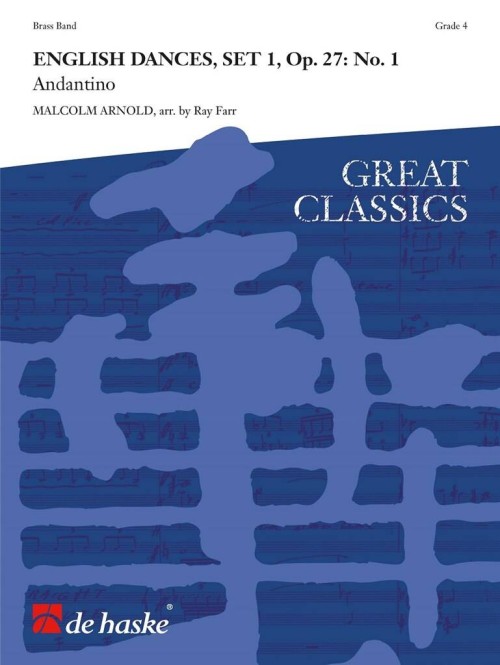
English Dances, Set 1, Op.27: No.1, Andantino (Brass Band - Score and Parts) - Arnold, Malcolm - Farr, Ray
English Dances, Set I, opus 27, is a light classic composition that was written for orchestra by the British composer Malcolm Arnold in 1950. The set contains four dances that continue without pause: the individual movements are indicated by the tempo markings. The work came about at the request of Bernard de Nevers, at the time the head of publisher Alfred Lengnick & Co., who asked Arnold to write a suite of dances as an English counterpart to Dvovk's Slavonic Dances and Bartk's Romanian Folk Dances. The premire took place in the spring of 1951, played by the London Philharmonic Orchestra, conducted by Sir Adrian Boult. Following the success of the first set, DeNevers asked the composer to write a second one, which Arnold completed the next year (Op. 33). The Andantino from the first set has been skilfully arranged and orchestrated for brass band by Ray Farr.Duration: 2.45
Estimated dispatch 7-14 working days
-
 £83.00
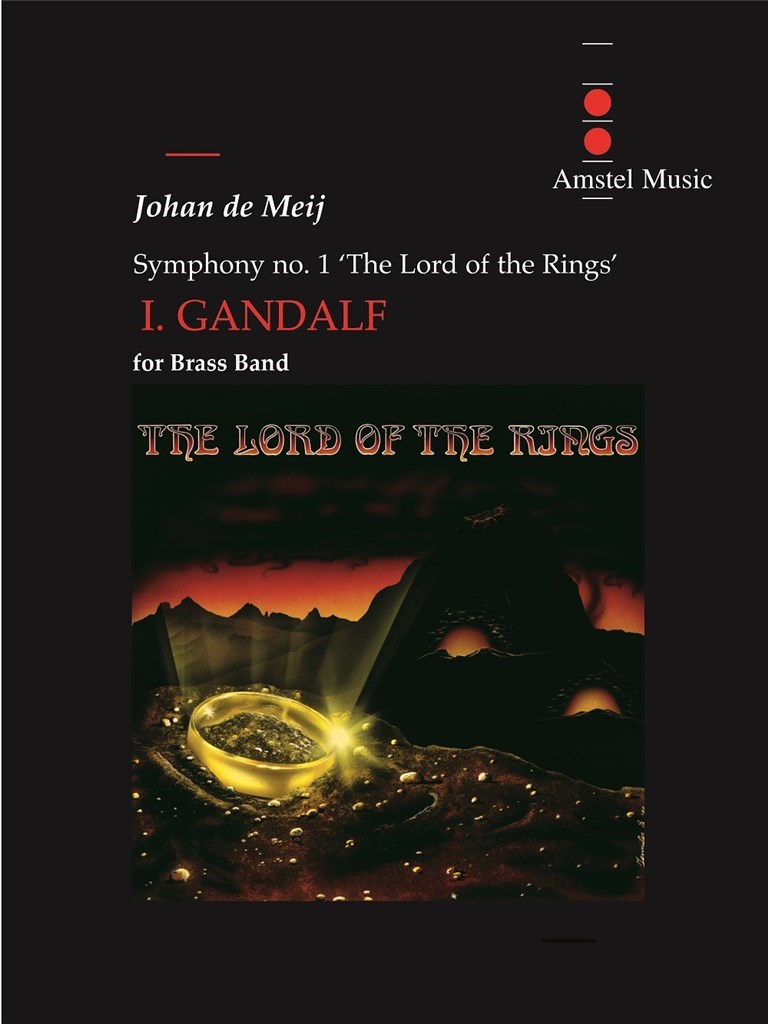
Gandalf (from Symphony No.1: The Lord of the Rings) (Brass Band - Score and Parts) - De Meij, Johan
Johan de Meij's first symphony The Lord of the Rings is based on the trilogy of that name by J.R.R. Tolkien. This book has fascinated many millions of readers since its publication in 1955. The symphony consists of five separate movements, each illustrating a personage or an important episode from the book. This transcription for brass band has been arranged by the composer. The symphony was written in the period between March 1984 and December 1987, and had its premiere in Brussels on 15th March 1988, performed by the The Royal Band ofthe Belgian Guides under the baton of Norbert Nozy. In 1989, the symphony The Lord of the Rings was awarded a first prize in the Sudler International Wind Band Composition Competition in Chicago, and a year later, the symphony was awarded a grant by the Dutch Composers Fund. In 2001, the orchestral version was premiered by the Rotterdam Philharmonic Orchestra and recorded by the London Symphony Orchestra. Duration: 6.30
Estimated dispatch 7-14 working days
-
 £60.99
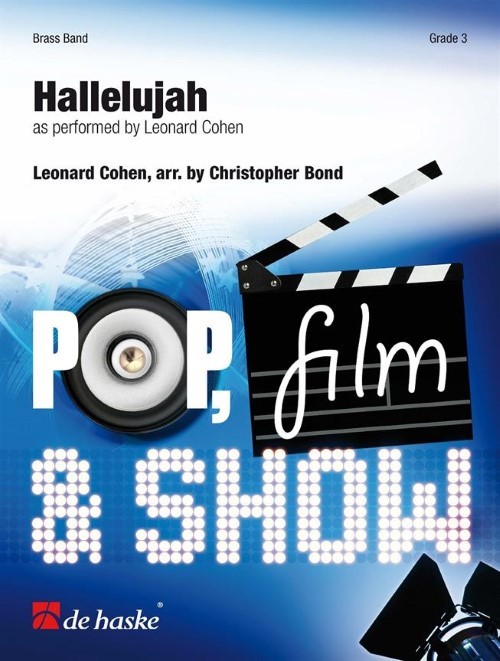
Hallelujah (Brass Band - Score and Parts) - Cohen, Leonard - Bond, Christopher
The songs of Leonard Cohen are difficult to categorize. His songs are sometimes more like poems to music. 'Hallelujah' is probably the most widely known Cohen composition and has been covered many times, most notably by Jeff Buckley. This is a beautiful addition to the brass band repertoire and is suitable for young bands working on phrasing, intonation and musicality. Duration: 3.30
Estimated dispatch 7-14 working days
-
 £102.99
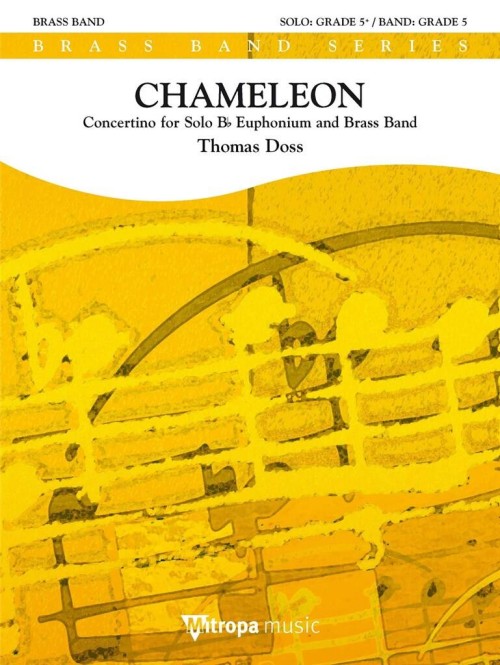
Chameleon (Euphonium Solo with Brass Band - Score and Parts) - Doss, Thomas
Chameleon is a three-part solo piece for euphonium and brass band. The different styles within the piece provide lots of variety, requiring refined technique and a great deal of flexibility from the soloist. This composition was commissioned by Georg Pranger, to whom the piece is also dedicated. As a pioneer of the Austrian euphonium soloist scene, Pranger is committed to the unshackling of this wonderful instrument and the creation of great musical momentum, as achieved by this commission.Duration: 8.30
Estimated dispatch 7-14 working days
-
 £60.99
Fanfare for the Best (Brass Band - Score and Parts) - Doss, Thomas
Fanfare for the Best is a short composition inspired by best friends and memories of good times in pleasant company. I wrote this piece for the 50th birthday of my friend Otto M. Schwarz.Duration: 1.45
Estimated dispatch 7-14 working days
-
 £119.99
The Patriots (Brass Band - Score and Parts) - De Haan, Jan
The Dutch patriottentijd (literally Time of the Patriots) was a period of political instability in the 1780's. The country was led by regents who were occupied with their own personal interests rather than dedicating themselves to the needs of the people. In this revolutionary period, the devoted republican Patriots were in conflict with the Orangists. A civil war followed, in which the Patriots were beaten and driven away by a Prussian army. This composition is an abstract piece inspired by the Patriots. The thematic material is based on the Dutch war song Merck toch hoe sterck. Its powerful minor melody, which has its origins in the Eighty Years' War, is recognisable throughout the work, presented in variations of constantly shifting character.Duration: 14.15
Estimated dispatch 7-14 working days
-
 £104.99
Purcellian Fantasia (Brass Band - Score and Parts) - De Haan, Jan
This composition is based on the march from Henry Purcell's Music for the funeral of Queen Mary II, a work written in 1694. In this fantasia, various movements flow from one to the next following the main theme; these movements not only elaborate on the theme, but also contrast with it. At times, the thematic material diverges so much, that the work acquires a character of its own; however, the composer often refers back to fragments of the theme. This work was test piece in the 4th division of the Dutch National Brass Band Championships (NBK) in 2017. Duration: 10.30
Estimated dispatch 7-14 working days
-
 £109.99
Frontier Vision (Brass Band - Score and Parts) - Bulla, Stephen
Frontier Vision is a concert or contest piece based on three elements: the commemoration of the 500th anniversary of Reformation Day, the Martin Luther melody, A Mighty Fortress Is Our God (Ein Feste Burg ist unser Gott) on which this composition is based, and thirdly the spreading of the evangelical movement in the late 19th century, of which the analogous storyline forms the structural basis of this work. Multi-cultural ethnic influences, along with the driving rhythms that reflect the perseverance and hard work of those mission-minded pioneers, are both important components that make Frontier Vision an outstanding choice for your concert or contest. Frontier Vision was the test piece for the second division in the Dutch National Brass Band Championships 2017. Duration: 12.00
Estimated dispatch 7-14 working days
-
 £24.00
Evening Prayer (Cornet Duet with Brass Band - Score and Parts) - Humperdinck, Engelbert - Wilkinson, Keith M.
This beautiful music is from the end of Act 2 of the opera Hansel and Gretel by German composer Engelbert Humperdinck (1854-1921). The duet is a prayer by the brother and sister as they seek the protection of angels before falling asleep on the forest floor. The opera, Humperdinck's most famous composition, is based on the fairy tale by the Grimm brothers, and has libretto by the composer's sister. It was first performed in December, 1893.
Estimated dispatch 7-14 working days
-
 £73.00
Siegfried's Rhine Journey (Brass Band - Score and Parts) - Wagner, Richard - Wilson, Duncan
Arranged by Duncan Wilson, this extended orchestral selection from "G?tterd?mmerung", is one of the epic four-opera's called "Der Ring des Nibelungen" by Wagner. "Siegfried's Rhine Journey" is often presented outside the opera house and is published separately. This excerpt includes especially composed endings by Richard Wagner himself so that the work is better able to stand on its own as a complete composition. Duration: 11.00. Suitable for Championship Section Bands.
Estimated dispatch 7-14 working days
 View Music