
Results
-
 £17.50
The New Born Babe (Brass Band - Score only) - Broughton, Bruce
The chorale which forms the basis of this prelude dates from the sixteenth century and was used by J.S.Bach in his Cantata No.122, 'Das neugeborne Kinderlein'. On his score Bruce Broughton includes a translation by R. Rutledge of the words; 'There comes the true jubilee, what are we eternally lamenting? Look alive! It is a time for singing, for the Christ-child exorcises all sorrow'.
Estimated dispatch 7-14 working days
-
 £37.95
Terra Australis (Brass Band - Score only) - Ellerby, Martin
A descriptive work in one continuous movement. Terra Australis portrays the discovery of Australia, the wonders of the land, the promise of new life and the nation's anthem, closing with a massive grand chorale and an energetic conclusion.National Brass Band Championships of Great Britain Championship Section Finals 2010Australian Championships Easter 2007Recorded on Polyphonic QPRL231D Terra Australis
Estimated dispatch 7-14 working days
-
£82.95
Terra Australis (Brass Band - Score and Parts) - Ellerby, Martin
A descriptive work in one continuous movement. Terra Australis portrays the discovery of Australia, the wonders of the land, the promise of new life and the nation's anthem, closing with a massive grand chorale and an energetic conclusion.National Brass Band Championships of Great Britain Championship Section Finals 2010Australian Championships Easter 2007Recorded on Polyphonic QPRL231D Terra Australis
Estimated dispatch 7-14 working days
-
 £69.99
Cause for Celebration (Brass Band - Score and Parts) - Himes, William
This rousing, jubilant overture mixes five original themes with the well-known doxology Old Hundredth, which is also known as Praise God, from Whom All Blessings Flow. The hymn is presented in short lyrical, energetic motif fragments, which combine until the complete hymn is presented in the form of a chorale prelude. This is a wonderful and truly uplifting concert work. Duration: 4.30
Estimated dispatch 7-14 working days
-
 £59.99
Jesu, Joy of Man's Desiring (Brass Band - Score and Parts) - Bach, Johann Sebastian - Sparke, Philip
Bach's appointment as the Cantor at Leipzig's Thomaskirche in 1723 required him to produce a new cantata for every Sunday service. Jesu, Joy of Man's Desiring is taken from his Cantata No.147 and is unusually elaborate, treated more like an aria than a chorale. It is perhaps the best-loved cantata movement from Bach's entire output and is a certain crowd pleaser for your concert programme.Duration: 2:45
Estimated dispatch 7-14 working days
-
 £152.99
Between the Two Rivers (Brass Band - Score and Parts) - Sparke, Philip
Between the Two Rivers was commissioned by Fanfare Prins Hendrik, from Aalst in the Netherlands. The title derives from the fact that the town of Aalst lies between two tributaries of the River Dommel. The community is a highly religious one, so the famous Luther chorale, Ein' Feste Burg, was an obvious choice for Philip Sparke to use as the theme for this new work. It takes the form of a theme with four contrasting variations. Variation 1 is a moto perpetuo, variation 2 has a slower march like feel, variation 3 is a sinister slow movement and the final variation is in the form of a lyrical fugue. Between The Two Rivers is sure to become a major work in modern brass band repertoire.Duration: 15:00
Estimated dispatch 7-14 working days
-
 £69.99
South Down Pictures (Brass Band - Score and Parts) - Sparke, Philip
South Down Pictures was commissioned by Millenium Brass 2000, an organisation comprising three brass bands from the county of Sussex, England.The bands (Patcham Silver, Hangleton and Brighton Silver) had got together to organise many events to mark the new millennium and these culminated in a concert in Hove Town Hall on July 9th 2000 when all three bands combined to give the first performance of South Down Pictures. The composer spent much of his childhood amongst the South Downs, a range of hills in Sussex which runs parallel to the sea.Opening with a strong unison passage, interrupted briefly by faster figures based on the interval of a fifth, South Down Pictures develops with an often-passionate legato melody. Reaching a climax, this is then followed by the main vivo section of the work, whose main theme is based on the earlier 'fifth' figures. A bridge passage leads to a short chorale figure and a rhythmic climax which dissolves into a plaintive cornet solo over staccato chords. This theme is taken up by the whole band and leads back to a recapitulation of the main theme and earlier material. The cornet tune returns triumphantly in the major key before the opening unison passage reappears to provide a stirring coda.Duration: 5:30
Estimated dispatch 7-14 working days
-
 £69.99
Suite Symetrique (Brass Band - Score and Parts) - De Haan, Jacob - Haantjes, Menno
This playful three-part suite is largely based on symmetry. This of course is largely due to the relations of the arrangement of the themes; however, on the other hand, to the larger structures in form. The first part, (Prelude et Scherzo) has a solemn opening. Followed by it a related scherzo with many changes in time, this too is composed in a symmetrical form. In the second movement, Choral Dorian, the theme of the prelude is reversed and used in chorale in Dorian tonality. The suite comes to a close with Rondo d'Avignon. An annual theatre festival in a French city on the Rhone inspired this suite. It is a lively movement, symmetrically bought to a finish with a repeat of the prelude from the first movement.Duration: 5:15
Estimated dispatch 7-14 working days
-
 £69.99
Homage (Brass Band - Score and Parts) - Van der Roost, Jan
In the most literal sense: a piece for an occasion. The actual occasion was Jan de Haan's twentieth anniversary as a conductor of the top Dutch brass band, "Soli Deo Gloria" (Leeuwarden). To mark the occasion, the band commissioned the Belgian composer Jan Van der Roost to create a surprise piece: without knowledge of the person being celebrated, a suitable source of inspiration was sought for. After some thought the chorale-theme from Camille Saint-Sans organ symphony was chosen, a piece with which Jan de Haan has a special bond. Apart from this chorale, Homage is also based on the names of notes taken from 'Jan de Haan' and 'Soli Deo Gloria', resulting in the tone row: DEGAH. Both elements are combined together and form a grand climax towards the end of the piece when the whole band unites in the Saint Sans' theme.Duration: 5:30
Estimated dispatch 7-14 working days
-
 £60.99
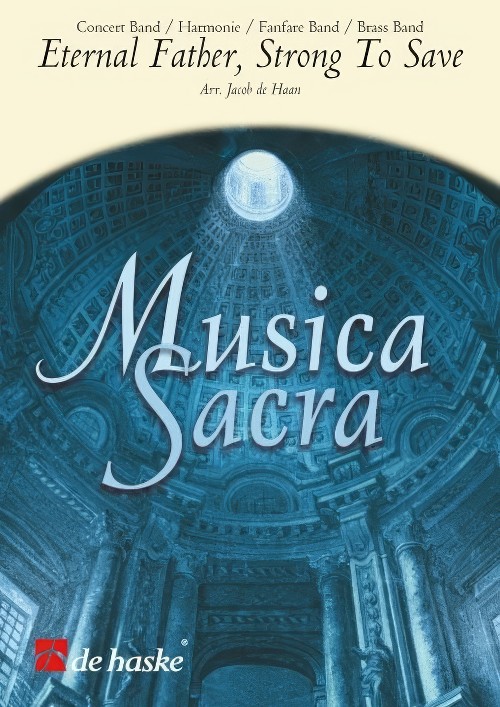
Eternal Father, Strong to Save (Brass Band - Score and Parts) - Dykes, John Bacchus - De Haan, Jacob
Eternal father Strong to Save is a arrangement from the chorale of the same name. This work is ideal for use in church services, however it also makes a useful warm-up piece or a quiet interlude in any concert.Duration: 6:00
Estimated dispatch 7-14 working days
 View Music