
Results
-
 £99.99
Compostela - Thierry Deleruyelle
"Four roads lead to Santiago", so begins the Book of the Pilgrim. Written in the 12th century, the Codex Calixtinus opened the way for pilgrimage from most cities in Europe and North Africa to Santiago de Compostela, in Spain. Compostela - The Way of St James describes the pilgrims' journey. After a slow introduction, a brilliant theme announces the start of the journey. The arrival in Spain is indicated by incantatory chants and majestic chords. Finally, the music softens as the pilgrims venerate St James.
Estimated dispatch 5-14 working days
-
 £154.99
Cantabile - Philip Harper
"As long as we live there is never enough singing." - Martin Luther Philip Harper composed this piece in response to his personal concern about the direction of new music for brass band. His goal with this 5 movementCantabile, was to compose a piece which fully complied with all that is asked of a top-level test in the 21st Century, but also to reconnect with more traditional values such as lyricism in melody and richness of blendedbrass sound. Each of the 5 parts seek to capture this idea.
Estimated dispatch 5-14 working days
-
 £115.60
Valdresmarsj - Johannes Hanssen - John Philip Hannevik
Valdres is a mountain region that lies between Oslo and Bergen. Johannes Hanssen (1874-1967) composed the march for the Valdres Battalion between 1901 and 1904, using the Battalions horn-signal combined with a traditional style folk-tune. The march has been named "one of the greatest marches in the world" on many occasions, and it is a firm favourite with it's national flavor and unusual style. This version is similar to Johannes Hanssens revised version for Wind Band from 1954. However, it is interesting to notice that in Hanssens very first version of the march half a century earlier, the first theme was played by the Eb-Cornet, just like in this arrangement for brassband.
Estimated dispatch 5-14 working days
-
 £154.60
Circius - Torstein Aagaard-Nilsen
The work is important for me because it was my first piece to be performed outside Norway. Black Dyke Band/David King performed it and did a recording of it in 1991. In the original score I quote a Swedish bishop (Olaus Mangnus) who lived in the 15th century. He travelled around Scandinavia and drew maps - very important historic material. When he came to the north of Norway (where I come from) he decribed the wind from the north as Ciricus: (something like) Worst of all winds is Circius, that revolves (?= turn upside down) heaven and earth. (Well, not a good translation Im afraid). The fast sections reflects the mighty winds from the north. In the middle section, I borrowed afolksong-like tune (by C. Elling, a Norwegian composer). The text (by Kristoffer Janson) tells about old times when the fishermen used open boats: they had to put their lives in the hands of God.
Estimated dispatch 5-14 working days
-
 £109.99
Frontier Vision - Stephen Bulla
Frontier Vision is a concert or contest piece based on three elements: the commemoration of the 500th anniversary of Reformation Day, the Martin Luther melody, A Mighty Fortress Is Our God (Ein Feste Burg ist unser Gott) on whichthis composition is based, and thirdly the spreading of the evangelical movement in the late 19th century, of which the analogous storyline forms the structural basis of this work. Multi-cultural ethnic influences, along with the driving rhythms thatreflect the perseverance and hard work of those mission-minded pioneers, are both important components that make Frontier Vision an outstanding choice for your concert or contest. Frontier Vision was the test piece for the seconddivision in the Dutch National Brass Band Championships 2017.
Estimated dispatch 5-14 working days
-
 £104.99
Viking Age - Thierry Deleruyelle
The Viking age lasted from the late eighth, to the middle of the eleventh century. During this period, Scandinavian warriors and merchants explored, plundered and left their mark on numerous territories. This work is based on a series of four notes that appear in different forms, consisting of 4 movements: Northern Men, Explorer, Raids and Heritage. It is an impressive and spectacular piece, with lots of interesting and playful parts for all sections. This is a perfect contest piece or an outstanding work for thematic concerts.
Estimated dispatch 5-14 working days
-
 £101.30
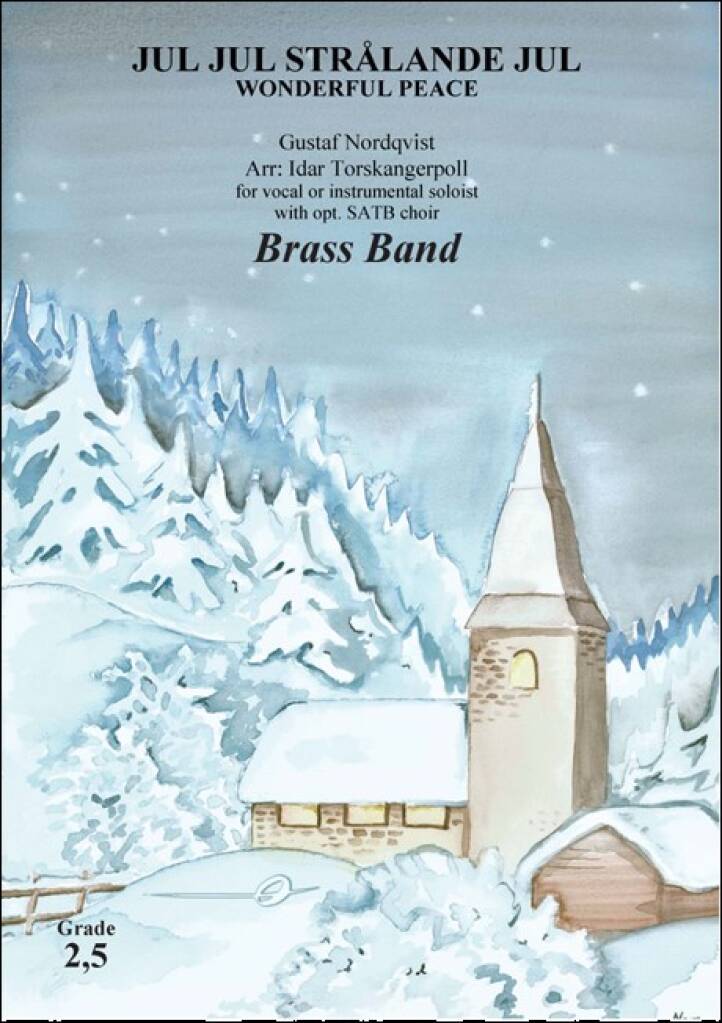
Wonderful Peace - Gustaf Nordquist - Idar Torskangerpoll
This song is one of the most used and loved Christmas songs in Sweden during the 20th century. The lyrics describe Christmas as white and snowy, and describe the blessings of Christmas as well as the hope that Christmas will bring peace onearth.To the conductorThis arrangement has soloist parts for several instruments or a vocalist. It can be used by band and choir (swedish lyrics).
Estimated dispatch 5-14 working days
-
 £139.99
The Raid - Oliver Waespi
This piece tells the story of a conflict between the communities in the valleys around Srenberg, a village in Entlebuch in the Swiss canton of Lucerne.An old legend from the 14th century tells of an attack on Srenberg by marauding Obwaldners who stole the local cattle. It's full of spectacular effects and impressive rhythmical and dynamic sequences. Ideal as a contest piece.
Estimated dispatch 5-14 working days
-
 £54.99
Machet die Tore Weit - Robert van Beringen
The numerous, mostly religious works of the Bohemian composer Andreas Hammerschmidt are composed with great craftmanship, and sound full and catchy. They were composed for 17th century village churches, in which they were sung by the congregation--and they are still familiar and popular today. Robert van Beringen took the advent hymn Lift Up Your Heads, Ye Gates and created this beautiful arrangement.
Estimated dispatch 5-14 working days
-
 £60.99
Gelobet seist du, Jesu Christ - John Blanken
Gelobet Seist Du Jesu Christ (We Praise You Jesus Christ) is an old Christmas hymn dating from the 16th century, which can still be found in many hymnbooks today. John Blanken has created a varied and imaginative arrangement on four verses of the hymn. A perfect item for you next Christmas concert.
Estimated dispatch 5-14 working days
 View Music