
Results
-
£24.50
Radcliffe Tower March - Darrol Barry
Commissioned by the Radcliffe Band for their centenary in 2013, the Radcliffe Tower March grabs the attention of the listener right from the very start. Composed in a traditional format, this memorable new work would feature perfectly in any concert or entertainments contests programme.
In Stock: Estimated dispatch 1-3 working days
-
£37.95
Centenary March - Gilbert Vinter
Estimated dispatch 5-14 working days
-
£30.00
THURCROFT CENTENARY MARCH ??" Darrol Barry
In Stock: Estimated dispatch 3-5 working days
-
 £37.95
CENTENARY MARCH (Brass Band) - Vinter, Gilbert
Duration: 6:13 Recorded by Williams Fairey Engineering Band on Polyphonic QPRL058D Spectrum
Estimated dispatch 7-14 working days
-
 £45.00
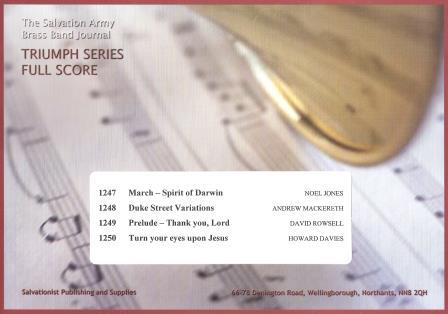
Triumph Series Band Journal March 2014 Numbers 1247-1250
No.1247 March - Spirit of Darwin (Noel Jones)This march was written as a tribute to Majors Hilton and Wilga Morris for the wonderful ministry they provided as reginal officers. It includes two well-known Salvation Army songs; 'Ever is the War Cry, Victory, Victory!' and'O My Heart is Full of Music and of Gladness'.No. 1248 Duke Street Variations (Andrew Mackereth)A set of variations on the well-known tune 'Duke Street', written at the request of Young People's Bandleader Andrew Laird for the centenary weekend of the Clydebank YP Band in 2012. No.1249 Prelude - Thank you, Lord (David Rowsell)A prelude based on the chorus 'Thank you , Lord for saving my soul'.No. 1250 Turn Your Eyes Upon Jesus (Howard Davies)A setting of the well-loved melody 'Turn your eyes upon nJesus', which also incorporates the tune 'Open our eyes, Lord'.
Estimated dispatch 7-14 working days
-
 £29.95
British Bandsman (Score and Parts) - Derek Broadbent
Winner of the British Bandsman Centenary March Competition in 1987. Duration: 3:00
Estimated dispatch 7-9 working days
-
 £59.99
Sandstone Centennial - Philip Sparke
Sandstone Centennial was commissioned by the Frodsham Silver Band from north-west England, to celebrate their centenary. The title refers to the fact that Frodsham is situated at one end of The Sandstone Trail, a hiking route which was opened in 1974 and traces a ridge of sandstone. The march is in traditional English 'contest march' style.
Estimated dispatch 5-14 working days
-
£34.95
CHALK FARM No.2 (Brass Band Set) - Edward Gregson
In 1909, The Salvation Army published a march called 'Chalk Farm'. 'Chalk Farm No. 2' was written to commemorate the centenary of the birth of Bandmaster Punchard, Bandmaster to Chalk Farm band for 50 years. The tune 'March on, we shall win the day' is common to both marches. The later march is symphonic rather than processional, including as it does irregular bars of 5 and 7 beats.
Estimated dispatch 7-14 working days
-
£29.95
EXETER TEMPLE (Brass Band Set) - Leslie Condon
This march was written for the centenary of Exeter Tempe Corps in 1981 and first played in Exeter Cathedral during those celebrations. While the march is intentionally retrospective, the unashamed absence of modernity receives some splashes of colour from the styles of march 'kings' like Bramwell Coles, Arthur Gullidge, Albert Jakeway and George Marshall.
Estimated dispatch 7-14 working days
-
 £29.95
Judd: Exeter Temple
This march was written for the centenary of Exeter Tempe Corps in 1981 and first played in Exeter Cathedral during those celebrations. While the march is intentionally retrospective, the unashamed absence of modernity receives some splashes of colour from the styles of march 'kings' like Bramwell Coles, Arthur Gullidge, Albert Jakeway and George Marshall.
Estimated dispatch 7-14 working days
 View Music