
Results
-
£60.99
From A Distance - Julie Gold - Georges Moreau
This splendid ballad made pop history thanks to the gleaming performance of Julie Gold. A successful arrangement by our house arranger, Georges Moreau, that can be played by every orchestra.
Estimated dispatch 5-14 working days
-
£60.99
Aurora Borealis - Morten J. Wallin
Aurora Borealis, more popularly known as the Northern Lights, was a source of superstition in the Middle Ages. This dazzling spectacle, which is accompanied by whispering sounds, put the fear of God into those who didn't know that this was simply one of nature's grand shows. Many heathen attributed the phenomenon to the incomprehensible ways of the gods. Today we know better. Every 11 years, the amount of particles emitted by the sun is at its highest level, as is the case this year. These particles are hurled away from the sun, beyond its magnetic field. A small percentage of these particles are able to penetrate the earth's atmosphere. Once they are here, they begin tocollide and form the beautiful patterns in the night sky which we call the Aurora Borealis.
Estimated dispatch 5-14 working days
-
£60.99
Join The Club - Stef Minnebo
Join the club is an easy and pleasant work in swing style by the Belgian Stef Minnebo. It can be played by any orchestra thanks to it's simple instrumentation and large orchestration.
Estimated dispatch 5-14 working days
-
£76.99
Haexdonck - Guido De Ranter
This work was commissioned by the municipality of Kapelle-op-den-Bos on the occasion of the 150th anniversary of canon Jaak Muyldermans. Haexdonck is the old spelling of the present day region of "Oxdonk" where Jaak Muyldermans lived. In this three-part work the composer describes the different human aspects of canon Muyldermans' rich life. The first part, slow and dreamy, describes the writer/poet. The second dissonant part with much percussion describes his time as an army chaplain during the Great War. The third hymn-like part depicts his time as a priest. This work by Guido De Ranter, a newcomer to composition,is suitable for competitions or concerts.
Estimated dispatch 5-14 working days
-
£60.99
Unexpected Song - Andrew Lloyd Webber - Erik Mast
Andrew Lloyd Webber is without a doubt the most famous and successful composer of musicals of all times. Musicals such as 'Cats' and 'Phantom of the Opera' are played around the world and have been seen and heard by millions of people. Erik Mast re-discovered this unknown but exquisite piece which has been recorded once again by Sarah Brightman. A great moment of rest for your concert.
Estimated dispatch 5-14 working days
-
£72.99
Hail Nero - Triumphal March (From Quo Vadis) - Miklos Rozsa - Steven Verhaert
In the 1950 motion picture "Quo Vadis" starring Robert Taylor and Peter Ustinov still is one of the greatest movies in the history. The music was composed by Miklos Rosza. The "Hail Nero - Triumphal March" beautifully arranged by Steven Verhaert gives an impression of the greatness of the Roman empire in the days of Emperor Nero.
Estimated dispatch 5-14 working days
-
£47.50
With Sweet Jubilation - James Curnow
Explore different settings of the Medieval Latin carol "In Dulci Jubilo" via this solid arrangement by James Curnow. Opening with an exquisite "Brass Choir" section a la Michael Praetorius (1571-1621) and progressing through a "Woodwind Choir" section in the later J.S.Bach style, WITH SWEET JUBILATION is wonderful "style study" material. The grace of the early masters and the clearly focused unifying concept of the arrangement by James Curnow combine to make this addition to the Curnow Music Press "Splendor of Christmas Series" a wonderful holiday experience for the young band.
Estimated dispatch 5-14 working days
-
£94.99
Brass Miniatures - James Curnow
Brass Miniatures features four contrasting sections, each linked by the fact they are based on the same interval. The opening is an exciting fanfare which leads into a lovely ballad, introduced by a solo cornet. The third section is a playful pseudo-blues and the work comes to a thrilling close with fanfare and march.
Estimated dispatch 5-14 working days
-
£76.99
The Universal Band Collection - Jacob de Haan
A collection of 5 short works in pop style which can be performed by any kind of compilation. The titles can be presented on the programme as separate works but the Universal Band Collection can also be performed as a complete suite. From a didactic point of view it is a suitable work to teach musicians something about the structure in music. For this purpose not only the big structure but also the small structure was kept very clear.Western Girl : A girl from the west of the USA rides her horse across the prairie, dreaming of her future. The rough structure: introduction - theme in a blues scale - the same thing in a different instrumentation - finale.Just a ballad : A balladin pop style with a rough A-B-A form. First there is the introduction of the main theme (A), then follows a tenor melody in minor with a rhythmical reference to the main theme (B). Finally there is the main melody, performed tutti with a different rhythm in the drums (A').Play the Game : An English saying meaning: play fairly. Playful music in up-tempo with a wink to China, where almost all games are manufactured nowadays. Once again an A-B-A structure here.San Diego : A Mexican fugitive enjoys his freedom in America but also remembers his place of birth with melancholy. A sad minor melody with a straight trendy beat appears twice. The second time it has a slightly different instrumentation, in which the muted trumpets represent the Mexican feeling.Final Dance : Eventually there is a dance with an introduction in renaissance style, followed by a fast dance in rock style. All this composed in a classical song structure: introduction, verse, bridge, chorus, shortened verse, bridge, chorus, chorus.
Estimated dispatch 5-14 working days
-
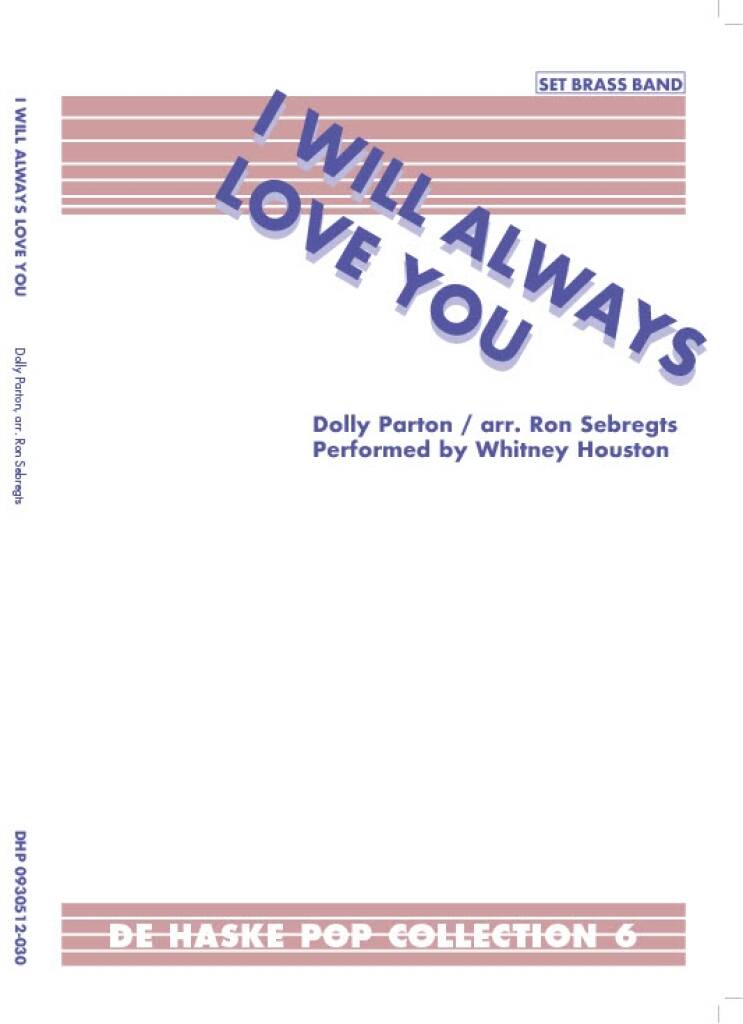 £54.99
I Will Always Love You - Ron Sebregts
The title song to the 1992 film The Bodyguard, I Will Always Love You, written by Dolly Parton and sung by Whitney Houston spent over 10 weeks at number one in the UK charts. The beautiful ballad has been sensitively arrangement for brass band and is sure to be a big hit with both musicians and audiences.
Estimated dispatch 5-14 working days
 View Music