
Results
-
 £33.62
Silent Night (Vocal Solo with Brass Band) Joseph Mohr arr. Andrew Wainwright
This solo for soprano voice with brass band accompaniment was arranged for ITV's Britain's Got Talent star Faryl Smith and the GUS Band for a joint Christmas concert. It was recorded on the CD Christmas Fantasia - The Music of Andrew Wainwright by the same performers. This simple but charming setting features three verses of the carol. To view a rolling score video featuring Faryl Smith performing the solo with GUS Band please visit https://www.youtube.com/watch?v=qmIRwYogtzU&t=2s Length: 5.20 minutes Instrumentation: Vocal Soloist Soprano Cornet Eb Solo Cornet Bb 1st Cornet Bb 2nd Cornet Bb Flugel Horn Bb Solo Horn Eb 1st Horn Eb 2nd Horn Eb 1st Baritone Bb 2nd Baritone Bb 1st Trombone Bb 2nd Trombone Bb Bass Trombone Euphonium Bb Bass Eb Bass Bb Timpani Percussion
In Stock: Estimated dispatch 1-3 working days
-
£24.95
DAVID OF THE WHITE ROCK (Cornet Solo with Brass Band Set) - Ray Bowes
This melody is reputed to have originated in Caernarvonshire, North Wales. Tradition holds that a bard called David, lying on his deathbed, called for his harp and performed this plaintive tune, expressing a desire that it should be played at his funeral. Ever since the tune has been called by his name and that of his house 'Garagwen' ('Druid Stone' or 'White Rock'). The solo is not just a slow melody with brass band accompaniment but is a composite whole, the band needing as much sensitivity as the soloist in the presentation.
Estimated dispatch 7-14 working days
-
 £29.88
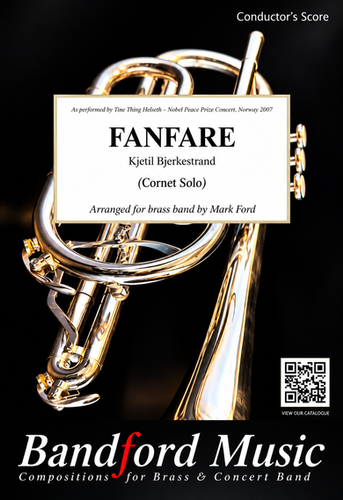
Fanfare (Cornet Solo with Brass Band) Kjetil Bjerkestrand arr. Mark Ford
Capture the prestige and grandeur of one of the world's most celebrated stages. Originally composed by Kjetil Bjerkestrand, this stirring fanfare opened the 2007 Nobel Peace Prize Concert at the Oslo Spektrum. The piece was famously premiered by the acclaimed Norwegian trumpeter Tine Thing Helseth, marking a historic moment broadcast to millions. This arrangement brings that same professional brilliance to the brass band concert stage, featuring a soaring solo cornet part that embodies the spirit of peace and international honor. To view a rolling score video of the work please visit www.youtube.com/watch?v=aMfjKLu8BjA Duration: 1.30 minutes Difficulty Level: 4th Section + This PDF download includes the full score and parts. Sheet music available at www.brassband.co.uk (UK) or https://satradecentral.org (USA) Instrumentation: Cornet Soloist Bb Soprano Cornet Eb Solo Cornet Bb Repiano Cornet Bb 2nd Cornet Bb 3rd Cornet Bb Flugel Horn Bb Solo Horn Eb 1st Horn Eb 2nd Horn Eb 1st Baritone Bb 2nd Baritone Bb 1st Trombone Bb 2nd Trombone Bb Bass Trombone Euphonium Bb Bass Eb Bass Bb Timpani Sus. Cymbal Marimba
In Stock: Estimated dispatch 1-3 working days
-
 £33.62
O Holy Night (Flugel Solo with Brass Band) arr. Kevin Larsson
VIEW SCORE PDF O Holy Night, also known as Cantique de Noel, was originally based on a poem by Placide Cappeau before being set to music by Adople Adam. This carol has become a favourite to many, being performed all over the world in various styles and forms. This jazz-style arrangement for flugel horn and brass band was written for John Docter for The Salvation Army's Night of Wonder Carol Service in Los Angeles. To view a performance video please visit: www.youtube.com/watch?v=tMobVKBLmMY Sheet music available from: UK - www.brassband.co.uk USA - www.solidbrassmusic.com Difficulty Level: 3rd Section + Instrumentation: Flugel Horn Soloist Bb Soprano Cornet Eb Solo Cornet Bb 1st Cornet Bb 2nd Cornet Bb Solo Horn Eb 1st Horn Eb 2nd Horn Eb 1st Baritone Bb 2nd Baritone Bb 1st Trombone Bb 2nd Trombone Bb Bass Trombone Euphonium Bb Bass Eb Bass Bb Timpani Drum Kit Percussion Bongos
In Stock: Estimated dispatch 1-3 working days
-
 £30.00
Scots Fantasia for Euphonium and Brass Band.
Recommended - Championship to 3rd Section Scots Fantasia is a Euphonium solo with brass band which begins with a slow Celtic folk-style melody followed by an exciting and challenging reel to get the fingers flying and the toes tapping! Scots fantasia was written in 2012 for euphonium soloist, Scott Kerr. Includes score & parts Also see: Scots Fantasia for Euphonium & Piano
-
£44.95
EUPHONY (Euphonium Solo with Brass Band Set) - Robert Redhead
Previously only available in manuscript form, this euphonium solo with brass band accompaniment is now available in printed format. Euphony (meaning a pleasant, sweet sound) is based on the tunes of Sidney Cox with material taken from the songs; 'He found me', 'This one thing I know', 'You can tell out the sweet story' and 'Deep and wide'. At the time of writing, the composer remarked; 'The euphonium is often associated with melodies and harmonies that lend themselves to pleasing sounds'. That is true of this solo but it also presents considerable technical challenges for the soloist in terms of range and technique.
Estimated dispatch 7-14 working days
-
 £34.95
By Trevone Bay (Flugel Horn Solo with Brass Band - Score and Parts))
By Trevone Bay was composed for Flugel Soloist Zoe Hancock and the Black Dyke Band to celebrate both their Double Champion Victory at the British Open and National Championships 2014 and Zoe's unique achievement in winning the Best Soloist Award in both contests - an accomplishment never done before. The world premier was performed by Zoe and the band at Birmingham's Symphony Hall on February 8th 2015.By Trevone Bay is a lovely lyrical slow melody that utilises the full range and colour of the flugel horn. Starting with an atmospheric opening the soloist performs the main theme, which repeats with more colour in the accompanying parts and solo line. After introducing a second theme from the ensemble, the solo cornets perform the main melody with the soloist enjoying a lyrical counter melody. The piece develops with a tranquil middle section from the soloist that builds for the second theme to return, performed by the ensemble while the soloist soars over the top. Ending as it starts, the piece dies away to leave the soloist performing the opening melodic phrase to a tranquil close.As for the title: Trevone Bay is a beautiful tiny bay in Cornwall, close to Zoe's home town of Roche. Its tranquil waters lead out to the Celtic Sea and provide a picturesque landscape. The views there can be enjoyed all year round but they are particularly beautiful at sunset.
Estimated dispatch 7-14 working days
-
 £34.95
Rondo Alla Turk (Xylophone Solo with Brass Band - Score and Parts)
Rondo Alla Turk has been a popular concert piece for many performers the world over. This is an arrangement I have done for solo xylophone that shows off the technical dexterity of both the piece and the instrument. Starting in a brisk tempo, the soloist performs the main themes of the piece with the major key fanfare-like interludes introducing each new section.The main melody from the opening returns with an even brighter tempo that takes the soloist into a flamboyant cadenza section. The cadenza section is scored out for the xylophone but the ad-lib marking allows the soloist in true Mozart fashion to improvise (if they wish) the cadenza section which leads into the finale.The finale brings back the major key motifs from the opening to a coda section that concludes in a breathless flurry from the soloist.Paul Lovatt-Cooper Suitable for 3rd section bands and above, soloist grade 8
Estimated dispatch 7-14 working days
-
 £87.99
Sunday in the Park (Eb Horn Solo with Brass Band - Score and Parts)
Sunday in the Park opens with an accompanied cadenza for the soloist, which leads to a gentle rhythmic melody with a laid-back feel. This is taken up by the band but the soloist sparks a change of mood by introducing a faster light rock interlude. This reaches a climax, at which point the music unwinds until the original mood returns. A variation on the original melody leads to a short cadenza from the soloist, which brings the work to a peaceful close.
Estimated dispatch 7-14 working days
-
 £39.95
When Thunder Calls (Brass Band - Score and Parts)
When Thunder Calls was commissioned by Dr Nicholas Childs and the Black Dyke Band for their performance at the Gala Concert of the Swiss Open Championships in September 2011. When composing this piece, I decided to focus on both the music and the stage presentation. The way the piece has been composed and designed makes it a very effective way of starting a concert or a second half of a concert.At the start of the piece, the percussion enter the stage and take their positions in their usual place behind the band. They begin playing the piece without a conductor. They keep repeating the opening section while the Basses, Horns, Baritones and Euphoniums march onto the stage.This group of musicians take their seats with the Horns, Baritones and Euphoniums sitting where they usually sit in the band but the Basses sit where the solo cornets usually sit, forming an inner semi-circle of lower brass. When seated and when the music gets to the end of bar 4 the piece continues onto section A. All performers keep repeating this next 4-bar phrase until the trombones march onto stage and stand at the front of the stage with the Bass Trombone standing in between the other two trombones.All performers then play from figure B to C with the trombones taking the lead at the front. When the performers get to rehearsal figure C they repeat this section (the same as section A) while the trombones move from the front of the stage and take their positions where the Basses would normally sit (between the horns and the percussion) and remain standing. Meanwhile, the flugel enters the stage and stands at the front of the stage (standing where the trombones did). When in position the flugel soloist picks up into rehearsal figure D.When the flugel soloist finishes playing, just before rehearsal figure F they then move to their normal seat in the band. At figure F the cornets march onto the stage from either side, they turn and stand side by side each other facing outward towards the audience forming two 'fanfare' lines either side of the lower brass. The conductor follows the cornets on stage and on cue they lift their instruments at the same time and perform when the piece gets to figure G.There is no more moving around from this point on other than the solo cornet to move forward with the solo euphonium and perform their duet at letter H. Also the horns are required to stand and play at letter I and then sit just before J.When performed with all the choreography, this piece makes for an exciting addition to any concert repertoire both for the performer and the audience.Suitable for 3rd Section Bands and Above
Estimated dispatch 7-14 working days