
Results
-
 £35.00
I'm Gonna Be (500 Miles) (Brass Band - Score and Parts) - Reid & Reid - Duncan, Andrew
A fantastic brass band arrangement of this classic hit by The Proclaimers. Not only the featured song for Comic Relief 2007, but a highly popular song in its own right across the country.
Estimated dispatch 7-14 working days
-
 £89.95
Visions of Gerontius (Brass Band - Score and Parts) - Downie, Kenneth
Commissioned for the Open Brass Band Championships 2007Visions of Gerontius is a set of variations on a hymn tune which is invariably associated with Cardinal John Henry Newman 's words taken from his visionary poem "The Dream of Gerontius", which deals with the journey of the soul from this world to the next. The stanzas of the hymn are taken from the poem which Elgar set to music in his great masterpiece of the same name, for soloists, chorus and orchestra, first performed in Birmingham in 1900. The dramatic setting of those words provides some of the most memorable moments in the music.
Estimated dispatch 7-14 working days
-
 £134.99
Tuba Concerto (Eb Bass Solo with Brass Band - Score and Parts) - Sparke, Philip
When writing his tuba concerto, Philip Sparke wanted to create a work which explored the many aspects of the instrument's technical and vocal qualities but without resorting to caricature. The result is a concerto in two joined movements, which can both be programmed individually, that contains both many lyrical lines together with stunning virtuosic passages. An outstanding concerto that tuba players and brass band audiences alike will enjoy and applaud.Duration: 13:15
Estimated dispatch 7-14 working days
-
 £37.95
Terra Australis (Brass Band - Score only) - Ellerby, Martin
A descriptive work in one continuous movement. Terra Australis portrays the discovery of Australia, the wonders of the land, the promise of new life and the nation's anthem, closing with a massive grand chorale and an energetic conclusion.National Brass Band Championships of Great Britain Championship Section Finals 2010Australian Championships Easter 2007Recorded on Polyphonic QPRL231D Terra Australis
Estimated dispatch 7-14 working days
-
£82.95
Terra Australis (Brass Band - Score and Parts) - Ellerby, Martin
A descriptive work in one continuous movement. Terra Australis portrays the discovery of Australia, the wonders of the land, the promise of new life and the nation's anthem, closing with a massive grand chorale and an energetic conclusion.National Brass Band Championships of Great Britain Championship Section Finals 2010Australian Championships Easter 2007Recorded on Polyphonic QPRL231D Terra Australis
Estimated dispatch 7-14 working days
-
 £106.99
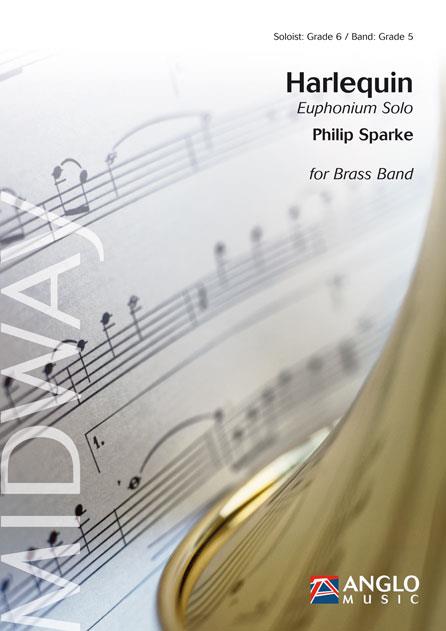
Harlequin (Euphonium Solo with Brass Band - Score and Parts) - Sparke, Philip
Harlequin was commissioned by, and is dedicated to, euphonium virtuoso David Childs. The piece takes its inspiration from the happy and sad masks that symbolise the Commedia dell'Arte (which features Harlequin as one of its main characters) and comprises of two movements, a slow modal ballad followed by a frenetic faster movement. A fantastic showpiece for the euphonium and brass band.Duration: 9:15
Estimated dispatch 7-14 working days
-
 £59.99
David of the White Rock (Brass Band - Score and Parts) - Sparke, Philip
This is an ancient Welsh air that was first published in Relics of the Welsh Bards in 1794. Dafydd (David) Owain was a famous Welsh bard who lived on a farm called Gareg Wen (The White Rock) in Eifionydd, Carnarnvonshire, North Wales. Tradition has it that on his deathbed he called for his harp and composed this lovely melody, requesting that it be played at his funeral. Accordingly, it was later played at the parish church of Ynys-Cynhaiarn. Lyrics were later added by Ceiriog Hughes, which describe the melody's inspiration. This version for brass band retains all the beauty and simplicity of the original.Duration: 2:45
Estimated dispatch 7-14 working days
-
 £59.99
Magga (Brass Band - Score and Parts) - Sparke, Philip
The Four Noble Truths was commissioned by the Dutch National Brass Band Championships for their 2003 competition. The Four Noble Truths are the most basic expression of the teaching of Buddha and therefore still form the guidelines for Buddhists to this day. They concern themselves with Dukkha, which has no exact translation but can mean suffering, stress or sadness etc. Magga is The Noble Truth of the Path Leading to the Cessation of Dukkha - the Fourth Noble Truth - which gives us a description of eight disciplines which can help us eliminate the origins of stress from our lives.Duration: 4.45
Estimated dispatch 7-14 working days
-
 £50.00
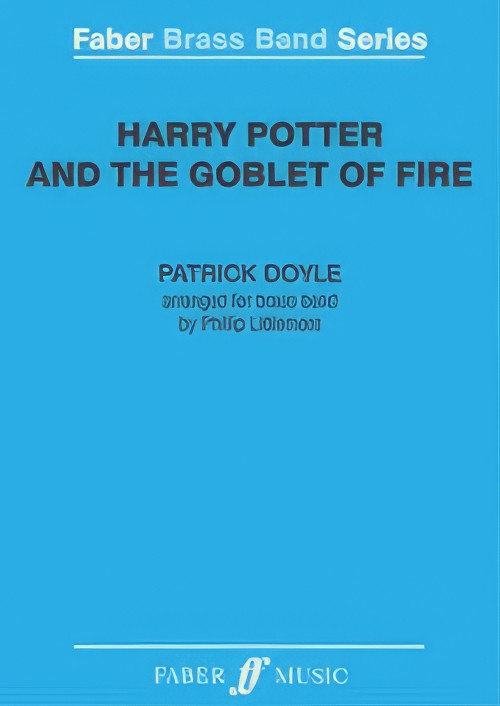
Harry Potter and the Goblet of Fire (Brass Band - Score and Parts) - Doyle, Patrick - Littlemore, Phillip
Harry Potter and The Goblet of Fire is the pivotal fourth novel in the seven-part tale of Harry Potter's training as a wizard and his coming of age. This suite for brass band includes the themes Harry In Winter, The Quidditch World Cup, Hogwarts' Hymn, Hogwarts' March and The Death Of Cedric. Suitable for Advanced Youth/3rd Section Bands and above. Duration: 7.00
Estimated dispatch 7-14 working days
-
 £59.99
In the Bleak Mid-Winter (Brass Band - Score and Parts) - Holst, Gustav - Sparke, Philip
Christina Rossetti wrote the words to this famous Christmas carol in 1872 in response to a request from the magazine Scribner's Monthly for a Christmas poem. They were set to music by Gustav Holst (1874-1934) for inclusion in the first edition (1906) of The English Hymnal, edited by his life-long friend, Ralph Vaughan Williams. Philip Sparke has carefully arranged the beautiful melody into this delightful version for brass band. A must for any Christmas concert.Duration: 3:30
Estimated dispatch 7-14 working days
 View Music