
Results
-
 £45.00
Three Christmas Portraits (Brass Band - Score and Parts) - Doe, Philip
A delightful set of three Christmas carols expertly adapted by Philip Doe. This suite of three pieces opens with Christmas Day, a dainty and light opening that shows the more delicate aspects of brass playing. The centre piece is a new version of The Coventry Carol, which open with a first verse rendition for quartet before developing a more baroque-style treatment that sits over an ostinato bass line. The movement reaches its climax with flourishes from the cornets leading to a rendition of the carol at fortissimo, and treated with slightly altered, harmonies before coming to rest with the opening quartet delivering the tierce de Picardie. The final movement is I Saw Three Ships, with handy interjections from several other carols, making a rousing climax to a enjoyable set of three Christmas portraits. Duration: 7.00
Estimated dispatch 7-14 working days
-
 £74.95
Song of Courage (Brass Band - Score and Parts) - Ball, Eric
New Contest VersionThe music reflects many moods. There is, to commence, joyfulness, and later some sense of fear and effort against great odds. The old chorus 'Stand like the brave' typifies the call to action in the face of danger, and 'A prayer for courage' - the central part of the composition - is a reminder of the true source of Christian fortitude.
Estimated dispatch 7-14 working days
-
 £37.50
Song of Courage (Brass Band - Score only) - Ball, Eric
New Contest VersionThe music reflects many moods. There is, to commence, joyfulness, and later some sense of fear and effort against great odds. The old chorus 'Stand like the brave' typifies the call to action in the face of danger, and 'A prayer for courage' - the central part of the composition - is a reminder of the true source of Christian fortitude.
Estimated dispatch 7-14 working days
-
 £84.95
Force of Nature (Euphonium Solo with Brass Band - Score and Parts) - Graham, Peter
Concerto for EuphoniumIn his writings, Ernest Hemingway defined the American hero for a generation.He created a new type of fictional character - a "man's man" - a hard drinking pugilist who enjoyed bullfights, big game hunting, deep-sea fishing and other "macho" pursuits. In many respects Hemingway was the living embodiment of his creation, though his somewhat idealised life ended in suicide on July 2nd 1961 and the chapter on this Force of Nature came to a close. The concerto reflects upon moments in this extraordinary life.Matador - the traditions of the Spanish bullfight fascinated Hemingway. He wrote frequently on the subject, going beyond the superficial and exploring at a deeper level the nature of fear and courage. This flamenco-inspired music equally contrasts moments of uncertainty and resolve.Wayfarer (Reflections on Poor Wayfaring Stranger) - the tensions of Hemingway's early life in the midwest suburb of Oak Park (a town he reputedly described as "narrow-minded") fuelled his wanderlust. At the age of 18 he arrived at the Italian Front, serving as an ambulance driver. Within days he was seriously wounded and the horrors of war put paid to adolescent illusions of immortality.Pilar - Hemingway's beloved boat Pilar could cut through the waves off the coast of Cuba at sixteen knots full-out. The music conjures up the thrill of the chase as the great fish hoves into view.Duration: 14.00
Estimated dispatch 7-14 working days
-
 £28.95
Hopak (Brass Band - Score and Parts) - Wiffin, Rob
An extended fanfare/opener, A New Beginning is a joyous and exuberant outburst, an affirmation of the eternal hope of the human spirit. It starts and ends with the drama and splendour of a simple fanfare and the sections in between are full of energy, drive and purpose.The musical language is typically American in style with its typical feel of openness, space and grandeur. There are plenty of big moments but players and conductors are asked to pay careful attention to the various layers to prevent it all being performed at full volume.Duration: 4.30
Estimated dispatch 7-14 working days
-
 £29.95
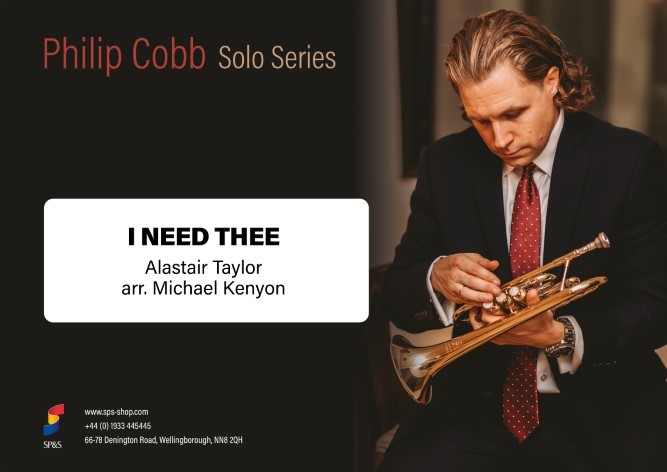
I Need Thee (Cornet Solo with Brass Band - Score and Parts) - Taylor, Alastair - Kenyon, Michael
In the late 1980s, Scottish composer Alastair Taylor bought a new setting to words by Annie S. Hawkes entitled I Need Thee. The impact of Taylor's setting was instant, and has since become a popular and much-loved song. Duration: 5.30
Estimated dispatch 7-14 working days
-
 £94.90
Sacred Night (Brass Band - Score and Parts) - Lovland, Rolf - Torskangerpoll, Idar
Secret Garden and Rolf Lovland have for many years given us unforgettable music. This is the title track from their first Christmas released in 2020.It's a warm and beautiful piece with a typical folk-music vibe. The instrumentation varies from the chamber-musical in the first verse to the tutti sounding refrains. This is music for those who want new Christmas music alongside the more traditional numbers on their Christmas concerts.Duration: 4.00
Estimated dispatch 7-14 working days
-
 £56.00
One Small Step (Brass Band - Score and Parts) - Fernie, Alan
New entertainment concert item from the pen of Alan Fernie.
Estimated dispatch 7-14 working days
-
 £74.99
Star Wars: The Last Jedi (Brass Band - Score and Parts) - Williams, John - Brown, Michael
From the blockbuster movie Star Wars: The Last Jedi, John Williams continues to display his mastery of music for film. This dynamic medley includes poignant new themes along with familiar older melodies as some of our favorite characters return for this episode. Duration: 4.45
Estimated dispatch 7-14 working days
-
 £64.99
March of the Resistance (Brass Band - Score and Parts) - Williams, John - Sparke, Philip
From the blockbuster film Star Wars: The Force Awakens, John Williams reprises a few earlier themes along with dynamic new material. The memorable March of the Resistance is fittingly dramatic and powerful, and is prominent at key moments inthe movie. Duration: 2.15
Estimated dispatch 7-14 working days
 View Music