
Results
-
 £17.99
Penlee (Brass Band - Score only) - Dobson, Simon
2013 Finals of the National Brass Band Championships of Great Britain - 3rd SectionTo some, the tragic story of the Penlee lifeboat, Solomon Browne, would need no introduction, and to some the pain felt is still very much a reality. The composer, born just a few weeks before that fateful night on the 19th December 1981, has created this work as a musical homage to the bravery of the souls who lost their lives and has dedicated it to their memory.Penlee was commissioned by the Cornwall Youth Brass Band using funds bequeathed by Michael Pickett. The first performance was given by the Cornish Youth Brass Band, conducted by Ian Porthouse, at St. Michael's Church, Newquay, on 30th December 2008.Penlee has been voted into the Classic FM Hall of Fame 2011 at No.106. Not only is it the first time a brass work has been featured in the Hall of Fame, but it was also the highest new entry.The work has subsequently been recorded by the Leyland Band, conducted by Jason Katsikaris, on the CD entitled Penlee.Suitable for Advanced Youth/3rd Section Bands and aboveDuration: 13:30
Estimated dispatch 7-14 working days
-
 £85.00
The Alchymist's Journal (Brass Band - Score and Parts) - Hesketh, Kenneth
The Alchymist's Journal (Variants for Brass Band) was commissioned by Faber Music Band Consultant Paul Hindmarsh in 2001, with the support of the Brass Band Heritage Trust, as a substantial concert/contest challenge that would be within the compass of the country's most able youth and first section bands. It received its first performance in January 2002, by Black Dyke Band under Nicholas Childs, as part of the Royal Northern College of Music Festival of Brass.Since its original publication, composer Kenneth Hesketh has made a number of revisions to the work. Most of these were included in the recording made by Foden's Band conducted by Bramwell Tovey. This definitive new edition, including all the composer's revisions, has been specially prepared for the 2015 National Brass Band Championships of Great Britain and is the text that all bands performing were required to use.Suitable for 1st Section Bands and aboveDuration: 12 minutes
Estimated dispatch 7-14 working days
-
 £79.95
The Plantagenets (Brass Band - Score and Parts) - Gregson, Edward
A Symphonic Study for Brass BandThe Plantagenets was Gregson's first major test piece, written specially for the 1973 National Brass Band Championships.In this ambitious symphonic study he turned his attention to music which sets out to create a mood or atmosphere, in contrast to his earlier brass band works such as Essay and Partita where the underlying concerns are technical rather than expressive. However, Gregson is at pains to emphasise that The Plantagenets is not programme music. 'Symphonic' is the optimum word here. In its textural and harmonic complexity, its rhythmic and melodic variety, this was his most ambitious brass band piece so far. His language, with its roots in Hindemith and Bartok is further enriched here with the expressive language of Holst and Rachmaninov.As he says in his notes on the work: The Plantagenets attempts to portray the mood and feelings of an age - that of the House of Plantagenet which lasted from the middle of the twelfth century to the end of the fourteenth. To many it conjures up an age of chivalry and this is represented by fanfare motifs which occur throughout the work in varied form.Characteristically, the composer then goes on to describe not the atmosphere or mood he is trying to convey, but the means by which the music has been composed: the opening fanfares, based on the interval of the third, generating the musical material for the whole work; an exposition of two themes - one fanfare-like, one lyrical (on horns); a slow episode introducing a new melody on solo horn (answered by cornet and euphonium in canon); a little scherzo, fugal in character; and a recapitulation leading to a maestoso statement of the slow movement theme with a final reference to the fanfares as a triumphant conclusion.Duration: 11.30
Estimated dispatch 7-14 working days
-
£39.95
The Plantagenets (Brass Band - Score only) - Gregson, Edward
A Symphonic Study for Brass BandThe Plantagenets was Gregson's first major test piece, written specially for the 1973 National Brass Band Championships.In this ambitious symphonic study he turned his attention to music which sets out to create a mood or atmosphere, in contrast to his earlier brass band works such as Essay and Partita where the underlying concerns are technical rather than expressive. However, Gregson is at pains to emphasise that The Plantagenets is not programme music. 'Symphonic' is the optimum word here. In its textural and harmonic complexity, its rhythmic and melodic variety, this was his most ambitious brass band piece so far. His language, with its roots in Hindemith and Bartok is further enriched here with the expressive language of Holst and Rachmaninov.As he says in his notes on the work: The Plantagenets attempts to portray the mood and feelings of an age - that of the House of Plantagenet which lasted from the middle of the twelfth century to the end of the fourteenth. To many it conjures up an age of chivalry and this is represented by fanfare motifs which occur throughout the work in varied form.Characteristically, the composer then goes on to describe not the atmosphere or mood he is trying to convey, but the means by which the music has been composed: the opening fanfares, based on the interval of the third, generating the musical material for the whole work; an exposition of two themes - one fanfare-like, one lyrical (on horns); a slow episode introducing a new melody on solo horn (answered by cornet and euphonium in canon); a little scherzo, fugal in character; and a recapitulation leading to a maestoso statement of the slow movement theme with a final reference to the fanfares as a triumphant conclusion.Duration: 11.30
Estimated dispatch 7-14 working days
-
 £49.99
Journey to the Past (from Anastasia) (Brass Band - Score and Parts) - Flaherty, Stephen - Bond, Christopher
Step into an enchanting world of nostalgia with the compelling sounds of Journey To The Past, a wonderful little gem by Stephen Flaherty, magically arranged for brass band by Christopher Bond. This song, originally composed for the popular animated film Anastasia, tells a story of hope, discovery and finding one's true self. The warm brass band sounds add a new dimension, infusing each note with emotion and passion.Duration: 3.15
Estimated dispatch 7-14 working days
-
 £91.99
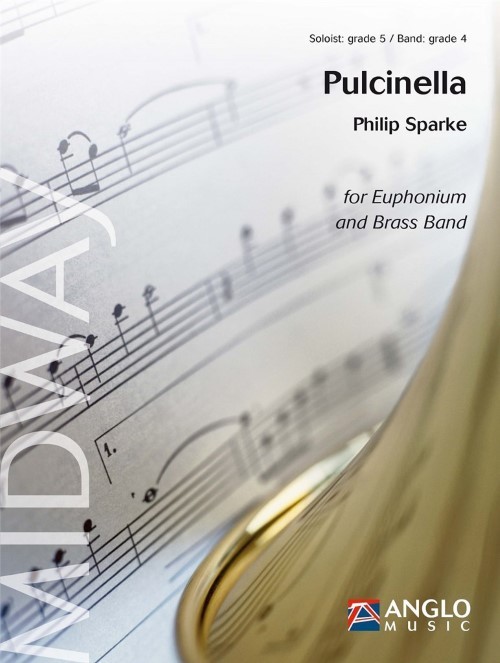
Pulcinella (Euphonium Solo with Brass Band - Score and Parts) - Sparke, Philip
Pulcinella was commissioned by the Taiwanese euphonium player Tzu-Hsiang Lin. Lin is a renowned soloist and teacher and a Besson Euphonium Artist. He teaches euphonium at Taipei National University of the Arts, National Taiwan University of Arts, Shih Chien University and National Kaohsiung Normal University. Lin gave the premiere of Pulcinella in both its concert band and brass band versions in January 2021. Pulcinella continues Sparke's series of euphonium solos named after characters of the Italian commedia dell'arte and opens with a long and expressive minor melody for the soloist over a brooding accompaniment. This is taken up briefly by the full band and is extended by the soloist after a change of key. A cadenza, accompanied by fragments of the main melody leads to a complete change of mood, tempo and tonality, introducing a Vivo section starting with a perky syncopated tune for the soloist. The band then uses elements of this new tune to introduce a change of key, where the soloist introduces a more lyrical second subject over a pulsing accompaniment. The band then takes this up and changes key to reintroduce the original Vivo melody, which leads to a short and acrobatic coda to bring the work to a spectacular close. Duration: 6.45
Estimated dispatch 7-14 working days
-
 £154.99
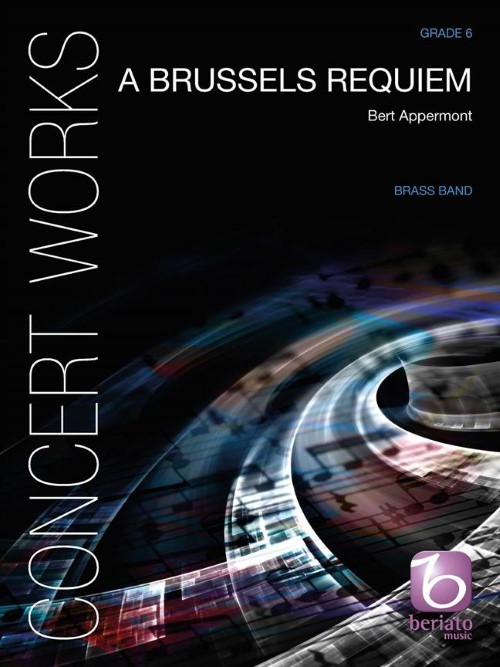
A Brussels Requiem (Brass Band - Score and Parts) - Appermont, Bert
The attacks in Brussels on 22 March 2016 created a shockwave throughout Belgium and the rest of the world. Equally, the attacks in Paris and Nice led to great public indignation, fear and disbelief. What has happened to the western world? Have our cultures grown apart to such an extent that we do not understand each other anymore? Bert Appermont's intention was to voice certain emotions that these acts of terror have caused: particularly fear, grief, anger, and helplessness. He uses the French children's song Au Claire de la Lune as a connecting thread throughout the work. This piece is also about hope and faith in another world, and is meant to pay homage to all victims, resulting in a dignified remembrance. The musical development is presented in four through-composed parts, titled Innocence, In Cold Blood, In Memoriam - We Shall Rise Again and A New Day. This work was commissioned by the Brassband Oberosterreich (Brass Band Upper Austria) to be played at the European Brass Band Championships 2017.Duration: 16.30
Estimated dispatch 7-14 working days
-
 £38.50
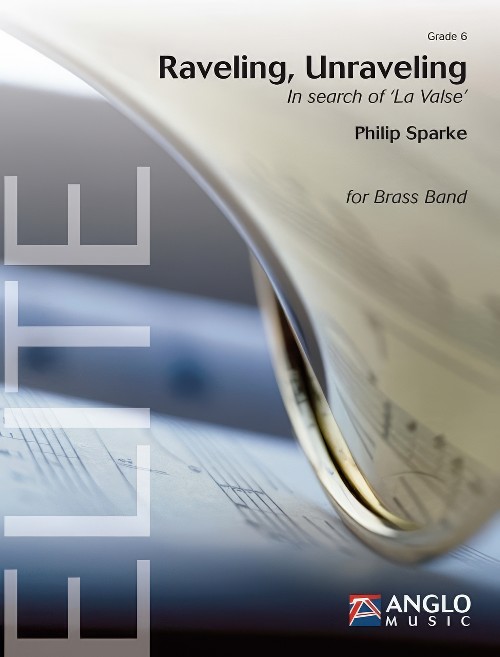
Raveling, Unraveling (Brass Band - Score only) - Sparke, Philip
Raveling, Unraveling - In Search of 'La Valse' was written for the Cory Band as their own-choice test piece for the 2016 European Brass Band Championships in Lille. The piece found its genesis in Sparke's The Unknown Journey (2014) for concert band, and the use of Ravel's La Valse as a structural undercurrent to the original piece is an act of reverence. Sparke's aim was to produce a work that is organic rather than episodic in nature. The composer's view is that little in music does this better than La Valse and for this reason he uses various sections of this masterpiece, both manipulated and quoted verbatim (including much of its stunning closing passages) to provide the overall geography of his new work. As the music progresses, more of the Ravel appears, surfacing completely as the piece reaches its climax - a gesture of homage to the French master.Duration: 16:30
Estimated dispatch 7-14 working days
-
£164.99
Raveling, Unraveling (Brass Band - Score and Parts) - Sparke, Philip
Raveling, Unraveling - In Search of 'La Valse' was written for the Cory Band as their own-choice test piece for the 2016 European Brass Band Championships in Lille. The piece found its genesis in Sparke's The Unknown Journey (2014) for concert band, and the use of Ravel's La Valse as a structural undercurrent to the original piece is an act of reverence. Sparke's aim was to produce a work that is organic rather than episodic in nature. The composer's view is that little in music does this better than La Valse and for this reason he uses various sections of this masterpiece, both manipulated and quoted verbatim (including much of its stunning closing passages) to provide the overall geography of his new work. As the music progresses, more of the Ravel appears, surfacing completely as the piece reaches its climax - a gesture of homage to the French master.Duration: 16:30
Estimated dispatch 7-14 working days
-
 £89.95
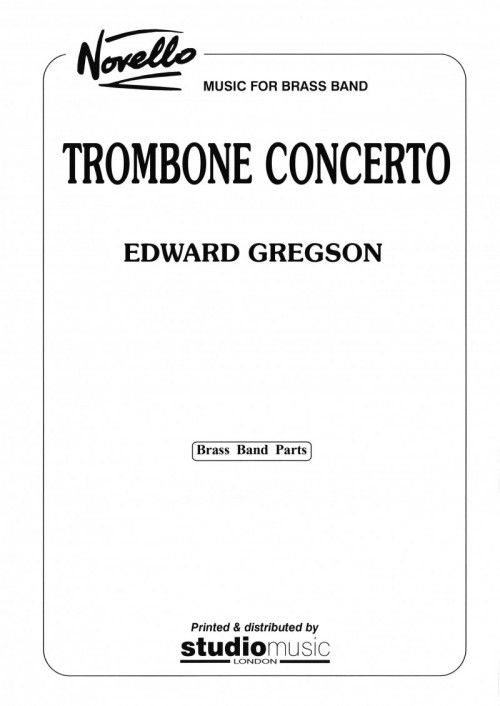
Trombone Concerto (Trombone Solo with Brass Band - Score and Parts) - Gregson, Edward
The Gregson Trombone Concerto was originally written in 1979 to a commission from Bedfordshire Education Service, for a new work for Michael Hext, winner of the first BBC Young Musician of the Year competition. This version for brass band was commissioned by Nicholas Childs, Music Director of the Black Dyke Band, specially for Brett Baker, the then principal trombone of the band. He has recorded it on the Doyen label with the Black Dyke Band.The work falls into three main sections, played without a break, but conforming to the traditional pattern of concerto structure. After a slow introduction, containing most of the motivic and rhythmic ideas used in the work, there follows the main fast section which is itself divided into three parts and concludes with a fierce climax (timpani and gong). The slow and rather intense middle section is linked to a cadenza for the soloist, at first unaccompanied but leading to accompanied references to earlier material. The final section is a scherzo which ends dramatically with a re-statement of the opening slow introduction. A brisk coda concludes the work. The interval of a fourth (and its augmented form) provides melodic and harmonic unity for the work, whilst the tonal juxtaposition between E minor and B flat major throughout the concerto is an important element of the structure.The writing for trombone is virtuosic, encompassing the whole range of the instrument, but it also exploits the rather beautiful lyrical sound of which this instrument is capable.
Estimated dispatch 7-14 working days
 View Music