Searching for Wind Band Music? Visit the Wind Band Music Shop
We've found 431 matches for your search. Order by

Results

  • £65.00

    Lyonesse. - Simon Dobson

    Lyonesse was commissioned by the Brass Band Heritage Trust as the test piece for the Finals of the National Youth Brass Band Championships held in Manchester in April 2005. This atmospheric music, ideal as atest piece for First and Second section bands, takes its inspiration from the lost kingdom of Lyonesse, the mythical spur of land linking Cornwall and the Scilly Isles, and its associated legend of Tristan and Isolde. BrassBand Grade 5: 1st Section Duration: 13 minutes

    Estimated dispatch 5-14 working days
  • £85.00

    Another world's hell - Simon Dobson

    Another World's Hell was commissioned in versions for brass, wind and fanfare bands by the Socit Cantonale des Musiques Vaudoises and the Association Cantonale des MusiquesNeuchteloises for the 2013 Swiss Cantonales festivals. It is inspired by a passage in Aldous Huxley's classic 1932 science-fiction novel Brave New World, which describes in unusually close detail themusic that is being played at a dance. This is Dobson's interpretation of the imagined 'future music' that Huxley dreamed of. Brass Band Grade 5Duration: 13 minutes

    Estimated dispatch 5-14 working days
  • £55.00

    Christmas Overture - Nigel Hess - Phillip Littlemore

    Nigel Hess' vivacious and colourful A Christmas Overture, originally commissioned as an orchestral work by John Rutter for his 2007 Christmas Festival, proved an instant success with audience and orchestra alike. Traditional carols, skilfully juxtaposed and interwoven, provide the thematic material. These include Ding Dong! Merrily On High; Il Est N Le Divin Enfant; Infant Holy, Infant Lowly; Personent Hodie; We Wish You A Merry Christmas and Angels From The Realms Of Glory, which brings the overture to a majestic close. Fragments of other carols appear along the way to enrich the texture of what is surely one of the mostattractive pieces written for the festive season. Brass Band Grade 4/5. Duration: 7 minutes, 30 seconds

    Estimated dispatch 5-14 working days
  • £76.99

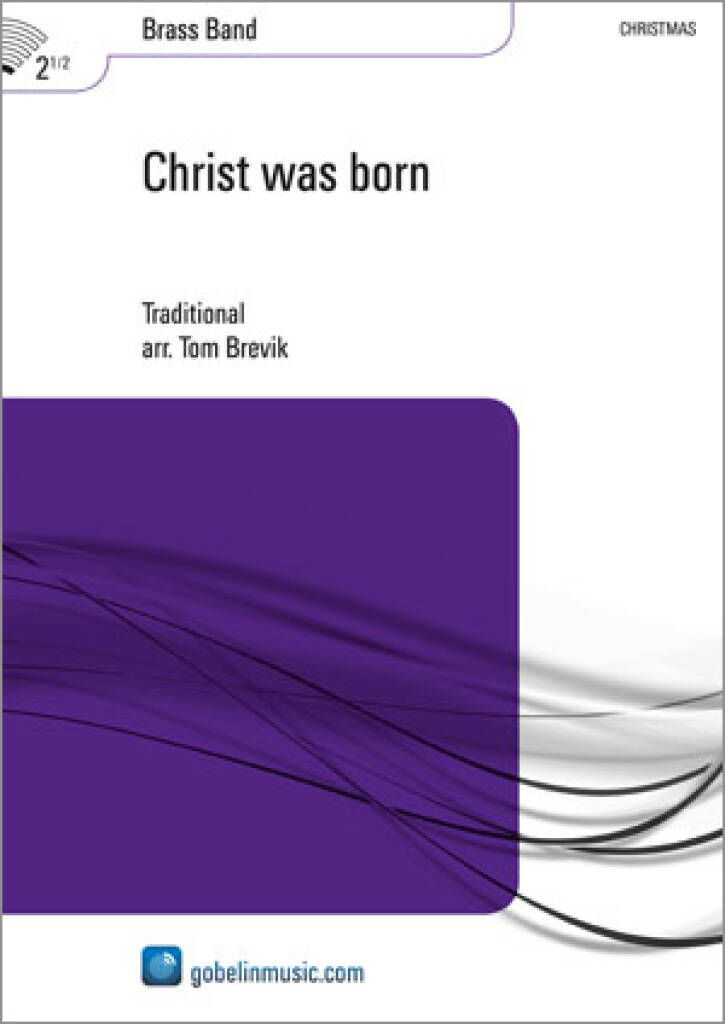
    Christ was born - Tom Brevik

    Norwegian traditional, arranged by Tom Brevik for cornet soloist and brass band.

    Estimated dispatch 5-14 working days

     PDF View Music

  • £104.99

    Kefas - Rob Goorhuis

    The composition Kefas was written for the brass band 'Apollo' from Grou (The Netherlands), by order of the Unisono Foundation, the organisation for wind music in The Netherlands.The assignment was given on account of earning the Champions Title during the Dutch Brass Band Championships in the year 2001 (4th division). The theme of the composition links the tradition of the village Grou, not to celebrate Sint Nicolaas but Sint Pieter.By this typical Dutch festivity (in December) the holy Nicolaas gives presents to the children. It is a popular custom where young and old participate. Grou is the only place where this is not done by Sint Nicolaas but by Sint Pieter.Apart from that, on the 22th of Februari, a lot of festivities that take place,resemble those of the Sinterklaas celebration. In the composition two Sint Pieter songs are processed, set through bible scenes, wherein in among others the visit of Christ to the house of Peter's Mother-in-law and the calling of Peter are depicted. The title refers to the pronouncement of Christ, where he named Peter the rock on which he shall build his church. The Hebrew word for rock is Kephas. Kefas was premiered in 2003.

    Estimated dispatch 5-14 working days

     PDF View Music

  • £137.99

    La Viuda Negra - Carl Wittrock

    Carl Wittrock composed La Viuda Negra (The Black Widow) for the Dutch Brass Band Championships (2010). A Spanish tinged composition filled with drama and emotion. La Viuda Negra is a Spanish widow, dressed in black clothes. Her face is marked by traces of sorrow, but her speaking eyes and sanguineous appearance attracts the attention of everyone. Many man's heart should beat faster! What is the story of this mysterious woman? The black widow (Latrodectus Mactan) is also the nickname of a spider. This spider is well known for the distinctive black and red coloring of the female of the species and for the fact that she will occasionally eat her mateafter reproduction.

    Estimated dispatch 5-14 working days

     PDF View Music

  • £80.00

    St. Magnus - Kenneth Downie

    Dedicated to Alastair Massey, an inspirational music teacher. Commissioned by the Scottish Brass Band Association for the 2004 European Brass Band Championships in Glasgow. This music is a set of variations on the tune known as St Magnus, which is attributed to Jeremiah Clarke. Most people will associate it with Thomas Kelly's hymn which begins: "The Head that once was crowned with thorns is crowned with glory now". The tune is very simple, consisting of just two, four-bar phrases. Neither is there much in the way of rhythmic variety, every note being a crotchet with the exception of two quavers, and the last note in each phrase. Within such a simple structure, however, lies considerable strength. THEME The listener is given the opportunity of hearing it twice, in full, at the beginning, starting with one player but soon taken up by the full ensemble. It returns in the middle of the music and is stated again near the end. This has been done quite deliberately in the hope that there will be an appreciation of what material is being developed, by the listener as well as by those with access to the score, who are able to see the visual connections. VARIATION 1 This takes the rhythm of the last part of the theme and also uses the shape of the opening as a recurring figure. The mood is whimsical and skittish, with short, teasing rhythmic figures tossed around the band, and quick interplay with percussion, at a fast tempo. An energetic flourish finishes this variation before the Andante espress. VARIATION 2 This commences with chords related to the opening of Variation 1. The cantabile on solo comets establishes a new, lyrical mood and there is scope for expressive playing in a series of short solo passages. The theme works its way unobtrusively into the texture before a reprise of the solo cornet melody and some more lyrical interchanges between Eb bass, euphonium, flugel horn and comets. The variation ends serenely with clear references to the last phrase of the theme. VARIATION 3 The first idea to dominate is clearly linked to the shape of the theme's first phrase. There is a frenetic feel to much of this variation, with considerable energy and instability created by extensive use of cross-rhythms. A thinning-out of the score marks a clear change to development of the start of the second phrase of the theme. This proves to be short-lived however, and the opening material returns leading to a restatement of the theme, "Maestoso," after which a euphonium cadenza links to Variation 4. VARIATION 4 Here we have some solos for euphonium, cornet, trombone and Eb bass set against a background of horns and baritones presenting a pensive statement of the theme's opening. VARIATION 5 This commences Allegro, with lively work for cornet and euphonium spreading to the whole band before attention focuses on the beginning of the second phrase of the theme which is initially presented in diminution, then in regular rhythm, then in inversion. An increase in tempo coupled with a decrease in volume, requires dexterity and control, with several metrical challenges thrown in for good measure. The same fragment of phrase becomes an ostinato which generates a frenzied climax, punctuated by short, dramatic silence, before the opening figure returns and the music gradually winds down. The tubular bells herald the final return of the theme, in augmentation, marking the start of the Finale. FINALE This features the running semiquavers of the previous variation sounding in counterpoint. A fast, furious coda speeds the work to a conclusion while references to the opening of the theme are still trying to break into the texture of the music. Kenneth Downie

    Estimated dispatch 5-14 working days
  • £271.60

    Aubade - Dawn Songs of the Fabulous Birds - Torstein Aagaard-Nilsen

    Commissioned by The Norwegian Band Federation for The European Brass Band Championship 2003, in Bergen, Norway (Third edition) I remember as a kid the very early morning wake-up ceremonies caused by Seagulls having a "party" outside our home. Very few would describe it as beautiful, particularly not at 4:30 in the morning... But by listening carefully to birds I was fascinated by their diversity and musical language: they dont sing tunes or long phrases, they rather make sounds and signals, based on short motives. Aubade is based on musical pictures of the imaginary birds: the creatures with wings that exists only in myths and legends. The whole story starts with aBaritone-cadenza that evoke all the sleeping creatures. Very soon they all start to sing their songs in one way or another. The composition has a burlesque scherzo-character including slow espressive intersections. Traditional elements like melody and harmony is combined with extensive sounds and textural effects created by use of multiple muting, singing and playing at the same time. I am not too concerned about having a program for the piece. I just know that by thinking of the unheard dragon-songs, griffin-songs, the sound of the dodo, my creativity was stimultated. As a piece of music, Aubade follows its own rules based on well-known elements like melodies, arpeggio-figures, harmonies, rhythms, variations and recapitulation of ideas. - Torstein Aagaard-Nilsen

    Estimated dispatch 5-14 working days

     PDF View Music

  • £137.70

    Why Not? - Michel A. Camilo - Lars Erik Gudim

    "Why Not?" is the most well-known piece by Dominican Republic pianist/composer Michel Camilo. It appeared for the fist time on his 1984 album record "French Toast". He re-recorded it in 1985 for the "Why Not?"-album whoich is among his best-selling to date. The song has also been recorded by other artist like the vocal group The Manhattan Transfer. "Why Not?" ia a modern latin-jazz classic and this demaning arrangement for Brass Band captures the featureless and musical challenges of the original piece.

    Estimated dispatch 5-14 working days
  • £115.60

    Julen ar har - Sölve Jan Rydell - Haakon Esplo

    The beautiful and popular duet "Christmas is Here", written by Billy Butt and Solve Rydell is now available in a beautiful, symphonic arrangement for brass band.Many people know the song from a recording made by Tommy Korberg and Sissel Kyrkjebo in 1989. This version ended up on the Swedish charts for four weeks over the Christmas-New Year 1989-1990 and has been very popular at Christmas concerts since.The lyrics of the song describe Christmas in the Nordic countries.

    Estimated dispatch 5-14 working days

     PDF View Music