
Results
-
 £34.00
99 Red Balloons (Nena arr. by David Beal) - Brass Band Music Full Score & Parts - LMAM118 DOWNLOAD ONLY
COMPOSER: Carlo Karges, Kevin Mcalea, Joern Uwe Fahrenkrog-PetersonARRANGER: David Beal"99 Luftballons" (German: Neunundneunzig Luftballons, "99 balloons") is a song by the West German band Nena from their 1983 self-titled album. An English-language version titled "99 Red Balloons" (German: Neunundneunzig Rote Luftballons), with lyrics by Kevin McAlea, was also released by Nena on the album 99 Luftballons in 1984 after widespread success of the original in Europe and Japan. The English version is not a direct translation of the German original and contains lyrics with a somewhat different meaning. In the US, the English-language version did not chart, while the German-language recording became Nena's only US hit on the Billboard Hot 100.
In Stock: Estimated dispatch 3-5 working days
-
 £30.00
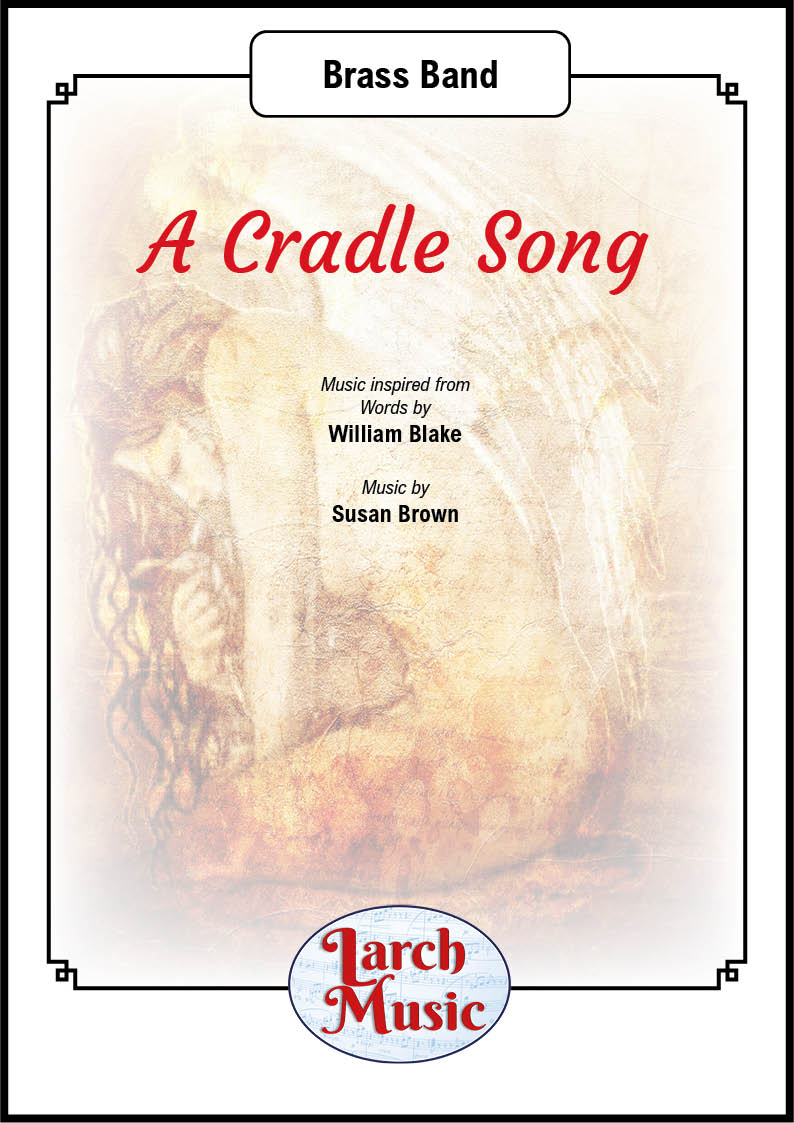
A Cradle Song - Brass Band Sheet Music Full Score & Parts - LM856 - Susan Brown
COMPOSER: Susan BrownMusic inspired by the Words of William BlakeA soothing and relaxing gentle cradle song from the pen of Susan BrownPlayable by most bands from 4th section upwardsA must for your band libraryLM856 - ISMN : 9790570008568
In Stock: Estimated dispatch 3-5 working days
-
 £30.00
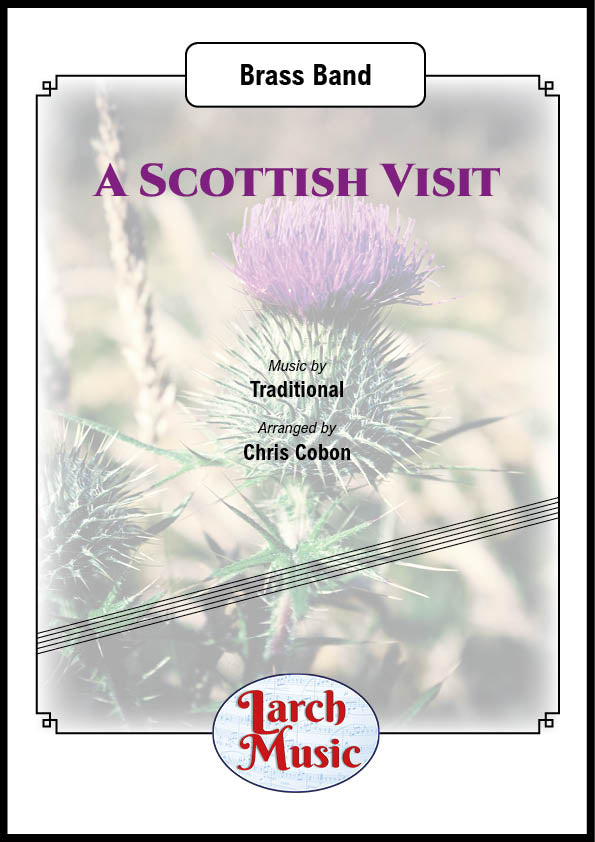
A Scottish Visit (Traditional arr. by Chris Cobon) - Brass Band Sheet Music Full Score & Parts - LM409
COMPOSER: TraditionalARRANGER: Chris CobonISMN : 9790570004096Take a trip to Scotland with your band. This medley comprises ofCock 'O The NorthWi' A Hundred PipersScotland The BraveGet the audience clapping along and maybe a highland fling....!LM409 - ISMN : 9790570004096
In Stock: Estimated dispatch 3-5 working days
-
 £30.00
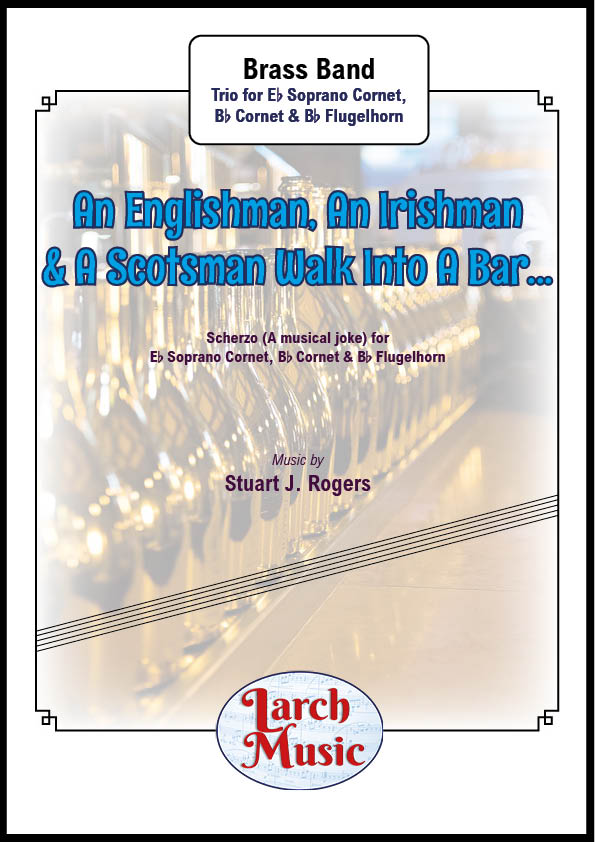
An Englishman, An Irishman & A Scotsman Walk Into A Bar - Trio & Brass Band Sheet Music Full Score & Parts - LM562
COMPOSER: Stuart J. RogersA delightful musical Scherzo (Joke) for the unlikely trio of Eb Soprano Cornet, Bb Cornet & Bb Flugelhorn.A great piece for both soloists and band alike with many a twist and turn.Suitable for 2nd Section and aboveLM562 - ISMN : 9790570005628
In Stock: Estimated dispatch 3-5 working days
-
£34.95
MARCH OF THE HOURS (Brass Band Set) - Emil Soderstrom
March of the Hours was first performed at Star Lake Music Camp in 1962 with the composer supplying an informative listening guide which was printed in the published score; "The phrases are of 12 crotchets each (three bars) signifying the 12 hours. Up to the trio, the music describes the headlong search for pleasure by the thoughtless. Abruptly, the trio brings 'I need thee every hour', but an episode employing the original theme pushes it aside until it reappears, this time against a background of chimes of the full hour (Westminster chimes). While the hour strikes 12, a paraphrase of the opening strains of 'When the trumpet of the Lord shall sound and time shall be no more' is heard. Here the music stops, to be followed by the trumpet sounding (cornets and trombones) and the rest of the band responds with 'When the roll is called up yonder' with a final 'I'll be there'."
Estimated dispatch 7-14 working days
-
 £37.06
Fanfares and Proclamations (Brass Band) Steven Ponsford
Fanfares and Proclamations was originally written in 2015 by Steven Ponsford for the massed bands of the International Staff and Melbourne Staff Bands of The Salvation Army. This piece of music, suitable as a concert opener, makes use of the hymn tunes Miles Lane and Diadem, both of which are associated with the words 'All hail the power of Jesus name'. To view a video of the International Staff and Melbourne Staff Bands performing the work please visit: www.youtube.com/watch?v=kzm4Mn1tdw8 PDF download includes score and full set of parts. Sheet music available from: UK - www.brassband.co.uk USA - www.solidbrassmusic.com Difficulty Level: Third Section + Instrumentation: Soprano Cornet Eb Solo Cornet Bb 1st Cornet Bb 2nd Cornet Bb Flugel Horn Bb Solo Horn Eb 1st Horn Eb 2nd Horn Eb 1st Baritone Bb 2nd Baritone Bb 1st Trombone Bb 2nd Trombone Bb Bass Trombone 1st Euphonium Bb 2nd Euphonium Bb Bass Eb Bass Bb Timpani Percussion 1-2
In Stock: Estimated dispatch 1-3 working days
-
 £52.50
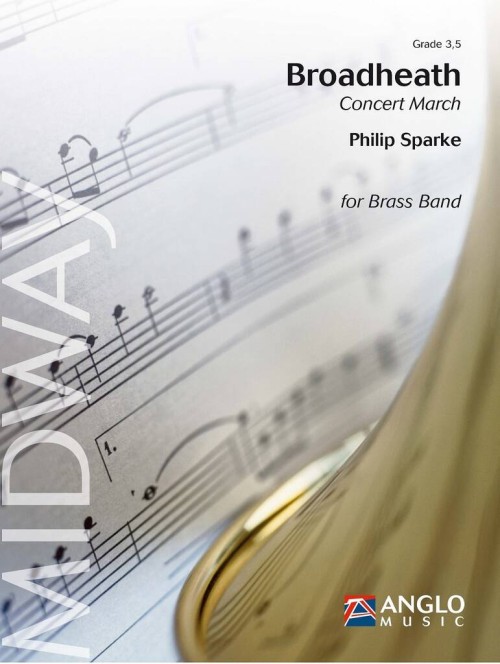
Broadheath (Brass Band - Score and Parts) - Sparke, Philip
Broadheath was commissioned by the Elgar International Brass Band Summer School for their 2024 course. The premiere took place in the Routh Hall at Bromsgrove School on Friday 26 July.It is in conventional march form, opening with a brief fanfare before the horns take up the main theme. This is then repeated by the full band before euphoniums and baritone announce the second subject. This builds to a stirring tutti passage utilising elements of the opening theme, which brings the opening section to a close.In honour of the summer school's tribute to Sir Edward Elgar (it is held in 'Elgar country'), the trio uses the opening melody of his 1st symphony as its main theme, decorating it with filigree work from the cornets. This is repeated on the full band and leads to a varied recapitulation of the opening material to bring the march full circle.Duration: 5.00
Estimated dispatch 7-14 working days
-
 £15.00
SALT OF THE EARTH, FINALE (Brass Band Score) - Scott, Andy
Brass Band score only. A full band arrangement created by the composer from the third movement of 'Salt of the Earth', a Concerto for Tuba & Brass Band is a fiery mix of Latin rhythms and big band power! With a virtuosic introduction from the solo cornets and percussion, the full band then enters with the catchy melody, before a two part contrapuntal passage that leads into a series of short 'solo breaks'. The main theme returns, re-scored for added impact, before an extended contrapuntal section, which leads to two closing paused chords, which may be separated by an optional extended drum/percussion solo if required. Dur: 3:30
Estimated dispatch 7-14 working days
-
 £107.95
Cornet Concerto (Brass Band - Score and Parts) - Gregson, Edward
The Cornet Concerto was commissioned by Black Dyke Band for their principal cornet, Richard Marshall, and was premiered at the European Brass Band Festival's Gala Concert in Lille, France, on 30 April 2016 by the same performers, conducted by Nicholas Childs.It is challenging work, both musically and technically, and one that exploits the wide range of the instrument's capabilities. Lasting for some 17 minutes, it is in the usual three movements: Sonata, Intermezzo (subtitled 'Of More Distant Memories') and Rondo.The first movement presents four main ideas:Cadenzas (which recur throughout the movement, and indeed appear at the end of the work); a fast and rhythmically energetic motive; Bugle calls (echoing the ancestor of the cornet), and a lyrical and expressive melody, full of yearning. These four ideas are juxtaposed within the broad shape of a Sonata form structure, although here the word 'Sonata' is used in its original meaning of 'sounding together'.The second movement is music in search of a theme, which eventually comes at the end of the movement. In the middle section there are brief quotations, albeit mostly hidden, from three cornet solos written by the Swedish/American composer Erik Leidzen for the Salvation Army in the 1940s and 50s; these are solos I loved as a teenager, and my use of them is by way of tribute, not imitation - a sort of memory bank, just as the main theme of the movement, when it eventually comes, is reminiscent of the tune from my earlier work for brass band, 'Of Distant Memories'.The final Rondo, the shortest of the three movements, is a lively and 'fleet-of foot' Scherzo, its main theme full of cascading arpeggios, but with a contrasting lyrical second theme intertwined in the structure. There is much interplay between soloist and band in the development of the music, but eventually a brief reprise of the opening cadenzas leads to an exciting and climactic coda.Click here for the piano reduction
Estimated dispatch 7-14 working days
-
 £49.95
Cornet Concerto (Brass Band - Score only) - Gregson, Edward
The Cornet Concerto was commissioned by Black Dyke Band for their principal cornet, Richard Marshall, and was premiered at the European Brass Band Festival's Gala Concert in Lille, France, on 30 April 2016 by the same performers, conducted by Nicholas Childs.It is challenging work, both musically and technically, and one that exploits the wide range of the instrument's capabilities. Lasting for some 17 minutes, it is in the usual three movements: Sonata, Intermezzo (subtitled 'Of More Distant Memories') and Rondo.The first movement presents four main ideas:Cadenzas (which recur throughout the movement, and indeed appear at the end of the work); a fast and rhythmically energetic motive; Bugle calls (echoing the ancestor of the cornet), and a lyrical and expressive melody, full of yearning. These four ideas are juxtaposed within the broad shape of a Sonata form structure, although here the word 'Sonata' is used in its original meaning of 'sounding together'.The second movement is music in search of a theme, which eventually comes at the end of the movement. In the middle section there are brief quotations, albeit mostly hidden, from three cornet solos written by the Swedish/American composer Erik Leidzen for the Salvation Army in the 1940s and 50s; these are solos I loved as a teenager, and my use of them is by way of tribute, not imitation - a sort of memory bank, just as the main theme of the movement, when it eventually comes, is reminiscent of the tune from my earlier work for brass band, 'Of Distant Memories'.The final Rondo, the shortest of the three movements, is a lively and 'fleet-of foot' Scherzo, its main theme full of cascading arpeggios, but with a contrasting lyrical second theme intertwined in the structure. There is much interplay between soloist and band in the development of the music, but eventually a brief reprise of the opening cadenzas leads to an exciting and climactic coda.Duration: 17.00
Estimated dispatch 7-14 working days

 View Music