
Results
-
 £34.95
Jesus Shall Conquer (Brass Band - Score and Parts) - Downie, Kenneth
This music was written for Salvation Brass. It is declamatory in style and would fit the role of an intrada. The words associated are by a former General of The Salvation Army, Albert Orsborn, and have a very optimistic tone, consistent with the Christian faith. The chorus reads: Jesus shall conquer, lift up the strain! Evil shall perish and righteousness shall reign.The tune used is Pilgrims (T.B. 548), by Henry Thomas Smart, the 19th Century English composer and organist, who also wrote another of my favourite hymn tunes, Regent Square. Keeping a steady tempo will help to preserve the dignity of the theme and also help to avoid the busier passages in the score from being rushed. As ever, articulation and dynamics require careful attention.
Estimated dispatch 7-14 working days
-
£17.50
Jesus Shall Conquer (Brass Band - Score only) - Downie, Kenneth
This music was written for Salvation Brass. It is declamatory in style and would fit the role of an intrada. The words associated are by a former General of The Salvation Army, Albert Orsborn, and have a very optimistic tone, consistent with the Christian faith. The chorus reads: Jesus shall conquer, lift up the strain! Evil shall perish and righteousness shall reign.The tune used is Pilgrims (T.B. 548), by Henry Thomas Smart, the 19th Century English composer and organist, who also wrote another of my favourite hymn tunes, Regent Square. Keeping a steady tempo will help to preserve the dignity of the theme and also help to avoid the busier passages in the score from being rushed. As ever, articulation and dynamics require careful attention.
Estimated dispatch 7-14 working days
-
£34.95
Salsalvation (Brass Band - Score and Parts) - Mackereth, Andrew
In writing this piece the composer set out to emulate the sound of the Stan Kenton big band and music of that 'golden' era. The piece itself is based around two Salvation Army tunes that are associated with the word, 'salvation'; Steadily forward march! (T.B. 799) and Hark, hark, my soul (T.B.542). The music is intentionally flamboyant and requires a secure grasp of the style and rhythm to be successful. It was featured at the Belfast Temple Music School to great effect.
Estimated dispatch 7-14 working days
-
£17.50
Salsalvation (Brass Band - Score only) - Mackereth, Andrew
In writing this piece the composer set out to emulate the sound of the Stan Kenton big band and music of that 'golden' era. The piece itself is based around two Salvation Army tunes that are associated with the word, 'salvation'; Steadily forward march! (T.B. 799) and Hark, hark, my soul (T.B.542). The music is intentionally flamboyant and requires a secure grasp of the style and rhythm to be successful. It was featured at the Belfast Temple Music School to great effect.
Estimated dispatch 7-14 working days
-
 £33.00
In Storm and Sunshine (Brass Band - Score and Parts) - Heed, John Clifford - Houlding, Christopher
New Jersey born composer and musician John Clifford Heed, who was born during the American Civil War was as a cornet soloist and arranger in the legendary band of John Philip Sousa. J.C Heed was also known as the "March Wizard". According to local legend in his hometown, it is claimed that Heed possibly wrote "The Stars and Stripes Forever". Chris Houlding's vibrant arrangement of "In Storm and Sunshine" is written in the style of a vibrant circus march, to be performed as quick as possible! Duration: 5.00. Suitable for 2nd Section Bands and above.
Estimated dispatch 7-14 working days
-
 £89.99
Broken Sword (Brass Band - Score and Parts) - Houben, Kevin
The Broken Sword is one of the five ceremonial swords kept in the Tower of London and is used during the coronation of a new king or queen. Legend has it that an angel broke off the tip of the sword in an effort to prevent an unjust killing. Composer Kevin Houben lets his music retell this intriguing legend. Broken Sword resembles a film score in many ways and will paint vivid images as the band plays its way through the legend. Many different moods create a contrast-rich work that makes for an exciting listening and playing experience every time!Duration: 11.45
Estimated dispatch 7-14 working days
-
 £40.00
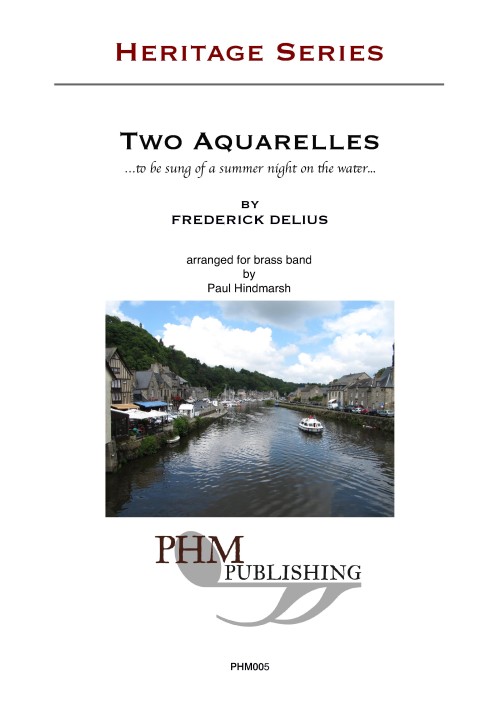
Two Aquarelles (Euphonium Feature with Brass Band - Score and Parts) - Delius, Frederick - Hindmarsh, Paul
In the late spring of 1917, the Bradford born composer, Frederick Delius (1856 - 1934) composed two short part-songs at his home in Grez-sur-Loing. The river ran along the bottom of his garden and he called the two miniatures To be sung of a summer night on the water. The First World War was at its height, but one would never guess that from the languid and serene quality of these richly textured nocturnes. The songs were first heard in London on 28 June, sung by the Oriana Madrigal Society, conducted by Charles Kennedy Scott. In 1932 Delius's amanuensis, Eric Fenby, arranged them for string orchestra as Two Aquarelles. While I have taken Fenby's title, my arrangement is a note-for-note transcription of the choral original. It was prepared in early in 1993 for Besses o' th' Barn Band, of which I was Musical Director at the time. In the second song, the prominent tenor solo has been given to the solo euphonium, who should stand apart from the band in performance.- Paul HindmarshDuration: 5.00
Estimated dispatch 7-14 working days
-
 £164.99
Diamond Concerto (Euphonium Concerto No.3) (Euphonium Solo with Brass Band - Score and Parts) - Sparke, Philip
Diamond Concerto was commissioned by Musikverein Morschied from Germany - Dr. Eric Grandjean, conductor - for a special concert featuring Steven Mead as guest soloist. Together they gave the world premiere on 28th April 2012 in the town theatre of Idar-Oberstein. The commission is a highlight in the 30-year friendship between composer and soloist, which has included many mutual CD projects and concerts and, now, a concerto. Sparke had Steven Mead's special euphonium sound in his head throughout the composition process and made free use of the variety of styles which the world-renowned virtuoso has made his own during his highly successful solo career.The village of Morschied lies to the west of Frankfurt am Main in the area known as the German Road of Precious Stones, which is famous for its thriving gem industry. Because of this it was decided to give the commission a local connection by choosing the title, Diamond Concerto. Each of the three movements is named after a famous diamond:Earth Star is rather stern in mood, opening with a free fantasy for the soloist over a static chord from the band. This leads to an Allegro Moderato in minor mode where small motives are gradually repeated and developed by both band and soloist.Ocean Dream uses a varied quote from the composer's Music for Battle Creek, including a melting slow melody that was originally written with Steven Mead in mind.Blue Heart was written, at Steven Mead's suggestion, in bebop style and takes the form of a jazz waltz. The quasi-improvisatory central section features a call-and-response passage for the soloist and upper woodwinds.Duration: 16:45
Estimated dispatch 7-14 working days
-
£44.95
The Victor (Brass Band - Score and Parts) - Downie, Kenneth
Written for the Melbourne Staff Band, this march features the hymn tune, 'Millennium'. While the origins of the tune are unclear, it has a distinct character; from the opening rising fourth interval through to its conclusion, it embodies strength and vigour. The composer has hinted at the style brilliantly employed by the great Australian march writer, Arthur Gullidge, by opting for a minor key in the first section offset by a melodious trio section in a major key.
Estimated dispatch 7-14 working days
-
£22.50
The Victor (Brass Band - Score only) - Downie, Kenneth
Written for the Melbourne Staff Band, this march features the hymn tune, 'Millennium'. While the origins of the tune are unclear, it has a distinct character; from the opening rising fourth interval through to its conclusion, it embodies strength and vigour. The composer has hinted at the style brilliantly employed by the great Australian march writer, Arthur Gullidge, by opting for a minor key in the first section offset by a melodious trio section in a major key.
Estimated dispatch 7-14 working days
 View Music