
Results
-
 £44.95
Funk Engine (Brass Band - Score and Parts)
'Funk Engine' was commissioned by Brass Bands England for the 2016 National Youth Brass Band Championships of Great Britain. What Ryan says about the piece:"When I was commissioned to write a piece for the Championships I decided that I wanted to create something a bit different to standard brass band repertoire. I decided that the best way to do this was to go a bit out of my comfort zone and explore some styles of music that I have yet to experiment with. I have always been a great lover of jazz, funk and big band music and the sounds associated with them. In 'Funk Engine' I have tried to capture some of these sounds, however I am a brass-bander at heart and as such I've tried to create a fusion of styles that hopefully combines the best of brass band and jazz into one piece.'Funk Engine' runs continuously, but is divided into three broad sections - fast, slow, fast. The opening is in driving big band style, which segues into a smoother lyrical section; the pace then picks up into a jazz inspired scherzo. After a delicate transition from the basses and trombones the euphonium plays a soaring scale - bringing us into the central movement - which begins with a series of languid solos before descending into a darker interlude. A flugel solo lightens the mood and the music gains momentum leading into a brief cornet chorale before a euphonium solo leads into a percussive climactic passage for full band. As this section winds down to settle on an open fifth, the Hi-hat and Bass section punctuate the texture with the first notes of the final section."The final section of the piece is in similar big band style to the opening and develops material from the first two movements. The percussion feature heavily at this stage and the tension builds towards a final statement, with the piece concluding with a bang!"
Estimated dispatch 7-14 working days
-
 £34.95
Island Whirl (Brass Band - Score and Parts)
Island Whirl was commissioned by Margaret Milligan who wanted a brand new piece of music composed as a present for Ian, her husband for his 70th birthday. Ian Milligan is a keen and dedicated musician and he is the musical director of Callendar Brass, based in Callendar near Stirling in Scotland.Margaret contacted me about the possibility of composing a short lively piece which had a Scottish theme that would be ideal for Callendar Brass Band and any other ensemble to get their teeth into. This piece takes its inspiration from the traditional Scottish folk song 'An Eriskay Love Lilt' which is a particular favourite of both Margaret and Ian.With thunderous Celtic drums the piece opens in a whirlwind of sound with fanfare brass and an off-stage soloist that can perform using either the cornet or trumpet. After the exciting opening, the brass and drums die away to allow the off-stage soloist to air the traditional tune 'An Eriskay Love Lilt'.The beautiful haunting melody, keeping its originality throughout undergoes a series of changes in the accompanying harmonic material before dying away to allow the Celtic drums to return. The percussion whip the band into a frenzy as the piece gets faster and faster. Just prior to the final notes the band diminuendo to allow one last closing statement from the Eriskay Love Lilt lead by the off-stage soloist before the ensemble charge to a dramatic close.When performing this piece I would recommend the off-stage soloist taking a position somewhere in the audience, so they can almost feel part of the performance. In addition, with the two tom-tom parts that represent the Celtic drums, bands should make the most of showcasing them by getting the two drummers out to the front of the band to perform. The ideal stage position would be with the players set up in stereo with one player in front of the soprano cornet and the other in front of the solo trombone.With the various choreographed movements from both the off-stage soloist and the percussionists. This piece is a great addition to any concert repertoire and is an ideal showcase for bands who want to try something a little different.I wish Ian at 70 years young, all the very best with his music making in the many years to come and I hope this piece, composed especially for him and Callender Brass brings them many years of musical enjoyment.Paul Lovatt-Cooper
Estimated dispatch 7-14 working days
-
 £100.00
Tuba Concerto (Tuba Solo with Brass Band - Score and Parts)
Ralph Vaughan Williams Tuba Concerto was written in 1953/4 in response to an invitation to compose a work for the Golden Jubilee of the London Symphony Orchestra. Vaughan Williams was by then in his eighty-second year. The lively, outer movements both conclude with extended cadenzas, while the beautifully lyrical Romanza is Vaughan Williams at his best. Phillip Littlemores brass band arrangement is a welcome addition to the brass band repertoire. Suitable for Championship Section Bands. Duration: 15.00
Estimated dispatch 7-14 working days
-
 £42.00
The Very Best Time of Year (Euphonium Solo with Brass Band - Score and Parts)
This new arrangement for Solo Euphonium & brass band by David Griffiths, truly evokes that feeling of nostalgia and longing anticipation of the joyous season and is a true celebration of all that we love about Christmas time! Suitable for 4th Section Bands and above
Estimated dispatch 7-14 working days
-
 £33.62
Les Chasseresses from 'Sylvia' (Brass Band) Delibes arr. Rob Bushnell
Clement Philibert Leo Delibes was a French composer, best known for his ballets and operas, including works such as Lakme (with its famous "Flower Duet"), Coppelia and Sylvia (both key works in the development of modern ballet). The latter started as a play, Aminta, by the Italian poet Torquato Tasso, which Delibes set to music. It was then adapted for the Paris Opera with rehearsals starting in August 1875. The premiere took place on 14 June 1876 and was the first ballet to be shown at the newly-built Opera Garnier. Whilst the scenery and costumes were created by top artists and designers (Cheret and Lacoste), it was Delibes's music that shown thrown, being said to have saved the production, preventing the ballet from drifting into obscurity.Sylvia is said to be one of the first modern ballets, with Tchaikovsky remarking to composer Sergei Taneyev upon its ingenuity: "... the first ballet, where the music constitutes not only the main, but the only interest. What charm, what elegance, what richness of melody, rhythm, harmony." Although Swan Lake, a contemporary to Sylvia, is considered one of the best ballets there is, Tchaikovsky preferred Sylvia to his own work, saying Swan Lake was "poor stuff in comparison". Tchaikovsky said to Taneyev, "I was ashamed. If I had known this music early then, of course, I would not have written Swan Lake". The music to Sylvia, rather than setting only the mood, also sets the action and is noted for its use of leitmotifs - Delibes was an admirer of Wagner - and more dominant use of brass and wind. The most famous piece from this ballet is the Pizzicati in the third act.Act I of the ballet takes place in sacred wood, where creatures are worshipping before Eros when Sylvia arrives with her huntresses to mock the god of love. Aminta, a lowly shepherd and infatuated with Sylvia, protects the deity and Sylvia is wounded by Eros's arrow. The hunter Orion kidnaps Sylvia, whilst Eros revives Aminta. Act II takes place in Orion's Island cave, where Sylvia tries to bribe Orion with jewels and wine. Unsuccessful, she appeals to Eros for help, who arrives and takes her to the temple of Diana (where the final act takes place). Orion and Aminta fight, Sylvia and Orion cause the goddess of the hunt, Diana, to be outraged, smiting Orion and denying the love of Aminta and Sylvia. Eros shows Diana a vision, which changes her mind and the couple finally come together.This brilliant and lively fanfare that introduces the huntresses in the first act is arranged here for the UK-style brass band, with alternative parts for horns in F and bass-clef lower brass. The piece has been lowered by a tone compared to the original. A recording of the original composition can be found here https://youtu.be/6yoGrUH38PI?si=0L0bFa1qXnYNvkR3 Duration: Approx. 3.10 minutes Difficulty Level: 1st Section + This PDF download includes the full score and parts. Includes alternative parts for soloist in Eb, horns in F and lower brass in bass clef. Sheet music available at www.brassband.co.uk (UK) or https://satradecentral.org (USA) Instrumentation: Soprano Cornet Eb Solo Cornet Bb Repiano Cornet Bb 2nd Cornet Bb 3rd Cornet Bb Flugel Horn Bb Solo Horn Eb 1st Horn Eb 2nd Horn Eb 1st Baritone Bb 2nd Baritone Bb 1st Trombone Bb 2nd Trombone Bb Bass Trombone Euphonium Bb Bass Eb Bass Bb Timpani Percussion - Triangle, Cymbal & Bass Drum
In Stock: Estimated dispatch 1-3 working days
-
 £85.92
Chorale Tangents (Brass Band) Kenneth Downie
VIEW SCORE PDF This magnificent work by Kenneth Downie was commissioned by Festival Brass Band of Belgium, and its conductor Manu Mellaerts. It was first performed by the band on 10th October 2010, in Mechelen, a beautiful old city in the province of Antwerp. The composer writes: 'The chorale in the title is the famous one associated with the words 'Now thank we all our God', dating from 17th century Germany. The words were written by Martin Rinkart and the music by Johann Cruger. The use of the word 'tangents' in the title can best be understood as variations. This is another set of variations, in the line of St. Magnus, Princethorpe and Purcell Variations. I still cannot resist the urge to present familiar material in an unfamiliar way! Hopefully, the listener can relate to these tangents, and experience some of the joy that I receive when writing them.' To view a video of Festival Brass Band performing the work please visit: https://www.youtube.com/watch?v=Kc83_BYkZSc Sheet music available from: UK - www.brassband.co.uk USA - www.solidbrassmusic.com Instrumentation: Soprano Cornet Eb Solo Cornet Bb Repiano Cornet Bb 2nd Cornet Bb 3rd Cornet Bb Flugel Horn Bb Solo Horn Eb 1st Horn Eb 2nd Horn Eb 1st Baritone Bb 2nd Baritone Bb 1st Trombone Bb 2nd Trombone Bb Bass Trombone Euphonium Bb Bass Eb Bass Bb Timpani Percussion 1-3
In Stock: Estimated dispatch 1-3 working days
-
 £29.88
Fanfare from La Peri(Brass Band) Dukas arr. Rob Bushnell
La Peri is a one-act ballet by the French composer Paul Dukas, best known for The Sorcerer's Apprentice (L'apprenti sorcier) as in the 1940 Disney film Fantasia. Dukas was commissioned to write La Peri by the Ballets Russes, producing a Poeme danse en un tableau ('dance poem in one scene') in 1911; this become his last published work. With Natalia Trouhanova due to play the Peri and Vaslav Nijinsky to play Iskender (the name of Alexander the Great in Persian, who is scouting around Iran in search of the Flower of Immortality), the production was ultimately cancelled because Serge Diaghilev feel Trouhanova was not a skilled enough dancer to be partnered to Nijinsky. Trouhanova later hired Ivan Clustine to choreograph the music, with the ballet premiering at the Theatre du Chatelet in Paris on 22 April 1912.The brilliant fanfare that precedes the ballet is often performed separately and is the arrangement available here. Arranged for British-style brass band, it has optional percussion parts as well as alternative parts for horns in F and bass-clef lower brass. The piece has been lowered by a tone compared to the original. A recording of the original composition can be found here: www.youtube.com/watch?v=7EDekMos1ok. Duration: Approx. 2 minutes Difficulty Level: 2nd Section + Duration: 4 or 5 minutes (depending on tempo and without any cuts) PDF download includes parts and score. Sheet music available at www.brassband.co.uk (UK) or https://satradecentral.org (USA) Instrumentation: Soprano Cornet Eb Solo Cornet Bb Repiano Cornet Bb 2nd Cornet Bb 3rd Cornet Bb Flugel Horn Bb Solo Horn Eb 1st Horn Eb 2nd Horn Eb 1st Baritone Bb 2nd Baritone Bb 1st Trombone Bb 2nd Trombone Bb Bass Trombone Euphonium Bb Bass Eb Bass Bb Timpani Percussion 1 - Snare Drum Percussion 2 - Bass Drum & Cymbal
In Stock: Estimated dispatch 1-3 working days
-
 £33.62
Nessun Dorma (Trombone Solo with Brass Band) Puccini arr. Ian Jones
This trombone solo with brass band was arranged by Ian Jones for Ronald Prussing, principal trombone of the Sydney Symphony Orchestra, for a recording with the Melbourne Staff Band. Nessun Dorma is an aria from the final act of Puccini's opera Turandot. It is one of the best loved of all Puccini's arias. To view a follow-the-score video featuring Ronald Prussing performing the solo with the Melbourne Staff Band, please visit www.youtube.com/watch?v=n9fREiH41sQ Sheet music available from: UK - www.brassband.co.uk USA - www.solidbrassmusic.com Instrumentation: Trombone Soloist Bb Soprano Cornet Eb Solo Cornet Bb 1st Cornet Bb 2nd Cornet Bb Flugel Horn Bb Solo Horn Eb 1st Horn Eb 2nd Horn Eb 1st Baritone Bb 2nd Baritone Bb 1st Trombone Bb 2nd Trombone Bb Bass Trombone Euphonium Bb Bass Eb Bass Bb Timpani Percussion
In Stock: Estimated dispatch 1-3 working days
-
 £42.00
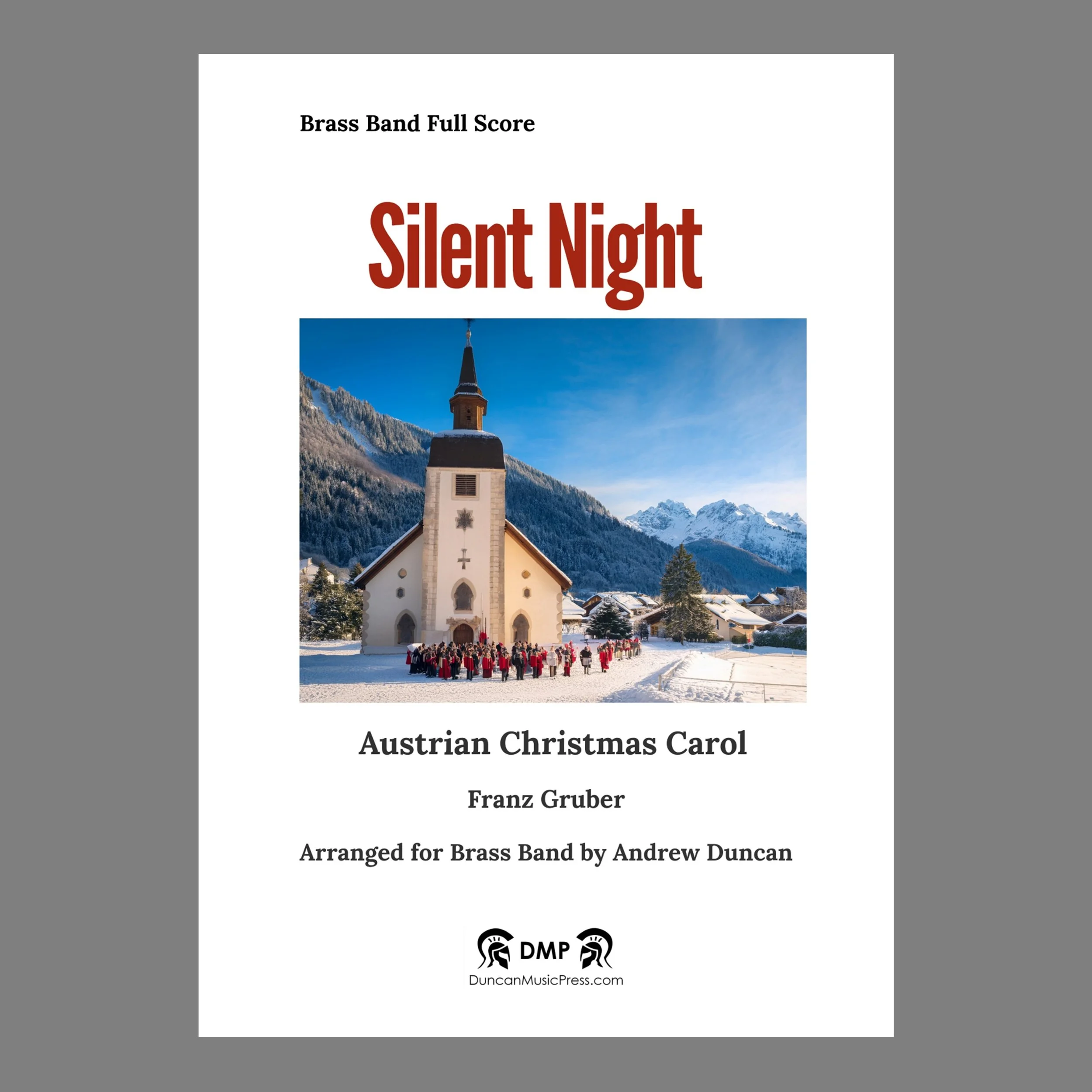
Silent Night. Franz Gruber arranged for brass band by Andrew Duncan
Silent Night is an Austrian Christmas Carol written by Franz Gruber, (1787-1863). Franz Gruber was an primary school teacher, organist and composer who lived in the village of Arndorf in Austria. Silent Night (Stille Nacht) has become one of the best loved Christmas Carols ever written. This arrangement for brass band imagines Christmas morning in a small Austrian village, such as Arndorf, with the sound of the local church bells ringing out along with the sound of a choir singing Silent Night accompanied by the local band.. The arrangement features the tubular bells playing a simple descending scale, which is also played by muted cornets (2nd and 3rd cornets). After 2 verses of the hymn the coda features a short trombone trio with a jazzy feel which leads into a final scale from the tubular bells and cornets bringing the piece to a peaceful close. To hear a sound file of Silent Night scroll down.
-
 £31.00
Braithwaite For Brass - Brass Band - MM013 - Ian Thomas, Daryl Braithwaite, Wlater Becker & Ricky Lee Jones - Tim Middleton
COMPOSER: Ian Thomas, Daryl Braithwaite, Wlater Becker & Ricky Lee JonesARRANGER: Tim MiddletonAll new Brass Band arrangement featuring the best of Daryl Braithwaite including:"The Horses", "One Summer", and "As The Days Go By"A must for your summer concerts!
In Stock: Estimated dispatch 3-5 working days
 Watch video