
Results
-
 £24.95
The Pilgrim's Prayer (Brass Band - Score and Parts) - Rouse, Sydney - Ball, Eric
Introduction - This could hardly be more simple. Inexperienced players may have some little difficulty in intonation, especially as they are starting 'cold', but a useful lesson can be learned in this connection when rehearsing these two bars. Section A - The music is hymn tune-like in character, but it should not become stilted. Close intonation is still a point to study, especially in view of the chromatic nature of some of the harmony. Section B - Aim to secure just balance in the accompanying parts, especially in the second phrase, where the 1st comets may be inclined to treat their moving part as an independent melody rather than part of the 'colour' background. Section C -This is a reprise of the first theme, with a different arrangement. The same comments apply, however. Section D - Here the music becomes more song-like in style, and provides an interesting contrast. The scoring, too, is more varied, and there are a number of points that call for attention. Note that the 1st and 2nd comets and 2nd trombone work as a team throughout; see that the pulsating, syncopated background adds to the movement of the music without giving a jerky effect; the new entries in the fourth and twelfth bars are to be made quite smoothly; and do not allow the texture of the music, especially in the last eight bars of the section, to overshadow the simplicity of the main tune. Section E - Here the first subject appears again. In the arrangement the colour contrasts are quite clear-cut. In order to secure true balance in the fifth and sixth bars, it may be necessary to adjust the amount of tone given by the bass trombone, as this part is not doubled as are the other parts. Section F -This section forms a simple but expressive coda.
Estimated dispatch 7-14 working days
-
£12.50
The Pilgrim's Prayer (Brass Band - Score only) - Rouse, Sydney - Ball, Eric
Introduction - This could hardly be more simple. Inexperienced players may have some little difficulty in intonation, especially as they are starting 'cold', but a useful lesson can be learned in this connection when rehearsing these two bars. Section A - The music is hymn tune-like in character, but it should not become stilted. Close intonation is still a point to study, especially in view of the chromatic nature of some of the harmony. Section B - Aim to secure just balance in the accompanying parts, especially in the second phrase, where the 1st comets may be inclined to treat their moving part as an independent melody rather than part of the 'colour' background. Section C -This is a reprise of the first theme, with a different arrangement. The same comments apply, however. Section D - Here the music becomes more song-like in style, and provides an interesting contrast. The scoring, too, is more varied, and there are a number of points that call for attention. Note that the 1st and 2nd comets and 2nd trombone work as a team throughout; see that the pulsating, syncopated background adds to the movement of the music without giving a jerky effect; the new entries in the fourth and twelfth bars are to be made quite smoothly; and do not allow the texture of the music, especially in the last eight bars of the section, to overshadow the simplicity of the main tune. Section E - Here the first subject appears again. In the arrangement the colour contrasts are quite clear-cut. In order to secure true balance in the fifth and sixth bars, it may be necessary to adjust the amount of tone given by the bass trombone, as this part is not doubled as are the other parts. Section F -This section forms a simple but expressive coda.
Estimated dispatch 7-14 working days
-
 £54.50
Carnival of Venice (Bb Solo with Brass Band - Score and Parts) - Arban, Jean-Baptiste - Wilkinson, Keith M.
Bb Solo with Brass BandThe Carnival Of Venice is arguably everyone's favourite solo, especially the version by Arban (1820 - 1869), author of the famous brass-playing method book still in regular use today. Young soloists aspire to master the necessary techniques, accomplished soloists know that it is a "sure fire" winner with audiences and listeners love to be dazzled by a virtuoso display of variations on a theme they easily recognise.The theme is a traditional Italian song and has inspired variations for almost every possible instrument. Arban's famous variations were written in 1864. The arrangement remains faithful to the original while maintaining interest in the accompaniments by varying the orchestration. Although the arrangement is listed as featuring the euphonium as the solo instrument, it can also be used successfully as accompaniment for a cornet soloist.The arrangement has been recorded by Jeff Binns, euphonium, and St Louis Brass Band, musical director Keith M Wilkinson, on the CD Strike Up The Band and by Anthony Avitollo, euphonium, and Cuyahoga Valley Brass Band, musical director Keith M Wilkinson, on the CD Around The World.
Estimated dispatch 7-14 working days
-
£34.95
Vain Resistance (Brass Band - Score and Parts) - Ritman, Olaf
This extended suite was written for the Amsterdam Staff Band by its own Bandmaster. It features the tunes St. John in the first movement and Moscow in the third with a more reflective original melody within the second movement evoking the listener to 'Be still and know that I am God'.
Estimated dispatch 7-14 working days
-
£17.50
Vain Resistance (Brass Band - Score only) - Ritman, Olaf
This extended suite was written for the Amsterdam Staff Band by its own Bandmaster. It features the tunes St. John in the first movement and Moscow in the third with a more reflective original melody within the second movement evoking the listener to 'Be still and know that I am God'.
Estimated dispatch 7-14 working days
-
 £60.99
Gelobet seist du, Jesu Christ (Brass Band - Score and Parts) - Blanken, John
Gelobet Seist Du Jesu Christ (We Praise You Jesus Christ) is an old Christmas hymn dating from the 16th century, which can still be found in many hymnbooks today. John Blanken has created a varied and imaginative arrangement on four verses of the hymn. A perfect item for you next Christmas concert.Duration: 4:00
Estimated dispatch 7-14 working days
-
 £80.00
St. Magnus - Kenneth Downie
Dedicated to Alastair Massey, an inspirational music teacher. Commissioned by the Scottish Brass Band Association for the 2004 European Brass Band Championships in Glasgow. This music is a set of variations on the tune known as St Magnus, which is attributed to Jeremiah Clarke. Most people will associate it with Thomas Kelly's hymn which begins: "The Head that once was crowned with thorns is crowned with glory now". The tune is very simple, consisting of just two, four-bar phrases. Neither is there much in the way of rhythmic variety, every note being a crotchet with the exception of two quavers, and the last note in each phrase. Within such a simple structure, however, lies considerable strength. THEME The listener is given the opportunity of hearing it twice, in full, at the beginning, starting with one player but soon taken up by the full ensemble. It returns in the middle of the music and is stated again near the end. This has been done quite deliberately in the hope that there will be an appreciation of what material is being developed, by the listener as well as by those with access to the score, who are able to see the visual connections. VARIATION 1 This takes the rhythm of the last part of the theme and also uses the shape of the opening as a recurring figure. The mood is whimsical and skittish, with short, teasing rhythmic figures tossed around the band, and quick interplay with percussion, at a fast tempo. An energetic flourish finishes this variation before the Andante espress. VARIATION 2 This commences with chords related to the opening of Variation 1. The cantabile on solo comets establishes a new, lyrical mood and there is scope for expressive playing in a series of short solo passages. The theme works its way unobtrusively into the texture before a reprise of the solo cornet melody and some more lyrical interchanges between Eb bass, euphonium, flugel horn and comets. The variation ends serenely with clear references to the last phrase of the theme. VARIATION 3 The first idea to dominate is clearly linked to the shape of the theme's first phrase. There is a frenetic feel to much of this variation, with considerable energy and instability created by extensive use of cross-rhythms. A thinning-out of the score marks a clear change to development of the start of the second phrase of the theme. This proves to be short-lived however, and the opening material returns leading to a restatement of the theme, "Maestoso," after which a euphonium cadenza links to Variation 4. VARIATION 4 Here we have some solos for euphonium, cornet, trombone and Eb bass set against a background of horns and baritones presenting a pensive statement of the theme's opening. VARIATION 5 This commences Allegro, with lively work for cornet and euphonium spreading to the whole band before attention focuses on the beginning of the second phrase of the theme which is initially presented in diminution, then in regular rhythm, then in inversion. An increase in tempo coupled with a decrease in volume, requires dexterity and control, with several metrical challenges thrown in for good measure. The same fragment of phrase becomes an ostinato which generates a frenzied climax, punctuated by short, dramatic silence, before the opening figure returns and the music gradually winds down. The tubular bells herald the final return of the theme, in augmentation, marking the start of the Finale. FINALE This features the running semiquavers of the previous variation sounding in counterpoint. A fast, furious coda speeds the work to a conclusion while references to the opening of the theme are still trying to break into the texture of the music. Kenneth Downie
Estimated dispatch 5-14 working days
-
£54.99
God rest ye merry Gentlemen - Andrew R. Mackereth
'God rest ye merry, Gentlemen' is an ancient English carol. It was first published in 1833, but it can be traced as far back as the 15th century, which makes it one of the oldest carols known. 'God rest ye merry' is a Middle English salutation. In this manner, people wished one another greatness and might. In modern English, the first line of this carol would read 'May God keep you mighty, gentlemen'. Andrew R. Mackereth has not kept to the original words in his up-tempo arrangement of the carol. It is still clearly recognizable, but the arranger has taken a good many liberties. Sometimes a particular note is held longer, at times motifs follow oneanother in various parts. If you listen carefully, you may even be able to detect a motif from another well-known song.
Estimated dispatch 5-14 working days
-
 £105.20
Optimist - John Teigen - Øystein Sjøvaag Heimdal
"Optimist" is one of the most well-known songs by Norwegian singer and composer Jahn Teigen. It was written for the Norwegian Eurovision in 1989. It did not win this competition, but is still one of the greatest Norwegian songs from the late 1980's. This arrangement is very close to the original in form, rhythmic- and melodic lines. The repeat at bar 65 may be played as many times as one wish, or it can be omitted.
Estimated dispatch 5-14 working days
-
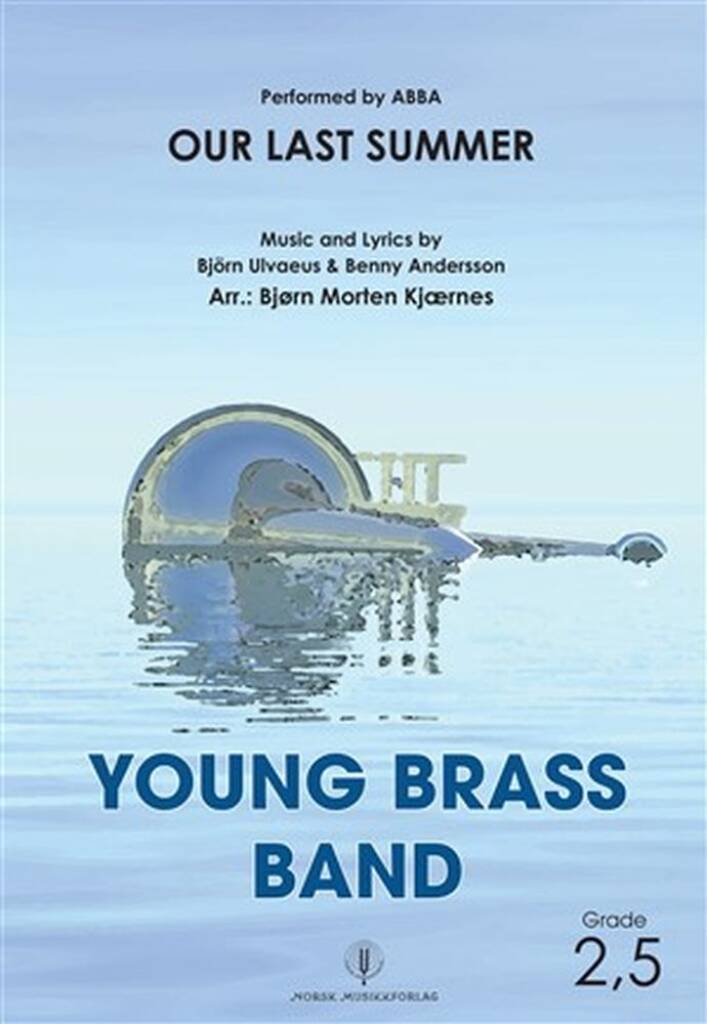 £105.20
Our Last Summer - Benny Andersson - Bjørn Morten Kjærnes
An exciting arrangement where almost all players have a bit of the melody line. There are many opportunities to give individual musicians soloistic challenges. Any bandmember should find something interesting in this piece. It will be possible to add vocals to the arrangement. A lovely melody with great expressions.Our Last Summer" is a song by the Swedish pop group ABBA from their seventh studio album, "Super Trouper," released in 1980. The song is indeed featured in the musical "Mamma Mia!", a little bit shortened and with small changes in the lyrics. The musical premiered in London's West End in 1999 and is a duet performed by the characters Harry Bright and Donna Sheridan, reflecting on their past romance during a summer spent in Paris.The song is primarily sung by Bjorn Ulvaeus, with backing vocals provided by Agnetha Faltskog and Anni-Frid Lyngstad, the female members of ABBA. Their harmonies contribute to the song's nostalgic and wistful atmosphere. The lyrics vividly describe the memories of the summer spent together, including scenes of walking along the Seine River in Paris and listening to French songs. The song also touches on the passage of time and the realization that the summer romance has ended.While not released as an official single in most countries, "Our Last Summer" still received considerable airplay and became a fan favorite. It charted in some European countries and has remained popular among ABBA fans over the years.
Estimated dispatch 5-14 working days
 View Music