
Results
-
Wild Flower Variations - Traditional - Len Jenkins
The theme for this delightful piece is believed to be Spanish and was originally heard in a Mediterranean church over 30 years ago, sung by the local choir accompanied by local musicians. The theme is not stated separately, and the piece begins directly with the First Variation. The following Variations are subtly different from the First, yet both retain the essential warmth of the Mediterranean sun in their harmonic progression. A short Coda rounds off this relaxing and escapist siesta. Time to wake up...The piece is scored to be playable by most Third or Fourth Section bands.
-
Runaway - Max Crook & Del Shannon - Len Jenkins
"Runaway" was made famous by Del Shannon in 1961 when it was released in the February of that year and quickly became an international hit. At its height it was said to be selling at the rate of 80,000 singles per day and in the June made number one in the UK. It was written with Max Crook who had invented his own clavioline-based electric keyboard called a Musitron which features in the original recording. The song was originally recorded in A minor, but the producer sped up the finished recording to just below B-flat minor. The iconic synthesiser sound in this arrangement is reproduced as a solo on Soprano cornet, and should be within the capabilities of most players provided attention is paid to the breathing regime.
-
Duet For Two Cats - G. Rossini - Len Jenkins
"Duet For Two Cats" is often performed as an encore to vocal recitals and operatic galas. It may be sung by two sopranos, male-female pairs, or even as a tomcat duet and can be accompanied by a piano or a full orchestra. The lyrics are simple; the single word 'Miaow', repeated with various styles of inflexion and attitude throughout the piece. Our arrangement is for a cornet and trombone. The piece is generally ascribed to Rossini, though there is some doubt as to its actual origins and whether it is an authentic work by that composer. It is believed that an English composer, Robert Lucas Pearsall under the pseudonym G. Berthold may have assembled the various elements from Rossini and perhaps other composers into the piece as we now know it. In order to achieve the correct balance between band and soloists, there is a need to mute most of the band instruments. Recognising that not all bands will have the larger mutes which are expensive and sometimes unwieldy, we suggest a form of muting made famous by a jazz trumpeter and which works well on most instruments. It consists of a circle of heat resistant padded table covering or felt, slightly larger than the bell diameter, with an elasticated edge like a 'mop-hat'. With 3 holes in it to let the sound out, the mute is then simply stretched over the bell to achieve the desired effect and folded up when not required.
-
The Tricorn - Len Jenkins - Len Jenkins
The Tricorn is a style of three-cornered hat from Europe in the 18th century, generally referred to as a 'cocked hat' in Britain and popular in America at the time of the War of Independence. It may still be seen on ceremonial occasions as part of the town-cryer's dress in England and features in a popular German song for children 'Mein Hut, der hat drei Ecken'. However, in the case of this music, the reference is to the cornet section and the requirement for triple-tonguing on the Eb Soprano cornet. Whilst ostensibly a concert march in style, its jaunty rhythm makes you want to stride along and it may therefore be used as a 'road march' as well. Pressure on the Soprano cornetist as a soloist is reduced by adding the Solo Cornets to the melody line in the 'road march' version. With this in mind, we supply the music in both A4 (concert) and A5 (march-card) sizes as a package.
-
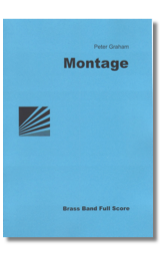 £62.00
Montage (Score only) - Peter Graham
Each of the movements of the symphony take as their starting point forms originating in music of the 16th and 17th centuries. The first, an intrada, introduces the main thematic material (based on the interval of a minor third) in its embryonic state. As the piece progresses, this material is developed and manipulated in a variety of ways. The interval of the third remains central to the overall scheme of the work, even unifying the three movements on a tonal plane (I: F (minor); II: A flat (major); III: C flat (minor). The internal structure of the intrada is an arch form: ABCBA, roughly modelled on the first movement of Concerto for Orchestra by Witold Lutoslawski, to whose memory the movement is dedicated. A chaconne follows - the basic material now transformed into expansive solo lines underpinned by a recurring sequence of five chords (again, a third apart). The movement's structure combines both ternary form and golden section principles and the chaconne's continuous cycle of chords may be visualised as circles. The final movement, a rondo, bears the dramatic weight of the entire work, as the underlying tonal tensions surface. A musical journey ensues, making diversions through lyrical territories as well as through more spiky, jazz-flavoured ones. The aural (and visual) montage is perhaps most apparent towards the climax of the piece, where three keys and polyrhythms sound simultaneously in the upper brass, xylophone, horns, and timpani. The climax itself combines the lyrical music heard earlier with the rondo theme, now presented by cornets and trombones in canon. The teleological thrust of the movement (if not the entire work) can be symbolized by the flight of an arrow, as it steers a predetermined course towards its target. Duration: 16:00
Estimated dispatch 7-9 working days
-
 £74.00
Montage (Parts only) - Peter Graham
Each of the movements of the symphony take as their starting point forms originating in music of the 16th and 17th centuries. The first, an intrada, introduces the main thematic material (based on the interval of a minor third) in its embryonic state. As the piece progresses, this material is developed and manipulated in a variety of ways. The interval of the third remains central to the overall scheme of the work, even unifying the three movements on a tonal plane (I: F (minor); II: A flat (major); III: C flat (minor). The internal structure of the intrada is an arch form: ABCBA, roughly modelled on the first movement of Concerto for Orchestra by Witold Lutoslawski, to whose memory the movement is dedicated. A chaconne follows - the basic material now transformed into expansive solo lines underpinned by a recurring sequence of five chords (again, a third apart). The movement's structure combines both ternary form and golden section principles and the chaconne's continuous cycle of chords may be visualised as circles. The final movement, a rondo, bears the dramatic weight of the entire work, as the underlying tonal tensions surface. A musical journey ensues, making diversions through lyrical territories as well as through more spiky, jazz-flavoured ones. The aural (and visual) montage is perhaps most apparent towards the climax of the piece, where three keys and polyrhythms sound simultaneously in the upper brass, xylophone, horns, and timpani. The climax itself combines the lyrical music heard earlier with the rondo theme, now presented by cornets and trombones in canon. The teleological thrust of the movement (if not the entire work) can be symbolized by the flight of an arrow, as it steers a predetermined course towards its target. Duration: 16:00
Estimated dispatch 7-9 working days
-
 £82.19
'Odyssey' Variations (Brass Band) Kevin Norbury
'Odyssey' Variations was composed as a result of a commission in May 2020 from Five Lakes Silver Band and its musical director, Christopher Ward. This music is based on an original theme that I first used in an earlier composition, Odyssey, which was the test piece for the European Brass Band Championships, held at Munich, Germany, in April 1999. I distinctly remember getting into my hotel room and turning on the television to be greeted by news coverage of the Columbine High School shooting, so that piece has always held some significance for me, though because of a very sad coincidence. The melody was originally a cornet solo in the central slow section of Odyssey and pitched deliberately to test the soloist. I have, more recently attempted a straightforward choral setting of the melody, and the harmonies I use in the three chorale-style settings at the start of these variations are loosely based on that setting. The melody is a setting of the familiar words of Be Thou My Vision, an old Irish hymn, translated by Mary E. Byrne, and versified by Eleanor H. Hull. The form of the work is as follows: Theme - three presentations Variation 1 - Allegro Variation 2 - Moderato (featuring the horns, baritones, euphoniums and basses) Variation 3 - Maestoso (featuring the cornets, flugel horn, and trombones) Variation 4 - Adagio Variation 5 - Allegretto Variation 6 - Largo - Moderato Variation 7 - Allegro molto Theme - Maestoso e sostenuto Finale - Allegro vivace - Adagio e allargando To view a video of Five Lakes Silver Band performing the work please visit: www.youtube.com/watch?v=vfLnld3bCw8 Sheet music available from: UK - www.brassband.co.uk USA - www.solidbrassmusic.com Difficulty Level: 1st Section + Instrumentation: Soprano Cornet Eb Solo Cornet Bb Repiano Cornet Bb 2nd Cornet Bb 3rd Cornet Bb Flugel Horn Bb Solo Horn Eb 1st Horn Eb 2nd Horn Eb 1st Baritone Bb 2nd Baritone Bb 1st Trombone Bb 2nd Trombone Bb Bass Trombone Euphonium Bb Bass Eb Bass Bb Timpani Percussion 1-3
In Stock: Estimated dispatch 1-3 working days
-
 £41.09
Christmas Day (Brass Band) Gustav Holst arr. Philip Rayment
VIEW SCORE PDF Well-known English composer, Gustav Holst (1874-1934) wrote this choral fantasy in 1910, about five years before his renowned orchestral suite, The Planets. The piece was originally composed for SATB choir and orchestra and dedicated to the students of Morley College, where Holst taught music. In the years since, it has been arranged for various combinations of voice and/or instruments. This arrangement is in the original key and could be adapted for use with choir and/or organ. Christmas Day features three carols in their entirety: Good Christian Men, Rejoice; God Rest Ye Merry, Gentlemen and Come, Ye Lofty, Come, Ye Lowly (an old Breton melody). There are also references to The First Nowell. Although well-received initially, this work (like many of Holst's) was neglected for many years and has not been widely recorded. It is hoped that it will be useful for brass bands during the festive season, particularly in a large acoustic. To listen to the Canadian Staff Band performing the work please visit www.youtube.com/watch?v=ccXkbWi_iWE Sheet music available from: UK - www.brassband.co.uk USA - www.solidbrassmusic.com Difficulty Level: 3rd Section + Instrumentation: Soprano Cornet Eb Solo Cornet Bb Repiano Cornet Bb 2nd Cornet Bb 3rd Cornet Bb Flugel Horn Bb Solo Horn Eb 1st Horn Eb 2nd Horn Eb 1st Baritone Bb 2nd Baritone Bb 1st Trombone Bb 2nd Trombone Bb Bass Trombone Euphonium Bb Bass Eb Bass Bb Percussion 1-3
In Stock: Estimated dispatch 1-3 working days
-
 £33.62
Coronation March from 'Le Prophete' (Brass Band) Meyerbeer arr. Rob Bushnell
The Coronation March by the German composer Giacomo Meyerbeer comes from Act 4, Scene 2 of his grand opera, Le Prophete (The Prophet). Set in the 16th century, it is based on the life of John of Leiden, Anabaptist leader and "King of Munster", with the libretto influenced by the works of Voltaire. The 5-act opera deals with love, revenge and tragedy. It was premiered by the Paris Opera at the Salle Le Peletier on 16 April 1849, with audience members including Chopin, Verdi, Delacroix, Charles Dickens and Berlioz.During his life, Meyerbeer was a dominant figure in the world of opera, with Hector Berlioz saying of him 'he has not only the luck to be talented, but the talent to be lucky.' To view a rolling score video of the work please visit www.youtube.com/watch?v=_M4DtUdQzhA Duration: Approx. 3.40 minutes Difficulty Level: 3rd Section + PDF download includes parts and score. Also includes alternative parts for horns in F and lower brass in bass clef. Sheet music available from www.brassband.co.uk Instrumentation: Soprano Cornet Eb Solo Cornet Bb Repiano Cornet Bb 2nd Cornet Bb 3rd Cornet Bb Flugel Horn Bb Solo Horn Eb 1st Horn Eb 2nd Horn Eb 1st Baritone Bb 2nd Baritone Bb 1st Trombone Bb 2nd Trombone Bb Bass Trombone Euphonium Bb Bass Eb Bass BbTimpani Percussion
In Stock: Estimated dispatch 1-3 working days
-
 £33.62
E lucevan le stelle (Cornet/Euphonium Duet with Brass Band) Puccini arr.Bushnell
Tosca is an opera in three acts by the Italian composer Giacomo Puccini. The opera is set in June 1800 in Rome, and tells the story of the Kingdom of Naples and the threat to its control of Rome by Napoleon's invasion of Italy. Some of Puccini's best-known arias can be found in Tosca. The opera is based on Victorien Sardou's dramatic play of the same name (La Tosca). Puccini saw the play at least twice in 1889 and begged his publisher, Giulio Ricordi, to obtain the rights to turn it into an opera, which were secured in 1891 - although Puccini relinquished the rights to Alberto Franchetti before being recommissioned in 1895. Puccini wrote "I see in this Tosca the opera I need, with no overblown proportions, no elaborate spectacle, nor will it call for the usual excessive amount of music." It took four years to write, with Puccini arguing with his librettists (Luigi Illica and Giuseppe Giacosa) and his publisher. Although the first performance was delayed by a day due to the unrest in Rome at the time, the opera was premiered on 14 January 1900 at the Teatro Costanzi in Rome. The critics reviews were indifferent, but it was an immediate success with the public. The opera is through-composed, with the different musical elements weaved from piece to piece. Puccini used the Wagner's leitmotif concept to identity different parts of the opera. Taken from Act 3, E lucevan le stelle is sung by Cavaradossi, a painter, who has fallen for the singer Tosca. The corrupt Chief of Police, Baron Scarpia, longs for Tosca himself and, upon suspecting Cavaradossi of helping a political prisoner escape, he takes the opportunity to get rid of Cavaradossi and blackmail Tosca into being with him. The guards lead Cavaradossi to the roof of Castel Sant'Angelo, where he is told he has 1 hour to live before being executed. He asks to write a letter to Tosca, overcome by memories, he sings E lucevan le stelle (And the stars shone). It was selected by the tenor Wynne Evans as one of the most romantic songs for his top ten arias for Classic FM. He described it as "another tenor classic, both tragic and beautiful." This arrangement (for cornet and euphonium duet with brass band) includes alternative parts for horns in F and lower brass in bass clef. A recording of the original song can be found here: www.youtube.com/watch?v=EAqHQMX7GHY
In Stock: Estimated dispatch 1-3 working days
" frameborder="0" allowfullscreen>
 Watch video