
Results
-
 £33.62
With the heart (Brass Band) Andrew Batterham
With the heart is a fanfare full of energy and celebration. The title references a quote from the book The Little Prince by Antoine de Saint-Exupery: "it is only with the heart that one can see rightly, what is essential is invisible to the eye". This aesthetic links the passion of music to the giving ethos of the Rotary organisation, whose District 9800 commissioned the work for their 2024 District Conference. With the Heart was premiered by the Victorian Youth State Brass Band directed by Phillipa Edwards in Bendigo in April 2024. To listen to a performance by Victorian State Youth Brass Band please click here. Duration: Approx. 3.15 minutes Difficulty Level: 4th Section + PDF download includes parts and score. Sheet music available from www.brassband.co.uk Instrumentation: Soprano Cornet Eb Solo Cornet Bb Repiano Cornet Bb 2nd Cornet Bb 3rd Cornet Bb Flugel Horn Bb Solo Horn Eb 1st Horn Eb 2nd Horn Eb 1st Baritone Bb 2nd Baritone Bb 1st Trombone Bb 2nd Trombone Bb Bass Trombone Euphonium Bb Bass Eb Bass Bb Percussion 1-3
In Stock: Estimated dispatch 1-3 working days
-
 £33.62
A Christmas Canon (Brass Band) Traditional arr. William Gordon
Seamlessly merging the traditional English carol The First Nowell with Johann Pachelbel's beloved Canon in D, A Christmas Canon is a captivating arrangement designed to bring rich texture and emotional depth to your band's winter concert repertoire. Suitable for intermediate to advanced bands, the piece opens Adagio sostenuto with a gently rolling, scalic ostinato in the euphonium and lower brass, establishing the unmistakable harmonic ground bass of Pachelbel's masterpiece. Over this foundation, expressive solo lines in the flugel and horns gracefully weave the familiar melody of The First Nowell into the texture. As the arrangement unfolds, the scoring gradually builds density and counterpoint. Intricate muted cornet passages give way to flowing arpeggios, bell-like glockenspiel accents, and cascading lines across the band, driving a gradual crescendo into a rich, full-ensemble statement of the carol theme. The work reaches its dramatic climax at an expanded Allargando section, where the full band, supported by percussion, delivers a majestic, fortissimo declaration of the melody before resolving into a warm, lingering final chord. To view a rolling score video of the Amsterdam Staff Band performing this piece please visit: www.youtube.com/watch?v=dr9hMLhAvRM Difficulty Level: 3rd Section + Duration: 3.30 minutes This PDF download includes the full score and parts. Sheet music available at www.brassband.co.uk (UK) or https://satradecentral.org (USA) Instrumentation: Soprano Cornet Eb Solo Cornet Bb 1st Cornet Bb 2nd Cornet Bb Flugel Horn Bb Solo Horn Eb 1st Horn Eb 2nd Horn Eb 1st Baritone Bb 2nd Baritone Bb 1st Trombone Bb 2nd Trombone Bb Bass Trombone Euphonium Bb Bass Eb Bass Bb Timpani Percussion 1-2
In Stock: Estimated dispatch 1-3 working days
-
 £37.35
A Fugal Overture (Brass Band) Gustav Holst arr. Rob Bushnell
A Fugal Overture was written in 1922 by Gustav Holst. It was first performed at the Royal Opera House, Covent Garden on 14 May 1923 and was used as an opening work to Holst's one-act opera The Perfect Fool. It received its concert premiere on 11 October 1923 at one of Henry Wood's Queen's Hall Promenade Concerts. It is an early example of neoclassicism and was influenced by the counterpoint of J. S. Bach, despite its unconventional use of the fugal process. Holst began writing the piece in the summer of 1922, having hoped to develop it into a ballet. It is divided into three sections, the fugal subject with its distinct 3+3+2 pattern, a slower section with solos at the end, and a third section where the subject returns. Although reviews of the piece were mixed at the time of its premiere, the likes of Adrian Boult have said it was "an invigorating work that could effectively start any [...] concert". In more recent years, it has been compared to John Adam's A Short Ride in a Fast Machine. This arrangement is for the British-style brass band, with alternative parts for horns in F and bass-clef lower brass. A recording of the original composition can be found here: www.youtube.com/watch?v=a8xfwJyFq2E. Duration: Approx. 5.40 minutes Difficulty Level: 1st Section + PDF download includes parts and score. Sheet music available from www.brassband.co.uk Instrumentation: Soprano Cornet Eb Solo Cornet Bb Repiano Cornet Bb 2nd Cornet Bb 3rd Cornet Bb Flugel Horn Bb Solo Horn Eb 1st Horn Eb 2nd Horn Eb 1st Baritone Bb 2nd Baritone Bb 1st Trombone Bb 2nd Trombone Bb Bass Trombone Euphonium Bb Bass Eb Bass BbTimpani Percussion 1-2
In Stock: Estimated dispatch 1-3 working days
-
 £41.09
Allegro Spirito from Symphony No.2 (Brass Band) Borodin arr. Harold Burgmayer
Alexander Borodin's Second Symphony in B minor dates from the years 1869-76, a time when he was also working on his enduring opera Prince Igor. Flavors of the exotic and outdoor celebration seemed to have spilled over from the opera in this brilliant sonata movement. Borodin seldom quotes Russian folk tunes, but his graceful melodic lines are permeated with the spirit of his native song, supported by iridescent harmonies and bright colors. This arrangement for brass band was premiered by The Salvation Army's New York Staff Band, with Ronald Waiksnoris conducting, at Alice Tully Hall in New York City on 11 April 2001. This complete transcription of the Finale movement of Borodin's Second Symphony has an approximate duration of 6.40 minutes. To alternatively utilize the piece as an opener, a cut from bar 173 to 272 is indicated with Coda signs, reducing the piece to 4.30 seconds. To view a rolling score video of the work please visit www.youtube.com/watch?v=x4SqSXLopRo Difficulty Level: 2nd Section + PDF download includes parts and score. Sheet music available at www.brassband.co.uk (UK) or https://satradecentral.org (USA) Instrumentation: Soprano Cornet Eb Solo Cornet Bb Repiano Cornet Bb 2nd Cornet Bb 3rd Cornet Bb Flugel Horn Bb Solo Horn Eb 1st Horn Eb 2nd Horn Eb 1st Baritone Bb 2nd Baritone Bb 1st Trombone Bb 2nd Trombone Bb Bass Trombone Euphonium Bb Bass Eb Bass Bb Timpani Percussion 1-3
In Stock: Estimated dispatch 1-3 working days
-
 £59.77
Avifauna (Brass Band) Joshua Tyler Jameson
This highly descriptive work was commissioned by the National Youth Brass Band of America and will be a terrific concert or entertainment contest item. The music paints the picture of the lives of a variety of different birds. The composer writes: 'When I began thinking about this project I was sitting in my office in the early morning, the sun having just risen. There was a gentle breeze and the only thing that I could hear (aside from my hungry whining cats) was the gentle song of the birds outside my open window. As much of my work is programmatic, almost like symphonic poems, this immediately gave me the image of a majestic sunrise with all types of birds fluttering about, almost as if out of an episode of Planet Earth. When I was commissioned by the National Youth Brass Band of America, I knew the project had to be something the ensemble could grab onto. Something they could see. Something they could relate to. There being so many types of birds in North America, I selected a handful to help tell my story... The scene where I came up with this idea seemed to be the perfect starting point. Sunrise, tiny chirps of Morning Birds floating around the twilight of dawn, swiftly moving towards the majesty of the sun cresting the horizon. A new day, the beginning of a story. As the sun rises higher in the sky, animal activity stirs, becoming lively and wild. The flowers have opened up to drink in the sun's rays, leaving them open to nectar-seeking Hummingbirds. Whizzing by at lightning speed, the hummingbirds journey from flower to flower, drinking their fill until the sun begins to set back over the horizon. When daylight fades, the enigmatic Owl floats silently through the sky. The wonder of these creatures comes not just from their beauty, but also from their mystery and their ferocity. We see images in pop culture of majestic white owls and marvel in their beauty... but to a mouse roaming the forest floor in the dark of the night, the terror of suddenly being dropped upon by a silent predator is anything but peaceful. In the dead of night, soft rolling clouds thicken as a storm begins to brew. With the ensuing rain also emerges the grotesque scavenging Vulture; marching along from carcass to carcass, tearing into the rotting leftovers of another predator's kill, gorging themselves until over-full. However, from this nightmare fuel of a bird, a new day awaits... As the dawn of another day approaches, you begin to hear the same morning birds you heard the previous day. When the light finally breaks the horizon, the soaring majesty of the Eagle drives us to the end of our story; an exciting journey told through the eyes of the winged creatures that paint the skies of North America. This is Avifauna.' To view a follow-the-score video please visit: www.youtube.com/watch?v=J2bhBpx9KvM Sheet music available from: UK - www.brassband.co.uk USA - www.solidbrassmusic.com Difficulty Level: 2nd Section + Instrumentation: Soprano Cornet Eb Solo Cornet Bb Repiano Cornet Bb 2nd Cornet Bb 3rd Cornet Bb Flugel Horn Bb Solo Horn Eb 1st Horn Eb 2nd Horn Eb 1st Baritone Bb 2nd Baritone Bb 1st Trombone Bb 2nd Trombone Bb Bass Trombone Euphonium Bb Bass Eb Bass Bb Percussion 1-4
In Stock: Estimated dispatch 1-3 working days
-
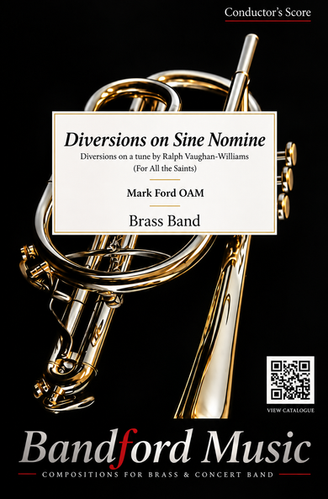 £59.77
Diversions on Sine Nomine (Brass Band) Vaughan Williams arr. Mark Ford
Diversions on Sine Nomine is a substantial concert work for brass band, derived entirely from Ralph Vaughan Williams' celebrated hymn tune For All the Saints. Rather than a conventional set of variations, the work unfolds as a sequence of contrasting diversions, each reimagining aspects of the melody's character, harmony, and rhythmic potential. The opening establishes the noble and timeless quality of Sine Nomine before leading into episodes that explore a wide expressive range - from reflective and lyrical writing to passages of rhythmic energy and grandeur. Fragments of the hymn are continually transformed and re-contextualised, allowing the music to progress with clarity and purpose while maintaining a strong sense of structural coherence. Scored specifically with 3rd and 4th Section bands in mind, the work combines musical substance with practical playability. Idiomatic brass writing, transparent textures, and effective use of traditional band colours ensure musical impact without excessive technical demand. The final section brings the work to a broad and affirmative conclusion, reaffirming the dignity and enduring strength of Vaughan Williams' original melody. To view a rolling score video of the work please visit www.youtube.com/watch?v=Sth69ate-Cs Duration: 11.00 minutes Difficulty Level: 4th Section + This PDF download includes the full score and parts. Sheet music available at www.brassband.co.uk (UK) or https://satradecentral.org(USA) Instrumentation: Soprano Cornet Eb Solo Cornet 1&2 Bb Solo Cornet 3&4 Bb Repiano Cornet Bb 2nd Cornet Bb 3rd Cornet Bb Flugel Horn Bb Solo Horn Eb 1st Horn Eb 2nd Horn Eb 1st Baritone Bb 2nd Baritone Bb 1st Trombone Bb 2nd Trombone Bb Bass Trombone Euphonium Bb Bass Eb Bass Bb Timpani Percussion 1-2 Tuned Percussion
In Stock: Estimated dispatch 1-3 working days
-
 £33.62
Extinction:2100! (Brass Band) Joe Galuszka
Extinction:2100!, by Joe Galuszka, takes us on a journey to the present day and shows us the devastating impacts of climate change. With the world reaching crisis, we open with a reminder that the world has suffered in recent years from some of the most raging destruction of our plants and animal life, from wildfires. With the time left becoming smaller and smaller with each day passing, the piece reminds us next of the 'Tolling Bell of Extinction' before the conclusion takes us to a place all too familiar - the present - where with action and with a 'Call for Change', we can hopefully make a difference to our future, our children's future, and save our planet from devastation, from decimation, from extinction! To listen to an audio demo of the work please visit https://on.soundcloud.com/SjxKbnM1Q55hVXck7 Duration: approx. 4.30 mins Difficulty Level: 1st Section + PDF download includes parts and score. Sheet music available from www.brassband.co.uk (UK) or https://satradecentral.org (USA) Instrumentation: Soprano Cornet Eb Solo Cornet Bb Repiano Cornet Bb 2nd Cornet Bb 3rd Cornet Bb Flugel Horn Bb Solo Horn Eb 1st Horn Eb 2nd Horn Eb 1st Baritone Bb 2nd Baritone Bb 1st Trombone Bb 2nd Trombone Bb Bass Trombone Euphonium Bb Bass Eb Bass Bb Timpani Percussion 1-3
In Stock: Estimated dispatch 1-3 working days
-
 £37.35
Fallen Souls (Brass Band) Andrew Wainwright
Fallen Souls was the winner of Grimethorpe Colliery Band's 1st Annual Composition Competition in 2023. This depictive and impactful work explores the theme of human fallibility. The piece begins with a slow, yearnful introduction that depicts a fall from grace, represented by a horn solo that reflects the innate goodness of humanity. However, the music soon becomes more agitated and dissonant as it represents the temptations that can lead us astray. The opening reaches a climax of chaos and despair, as we are shown the devastating consequences of our choices. The following section depicts the temptations of humanity. The music is chaotic and seductive in this section, with regular time changes and rhythmic instability, representing the many temptations that surround us. The section ends with a sense of uncertainty, as we are left wondering whether we will succumb to these temptations. There is a reprise of the opening horn solo, and a return to the notion of human fallibility, but this time in extended form. Again there is a build toward chaos, and the music becomes more complex and textured, reflecting the complexity of the human journey. The work ends somewhat abruptly with a blaze, leaving the listener with a sense of both hope and uncertainty. To view a rolling score video featuring Grimethorpe Colliery Band please visit www.youtube.com/watch?v=rM-p8CjnYo0 Duration: 5.00 minutes approx. Difficulty Level: 1st Section + PDF download includes parts and score. Sheet music available from www.brassband.co.uk/sheet-music/fallen-souls-brass-band-andrew-wainwright-brookwright Instrumentation: Soprano Cornet Eb Solo Cornet Bb Repiano Cornet Bb 2nd Cornet Bb 3rd Cornet Bb Flugel Horn Bb Solo Horn Eb 1st Horn Eb 2nd Horn Eb 1st Baritone Bb 2nd Baritone Bb 1st Trombone Bb 2nd Trombone Bb Bass Trombone Euphonium Bb Bass Eb Bass BbTimpani Percussion 1-3
In Stock: Estimated dispatch 1-3 working days
-
 £29.88
Fanfare from La Peri(Brass Band) Dukas arr. Rob Bushnell
La Peri is a one-act ballet by the French composer Paul Dukas, best known for The Sorcerer's Apprentice (L'apprenti sorcier) as in the 1940 Disney film Fantasia. Dukas was commissioned to write La Peri by the Ballets Russes, producing a Poeme danse en un tableau ('dance poem in one scene') in 1911; this become his last published work. With Natalia Trouhanova due to play the Peri and Vaslav Nijinsky to play Iskender (the name of Alexander the Great in Persian, who is scouting around Iran in search of the Flower of Immortality), the production was ultimately cancelled because Serge Diaghilev feel Trouhanova was not a skilled enough dancer to be partnered to Nijinsky. Trouhanova later hired Ivan Clustine to choreograph the music, with the ballet premiering at the Theatre du Chatelet in Paris on 22 April 1912.The brilliant fanfare that precedes the ballet is often performed separately and is the arrangement available here. Arranged for British-style brass band, it has optional percussion parts as well as alternative parts for horns in F and bass-clef lower brass. The piece has been lowered by a tone compared to the original. A recording of the original composition can be found here: www.youtube.com/watch?v=7EDekMos1ok. Duration: Approx. 2 minutes Difficulty Level: 2nd Section + Duration: 4 or 5 minutes (depending on tempo and without any cuts) PDF download includes parts and score. Sheet music available at www.brassband.co.uk (UK) or https://satradecentral.org (USA) Instrumentation: Soprano Cornet Eb Solo Cornet Bb Repiano Cornet Bb 2nd Cornet Bb 3rd Cornet Bb Flugel Horn Bb Solo Horn Eb 1st Horn Eb 2nd Horn Eb 1st Baritone Bb 2nd Baritone Bb 1st Trombone Bb 2nd Trombone Bb Bass Trombone Euphonium Bb Bass Eb Bass Bb Timpani Percussion 1 - Snare Drum Percussion 2 - Bass Drum & Cymbal
In Stock: Estimated dispatch 1-3 working days
-
 £59.77
Horizon: The Promise of the Lord (Brass Band) Andrew Wainwright
Horizon: The Promise of the Lord was written at the request of Bandmaster Stephen Cobb for The International Staff Band. It is based on the much loved hymn of the church, Cwm Rhondda (Guide me O thou great Jehovah). The work was recorded on the ISB's CD Manuscripts II (released 2023). This highly descriptive piece will be an excellent addition to concert programs, as well as being appropriate as a test piece. The inspiration for the work comes from the book of Exodus. Whilst the music is not intended to be directly programmatic, like the hymn Cwm Rhondda, the work takes the listener through the Exodus from Egypt to the promised land of Israel as a metaphor of the spiritual pilgrimage of the individual Christian through his or her earthly life. The music aims to evoke a sense of God's guidance through strife and affirm the reality that God provides for us and redeems all the wrong in the world. This God who provided for the Hebrew people wandering amidst 'barren lands' with 'bread of heaven' is still and ever will be a God of provisional grace. Through listening to the music, it is the composer's intention that we are reminded of God's promise of Deliverance as set out in Exodus 6 v7-8: 'I will take you as my own people, and I will be your God. Then you will know that I am the Lord your God, who brought you out from under the yoke of the Egyptians. And I will bring you to the land I swore with uplifted hand to give to Abraham, to Isaac and to Jacob. I will give it to you as a possession. I am the Lord.' Like the hymn, Horizon: The Promise of the Lord is intended as a prayer for guidance. The Christian is a pilgrim through 'this barren land'. The music is often chromatic and in large parts verging on atonality, as a reflection of the strife that the Israelites endured in their 40 years in the wilderness. However, it ends in climactic fashion with the Hebrew people finally reaching their destination after many years of wandering in the desert - as they approach the 'Horizon' promised by the Lord. To view a performance of the work by the National Youth Brass Band of Great Britain please visit www.youtube.com/watch?v=LjOHf7QEw1g PDF download includes score and parts. Sheet music available from: UK - www.brassband.co.uk USA - https://satradecentral.org Difficulty Level: 1st Section + Length: c11.00 minutes Instrumentation: Soprano Cornet Eb Solo Cornet Bb Repiano Cornet Bb 2nd Cornet Bb 3rd Cornet Bb Flugel Horn Bb Solo Horn Eb 1st Horn Eb 2nd Horn Eb 1st Baritone Bb 2nd Baritone Bb 1st Trombone Bb 2nd Trombone Bb Bass Trombone Euphonium Bb Bass Eb Bass Bb Percussion 1-4
In Stock: Estimated dispatch 1-3 working days