Searching for Wind Band Music? Visit the Wind Band Music Shop
We've found 69 matches for your search. Order by

Results

  • £87.99

    Ten Chorale Preludes - Max Reger - Philip Sparke

    During his short lifetime Max Reger (1873-1916) was a prolific composer with many of his best known works being composed for organ. The ten chorale preludes in this selection are from his set of Thirty Short Chorale Preludes Op.135a composed as short voluntaries for liturgical use rather than for recitals in these arrangements Philip Sparke has kept this in mind and each prelude can be performed with minimal instrumentation for those occasions where a small band is needed. They also make great pieces for band warm-ups or studies in intonation, sound and balance.

    Estimated dispatch 5-14 working days

     PDF View Music

  • £69.99

    Homage - Jan Van der Roost

    In the most literal sense: a piece for an occasion. The actual occasion was Jan de Haan's twentieth anniversary as a conductor of the top Dutch brass band, "Soli Deo Gloria" (Leeuwarden). To mark the occasion, the band commissioned the Belgian comopser Jan Van der Roost to create a surprise piece: without knowledge of the person being celebrated, a suitable source of inspiration was sought for. After some thought the chorale-theme from Camille Saint-Saens organ symphony was chosen, a piece with which Jan de Haan has a special bond.Apart from this chorale, Homage is also based on the names of notes taken from 'Jan de Haan' and 'Soli Deo Gloria', resulting in the tonerow: DEGAH. Both elements are combined together and form a grand climax towards the end of the piece when the whole band unites in the Saint Saens' theme.

    Estimated dispatch 5-14 working days
  • £73.60

    Drie Opwekkingsliederen - Henk Ummels

    Revival songs are sung more frequently these days in Christian churches in the Netherlands. The cheerful nature of these songs come into their own with use of a good catchy melody, everyday language, and often accompanied by a band with wind players, instead of an organ. In this collection: Together In the Name of Jesus, Thank You For This New Morning, and Praise Him. Arranged for a flexible setting, these are also well suited to a full orchestra.

    Estimated dispatch 5-14 working days

     PDF View Music

  • £106.99

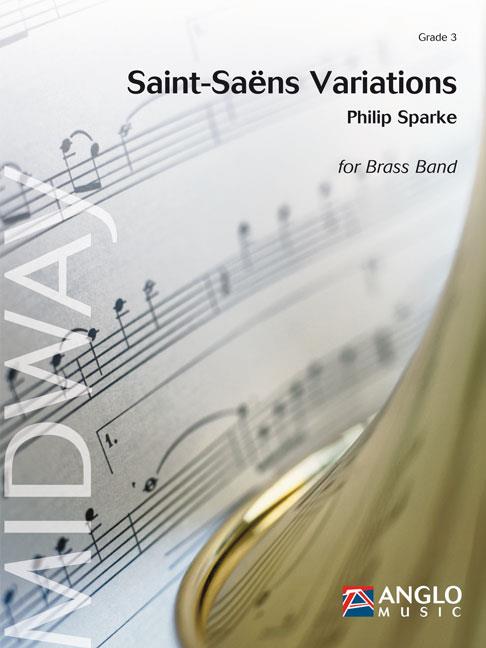
    Saint-Saens Variations - Philip Sparke

    In 2006, a long-time dream of Philip Sparke finally became reality: to compose a set of variations on the famous chorale from Saint-Saens' renowned Organ Symphony. In 2009 the composer reworked the piece for brass band. The resulting Saint-Saens Variations has been simplified, shortened and in many places completely recomposed, to distill the essence of the symphony even further and allow younger bands to enjoy the power of Saint-Saens' masterpiece in an approachable, yet completely faithful, work.

    Estimated dispatch 5-14 working days

     PDF View Music

  • £115.60

    Angels We Have Heard on High - Fredrick Schjelderup

    "Angels We Have Heard" on High is one of the most famous Christmas carols all over the world. Of French origin, it's also entitled Les Anges dans nos campagnes. The Irish bishop James Chadwick has written lyrics to the melody. His lyrics are the most widely used also today. For this Brass Band arrangement there are also optional parts for SATB Choir and Organ.

    Estimated dispatch 5-14 working days

     PDF View Music

  • £69.99

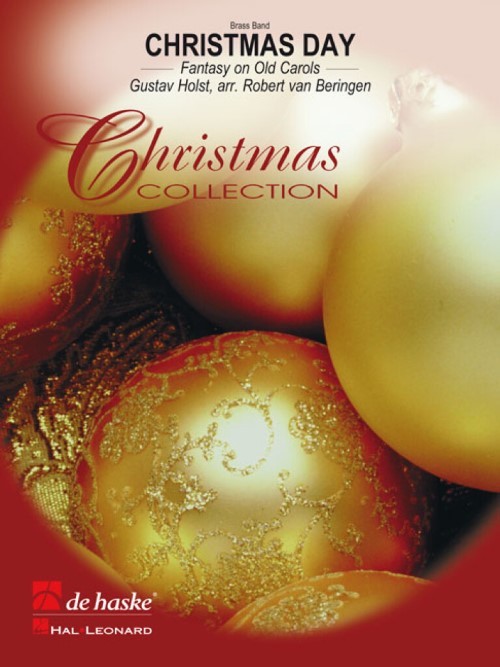
    Christmas Day - Gustav Holst - Robert van Beringen

    Gustav Holst composed almost 200 works, one being a very elegant and charming fantasy on the old English christmas carols: 'Good Christian Men, Rejoice'; 'God Rest You Merry, Gentlemen'; 'Come Ye Lofty, Come' and 'The First Nowell'. The fantasy called Christmas Day was originally written for Mixed Choir with Orchestra or Organ accompaniment. Robert van Beringen has arranged this work for concert band exactly 100 years later. His arrangement can be performed as an instrumental piece or with a Choir, making it suitable for any occasion.

    Estimated dispatch 5-14 working days

     MP3 Listen to MP3

     PDF View Music

  • £124.95

    Hyperlink - Peter Graham

    Hyperlink was commissioned by the National Youth Brass Band of Great Britain (funded by Arts Council England and the Department for Education) for its 70th Anniversary Year. Since the anniversary coincided with other significant celebrations in 2022 (including the Royal Albert Hall/Ralph Vaughan Williams 150th and the Platinum Jubilee of Elizabeth II) it was requested that these also be recognised in some way.

    Where better to begin this challenging brief but with a computer search for the NYBBGB founder Dr Denis Wright (coincidently born in Kensington, home of the RAH). The subsequent rabbit warren of hyperlinks led me to structure the work through a series of "associations":

    Movement I - The Voice of Jupiter.

    Alongside the discovery that Denis Wright had been a church organist was the realisation that while the RAH has hosted thousands of musical events the fabric of the building actually incorporates a musical instrument, the famous Henry Wills organ (aka The Voice of Jupiter).Organ and J S Bach are synonymous (e.g. Toccata in D min) and so both become fundamental to the content of the movement. An opening 7 note quote from the Toccata leads to a mammoth sound cluster, as if every note on the huge RAH organ is sustained. The material which follows is based upon the notes BACH (in German notation). The notes are manipulated in various ways in a 12 tone matrix; reversed, inverted and so on. Other techniques employed in the movement are ones of which Bach was master, including ground bass and fugue.

    Movement II - Remember Me.

    The lives of Salvationist composer Ray Steadman-Allen (born 1922) and Ralph Vaughan Williams are remembered here, with "RSA" in musical notation and fragments of RVWs famous Tuba Concerto providing the source material.While writing the movement my father passed away and to close his funeral service the family chose the uplifting Robert Lowry hymn They'll sing a welcome home. It seemed fitting to conclude the movement with a reflective setting of the chorus, the repeated phrase "Welcome, welcome home" eventually disappearing into the ether.

    Movement III - Vivat.

    The finale takes the form of a short fantasy upon Hubert Parry's marvellous coronation anthem I Was Glad, truly a celebratory note with which to conclude.The first performance of Hyperlink was given by the NYBBGB conducted by Martyn Brabbins at the Royal College of Music, London on August 6th 2022.

    Estimated dispatch 3-7 working days

     PDF View Music

  • £127.95

    Music of the Angels (Symphonic Brass Ensemble - Score and Parts)

    In 1998 Gregson was commissioned by conductor Martyn Brabbins to write a short concert opener with choir to mark his debut as Music Director of the Huddersfield Choral Society. Entitled ...and the seven trumpets... this ten minute flourish is founded on a verse from Chapter 8 of the Revelation To John (The Apocalypse), the last book in the Bible: 'and I saw the seven Angels which stood before God: and to them were given seven trumpets'. The performance employed the full power of the Huddersfield Town Hall organ and the brass section of the BBC Philharmonic, including seven trumpets and four horns placed strategically around hall.The following year, when Gregson received a commission from the Cheshire-based Foden's Brass Band (conducted at that time by Nicholas Childs) for a work to mark its centenary in 2000, he turned to the first portion of ...and the seven trumpets... as the basis for an ambitious celebratory work entitled The Trumpets of the Angels. "The opportunity to create an extended work which would break out of the brass band mould was an important milestone for me," the composer says. In 2015 he was asked by Nicholas Childs to create a new performing edition without organ for the Black Dyke Band. This received its first performance in April 2016 at the European Brass Band Festival in Lille. In 2018, Gregson revisited the music for a third time, returning the opening fanfares to orchestral brass and transforming substantial portions of the 'Black Dyke' version to create Music of the Angels, a dramatic canvas for symphonic brass and percussion.An array of bells and gongs offer an unmistakable key to the source of Gregson's inspiration. Inscribed In tribute to Olivier Messiaen, the work's principal material and its sound world, but crucially not the underlying musical processes, are influenced by Messiaen's masterpiece for wind and percussion, Et exspecto ressurectionem mortuorum (1964). Music of the Angels begins with braying of horns suggestive of the start of an ancient ritual. Six 'angel' trumpeters, set behind the ensemble, answer in sequence, with the evocative sound of tam-tams creating the Messiaen-like aura. Once the horns have reached the performing space, four of the trumpeters deliver highly contrasting fanfare cadenzas. At the climax of this episode, the individual fanfares are presented together, as if, perhaps, to reflect the Biblical writer's apocalyptic visions of hail, fire, seas of blood and the cataclysmic destruction of man and beast.This powerful vision of death and destruction gives way to a prayerful lament, re-imagining a sung Kyrie Eleison from the 'Black Dyke' edition, with flugel horn and euphonium obligati. The hushed atmosphere is broken by tenor and side drums, and trumpets five and six, which gallop away like the Horsemen of the Apocalypse. In the biblical account their steeds had 'heads like lions with fire and smoke and sulphur issuing from their mouths'.As the reverberation of a dramatic climax dies we hear the entry of the seventh trumpet, from 'on high', blazing forth with a version of the main that extends across the entire compass of the instrument - almost three octaves. Supported by a 'holy trinity' of gongs, an 'epic' final cadenza introduces new material which is further developed in a frenetic final section. This is announced by two sets of timpani, to the left and right. Braying brass (euphoniums and horns) once more adds an air of foreboding. As the music builds towards a magisterial conclusion, the Messiaen-inspired tritones of the principal motif are smoothed out into perfect 5ths and combined with the earlier material in a full-voiced chorale, over which the seventh trumpet blazes in triumph.- Programme note by Paul HindmarshScored for1 Trumpet in E flat (Trumpet 5)6 Trumpets in B flat (Trumpet 4 doubling Flugel Horn)4 Horns in F3 Tenor Trombones1 Bass TromboneEuphonium2 Tubas2 Timpani (Percussion 3 doubles Timpani 2)Percussion (3 players): 3 Tam-tams, 3 Suspended Cymbals, Bass Drum, Tenor Drum, Snare Drum, Tubular Bells.Duration: 16.00

    Estimated dispatch 7-14 working days
  • £30.00

    Finale from Tosca, Act 1 (Te Deum)

    DescriptionPuccini's opera Tosca, one of his most successful and popular works is set in 1800 in Rome, as Napoleon's invading army is approaching. There are rebels in Rome who see Napoleon as a liberator from Neapolitan rule and are plotting secretly. One of those is the young firebrand artist Cavaradossi. He and his lover, the beautiful and tempestuous Tosca, are being pursued by the evil chief of the secret police, Scarpia. At the end of Act 1, Scarpia is revelling in his plot to capture Cavaradossi and trick Tosca into sleeping with him to buy her lover's freedom, all inside a church in Rome while a Te Deum service is being sung; in the background the bells are tolling and we hear distant cannonfire from the approaching army.In this arrangement the part of Scarpia is played mostly by the solo trombone. There is an optional organ part, although all of the organ part is covered in the band parts.This arrangement was first performed by the Harrogate Band conducted by Andrew Baker in 2022. Watch a video preview of the score below!

    Estimated dispatch 7-14 working days
  • £30.00

    Three Pieces from Czechoslovakia - Leos Janacek

    This is the music of Leos Janacek (1854-1928) - exciting, powerful, emotive, impassioned, unpredictable, and many other definitions all rolled into one! Janacek was little known in Britain until the 1960's, when the conductor Charles Macherras introduced his unique music and opera to the western audience. His orchestral Sinfonietta was an instant hit. Janacek has since been one of the featured composers in the 'Proms'.The three pieces which I have arranged for brass band are INTRODUCTION, ORGAN SOLO and INTRADA from Janacek's Glagolitic Mass. They work equally well together or on their own, as they each have their own identity. They can be purchased together or separately.1. INTRODUCTIONA great 'starter' for the first or second half of a concert. 2. ORGAN SOLOThis is a 'must' if you want to impress your audience - every section of the band is incredibly busy, (although they can be assured that they do have time to breath)! 3. INTRADAThis piece, (and no.1 "Introduction"), both contain that 'fanfare' like quality which Janacek is famous for in his Sinfonietta.

    In Stock: Estimated dispatch 3-5 working days