
Results
-
 £35.00
Ascension - Lucy Pankhurst
A major work written for the RNCM Brass Festival Competition 2005, and inspired by the nature of Ascension - creating a Musical depiction of the spiritual journey towards enlightenment, sanctuary and ultimate inner peace.As aninitial muse for this work, the 'Tibetan Singing Bowl' is utilised with the Brass Band in order to represent this path to Serenity, together withBaoding Balls(Chinese Health Balls) to mark the point of Final Ascension.Programme notes from the composer, Lucy Pankhurst:Ascension is a Musical depiction of the Spiritual Journey towards enlightenment, sanctuary and ultimate inner peace.As my initial muse for this work, the Singing Bowl is utilised with the Brass Band in order to represent this path to Serenity. "Tibetan" Singing Bowls date back to the 8th Century A.D., originating in the pre-Buddhist shamanic Bon Po culture in the Himalayas and are still used in modern Monasteries. The original purpose of them still remains a mystery, with accounts stating that it is forbidden to disclose the true function of the Bowls, as the "secrets of sound" yield so much Power, that they must be kept hidden.Listening to the tones created by the Singing Bowl effectively silences the internal dialogue of the listener, making it an excellent tool for Meditation, Centering and entering trance-like states. In Buddhism, as with many cultures, sound is an important part of Spiritual Practice. There are 9 methods to reach Enlightenment in the Buddhist Doctrine ; the seventh is SOUND.These Bowls are used by Healers in a similar way to help balance the body's residual energies. The Bowls are usually made from seven different sacred metals, intended to correlate directly to the seven sacred "Planets" : GOLD (Sun), SILVER (Moon), MERCURY (Mercury), COPPER (Venus), IRON (Mars), TIN (Jupiter), ANTIMONY (Saturn). Any one Bowl can create up to seven different frequencies (tones) simultaneously. In Healing, the Singing Bowl is played whilst balanced on the palm of the hand, struck three times to stabilise the surrounding energies, before rotating the wooden "beater" around the outer circumference of the Bowl to create the "singing" effect.I have included an optional Vibraphone part (to be played with a Double Bass Bow) with Tubular Bells, to be used only in performances where a Singing Bowl cannot be acquired. However, a traditional Bowl should be used whenever possible, to create this specific and unique sound.Baoding Balls or Chinese Health Balls are also utilised in this work. Their appearance in the Music here, however, is to mark the point of Final Ascension, where the music reaches its ultimate goal. These delicate cloisonne iron Balls are said to stimulate the acupressure points on the hand, thus improving the Chi and Energy Paths (Life Force) throughout the entire body. The delicate "tinkle" produced by these spheres is hypnotic and captivating. For this reason, where no Baoding Balls are obtainable for performance, only delicate metallic percussion should be used in replacement (i.e. Crotales, Antique Cymbals or (liberal) single strikes on a Triangle etc.). Bell Trees, Wind Chimes and Cow Bells should not be used.As in many cultures, the number three is important in Ascension, as it represents not only the purification from the Singing Bowl, but also it is a number of confirmation, reiterated throughout the music in the metallic percussion in addition to the Brass, re-affirming the correct path to Enlightenment.
In Stock: Estimated dispatch 3-5 working days
-
 £35.00
strange geometry
Descriptionstrange geometrywas commissioned by Morgan Griffiths and the Hammonds Saltaire Band for their performance at the Brass in Concert Championships of 2015.As a bit of a space/sci-fi geek, as well as a musician, two events during the summer of 2015 had a particular effect on me. The first was the tragic early death in a plane crash of the famous film composer James Horner. Horner's music, particularly in films like 'Star Trek II: The Wrath of Khan', 'Avatar', 'Apollo 13' and even his debut in Roger Corman's 1980 budget film 'Battle Beyond the Stars', defined for a generation the sound of sci-fi at the cinema. Along with John Williams he created the vocabulary for those who wish to express other-worldly wonder in music and his inventive talent will be much missed in an industry where originality has become something of a dirty word in recent years.The second event was the epic flyby of Pluto by the NASA New Horizons spacecraft. There are many reasons to find this mission inspiring - for example, the scientists and engineers behind it created a craft that has travelled at 37,000 mph for nine years and three billion miles to arrive within seventy-two seconds of the predicted time for the flyby. That they achieved this with such accuracy is an outstanding tribute to humanity's ingenuity and insatiable curiosity. However, the most exciting aspect of the mission was the clear, high resolution pictures of this unthinkably remote and inhospitable world beamed back to mission control. The best previous image of Pluto was an indistinct fuzzy blob - suddenly we could see mountains made of ice, glaciers of methane and carbon monoxide and nitrogen fog - features previously unimagined on a world thought to be a slightly dull ball of cold rock. The BBC's venerable astronomy programme 'The Sky at Night' waxed lyrical about these newly discovered features, referring to "the surprising discoveries of mountains and strange geometry on the surface of this cold distant world".I like to think that Horner would have been as inspired as I have been by this real-life science story, and this piece uses some of the vocabulary of the sci-fi movie soundtrack in a tribute to the memory of a great musician and to the inspirational geeks at NASA who have boldly taken us where no-one has gone before.Note: This work comes with a B4 portrait score. Listen to a preview and follow the music below!
Estimated dispatch 7-14 working days
-
 £45.00
Bathgate Hills Trilogy - Andrew Duncan
Composed by Andrew Duncan and written for the West Lothian Schools Band, A Bathgate Hills Trilogy is in three movements, each one dedicated to and representing a different hill.Comments from the composer:Movement 1 - Dechmont LawThe first movement describes the peculiar events which took place in November 1979 when a forestry worker, Bob Taylor, had a close encounter with an alien spacecraft in Dechmont Woods at the bottom of Dechmont Hill. Bob Taylor's account from the time describes a large sphere like object about twenty feet across which pulled him by the legs towards it, caustic smoke then caused him to pass out. He awoke a short time later in the same spot but the spaceship had gone leaving behind marks in the soil. His story caused a great deal of media interest and a great deal of excitement in the local community.Movement 2 - The Knock HillThe Term 'Knock' is Scottish Gaelic for 'hill' and the Knock Hill is the highest peak in the Bathgate Hills being 305 metres above Sea Level. On a clear day the Knock hill has excellent views of the Bass Rock to the East and the distant hills of Arran to the West as well as of the whole of West Lothian and across the Firth of Forth to Fife and beyond to the North.The second movement is a description of a leisurely walk to the summit of this hill and the enjoyment of a pleasant summer's day spent walking and taking in the beautiful panoramic views. However, as is the case with the Scottish Summer, a change in the weather finds a clear blue sky being replaced with dark rain clouds. The changed weather brings a sudden brief but unwelcome cold downpour of rain, drenching anyone out walking! Finally, the clouds pass and the more pleasant summer weather returns.Movement 3 - Cairnpapple HillCairnpapple Hill is a near neighbour of the Knock Hill. It is almost as high but interest in Cairnpapple Hill lies in the outstanding archaeological monument near the summit, an Iron Age burial chamber. The chamber dates back to 25 years BC and was built by a mysterious people known as the Beaker People (so called because they left behind a number of large earthenware beakers). The mysteries of Cairnpapple Hill have always been a source of fascination for me ever since first visiting the hill as a school child.The third movement describes the lives of the Beaker People. The landscape they would have looked out on would have been mostly dense forest which would have contained many perils including dangerous wolves and bears. Life was harsh and short for the Beaker People and they would always have been close to danger and to death. The average life expectancy for the Beaker People was only 31 years of age. The summit of the hill would have been clear of forest and would have afforded the Beaker People some protection as they could see all around the near countryside enabling them to keep a watchful lookout for their enemies - both animal and human!
In Stock: Estimated dispatch 3-5 working days
-
 £64.95
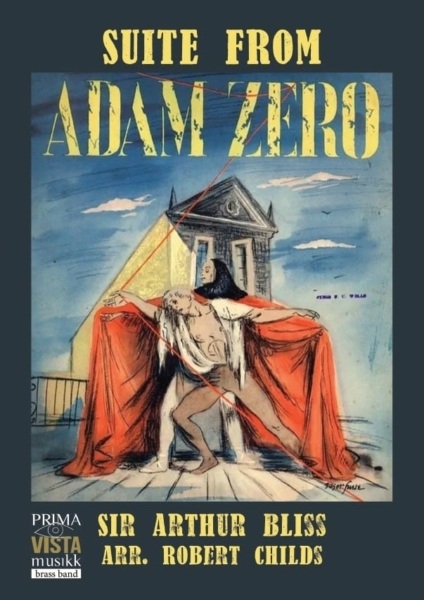
Adam Zero, Suite from (Brass Band - Score and Parts)
Selected as the Section 2 test piece for the National Brass Band Championships of Great Britain 2025Following his ballet Checkmate, Bliss composed another score for the, by then, Sadler's Wells Ballet, Miracle in the Gorbals, which was choreographed by Robert Helpmann, to a scenario by Michael Benthall. Premired in 1944, the ballet made a considerable impact and was a box-office success. It was followed in turn by a further collaboration with Helpmann and Benthall, Adam Zero. This would serve Helpmann, in the eponymous role, as a vehicle in two respects: demonstrating his gifts as a dancer-actor and as a choreographer. First performed at the Royal Opera House, Covent Garden, on 8 April 1946, Adam Zero was conducted by Constant Lambert, the work's dedicatee. Bliss considered it 'his most varied and exciting ballet score'. Benthall provided a synopsis for the programme:There is a philosophy that life moves in an endless series of timeless cycles. As Nature passes through Spring, Summer, Autumn and Winter, so man is born, makes a success in his own particular sphere, loses his position to a younger generation, sees his world crumble before his eyes and only finds peace in death. This age-old story is told in terms of a Company creating a ballet and calling on the resources of the theatre to do so. Lighting, stage mechanism, dance conventions, musical forms and costumes and scenery of all periods are used to symbolize the world of 'Adam Zero'.Apart from Adam, as the Principal Dancer, other main roles included the Stage Director (representing Omnipotence), and Adam's Fates (Designer, Wardrobe Mistress, and Dresser). 'The Woman in this allegory', wrote Bliss, 'under the symbol of the Choreographer, was both the creator and destroyer of Adam: his first love, his wife, his mistress, and finally the figure of beneficent Death.' When the curtain rose, the 'audience saw the Covent Garden stage right back to the wall, completely empty except for the protagonists, 'the Company poised, still and expectant, as they await the birth of... Adam Zero.'Unfortunately, soon after the premire, Helpmann injured himself and had to withdraw from the remaining performances. Despite generally positive reviews, the ballet did not capture the imagination of audiences and, to Bliss's considerable disappointment, was not revived. Seventy years would elapse before its first major return to the stage, in 2016, performed by the ballet company of Stadttheater Bremerhaven with choreography by Sergei Vanaev.Bliss extracted a concert suite from the ballet, conducting its first performance with the City of Birmingham Symphony Orchestra on 28 October 1948. For his own suite, arranged for brass band in 2023, Dr Robert Childs chose three dances linked to the seasons, book-ending them with the ebullient 'Fanfare Overture' and 'Fanfare Coda'. After Adam has grown to manhood, his Fates clothe him in a costume synonymous with confident youth, appropriate for the virile, ardent 'Dance of Spring'. In the 'Approach of Autumn', Adam, now wearing a sombre costume, has grown older: his Fates have streaked grey in his hair and put lines on his face. But they had earlier raised Adam to the zenith of his power, and the 'Dance of Summer' depicts him in the prime of life, in music of sweeping grandeur. The 'Fanfare Coda' signals that the next cycle of life is about to begin.Duration: 10.30
Estimated dispatch 7-14 working days
-
£29.95
Adam Zero, Suite from (Brass Band - Score only)
Selected as the Section 2 test piece for the National Brass Band Championships of Great Britain 2025Following his ballet Checkmate, Bliss composed another score for the, by then, Sadler's Wells Ballet, Miracle in the Gorbals, which was choreographed by Robert Helpmann, to a scenario by Michael Benthall. Premired in 1944, the ballet made a considerable impact and was a box-office success. It was followed in turn by a further collaboration with Helpmann and Benthall, Adam Zero. This would serve Helpmann, in the eponymous role, as a vehicle in two respects: demonstrating his gifts as a dancer-actor and as a choreographer. First performed at the Royal Opera House, Covent Garden, on 8 April 1946, Adam Zero was conducted by Constant Lambert, the work's dedicatee. Bliss considered it 'his most varied and exciting ballet score'. Benthall provided a synopsis for the programme:There is a philosophy that life moves in an endless series of timeless cycles. As Nature passes through Spring, Summer, Autumn and Winter, so man is born, makes a success in his own particular sphere, loses his position to a younger generation, sees his world crumble before his eyes and only finds peace in death. This age-old story is told in terms of a Company creating a ballet and calling on the resources of the theatre to do so. Lighting, stage mechanism, dance conventions, musical forms and costumes and scenery of all periods are used to symbolize the world of 'Adam Zero'.Apart from Adam, as the Principal Dancer, other main roles included the Stage Director (representing Omnipotence), and Adam's Fates (Designer, Wardrobe Mistress, and Dresser). 'The Woman in this allegory', wrote Bliss, 'under the symbol of the Choreographer, was both the creator and destroyer of Adam: his first love, his wife, his mistress, and finally the figure of beneficent Death.' When the curtain rose, the 'audience saw the Covent Garden stage right back to the wall, completely empty except for the protagonists, 'the Company poised, still and expectant, as they await the birth of... Adam Zero.'Unfortunately, soon after the premire, Helpmann injured himself and had to withdraw from the remaining performances. Despite generally positive reviews, the ballet did not capture the imagination of audiences and, to Bliss's considerable disappointment, was not revived. Seventy years would elapse before its first major return to the stage, in 2016, performed by the ballet company of Stadttheater Bremerhaven with choreography by Sergei Vanaev.Bliss extracted a concert suite from the ballet, conducting its first performance with the City of Birmingham Symphony Orchestra on 28 October 1948. For his own suite, arranged for brass band in 2023, Dr Robert Childs chose three dances linked to the seasons, book-ending them with the ebullient 'Fanfare Overture' and 'Fanfare Coda'. After Adam has grown to manhood, his Fates clothe him in a costume synonymous with confident youth, appropriate for the virile, ardent 'Dance of Spring'. In the 'Approach of Autumn', Adam, now wearing a sombre costume, has grown older: his Fates have streaked grey in his hair and put lines on his face. But they had earlier raised Adam to the zenith of his power, and the 'Dance of Summer' depicts him in the prime of life, in music of sweeping grandeur. The 'Fanfare Coda' signals that the next cycle of life is about to begin.Duration: 10.30
Estimated dispatch 7-14 working days
-
£19.65
Adam Zero, Suite from (Brass Band - Study Score)
Selected as the Section 2 test piece for the National Brass Band Championships of Great Britain 2025Following his ballet Checkmate, Bliss composed another score for the, by then, Sadler's Wells Ballet, Miracle in the Gorbals, which was choreographed by Robert Helpmann, to a scenario by Michael Benthall. Premired in 1944, the ballet made a considerable impact and was a box-office success. It was followed in turn by a further collaboration with Helpmann and Benthall, Adam Zero. This would serve Helpmann, in the eponymous role, as a vehicle in two respects: demonstrating his gifts as a dancer-actor and as a choreographer. First performed at the Royal Opera House, Covent Garden, on 8 April 1946, Adam Zero was conducted by Constant Lambert, the work's dedicatee. Bliss considered it 'his most varied and exciting ballet score'. Benthall provided a synopsis for the programme:There is a philosophy that life moves in an endless series of timeless cycles. As Nature passes through Spring, Summer, Autumn and Winter, so man is born, makes a success in his own particular sphere, loses his position to a younger generation, sees his world crumble before his eyes and only finds peace in death. This age-old story is told in terms of a Company creating a ballet and calling on the resources of the theatre to do so. Lighting, stage mechanism, dance conventions, musical forms and costumes and scenery of all periods are used to symbolize the world of 'Adam Zero'.Apart from Adam, as the Principal Dancer, other main roles included the Stage Director (representing Omnipotence), and Adam's Fates (Designer, Wardrobe Mistress, and Dresser). 'The Woman in this allegory', wrote Bliss, 'under the symbol of the Choreographer, was both the creator and destroyer of Adam: his first love, his wife, his mistress, and finally the figure of beneficent Death.' When the curtain rose, the 'audience saw the Covent Garden stage right back to the wall, completely empty except for the protagonists, 'the Company poised, still and expectant, as they await the birth of... Adam Zero.'Unfortunately, soon after the premire, Helpmann injured himself and had to withdraw from the remaining performances. Despite generally positive reviews, the ballet did not capture the imagination of audiences and, to Bliss's considerable disappointment, was not revived. Seventy years would elapse before its first major return to the stage, in 2016, performed by the ballet company of Stadttheater Bremerhaven with choreography by Sergei Vanaev.Bliss extracted a concert suite from the ballet, conducting its first performance with the City of Birmingham Symphony Orchestra on 28 October 1948. For his own suite, arranged for brass band in 2023, Dr Robert Childs chose three dances linked to the seasons, book-ending them with the ebullient 'Fanfare Overture' and 'Fanfare Coda'. After Adam has grown to manhood, his Fates clothe him in a costume synonymous with confident youth, appropriate for the virile, ardent 'Dance of Spring'. In the 'Approach of Autumn', Adam, now wearing a sombre costume, has grown older: his Fates have streaked grey in his hair and put lines on his face. But they had earlier raised Adam to the zenith of his power, and the 'Dance of Summer' depicts him in the prime of life, in music of sweeping grandeur. The 'Fanfare Coda' signals that the next cycle of life is about to begin.Duration: 10.30
Estimated dispatch 7-14 working days
-
£70.00
Origins - Peter Meechan
Origins is in three movements, with each movement having a different subject matter, all linked by the idea of origins: the first movement refers to musical origins; the second to the origins of life; and the final movement to the space exploration - the research of all origins. The first movement is based on a short motif, heard in the first three notes the soloist plays. These three notes cover the interval of a minor third (an interval that often plays a crucial role in my music) on which the whole concerto is built. The soloist and accompaniment interplay freely throughout the opening section, before an ostinato accompaniment appears - over which the soloist sounds a long legato melody. A short cadenza follows and a return to the opening material leads the movement to an end. The second movement, titled Harryas Song, is - as tradition dictates - a slow movement. Happy and reflective in nature, the main melody was written on the evening that my closest friend, Mark Bousie (a fine euphoniumist himself), and his wife Jayne, had their first child - Harry Bousie. It seemed only fitting that this song should be written for Harry in celebration. The final movement brings me back to a lifelong fascination with space, and in this particular movement, the Space Shuttle Discovery. Having completed 39 missions (including flying the Hubble telescope in to orbit), and spent a total of 365 days in space, SS Discovery made its final voyage in 2011 and was taken to the Smithsonian in Washington D.C. in April 2012. This final movement, titled Discovery, pays tribute to the great shuttle whose missions inspired millions across the generations. Origins was commissioned by Marco Schneider, Adrian Schneider and the Dunshan Symphonic Wind Orchestra, Beijing, China.
Estimated dispatch 12-14 working days
-
 £36.30
Down By The Salley Gardens
A new brass band release for 2023 which also welcomes Fiona Neary as a new member of our ever-growing family of writers!This traditional Irish folk tune has been beautifully arranged for brass band, offering a tranquil moment to your programme with a memorable jaunty jig section to keep your listeners on their toes!Every concert needs that 'Aaahhhh' element, and Down By The Salley Gardens certainly brings all the qualities required to meet that need.This original traditional Irish melody has been referred to by a variety of titles: 'Mourne Shore', 'Moorlough Shore' and 'The Maids of Mourne Shore', and is believed to have dated back to the 17th-18th century.In 1889, William Butler Yeats had his poem 'Down By The Salley Gardens' published in The Wanderings of Oisin and Other Poems. The verse was then later set to the Irish melody by Herbert Hughes in 1909. Since this combining, the music has become synonymous with the poem and naturally adopted the poem's title.Due to the beauty of the melody and the emotive words of the associated poem, both elements of this work has been embraced by a variety of artistes, including recordings by The Corrs and Sinead O'Connor; John Ireland (1879-1962) set the words to an original melody in his song cycle Songs Sacred and Profane, written in 1929-31; there is a vocal setting by the poet and composer Ivor Gurney, which was published in 1938; and Benjamin Britten published a setting of the poem in 1943.
In Stock: Estimated dispatch 3-5 working days
-
 £30.00
Man In His Labour Rejoiceth (Band Parts Only) - John Ireland
This beautiful piece written by John Ireland, with words by Robert Bridges, has now been reborn.Originally commissioned by the National Coal Board in 1947 it is believed to have been performed on May 1st 1948 at the the Haringey Stadium, involving 9 bands and 8 colliery bands. Since the original brass band parts (which bring the piece to life in its full glory) were lost over time, the John Ireland Trust committed to a project to ensure the music was not lost forever.Andrew Duncan was commissioned with the honour of recreating the brass band set to bring the full performance of band and choir back to the public's enjoyment. His attention to detail and widespread knowledge of Ireland's writing style have now enabled 'Man in his Labour Rejoiceth' to be fully recreated and appreciated in its original written form, offering bands a remarkable opportunity to perform an historically significant concert work.Choir parts are sold separately and are available from The Music Company (UK) Ltd (please call 0845 68 08452 for more details) or Stainer & Bell Ltd (Catalogue Ref: 20303)
In Stock: Estimated dispatch 3-5 working days
-
£44.95
Harmony Music (Score Only)
Harmony Music was written for the Championship Section Finals of the National Brass Band Championships of Great Britain held at the Royal Albert Hall, London, in October 1987.It opens quietly with a long unison crescendo, interrupted by the basses, which in turn introduces a cornet fanfare, leading to a chorale-like episode, building from the lower half of the band to a huge tutti. There is a brief hint of faster music to come which fails to dispel a high, haunting euphonium solo before the main molto vivace arrives. This is a fast and furious gallop with a certain French flavour. This reaches a climax and subsides gradually into the slower central section (a homage to Maurice Ravel) which incorporates accompanied cadenzas for cornet and horn. The opening of the piece returns and leads back to an abbreviated recapitulation of the vivace. When it appears to be hurtling to a close, the trombones and sopranos introduce a brief moment of chaos before a presto coda asserts itself.
Estimated dispatch 7-14 working days