
Results
-
 £29.95
Festivity (Brass Band - Score only) - Condon, Leslie
This is a celebrational and witty composition that has all the hallmarks of Condon's innovative style. Originally written for brass quintet and first performed by chosen soloists in 1972, it was scored for brass band a few years later. Acrobatic energy, dignity and solemnity are all aspects of this work. The majestic hymn tune 'Gopsal' is the theme with which the words 'Rejoice, the Lord is King' are associated.
Estimated dispatch 7-14 working days
-
 £64.95
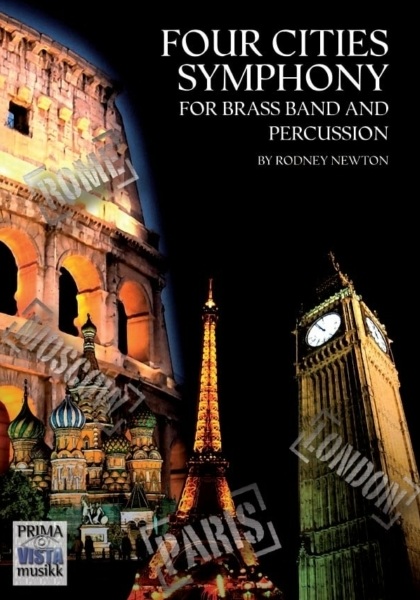
Four Cities Symphony (Brass Band - Score and Parts) - Newton, Rodney
This piece was commissioned by the National Contesting Council as the 4th section test piece for the 2008 Regional Brass Band Championships of Great Britain.This symphony (the composer's 12th) has four movements played without a break. The first centres on two aspects of the city of London: its history and pageantry and its role as a busy modern metropolis.The second movement depicts Paris, its street cafes and boulevards and riverside walks, in the form of a romantic waltz.The third movement is constructed around the Gregorian chants of the Lord's Prayer (Pater noster, qui es in caelis) and the Creed (Credo in unum Deum) in an evocation of the city of Rome. After a powerful climax, mysterious tramping footsteps are heard as the ghosts or a Roman legion march through the city by night. The vision fades and the pater noster is heard once again before the movement is brought to a close with the ancient Ambrosian chant, Christus Vincit, Christus Regnet, Christus Imperat.The final movement is an evocation of the city of Moscow, with its great historic buildings, its turbulent history and its fiery traditional music. At the outset a rather dour folk-like melody is heard which is transformed into a lively Cossack dance.This work is dedicated to Howard Wilson, former principal euphonium of City of Coventry Band who, in 1972, introduced the composer to top section brass band contesting.Duration: 11.00
Estimated dispatch 7-14 working days
-
 £134.99
Tuba Concerto (Eb Bass Solo with Brass Band - Score and Parts) - Sparke, Philip
When writing his tuba concerto, Philip Sparke wanted to create a work which explored the many aspects of the instrument's technical and vocal qualities but without resorting to caricature. The result is a concerto in two joined movements, which can both be programmed individually, that contains both many lyrical lines together with stunning virtuosic passages. An outstanding concerto that tuba players and brass band audiences alike will enjoy and applaud.Duration: 13:15
Estimated dispatch 7-14 working days
-
 £69.99
Thailand Impressions (Brass Band - Score and Parts) - Schoonenbeek, Kees
The source of inspiration for Thailand Impressions was a trip that the composer made to the magnificent country of Thailand. The three movements reflect the many different aspects of this fascinating part of the world including Bangkok - both modern and antique, Buddhist temples and the infamous Burma railway.Duration: 8.00
Estimated dispatch 7-14 working days
-
 £110.99
The Four Noble Truths (Brass Band - Score and Parts) - Sparke, Philip
The Four Noble Truths are the most basic expression of the teaching of Buddha and therefore still form the guidelines for Buddhists to this day. The four truths are Dukkha, which describes times of major stress in our lives - birth, ageing, desire and death; Samudaya which describes those parts of our life that induce stress, feeling, craving, desire; Nirodha which tells us how to eliminate those aspects of our lives which induce stress and Magga which describes the eight disciplines which can help us eliminate the origins of stress from our lives. It can be seen from these over-simplified definitions, that the Four Noble Truths fall into two pairs, the first two describing the origins of stress and the second two describing how we can reduce stress. To reflect this, the four movements of this work are also combined into two pairs - two quick movements and two slow movements. A fascinating work from this great English composer.Duration: 14:00
Estimated dispatch 7-14 working days
-
 £91.99
Time Remembered (Brass Band - Score and Parts) - Sparke, Philip
The initial idea was for a millennium piece, which it is, but rather than add to the many celebratory pieces that have understandably been written to salute the 3rd millennium, Philip Sparke thought it would perhaps be appropriate to think about the aspects of life that are constantly with us (such as faith and philosophy) rather than the exciting changes that the year 2000 has undeniably wrought. This calm meditative work will bring a moment of serenity and reflection to any concert.Duration: 8.30
Estimated dispatch 7-14 working days
-
 £119.95
Harrison's Dream (Brass Band - Score and Parts) - Graham, Peter
At 8.00pm on the 22nd of October 1707, the Association, flagship of the Royal Navy, struck rocks off the Scilly Isles with the loss of the entire crew. Throughout the rest of the evening the remaining three ships in the fleet suffered the same fate. Only 26 of the original 1,647 crew members survived. This disaster was a direct result of an inability to calculate longitude, the most pressing scientific problem of the time. It pushed the longitude question to the forefront of the national consciousness and precipitated the Longitude Act. Parliament funded a prize of �20,000 to anyone whose method or device would solve the dilemma.For carpenter and self-taught clockmaker John Harrison, this was the beginning of a 40 year obsession. To calculate longitude it is necessary to know the time aboard ship and at the home port or place of known longitude, at precisely the same moment. Harrison's dream was to build a clock so accurate that this calculation could be made, an audacious feat of engineering.This work reflects on aspects of this epic tale, brilliantly brought to life in Dava Sobel's book Longitude. Much of the music is mechanistic in tone and is constructed along precise mathematical and metrical lines. The heart of the work however is human - the attraction of the �20,000 prize is often cited as Harrison's motivation. However, the realisation that countless lives depended on a solution was one which haunted Harrison. The emotional core of the music reflects on this, and in particular the evening of 22ndOctober 1707.- Peter GrahamJuly 2000 Recorded on Polyphonic QPRL219D Master Brass (Volume Fifteen). Duration: 14'30"
Estimated dispatch 7-14 working days
-
£44.95
Harrison's Dream (Brass Band - Score only) - Graham, Peter
At 8.00pm on the 22nd of October 1707, the Association, flagship of the Royal Navy, struck rocks off the Scilly Isles with the loss of the entire crew. Throughout the rest of the evening the remaining three ships in the fleet suffered the same fate. Only 26 of the original 1,647 crew members survived. This disaster was a direct result of an inability to calculate longitude, the most pressing scientific problem of the time. It pushed the longitude question to the forefront of the national consciousness and precipitated the Longitude Act. Parliament funded a prize of �20,000 to anyone whose method or device would solve the dilemma.For carpenter and self-taught clockmaker John Harrison, this was the beginning of a 40 year obsession. To calculate longitude it is necessary to know the time aboard ship and at the home port or place of known longitude, at precisely the same moment. Harrison's dream was to build a clock so accurate that this calculation could be made, an audacious feat of engineering.This work reflects on aspects of this epic tale, brilliantly brought to life in Dava Sobel's book Longitude. Much of the music is mechanistic in tone and is constructed along precise mathematical and metrical lines. The heart of the work however is human - the attraction of the �20,000 prize is often cited as Harrison's motivation. However, the realisation that countless lives depended on a solution was one which haunted Harrison. The emotional core of the music reflects on this, and in particular the evening of 22ndOctober 1707.- Peter GrahamJuly 2000 Recorded on Polyphonic QPRL219D Master Brass (Volume Fifteen). Duration: 14'30"
Estimated dispatch 7-14 working days
-
 £74.95
Endeavour (Brass Band - Score and Parts) - Sparke, Philip
Commissioned by the Festival of Bands, Brisbane 1988, for the Bicentennial World Brass Band Championship held there on 29th July.Endeavour takes its title from the name of the ship in which Captain James Cook circumnavigated the world and attempts to depict in music some aspects of the history of the great continent which he discovered.The Unknown Continent tells the story of the many fruitless voyages undertaken to find the mysterious Terra Australis and conjures up something of the awe and excitement its discovery engendered. Early struggles and hardships of the first settlers are described in The New Challenge but the true story of Australia over the last 200 years is one of success and Celebration ends the piece in triumph.Duration: 11.30 mins
Estimated dispatch 7-14 working days
-
£37.95
Endeavour (Brass Band - Score only) - Sparke, Philip
Commissioned by the Festival of Bands, Brisbane 1988, for the Bicentennial World Brass Band Championship held there on 29th July.Endeavour takes its title from the name of the ship in which Captain James Cook circumnavigated the world and attempts to depict in music some aspects of the history of the great continent which he discovered.The Unknown Continent tells the story of the many fruitless voyages undertaken to find the mysterious Terra Australis and conjures up something of the awe and excitement its discovery engendered. Early struggles and hardships of the first settlers are described in The New Challenge but the true story of Australia over the last 200 years is one of success and Celebration ends the piece in triumph.Duration: 11.30 mins
Estimated dispatch 7-14 working days
 View Music