
Results
-
 £38.95
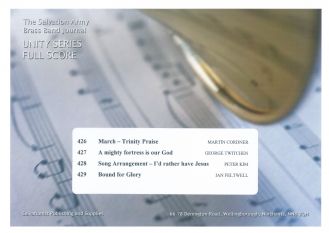
Unity Series Band Journal February 2015 Number 426 - 429
No. 426 March - Trinity Praise (Martin Cordner)Written in 2013 for the first anniversary of the Trinity Brass training band (a joint initiative between Rock Ferry and Birkenhead corps), this march celebrates God the Father, Son and Holy Spirit and calls to mind two songs: Father, we love you and verse 5 of Will J. Brand's song, Sing we many years of blessing.No. 427 A mighty fortress is our God (George Twitchen)The words and melody to this great hymn were written by Martin Luther and are based on PSalm 46. It has been called 'The battle hymn of the Reformation' for the effect it had on increasing support for the Reformer's cause. The words and melody are so closely associated with its author, that the first lines are inscribed on Luther's monument at Wittenberg.No. 428 Song Arrangement - I'd rather have Jesus (Peter Kim)Bandmaster Peter Kim from the USA Central Territory presents an arrangement of the popular gospel song, 'I'd rather have Jesus than silver or gold.' The lyrics were written by Rhea F. Miller in 1922 and have proved popular with many Christian denominations ever since.No. 429 Bound for Glory (Ian Feltwell)The song 'I'm a soldier bound for glory' was first published in 1922, is a great Salvation Army song of testimony and still remains a firm favourite today.
Estimated dispatch 7-14 working days
-
 £29.95
Battle Ground - Paul Sharman
This duet was written for Hendon Salvation Army band's annual Hendon Highlights concert, held at the Cadogan Hall in London. The soloists on that occasion were Philip Cobb and David Childs. A Salvation Army song entitled 'God's Soldier' provides the...
Estimated dispatch 5-7 working days
-
 £37.35
Drink to me only (Flugel Solo with Brass Band) Trad. English Melody arr. Bowen
Enhance your solo repertoire with this evocative and timeless setting for flugel horn. Originally arranged for the New York Staff Band in 1991, this piece offers a lyrical and deeply expressive showcase for the soloist. This arrangement draws from a rich heritage, blending secular and sacred traditions. The melody, famously attributed to Colonel R. Mellish (1777-1817), is inspired by the classic 17th-century poem by Ben Johnson. Within The Salvation Army tradition, this beloved tune is paired with the sacred lyrics of William Drake Pennick, "There is a holy hill of God, its heights by faith I see" (The Salvation Army Song Book, No. 627), making it a versatile choice for both concert and worship settings. This setting is celebrated for its warm, melodic lines, perfectly suited to the mellow tonal qualities of the flugel horn. For those interested in studying the interpretation of this work, the New York Staff Band featured this arrangement on their 1992 recording, Under Three Flags (Triumphonic TRCD 1050). To view a rolling score video featuring Donald Spencer (Flugel Horn Soloist) with the New York Staff Band please visit: www.youtube.com/watch?v=ZRocgjTrli4 Sheet music available from: UK - www.brassband.co.uk USA - www.solidbrassmusic.com Difficulty Level: 4th Section + Instrumentation: Flugel Horn Soloist Bb Soprano Cornet Eb Solo Cornet Bb Repiano Cornet Bb 2nd Cornet Bb 3rd Cornet Bb Solo Horn Eb 1st Horn Eb 2nd Horn Eb 1st Baritone Bb 2nd Baritone Bb 1st Trombone Bb 2nd Trombone Bb Bass Trombone Euphonium Bb Bass Eb Bass Bb Timpani Glockenspiel
In Stock: Estimated dispatch 1-3 working days
-
 £50.00
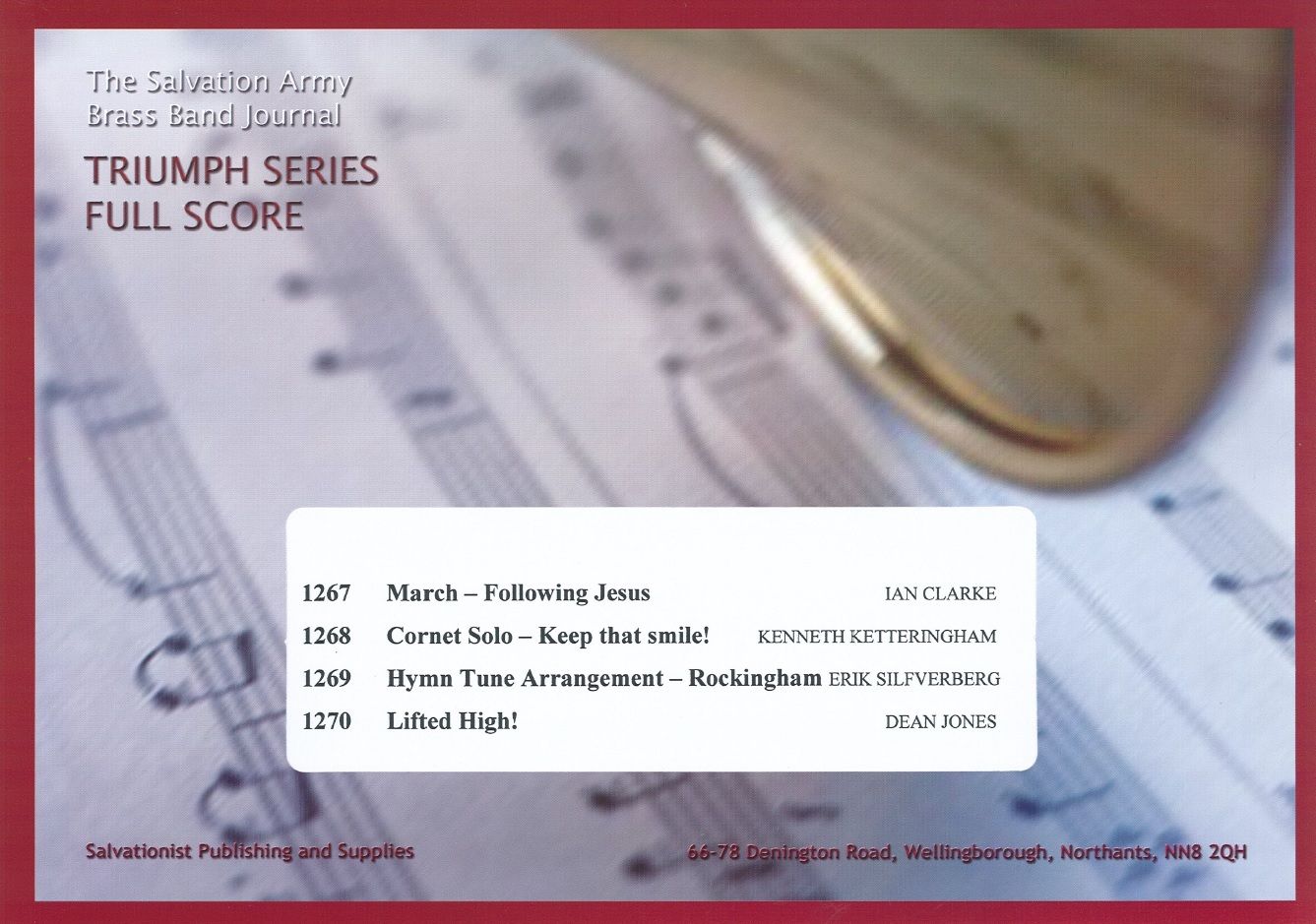
Triumph Series Band Journal November 2015 Numbers 1267 - 1270
No. 1267 March - Following Jesus (Ian Clarke)For more than two thousand years, countless Christians, the world over, have chosen to follow Jesus and try to live by his teachings. The words associated with the three tunes used in this march follow that theme: Sagina (T.B. 498), I will follow thee, my Saviour (T.B. 378) and There's joy in following (T.B.C.S. 206).No. 1268 Cornet Solo - Keep that smile! (Kenneth Ketteringham)This light-hearted, waltz-like solo features an old Army song written by Bandmaster George Marshall and Staff-Captain A.R. Wiggins.No. 1269 Hymn Tune Arrangement - Rockingham (Erik Silfverberg)A four-verse setting of the hymn tune, Rockingham, associated with the song 'When I survey the wondrous cross' by Isaac Watts.No. 1270 Lifted High! (Dean Jones)A bright, joyful arrangement of the song, 'Lord, I lift your name on high' in a Caribbean style.
Estimated dispatch 7-14 working days
-
 £14.95
Crugybar (Cornet and Piano)
The traditional Welsh tune of Crugybar is most commonly associated with words by Howell Elvet Lewis which appear in the Baptist Hymn Book of 1962; 'The light of the morning is breaking, the shadows are passing away'. The Salvation Army Song Book of 1986 lists two further hymns that can be sung to the tune; 'I stand all bewildered with wonder and gaze on the ocean of love' ( W F Crafts) and 'When Jesus from Calvary called me, unfolding its meaning to me' (Will J Brand). This arrangement was made for Martyn Bryant, the long-serving principal cornetist of Bristol Easton Band of The Salvation Army.
Estimated dispatch 7-14 working days
-
 £24.95
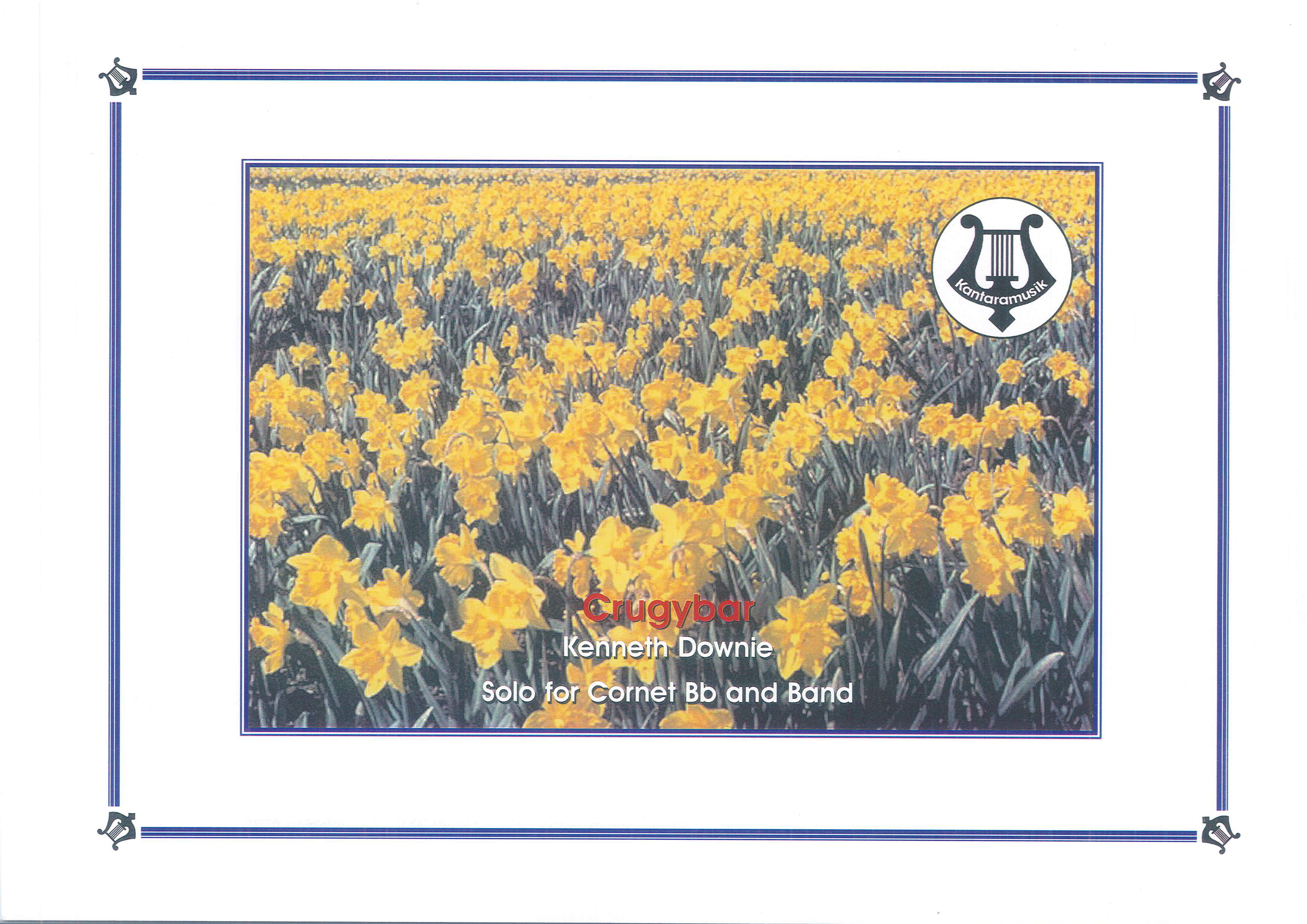
Crugybar (Cornet Solo with Brass Band - Score and Parts)
The traditional Welsh tune of Crugybar is most commonly associated with words by Howell Elvet Lewis which appear in the Baptist Hymn Book of 1962; 'The light of the morning is breaking, the shadows are passing away'. The Salvation Army Song Book of 1986 lists two further hymns that can be sung to the tune; 'I stand all bewildered with wonder and gaze on the ocean of love' ( W F Crafts) and 'When Jesus from Calvary called me, unfolding its meaning to me' (Will J Brand). This arrangement was made for Martyn Bryant, the long-serving principal cornetist of Bristol Easton Band of The Salvation Army.
Estimated dispatch 7-14 working days
-
£34.95
COME AND GET SAVED (Brass Band Set) - Bruce Broughton
This fantasia is based on the old Salvation Army song, 'Never can tell' which includes the words, 'You never can tell when the Lord will call you...Come and get saved and happy be'. The piece has many different and contrasting moods but is generally light-hearted and amiable like the straightforward message of the song and its genial melody.
Estimated dispatch 7-14 working days
-
 £29.95
Soliloquy II (Euphonium Solo with Brass Band - Score and Parts)
A few years ago, I wrote a Soliloquy based on a Salvation Army song by George Marshall called Soliloquy (In the Stillness), since published in the General Series. This solo follows up the form of that previous work, though it is quite different in emotional content, and was a commission during Covid lockdown from Euphonium player Micah Dominic Parsons.The main inspiration is the tune Cross of Jesus by John Stainer as well as a motif from some older Euphonium Studies from the Royal Military School of Music, Kneller Hall, that Micah had discovered. The tune is used in a chorale form and, after an introduction, the very first section is a reversal of the chorale that appears in the second half of the work. The Euphonium exclamations are all derived from the main tune and the study motif. The work begins in quite a dark reflective manner, representing those aspects of the song, without being too specific. The second half reflects the more positive characteristics and finds a triumphal nature in its conclusion. The soloist lines throughout have a very declamatory style and can have a freedom in performance.There is one new element in the coda, where the triplet motif (bars 87-89) is a direct quotation from Romans 8 - A brass celebration by Ray Steadman-Allen. RSA was a good friend, mentor and encourager to me. The glorious climax of Romans 8 is his presentation of the same tune (Cross of Jesus) used in this work. And so the piece ends with a final and personal reference to RSA!- Howard Evans
Estimated dispatch 7-14 working days
-
 £29.95
Keep in step! (Brass Band - Score and Parts)
The Salvation Army song Keep in step (S.A.S.B. 986) is given a tongue-in-cheek treatment, with the irony of a song that speaks of keeping in step at all times being used in a time signature that would be impossible to march to! This does make the music technically challenging and therefore careful preparation is needed to ensure everything remains within the correct bear, and that the rhythms sound convincing to the listener. There is also a touch of Broadway thrown in, with a recurring motif reminiscent of Gershwin's appropriately named Fascinating Rhythm.
Estimated dispatch 7-14 working days
-
 £29.95
Judd: Come and get Saved
This fantasia is based on the old Salvation Army song, 'Never can tell' which includes the words, 'You never can tell when the Lord will call you...Come and get saved and happy be'. The piece has many different and contrasting moods but is generally light-hearted and amiable like the straightforward message of the song and its genial melody.
Estimated dispatch 7-14 working days