Searching for Wind Band Music? Visit the Wind Band Music Shop
We've found 552 matches for your search. Order by

Results

  • £189.95

    'The New Christmas Collection' - Full Set March Card Size

    The new Christmas Collection carol books contain all the traditional Christmas Carols, with some new 'pop' music arrangements included to add more variety to your carolling this year.


    * Note, these are not compatible with the New Christmas Praise books.

    Full list of works in The Christmas Collection:-

    • A child this day is born
    • A Christmas lullaby
    • A great and mighty wonder
    • All I want for Christmas is you
    • All my heart this night rejoices
    • Angels, from the realms of Glory (Come and worship)
    • Angels, from the realms of Glory (Iris)
    • Angels we have heard on high
    • A starry night
    • As with gladness men of old
    • Auld lang syne
    • A virgin most pure
    • Away in a manger (The manger scene)
    • Away in a manger (Traditional)
    • A winter’s tale
    • Bethlehem
    • Brightest and best (Spean)
    • Brightest and best (Traditional)
    • Calypso Carol
    • Carol for the Nativity
    • Carol of the bells
    • Carol of the drum
    • Child of Mary
    • Christians Awake!
    • Christ is born (Il est né)
    • Christ was born on Christmas Day
    • Come and join the celebration
    • Come, children, come quickly
    • Coventry Carol
    • Deck the hall
    • Ding dong! merrily on high
    • Do you hear what I hear?
    • Frosty the snowman
    • Gabriel’s Message
    • Gaudete
    • Glory in the highest
    • Glory in the highest Heaven
    • God of God, the uncreated
    • God rest you merry, gentlemen
    • Good Christian men, rejoice
    • Good King Wenceslas
    • Go, tell it on the mountain!
    • Happy Christmas (War is over)
    • Hark the glad sound!
    • Hark! the herald angels sing
    • Have yourself a merry little Christmas
    • Here we come a-wassailing
    • How far is it to Bethlehem?
    • Huron Carol
    • Infant Holy
    • In the bleak midwinter (Cranham)
    • In the bleak midwinter (Darke)
    • I saw mommy kissing Santa Claus
    • I saw three ships come sailing in
    • It came upon a midnight clear (Traditional)
    • It came upon a midnight clear (Willis)
    • It’s beginning to look a lot like Christmas
    • It’s the most wonderful time of the year
    • I wish it could be Christmas everyday
    • I wonder as I wander
    • Jesus, good above all other
    • Jingle Bells
    • Jingle bell rock
    • Joy to the world!
    • Last Christmas
    • Let it snow!
    • Little baby Jesus
    • Little children, wake and listen
    • Little Donkey
    • Little Jesus, sweetly sleep
    • Lo! he comes with clouds descending
    • Long, long ago
    • Love came down at Christmas
    • Mary’s boy child
    • Mary’s Child
    • Masters in this hall
    • Merry Christmas everyone
    • Mistletoe and wine
    • Noel
    • O Christmas tree
    • O come, all ye faithful
    • O come, Immanuel
    • O Heaven-sent King
    • O holy night!
    • O little town of Bethlehem (Christmas Carol)
    • O little town of Bethlehem (Forest Green)
    • O little town of Bethlehem (St Louis)
    • Once in royal David’s city
    • Past three o’clock
    • Patapan
    • Personent Hodie
    • Praise ye the Lord
    • Ring the bells
    • Rise up, shepherd!
    • Rockin’ around the Christmas tree
    • Rudolph, the red-nosed reindeer
    • Sans day carol
    • Santa Claus is comin’ to town
    • Saviour’s Day
    • See, amid the winter’s snow
    • Silent Night!
    • Sleigh Ride
    • Softly the night is sleeping
    • So here it is, merry Christmas
    • Stars are shining
    • Still, still, still
    • Stop the cavalry
    • Sussex Carol
    • Sweet chiming bells
    • Sweet chiming Christmas bells
    • The candle song
    • The cherry tree carol
    • The Christmas song
    • The first Nowell
    • The holly and the ivy
    • The infant King
    • The light has come
    • The shepherds’ farewell
    • The stable door
    • The star in the east
    • The twelve days of Christmas
    • The virgin Mary had a baby boy
    • They all were looking for a king
    • Thou didst leave thy throne
    • Three kings’ march
    • Unto us a boy is born
    • Walking in the air
    • We gather round the manger-bed
    • We three kings of Orient are
    • We wish you a merry Christmas
    • What child is this?
    • When a child is born
    • When Santa got stuck up the chimney
    • Whence is that goodly fragrance flowing?
    • When wise men came seeking
    • While shepherds watched (Cranbrook)
    • While shepherds watched (Handel)
    • While shepherds watched (Winchester Old)
    • White Christmas
    • Who is he?
    • Winter Wonderland
    • Worldwide Christmas message
    • Zither Carol
    • A starry night
    • Christmas Joy
    • Christmas Praise
    • Coventry Carol
    • Infant Holy
    • Mid-winter
    • Rudolph, the red-nosed reindeer
    • The everlasting light
    • To celebrate his birth
    • Yuletide Rag

    Estimated dispatch 7-14 working days
  • £33.41

    Libera Me from 'Requiem' (Brass Band) Faure arr. Rob Bushnell

    Composed between 1887 and 1890, Gabriel Faure's Requiem is not only one of his best-known works but one of the most popular piece of choral music in the Classical repertoire, coming 23rd in the Classic FM's Hall of Fame 2024. Believed to be a tribute to his father (who died in 1885), Faure himself said "My Requiem wasn't written for anything - for pleasure, if I may call it that!" It started life as a five-movement work but was later expanded to be the final seven-movement work we know today. The first version (which Faure called "un petit Requiem") was first performed on 16 January 1888, with Faure conducting, a second version premiered on 21 January 1893 before the final version (reworked for full orchestra) was played on 12 July 1900; the Requiem was performed at the composer's own funeral in 1924.The Libera Me, or Deliver Me, was actually written in 1877 and is the sixth part of the Requiem.Faure once said of the work, "Everything I managed to entertain by way of religious illusion I put into my Requiem, which moreover is dominated from beginning to end by a very human feeling of faith in eternal rest." Upon interview, he also said, "It has been said that my Requiem does not express the fear of death and someone has called it a lullaby of death. But it is thus that I see death: as a happy deliverance, an aspiration towards happiness above, rather than as a painful experience. The music of Gounod has been criticised for its inclination towards human tenderness. But his nature predisposed him to feel this way: religious emotion took this form inside him. Is it not necessary to accept the artist's nature? As to my Requiem, perhaps I have also instinctively sought to escape from what is thought right and proper, after all the years of accompanying burial services on the organ! I know it all by heart. I wanted to write something different."This arrangement is for the British-style brass band, with alternative parts for horns in F and bass-clef lower brass. The tenor solo is featured on the euphonium. A recording of the original composition can be found here: www.youtube.com/watch?v=fXwFNoBHCf0 Duration: 4.20 minutes approx. Difficulty Level: 4th Section + PDF download includes parts and score. Sheet music available from www.brassband.co.uk Instrumentation: Soprano Cornet Eb Solo Cornet Bb Repiano Cornet Bb 2nd Cornet Bb 3rd Cornet Bb Flugel Horn Bb Solo Horn Eb 1st Horn Eb 2nd Horn Eb 1st Baritone Bb 2nd Baritone Bb 1st Trombone Bb 2nd Trombone Bb Bass Trombone Euphonium Bb Bass Eb Bass BbTimpani

    In Stock: Estimated dispatch 1-3 working days
  • £35.00

    Epitaph (for Hillsborough) - Peter Meechan

    Epitaph (for Hillsborough) was written on the 20th anniversary of the Hillsborough stadium disaster, April 15 1989, in memory of the 96 victims. All of the victims were fans of Liverpool Football Club, the club I have supported since I was a young child.The disaster unfolded in front of the BBC television cameras, and due to the importance of the match (FA Cup semi final), millions, including myself, witnessed it first hand, leaving a lasting impression in the public psyche.Several features of the piece were determined by the tragedy. The length of the piece, 6 and a half minutes, represents the minutes of the game that were played that day (The match was abandoned after 6 minutes), and the final thirty seconds of the work, where the band gently applaud, is a reference to the first match played after the tragedy, a European Cup semi final between AC Milan and Real Madrid.After 6 minutes, the referee blew his whistle and all the players stood still where they were, both sets of fans applauded in memory of the perished, and the fans of AC Milan began singing Youall Never Walk Alone, the anthem of Liverpool Football Club.The work also features 96 strikes of the tubular bells, in memory of each person who lost their life.Epitaph is dedicated to the 96 people who died that day, and to their families whose fight for justice is an inspiration to all.

    Estimated dispatch 12-14 working days

     PDF View Music

  • £76.99

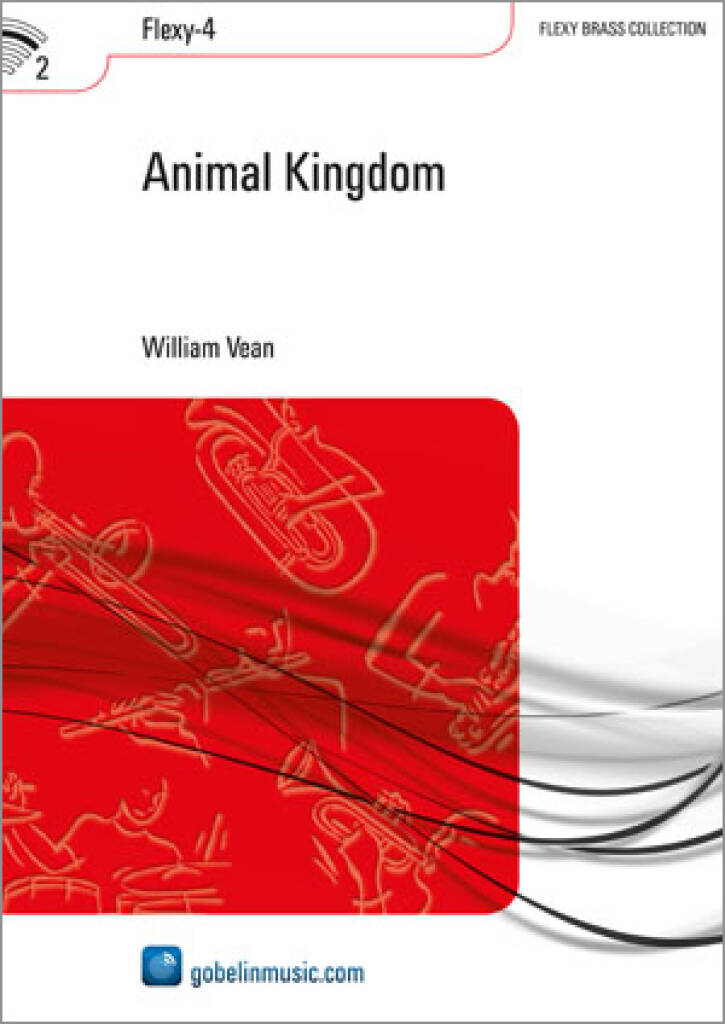
    Animal Kingdom - William Vean

    In this composition William Vean takes you on a journey through the fascinating and exciting world of animals. Apart from it being a composition filled with "special effects", Animal Kingdom contains many educational elements, such as playing inswing (triplets feeling), chromatics, flutter tonguing, gypsy tuning, varying keys, and, of course, dynamics and articulation. The melodic lines occur in all four voices, as well as in all percussion parts, providing each musician with theopportunity to play a solo or to accompany. Highly recommended for your youth band! William Vean is an educational composer. He knows how to musically shape the special elements from our daily lives. His music is therefore veryexpressive, containing creative solutions to possible problems. Special ways of playing make his music particularly interesting for the winds, but the percussion section is also featured in his special effects. The world of the animalsalways plays on ones imagination. In Animal Kingdom, William Vean has portrayed a number of animals in a special manner: Kevin Kangaroo - The jumping character of this animal can be heard in different voices. The swing style alsoemphasizes the characteristic movements of the kangaroo. Playing in swing style can be practised by using scales. Eddy Elephant - For some of his smaller fellow fauna friends this can be quite an ordeal, but for Eduard (Eddy for friendsand intimates) it is his daily walk. Baldrick Bat - Baldrick the Bat is a mysterious character. This can be heard in the fast moving valves and keys, accompanied by special effects in the percussion section. Curtis Camel - Curtisthe Camel trudges across the desert, feeling bored. The idea that the horizon will never change does not affect him anymore. He has accepted his fate. The distinctive tones from the gypsy scale provide the suitable oriental sounds. BettyButterfly - Butterfly Betty elegantly, and without worries, flutters from flower to flower in the garden. Her motto: Carpe Diem (Seize the Day). Betty is a one-day butterfly. Marvin Monkey - A "swing" monkey stirs up the feelings. Evenmembers of the orchestra will look like real monkeys. How about your audience? Each part has its own difficulties and challenges. Important in the first part is playing "in swing" (triplets feeling). This can be practised usingscales. In the second part ensemble playing and balance are important. In Baldrick additional information on the effects that have to be played might be useful. "New" sounds are, of course, welcome. Curtis the Camel introduces thegypsy scale. Additional explanation of the use of the scale might be useful. Key changes are interesting in this part. A slight accent on the first beat of the bar will add to the charm of this part. Marvin the Monkey brings back the swingrhythm that was introduced in the first part, alternated by a "straight" part with attention to chromatics and articulation. A story teller will definitely be an asset when performing this composition.

    Estimated dispatch 5-14 working days

     PDF View Music

  • £83.60

    Los Hermanos de Bop - Mark Taylor - Sandy Smith

    Los Hermanos De Bop is a composition by Mark Taylor (arr. Sandy Smith). In the Obrasso webshop are the Sheet Music for Brass Band with the article no. 16198 available. The sheet music is classified in Difficulty level C (medium). More Music for entertainment for Brass Band can be found using the flexible search function. Use the free trial score for Los Hermanos De Bop and get a musical impression from the audio samples and videos available for the Brass Band piece. With the user-friendly search function in the Obrasso webshop, you can find in just a few steps more sheet music from Mark Taylor for Brass Band. So that you can complete your concert program, show all music sheets can be displayed with one click on Music for entertainment in Difficulty level C (medium) . Los Hermanos De Bop is one of many brass music compositions that have been published by Musikverlag Obrasso. Next to Mark Taylor over 100 composers and arrangers work for the Swiss music publishing house. In addition to the notes for Brass Band you will also find literature in other formats such as Brass Band, Concert Band, Junior Band, Brass Ensemble, Woodwind Ensemble, Symphony Orchestra as well as CDs and Music Education. A large part of the publisher's own literature from top brass bands such as the Black Dyke Band, Cory Band, Brighouse & Rastrick Band or the Oberaargauer Brass Band was recorded on Obrasso Records. All sound carriers are also available digitally on the popular portals of Apple, Amazon, Google, Spotify and other providers worldwide. All Obrasso sheet music is produced on high quality paper. The slightly yellowish note paper offers a good contrast and is easy on the eyes in difficult lighting conditions. Delivery to private customers worldwide is free of shipping costs. Order your sheet music now directly from Obrasso Verlag.

    Estimated dispatch 5-14 working days
  • £98.00

    KirkFeld (Trombone Solo with Brass Band - Score and Parts) - Kirkhope, Grant - McKenzie, Jock

    Written for Ian Bousfield and the International Trombone Festival 2017. Grant Kirkhope is a BAFTA nominated British composer who has created the soundtrack for video games that have sold in excess of 30 million copies. From "GoldenEye" to "Banjo-Kazooie", "Viva Pi?ata" to "Donkey Kong", "Kingdoms of Amalur: Reckoning" to "Civilization: Beyond Earth" and "Perfect Dark" to "Castle of Illusion starring Mickey Mouse". He has also recently scored the feature film "The King's Daughter" starring Pierce Brosnan and William Hurt and is currently working on "Yooka Laylee" and "Dropzone". Grant's score for "Viva Pi?ata" was nominated by BAFTA in the Original Score category in its 2007 awards. Grant is represented by the prestigious Gorfaine/Schwartz Agency by Cheryl Tiano and Kevin Korn. Grant has a degree in music from the Royal Northern College of Music, Manchester, where he majored in classical trumpet, is a green card holder and now lives in Agoura Hills, LA with his wife and two children. "Ian and I first met when we were around 15 years old. We both played in our county orchestra, the North Yorkshire Schools Symphony Orchestra (I was a trumpet player). I think we hit it off straight away, as we were definitely a couple of cheeky kids, if you know what I mean! We both ended up playing in Rowntree Mackintosh Brass Band for a while too which Ian's Dad, Trevor conducted. We bumped into each other again when we both went for the Shell/LSO Scholarship. I got to the area finals in Manchester so I was pretty pleased with myself but then I saw Ian and I knew it was all over! Of course Ian went on to win and the rest is history. I saw him again when I was attending the Royal Northern College of Music around 1983 by which time Ian had just got the principal chair at the Halle Orchestra. Then I guess 30 something years went by as we both went about our lives and lost touch. We re-kindled our friendship due to his wife really. She emailed me to say it was Ian's 50th birthday and she was collecting stories from all his friends over the years. After that we got back in touch and then one day on Facebook I got a message from him in typical dry Yorkshire fashion "now then Grant, I had a listen to your music and I think it's good, how about writing a piece for me ?" I was a little bit unsure at first but of course I loved Ian's playing and of course I said yes. Over a Skype call in 2016, he asked me what I thought I'd write. I said since I live in LA I'd like to write a "Hollywood" trombone piece. Imagine if John Williams had written a piece for solo trombone, that's what I'd like to write - well I'd certainly like to try" - Grant Kirkhope

    Estimated dispatch 7-14 working days
  • £29.95

    Unity Series Band Journal February 2014 Numbers 414-417

    No.414 March - Zambia Salute (Paul Drury)In April 2009, a group from Chelmsford Citadel Corps visited Zambia. The purpose of the visit was to assist in the leadership of the Zambian Territorial Music School, held at Chikankata. This march was written to commemorate the event and received its premiere performance at the final festival. The melody featured is the chorus of the song, I know not why Dod's wondrous grace (S.A.S.B. 730).No.415 A Joystrings sing-along (Erik Silfverberg O.F.)This piece represents the first published work since the sudden Promotion to Glory of Bandmaster Erik Silfverberg O.F. The Joystrings made Salvation Army history about fifty years ago, introducing rock music on the Christian music scene. Many of their songs have become classics and have been used as thematic material in our brass music. Here is a selection of three of their songs, to be used either as a band piece or as accompaniment to a sing-along. The three songs are:- 'I want to sing it', 'It's an open secret' and 'Have faith in God'.No.416 Festival Arrangement - At the cross (Martyn Thomas)The well-known song, 'At the cross' (T.B. 580), is given a lively new setting by Martyn Thomas. The rock and swing treatment of this old melody should appeal to many!No.417 Lord of all (Martin Cordner)This piece was written for the 120th Anniversary of Balham corps (London Central Division) in 2011. In terms of a theme, the anniversary occasion prompted the primary thought that the piece should first be a praise-offering to God, acknowledging him for who he is. Therefore songs referenced in the piece are praide songs: 'Lord, reign in me', 'He is Lord', 'All hail the Lamb', along with a song of testimony, 'I'm a soldier bound for Glory' (T.B. 382),which speaks of the Christian hope in Heaven and challenges Salvationists to influence others by living out that hope. There is also a brief reference to the National Anthem of the Democratic Republic of Congo (4 bars before D)- man acknowledgement to the faithfulness of corps soldiers who in recent years have arrived from that country.

    Estimated dispatch 7-14 working days
  • £34.95

    Aristotle's Air - Christopher Bond

    The Ancient Greeks believed that there were four elements that everything was made up of: earth, water, air and fire. This theory was suggested around 450 BC, and was later supported and added to by Aristotle. The idea that these four elements - earth, water, air and fire - made up all matter was the cornerstone of philosophy, science, and medicine for two thousand years. Air was considered a 'pure' element, but in fact the air that's all around us is made up of a variety of gasses. Of course, in music, air has a different meaning; a beautiful song-like melody or tune and Aristotle's Air is just that. The work was commissioned by and written for The Cory Band as part of their winning 2015 Brass in Concert programme 'The Four Elements of the Universe', being premiered at the contest at The Sage, Gateshead, on 15th November 2015. The work was awarded the Cyril Beere Memorial Trophy for the Best New Composition or Arrangement.

    Estimated dispatch 10-14 working days
  • £70.00

    Origins - Peter Meechan

    Origins is in three movements, with each movement having a different subject matter, all linked by the idea of origins: the first movement refers to musical origins; the second to the origins of life; and the final movement to the space exploration - the research of all origins. The first movement is based on a short motif, heard in the first three notes the soloist plays. These three notes cover the interval of a minor third (an interval that often plays a crucial role in my music) on which the whole concerto is built. The soloist and accompaniment interplay freely throughout the opening section, before an ostinato accompaniment appears - over which the soloist sounds a long legato melody. A short cadenza follows and a return to the opening material leads the movement to an end. The second movement, titled Harryas Song, is - as tradition dictates - a slow movement. Happy and reflective in nature, the main melody was written on the evening that my closest friend, Mark Bousie (a fine euphoniumist himself), and his wife Jayne, had their first child - Harry Bousie. It seemed only fitting that this song should be written for Harry in celebration. The final movement brings me back to a lifelong fascination with space, and in this particular movement, the Space Shuttle Discovery. Having completed 39 missions (including flying the Hubble telescope in to orbit), and spent a total of 365 days in space, SS Discovery made its final voyage in 2011 and was taken to the Smithsonian in Washington D.C. in April 2012. This final movement, titled Discovery, pays tribute to the great shuttle whose missions inspired millions across the generations. Origins was commissioned by Marco Schneider, Adrian Schneider and the Dunshan Symphonic Wind Orchestra, Beijing, China.

    Estimated dispatch 12-14 working days
  • £44.95

    Princethorpe Variations (Brass Band - Score and Parts) - Downie, Kenneth

    Colourful harmony, rhythmic flair and melodic invention are the hallmarks of this excellent set of variations by Kenneth Downie, based on the well known church tune, Princethorpe.This major work demonstrates the well-known characteristics of the composer: colourful harmony, rhythmic flair and melodic invention, all encapsulated in scoring which is engulfing both to players and listeners alike. Following a presentation of the theme there are five variations culminating in what can be described as either a finale or coda.Theme. The composer shows his originality in the harmonic sense of this introduction. Perhaps it could be suggested that over-indulgence of rubato may be a temptation to be avoided.Sections A to F. Relentless rhythmic drive is of paramount importance in this first variation. Conscientious observance of dynamics is of course an essential requirement in conveying the exciting quality of the music; there are moments of sudden contrast of which all will need to be aware. Moving between the time-signatures of 5/4 and 6/4 these sections are built from strong easily-identifiable fragments of the theme. These is a significant increase in temp at letter F which will further the exciting impact of the music.Sections G & H. In a pastorale style this short, gentle variation affords a contrast in style between the previous and succeeding ones. The gentle undulating character of the melodic lines is governed by the Allegretto grazioso directive.Sections I to M. Commencing two bars before letter I the music is now exuberant and the tempo and style is that of a march in compound time. In this exhilarating movement there are moments of contrast and indeed of delicacy which are a foil to the more energetic moments. Rhythmic control will be essential to maintain a consistent tempo. As elsewhere in the work, the percussion section will contribute much to the success of the performance there are bars where this section alone is heard and there are important entries for glockenspiel.Sections N & O. With emotional content this Adagio variation has the first two notes of the melody as its melodic impetus. Apart from just over two bars at O (where there is an interpolatory phrase from Cornets and Trombones), the melodic line is entrusted to the plaintive sounds of the horn section. Cornets and Trombones provide a change of tone colour at the beginning of section O. Under a poco rall, this very expressive variation is concluded; there is an important link supplied by Eb Bass.Sections P & Q. A lively march-tempo is launched immediately and these sections are in the nature of an introduction to the final variations. There is a quickening of pace at Q which assists the generation of excitement which should be an essential part of the performance. Solo Cornets introduce a melodic line at Q which anticipates the compound time of the following section.Sections R & S. The Solo Cornet theme of the previous section is now a contrapuntal line accompanying the theme tune. With an elongation of the notes in the melody, the conductor will need to call on the sustaining powers of the band and at no time should the interesting accompanying lines be allowed to detract from the sonorous presentation of the basic theme.Sections T, U & V. Following a poco rit, the finale begins at letter T with the directive, molto vivace. There is much detail to be rehearsed, not least being the dynamic contrasts which are encountered. As throughout the work, the listener should have no difficulty in identifying the thematic sources of the composer's music.

    Estimated dispatch 7-14 working days

     PDF View Music