
Results
-
 £59.95
Judd: Caelum Corona - Stephen Bulla
Stephen Bulla's 'Caelum Corona' ('Crown of Heaven') portrays, in sound, a Christian's walk in faith, intended metaphorically via a musical narrative reminiscent of the early church pilgrims, their struggles and triumphs. The composer initially evokes the atmosphere of Rome at the time of St. Paul and other martyrs, thus the Latin title. Bulla marks his imaginative tone poem with dark, brooding music in the first two of three parts, in each of which he has embedded an appropriate hymn or song reference as thematic material. The first of these sounds in a minor key following a symphonic exposition made up primarily of fanfare-like motives, the music at times quite harsh and abrasive. The song is Paul's statement of exuberant faith (2 Timothy 1:12) in the midst of prison and persecution: 'For I know whom I have believed, and am persuaded that he is able to keep that which I've committed unto him against that day.' More challenging, aggressive music returns until a further point of reflection on Christ's sacrifice is reached. The music graphically evokes the barren landscape of Golgatha, the horror of the crucifixion, including stark wind sounds, a loss of stability via eerie, dissonant chord clusters, and even the nails being driven into Christ's body. The Baritones and then Flugel Horn softly play 'He died of a broken heart.' Yet the Christian life, despite its perils - both at the time of Paul and now - is a victorious life, and the composer resolves the tensions of the work in a scintillating finale, a brilliant setting of the old song about spiritual warfare and the ultimate triumph of Christ the King: 'Victory for me!' (T.B. 841). The chorus of that tune proclaims: 'No retreating, hell defeating, shoulder to shoulder we stand; God look down, with glory crown our conq'ring band.' That crowning is the same one sought and claimed by St. Paul (2 Timothy 4:8): 'Now there is in store for me a crown of righteousness, which the Lord, the righteous judge, will award me on that day, but also to all who have longed for his appearing.' Believers look forward to participating in the final coronation of their Saviour - King of Kings and Lord of Lords - while humbly desiring their own 'crown of heaven.'
Estimated dispatch 7-14 working days
-
 £10.00
The Once and Future King
DescriptionThe Once and Future King is a suite of three movements; each movement was inspired by an Arthurian legend. The first movement, 'Tintagel', concerns the famous Cornish promontory said to be the birthplace of King Arthur. In Arthur's time, Tintagel was part of the court of King Mark of Cornwall and the music imagines a visit by the King of the Britons to his Cornish neighbour and the place of his birth, reflecting the ceremony and drama of such an occasion; the music is strongly antiphonal, contrasting the more strident fanfares of the cornets and trombones with the warmth of the saxhorns and tubas.The second movement, 'Lyonesse', takes its inspiration from the mythical land which once joined Cornwall to the Isles of Scilly. One legend claims that after the disastrous battle of Camlan where Arthur and Mordred were both killed, the remnants of Arthur's army were pursued across Lyonesse to Scilly, whereupon Merlin cast a spell to sink Lyonesse behind them and drown the pursuers. Some say the bells of the 140 churches inundated that day can still be heard ringing. All the material in this movement derives from two short motifs heard in counterpoint at the very beginning, which are intentionally dissonant and bitonal in character.The final movement, 'Badon Hill', takes its title from the legendary site of Arthur's last battle with the Saxons and is a lively toccata based on the medieval secular song L'Homme Armee ('The Armed Man'). The music uses a number of medieval devices including "hocketing" (passing melody from one voice to another). The actual site of Badon Hill is unknown but it has been associated with Badbury Rings in Dorset and a lot of evidence now points towards the town of Bath. Arthur's victory at Badon Hill was the last great victory for Celtic Britain over the Saxon invaders, but in the end only set the conquest back by a few decades. Arthur himself was dead by then, betrayed and defeated by his nephew Mordred, but it is said that Arthur only sleeps and will return in a time of dire need - hence the legend that Arthur's dying words were: Bury me in Britain, for I am the Once and Future King.Performance NotesWhere space and practicality permits the opening movement should be played with cornets and trombones standing behind the band facing the audience; they should retake their seats for the second and third movements.PercussionConcert Bass Drum (ideally NOT Kit/Pedal Bass Drum), Suspended Cymbal, pair of Clash Cymbals, Glockenspiel, Snare Drum, Tambourine, 2 x Timpani (Eb-G, Bb-D), 2 x Tom-toms, Triangle, Tam-Tam* (only if available), Tubular Bells *(only if available).MutesBaritones, all cornets and trombones will require metal straight mutes; all trombones and cornets will require cup mutes.*The Once and Future King was set as the test-piece for the 3rd section of the Swiss National Championships in 2007. The score was then slightly revised in July 2008, the main alteration being the exclusion of the tubular bells part for the Regional Championships of Great Britain in 2009. Some parts which were optional (or cued on other instruments) at the request of the Swiss Brass Band Association were restored to their original octaves and instruments. In 2015 the tubular bells part was restored in the optional Percussion 3 part; all parts in Percussion 3 are optional, although some are cued in the percussion 1 & 2 parts (and the cues should be played if only two players are available).Listen to a preview and follow along with the score below!
Estimated dispatch 7-14 working days
-
 £38.95
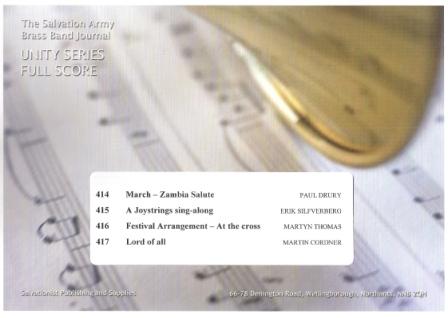
Unity Series Band Journal February 2014 Numbers 414-417
No.414 March - Zambia Salute (Paul Drury)In April 2009, a group from Chelmsford Citadel Corps visited Zambia. The purpose of the visit was to assist in the leadership of the Zambian Territorial Music School, held at Chikankata. This march was written to commemorate the event and received its premiere performance at the final festival. The melody featured is the chorus of the song, I know not why Dod's wondrous grace (S.A.S.B. 730).No.415 A Joystrings sing-along (Erik Silfverberg O.F.)This piece represents the first published work since the sudden Promotion to Glory of Bandmaster Erik Silfverberg O.F. The Joystrings made Salvation Army history about fifty years ago, introducing rock music on the Christian music scene. Many of their songs have become classics and have been used as thematic material in our brass music. Here is a selection of three of their songs, to be used either as a band piece or as accompaniment to a sing-along. The three songs are:- 'I want to sing it', 'It's an open secret' and 'Have faith in God'.No.416 Festival Arrangement - At the cross (Martyn Thomas)The well-known song, 'At the cross' (T.B. 580), is given a lively new setting by Martyn Thomas. The rock and swing treatment of this old melody should appeal to many!No.417 Lord of all (Martin Cordner)This piece was written for the 120th Anniversary of Balham corps (London Central Division) in 2011. In terms of a theme, the anniversary occasion prompted the primary thought that the piece should first be a praise-offering to God, acknowledging him for who he is. Therefore songs referenced in the piece are praide songs: 'Lord, reign in me', 'He is Lord', 'All hail the Lamb', along with a song of testimony, 'I'm a soldier bound for Glory' (T.B. 382),which speaks of the Christian hope in Heaven and challenges Salvationists to influence others by living out that hope. There is also a brief reference to the National Anthem of the Democratic Republic of Congo (4 bars before D)- man acknowledgement to the faithfulness of corps soldiers who in recent years have arrived from that country.
Estimated dispatch 7-14 working days
-
 £14.94
Jingle Boogie-Woogie Bells (Brass Band - Ukraine Charity Release) Ovcharenko
This piece was arranged by Halyna Ovcharenko, a Ukrainian composer who was born in Lugansk, a Ukrainian city that is currently under occupation by the Russian Federation. All the proceeds from this sale will go towards the 'A family for every orphan' appeal, which is providing emergency relief services to thousands of children and families in Ukraine. For more information about the charity please visit https://afamilyforeveryorphan.org/ukraine/ Halyna Ovcharenko has been composing music since she was 11. Many of her compositions of various genres have received international awards, but she discovered the world of brass band music with its specific timbre and huge range of musical colors only recently, in 2022, while composing her Vyshyvanka for Grimethorpe Colliery Band. Halyna comments: "I enjoyed my experience. Since then I have had an appetite to write more for brass bands, and here we are - an arrangement of a traditional English Christmas song which I have done especially to raise money for Ukrainian orphans. Their heroic parents stood for my Lugansk, for our Ukraine and for the whole World. I hope that the World will make these children feel that they are not left alone, giving them love, care and joy." The picture on the front cover was drawn by Victoria Lebed, a Ukrainian girl. This PDF download includes parts and score. Sheet music available from www.brassband.co.uk Instrumentation: Soprano Cornet Eb Solo Cornet Bb Repiano Cornet Bb 2nd Cornet Bb 3rd Cornet Bb Flugel Horn Bb Solo Horn Eb 1st Horn Eb 2nd Horn Eb 1st Baritone Bb 2nd Baritone Bb 1st Trombone Bb 2nd Trombone Bb Bass Trombone Euphonium Bb Bass Eb Bass Bb Percussion 1-2
In Stock: Estimated dispatch 1-3 working days
-
 £110.00
Diversions After Benjamin Britten (Brass Band - Score and Parts)
Suite by Lucy Pankhurst, Simon Dobson, Paul McGhee and Gavin HigginsHaving devised a collective centenary tribute for Michael Tippett at the 2006 RNCM Festival of Brass (Variations on a Theme of Michael Tippett by five eminent composers of brass band music, PHM002), I commissioned this companion piece as a Benjamin Britten tribute for the 2013 festival. In the late 1970s, while researching a book about the English composer, and Britten's first teacher, Frank Bridge (1879 - 1941), I came across a copy of the printed score of Benjamin Britten's Variations on a Theme of Frank Bridge (Op.10) for string orchestra, in which Britten had written descriptive titles for each of the variations suggesting appropriate character traits of his much loved mentor and guide. The character variations are cast in march, song and dance forms.Taking inspiration from Britten's youthful tribute, I invited four award-winning composers, who have all made significant contributions to the brass band medium, to create their own personal reflections on four aspects of Britten's character and music, designed to form a suite of Diversions after Benjamin Britten, but which can also be played separately.Lucy Pankhurst's hauntingly lyrical Prelude: His Depth refers to the emotional and symbolic subtexts that underpin Britten's operas, taking its musical cue from Britten's many arrangements of folk songs. The flugel horn takes a prominent role throughout.Simon Dobson's breathless Scherzo: His Vitality reminds us with its rapid passage work and leaping bass 'groove' that Britten loved tennis and fast cars in his younger days.Paul McGhee's evocative interpretation of the March: His Sympathy represents Benjamin Britten's pacifism, as the composer writes: 'We view the music through the eyes of a pacifist. Whilst war and violence surround us, we do not engage in it and though it continues to happen around us. With the use of muted effects in most of the band throughout the piece, the flugel horn is the lone voice of reason, standing firm against the mechanical and destructive society in which it is forced to live. As the machine of war continues around the lone voice, the voice is gradually dismissed and mocked as the war machine rumbles on into the distance.'In an extended finale, entitled Toccata: His Skill, Gavin Higgins celebrates Benjamin Britten's consummate creativity. For the RNCM Festival of Brass premiere, the four contrasting movements were framed and connected by Britten's Fanfare for St. Edmundsbury for three trumpets, with the trumpet soloists spaced round the hall. I am grateful to the Britten Estate and publishers Boosey & Hawkes for giving permission for the elements of Britten's fanfare to be incorporated in the collective work.- Paul HindmarshDuration: 19.30
Estimated dispatch 7-14 working days
-
£45.00
Diversions After Benjamin Britten (Brass Band - Score only)
Suite by Lucy Pankhurst, Simon Dobson, Paul McGhee and Gavin HigginsHaving devised a collective centenary tribute for Michael Tippett at the 2006 RNCM Festival of Brass (Variations on a Theme of Michael Tippett by five eminent composers of brass band music, PHM002), I commissioned this companion piece as a Benjamin Britten tribute for the 2013 festival. In the late 1970s, while researching a book about the English composer, and Britten's first teacher, Frank Bridge (1879 - 1941), I came across a copy of the printed score of Benjamin Britten's Variations on a Theme of Frank Bridge (Op.10) for string orchestra, in which Britten had written descriptive titles for each of the variations suggesting appropriate character traits of his much loved mentor and guide. The character variations are cast in march, song and dance forms.Taking inspiration from Britten's youthful tribute, I invited four award-winning composers, who have all made significant contributions to the brass band medium, to create their own personal reflections on four aspects of Britten's character and music, designed to form a suite of Diversions after Benjamin Britten, but which can also be played separately.Lucy Pankhurst's hauntingly lyrical Prelude: His Depth refers to the emotional and symbolic subtexts that underpin Britten's operas, taking its musical cue from Britten's many arrangements of folk songs. The flugel horn takes a prominent role throughout.Simon Dobson's breathless Scherzo: His Vitality reminds us with its rapid passage work and leaping bass 'groove' that Britten loved tennis and fast cars in his younger days.Paul McGhee's evocative interpretation of the March: His Sympathy represents Benjamin Britten's pacifism, as the composer writes: 'We view the music through the eyes of a pacifist. Whilst war and violence surround us, we do not engage in it and though it continues to happen around us. With the use of muted effects in most of the band throughout the piece, the flugel horn is the lone voice of reason, standing firm against the mechanical and destructive society in which it is forced to live. As the machine of war continues around the lone voice, the voice is gradually dismissed and mocked as the war machine rumbles on into the distance.'In an extended finale, entitled Toccata: His Skill, Gavin Higgins celebrates Benjamin Britten's consummate creativity. For the RNCM Festival of Brass premiere, the four contrasting movements were framed and connected by Britten's Fanfare for St. Edmundsbury for three trumpets, with the trumpet soloists spaced round the hall. I am grateful to the Britten Estate and publishers Boosey & Hawkes for giving permission for the elements of Britten's fanfare to be incorporated in the collective work.- Paul HindmarshDuration: 19.30
Estimated dispatch 7-14 working days
-
 £14.94
Finale from Symphony No.3 (Organ Symphony) (Brass Band) Additional Parts
Saint-Saens' magnificent Finale from Symphony No.3 (widely known as the 'Organ Symphony') has here been arranged for brass band with optional organ by Kevin Norbury. It was recorded by The International Staff Band on its CD Manuscripts, although this version has been revised in places. Saint-Saens decided to add the organ and piano to his 3rd symphony as a pragmatic orchestration innovation. The composition of this symphony was probably started in 1885 and a first draft was completed in Prague in 1886. Saint-Saens later recalled its eventful genesis: 'The Symphony in C was three-quarters sketched out when I found it impossible to write the finale. I did not know how to resolve this situation, until one night I suddenly woke up and, in a sort of hallucination, I heard the whole finale, which I hastily wrote down in outline, knowing that if I went back to sleep without having put anything on paper, I would have forgotten it all the next day.' The symphony was first performed under the composer's direction at Saint James's Hall in London on May 19, 1886. This arrangement by Kevin Norbury can both function as a stand-alone brass band piece, and be performed with an organ by omitting the notes found in square brackets in the parts and score. To view a rolling score video please visit www.youtube.com/watch?v=OlUd_FppBY8 PDF download includes additional parts as listed below. Full set including score available here. Sheet music available from: UK - www.brassband.co.uk USA - https://satradecentral.org Difficulty Level: 1st Section + Length: 8.30 mins. Alternative Parts included in this download: Solo Horn F 1st Horn F 2nd Horn F 1st Baritone B.C. 2nd Baritone B.C. 1st Trombone B.C. 2nd Trombone B.C. Euphonium B.C. Tuba 1 B.C. (Bass Eb equivalent) Tuba 2 B.C. (Bass Bb equivalent)
In Stock: Estimated dispatch 1-3 working days
-
£48.56
Finale from Symphony No.3 (Organ Symphony) (Brass Band) Saint-Saens arr. Norbury
Saint-Saens' magnificent Finale from Symphony No.3 (widely known as the 'Organ Symphony') has here been arranged for brass band with optional organ by Kevin Norbury. It was recorded by The International Staff Band on its CD Manuscripts, although this version has been revised in places. Saint-Saens decided to add the organ and piano to his 3rd symphony as a pragmatic orchestration innovation. The composition of this symphony was probably started in 1885 and a first draft was completed in Prague in 1886. Saint-Saens later recalled its eventful genesis: 'The Symphony in C was three-quarters sketched out when I found it impossible to write the finale. I did not know how to resolve this situation, until one night I suddenly woke up and, in a sort of hallucination, I heard the whole finale, which I hastily wrote down in outline, knowing that if I went back to sleep without having put anything on paper, I would have forgotten it all the next day.' The symphony was first performed under the composer's direction at Saint James's Hall in London on May 19, 1886. This arrangement by Kevin Norbury can both function as a stand-alone brass band piece, and be performed with an organ by omitting the notes found in square brackets in the parts and score. To view a rolling score video please visit www.youtube.com/watch?v=OlUd_FppBY8 PDF download includes score and parts. Additional parts (Horn in F and Baritone, Trombone, Euphonium & Tuba in Bass Clef) available here. Sheet music available from: UK - www.brassband.co.uk USA - https://satradecentral.org Difficulty Level: 1st Section + Length: 8.30 minutes Instrumentation: Soprano Cornet Eb Solo Cornet Bb Repiano Cornet Bb 2nd Cornet Bb 3rd Cornet Bb Flugel Horn Bb Solo Horn Eb 1st Horn Eb 2nd Horn Eb 1st Baritone Bb 2nd Baritone Bb 1st Trombone Bb 2nd Trombone Bb Bass Trombone Euphonium Bb Bass Eb Bass Bb Timpani Glockenspiel Percussion Organ (optional)
In Stock: Estimated dispatch 1-3 working days
-
£110.00
Legend - Geert Jan Kroon
Other than the title, there is no real story that connects this piece to eyeballs or werewolves. There is no real legend that precedes this work. The legend will evolve in the listener's mind while listening to this piece. For me, it started with the title. It was dreamed up by my son. He also suggested a musical gesture, which I then used to build all the musical materials in this piece. I have sought to capture a dark atmosphere with a sense of excitement. Although, there are some not so dark moments in the piece which serve as a musical contrast. I would like to invite every listener to imagine a world where there exists a legend of a bleeding eyeball and a blind werewolf. And if you do dream up a great story, please let me know and share it with each other!
-
 £33.62
Disinformation! (Brass Band) Joe Galuszka
This atmospheric work by English composer Joe Galuszka is set in three movements: I. Fear II. Hope III. Solidarity (March for Truth) The composer writes: 'All around us is mistrust in the information we receive. Chinese misinformation. Russian disinformation. 'Fake News' in the United States. At every turn we doubt what we hear, what we see. Disinformation was composed in response to the ever-growing and all powerful misinformation campaigns worldwide that reached dizzying levels of influence, coming from some of the most eminent heads of states, during the turn of the 21st century. With division and disillusionment now rife and engrained in Western democracies, the unravelling of the social order is reflected in this short work for brass band. Opening with Fear, Disinformation starts with vast amounts of noise taking over the establishment and paints a world with people coming to terms with the cacophony of sound that is 'false information'. With a retreat to a brief moment of solace, Hope conjures up a calm escapism where on the outside, the brave and the wise look on to what is becoming of our new world. Maybe there is chance to pull together? Ending with a frenzied, brazen climax, the piece concludes with Solidarity - where people and the politicians come to loggerheads in a battle - where those who seek division are called out and the lies are laid bare for all to see, as we enter, once more, the unknown.' To listen to a recording of Solna Brassperforming the work please visit https://open.spotify.com/track/2gvPdCsvmykdWpm2yjz3Uk?si=68cc33805d16449c To view a rolling score video of this work please visit www.youtube.com/watch?v=z-0I47yfvM0 PDF download includes score and parts. Sheet music available from www.brassband.co.uk Difficulty Level: 1st Section + Length: 4.35 minutes Instrumentation: Soprano Cornet Eb Solo Cornet Bb Repiano Cornet Bb 2nd Cornet Bb 3rd Cornet Bb Flugel Horn Bb Solo Horn Eb 1st Horn Eb 2nd Horn Eb 1st Baritone Bb 2nd Baritone Bb 1st Trombone Bb 2nd Trombone Bb Bass Trombone Euphonium Bb Bass Eb Bass Bb Timpani Percussion 1-4 (Part 2 optional)
In Stock: Estimated dispatch 1-3 working days
 View Music