
Results
-
 £30.00
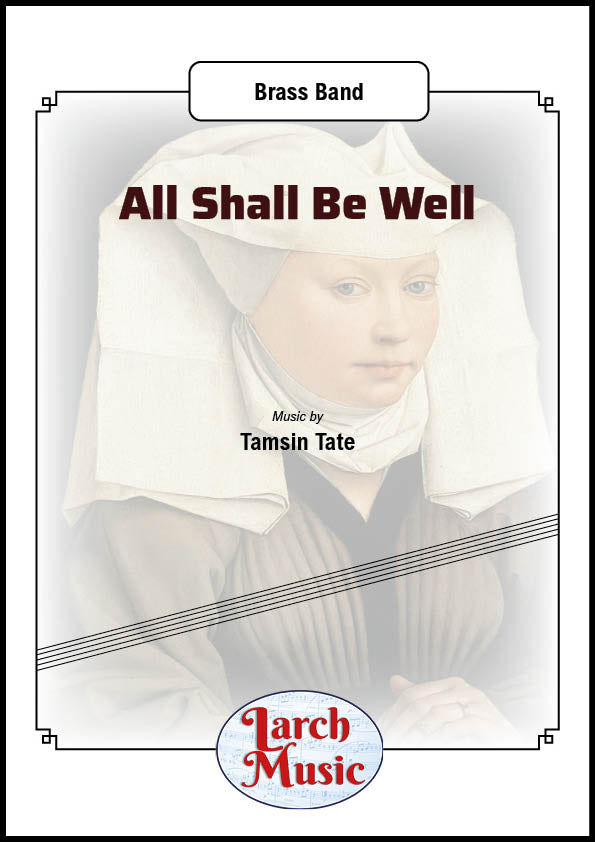
All Shall Be Well - Brass Band Sheet Music Full Score & Parts - LM931
COMPOSER: Tamsin TateCOMPOSERS NOTE"All shall be well" was composed during the first lockdown of the Covid crisis, from May 2020.This was a worrying time for many and a time of great anxiety and sadness for some.I have always tried to be practically optimistic in trying times, but still I needed hope.I am lucky to have a faith in God which gives me hope and assurance that things will be better,and I also know that music, particularly playing it, can help express some of these emotions.Certainly, music through the crisis was a wonderful, enjoyable escape for meand one I shared with my family and my band family through our online recordings.Julian of Norwich was an anchoress in the 14th Century.She set herself apart for God and spent a lot of time in prayer.Interestingly, she was the first published woman in the English language.Julian of Norwich is quoted as saying "all shall be well, all shall be well,and all manner of thing shall be well." The paraphrase of this spurred me on to develop this piece for brass band.Hopefully you will also find that the music portrays the worries and trials of this uniquetime through the natural minor key, with the rhythm hinting towards the phrase"All shall be well" and then the dawning transition to the major keyfollowed by a triumphant ending with the whole band joining together.Thanks to Adam Cable and the Martlesham Brass family for support and encouragement always.Thanks also to Alan Fernie and his supportive critique of my initial efforts.LM931 - ISMN : 9790570009312
In Stock: Estimated dispatch 3-5 working days
-
 £37.35
The Vow (Brass Band) Andrew Wainwright
VIEW SCORE PDF A majestic processional in the spirit of Elsa's Procession to the Cathedral, this powerful work blends the heartfelt beauty of William Himes' worship song All That I Am with an original theme by Andrew Wainwright. The piece was originally written for the composer's wedding. The piece features expressive interplay between solo lines and rich accompaniment, offering performers a dynamic canvas to shape and build the music. Gradually expanding in depth and intensity, it culminates in a stirring and triumphant conclusion - ideal for sacred ceremonies, concert halls, or moments of solemn celebration. PDF download includes score and full set of parts. Sheet music available from: UK - www.brassband.co.uk USA - www.solidbrassmusic.com To view a video of the Southern Territorial Band performing the work please visit: www.youtube.com/watch?v=h2VUSKHMbho Difficulty Level: Second Section + Instrumentation: Soprano Cornet Eb Solo Cornet Bb 1st Cornet Bb 2nd Cornet Bb Flugel Horn Bb Solo Horn Eb 1st Horn Eb 2nd Horn Eb 1st Baritone Bb 2nd Baritone Bb 1st Trombone Bb 2nd Trombone Bb Bass Trombone 1st Euphonium Bb 2nd Euphonium Bb Bass Eb Bass Bb Timpani Percussion 1-3
In Stock: Estimated dispatch 1-3 working days
-
 £59.77
Horizon: The Promise of the Lord (Brass Band) Andrew Wainwright
Horizon: The Promise of the Lord was written at the request of Bandmaster Stephen Cobb for The International Staff Band. It is based on the much loved hymn of the church, Cwm Rhondda (Guide me O thou great Jehovah). The work was recorded on the ISB's CD Manuscripts II (released 2023). This highly descriptive piece will be an excellent addition to concert programs, as well as being appropriate as a test piece. The inspiration for the work comes from the book of Exodus. Whilst the music is not intended to be directly programmatic, like the hymn Cwm Rhondda, the work takes the listener through the Exodus from Egypt to the promised land of Israel as a metaphor of the spiritual pilgrimage of the individual Christian through his or her earthly life. The music aims to evoke a sense of God's guidance through strife and affirm the reality that God provides for us and redeems all the wrong in the world. This God who provided for the Hebrew people wandering amidst 'barren lands' with 'bread of heaven' is still and ever will be a God of provisional grace. Through listening to the music, it is the composer's intention that we are reminded of God's promise of Deliverance as set out in Exodus 6 v7-8: 'I will take you as my own people, and I will be your God. Then you will know that I am the Lord your God, who brought you out from under the yoke of the Egyptians. And I will bring you to the land I swore with uplifted hand to give to Abraham, to Isaac and to Jacob. I will give it to you as a possession. I am the Lord.' Like the hymn, Horizon: The Promise of the Lord is intended as a prayer for guidance. The Christian is a pilgrim through 'this barren land'. The music is often chromatic and in large parts verging on atonality, as a reflection of the strife that the Israelites endured in their 40 years in the wilderness. However, it ends in climactic fashion with the Hebrew people finally reaching their destination after many years of wandering in the desert - as they approach the 'Horizon' promised by the Lord. To view a performance of the work by the National Youth Brass Band of Great Britain please visit www.youtube.com/watch?v=LjOHf7QEw1g PDF download includes score and parts. Sheet music available from: UK - www.brassband.co.uk USA - https://satradecentral.org Difficulty Level: 1st Section + Length: c11.00 minutes Instrumentation: Soprano Cornet Eb Solo Cornet Bb Repiano Cornet Bb 2nd Cornet Bb 3rd Cornet Bb Flugel Horn Bb Solo Horn Eb 1st Horn Eb 2nd Horn Eb 1st Baritone Bb 2nd Baritone Bb 1st Trombone Bb 2nd Trombone Bb Bass Trombone Euphonium Bb Bass Eb Bass Bb Percussion 1-4
In Stock: Estimated dispatch 1-3 working days
-
 £271.60
Aubade - Dawn Songs of the Fabulous Birds - Torstein Aagaard-Nilsen
Commissioned by The Norwegian Band Federation for The European Brass Band Championship 2003, in Bergen, Norway (Third edition) I remember as a kid the very early morning wake-up ceremonies caused by Seagulls having a "party" outside our home. Very few would describe it as beautiful, particularly not at 4:30 in the morning... But by listening carefully to birds I was fascinated by their diversity and musical language: they dont sing tunes or long phrases, they rather make sounds and signals, based on short motives. Aubade is based on musical pictures of the imaginary birds: the creatures with wings that exists only in myths and legends. The whole story starts with aBaritone-cadenza that evoke all the sleeping creatures. Very soon they all start to sing their songs in one way or another. The composition has a burlesque scherzo-character including slow espressive intersections. Traditional elements like melody and harmony is combined with extensive sounds and textural effects created by use of multiple muting, singing and playing at the same time. I am not too concerned about having a program for the piece. I just know that by thinking of the unheard dragon-songs, griffin-songs, the sound of the dodo, my creativity was stimultated. As a piece of music, Aubade follows its own rules based on well-known elements like melodies, arpeggio-figures, harmonies, rhythms, variations and recapitulation of ideas. - Torstein Aagaard-Nilsen
Estimated dispatch 5-14 working days
-
 £379.99
Tranquil Abiding - Paul Mealor
An 18-minute work for brass band, written for the world renowned Foden's Band. This is a melodic work divided into three movements. All sections of the band are featured with solo parts. Each movement is headed by a line from a poem by James Agee, the American novelist and poet. 'Tranquil Abiding', often referred to as 'Shamatha' in Buddhist traditions, signifies a state of peaceful and calm mental stillness, achieved through focused meditation, where the mind rests peacefully and without agitation."The term has always resonated with me particularly during my long, regular walks into, around and along the amazingly beautiful woodlands, mountains and streams of North Wales at night lit only by the stars. It's during these walks that my meditative focus is at its most emotive and I am at one with the 'it' that surrounds us", says Paul Mealor. "Often on these walks and meditations I am reminded of the American poet, James Agee's pantheistic vision of the natural world and the stars above, 'Sure on this Shining Night' which conjures a serene and harmonious image of a summer night, illuminated by celestial bodies and bathed in kindness. The poem evokes a sense of peace and tranquillity as nature heals and the earth is rejuvenated".
Estimated dispatch 5-14 working days
-
 £5.99
£5.99Scripture-based Songs Compilation Folio Books
No. of TuneTitleRefernece1Above all powersSpring Harvest Song Book 2003, 12All for theeThe Musical Salvationist, January 19763All Heaven declaresMagnify, 24All the world is waitingThe Musical Salvationist, April 19875As we are gatheredThe Source, 296Be bold, be strongThe Source,387Be still for the presence of the LordMagnify, 78Beauty for brokennessThe Source,379Blessd be the name of the LordThe Source,5310Breathe 11By his handSing to the Lord, Vol.1, Part 112Come, now is the time to worshipThe Source, 66213Come on and celebrate!The Source, 7514Come, thou Fount of every blessing (Nettleton)Salvation Army Song Book, 31315ContentmentHappiness & Harmony, 1416Crown him with many crowns (Diademata)Salvation Army Song Book, 15617Cwm RhonddaSalvation Army Song Book, 57818Do something beautifulSing to the Lord Children's Voices Series, Vol.1219Faithful GodThe Source, 8820Father, we love youHappiness & Harmony, 1621Give thanks with a grateful heartThe Source, 1822Glorious things of thee are spoken (Abbot's Leigh)Salvation Army Song Book, 15723God in youSing to the Lord, Vol.9, Part 224Great is the darkness (Come, Lord Jesus)Magnify, 1425He is ableSing to the Lord Children's Voices Series, Vol.1526He is the Lord (Show your power)Magnify, 1927Healing ChristSing to the Lord, Vol.6, Part 328Here am I, my LordThe Musical Salvationist, July 199129His ProvisionThe Musical Salvationist, July 198530Holy, holy, holy is the LordSongs of Fellowship, 18231HosannaThe Source, 18232How deep the Father's love for usThe Source, 185; Songs of Fellowship II, 78033I am a new creationThe Source, 19134I dare to be differentSing to the Lord, Vol.1, Part 135I love you, LordMagnify, 2436I will run to you (Your eye is on the sparrow)The Source, 109337In Christ aloneThe Source, 131138In his presenceSing to the Lord, Vol.9, Part 339In his time 40In Jesus' nameSing to the Lord, Vol.13, Part 141In this quiet momentSing to the Lord, Vol.13, Part 342It is to youMagnify, 3043Jesus is Lord!The Source, 28444Jesus, name above all namesHappiness & Harmony, 3245Joyful, Joyful (Europe)Salvation Army Song Book, 1046King of Kings, MajestyThe Source, 30947Knowing You (All I once held dear)Magnify, 348Light of the world (Here I am to worship)Sing to the Lord Children's Voices Series, Vol.1049Lord, I lift your name on highMagnify, 3850Lord, you know that we love youThe Musical Salvationist, April 198351Love Divine (Blaenwern)Salvation Army Song Book, 43852MajestyHappiness & Harmony, 4553My Lord and Christ!Sing to the Lord, Vol.2, Part 254My Lord, what love is thisThe Source, 37055My Saviour's love (I stand amazed)Salvation Army Song Book, 17956Nothing but thy bloodSing to the Lord Children's Voices Series, Vol.1357O God of burning, cleansing flame (Send the fire)Salvation Army Song Book, 20358O happy daySalvation Army Song Book, 36559Oh to see the dawn (The power of the cross)Spring Harvest Song Book 2005, 6760Only by graceMagnify, 4861Power of your love (Lord, I come to you)Magnify, 3762Praise, my soulSalvation Army Song Book, 1763Praise to the Lord (Lobe den Herren)Salvation Army Song Book, 1964Regent SquareSalvation Army Song Book, 14765Rejoice!The Source, 43866Shout to the Lord (My Jesus, my Saviour)Magnify, 4367Sing and make musicHappiness & Harmony, 5568Spirit of the living GodSongs of Fellowship, 511; The Source, 46369Storm the forts of darknessSalvation Army Song Book, 69670Teach me to danceThe Source, 46971The light has comeHappiness & Harmony, 6372The Potter's hand (Beautiful Lord, wonderful Saviour)The Source, 64073The servant King (From Heaven you came)The Source, 11474The splendour of the KingSpring Harvest Song Book 2005, 9775There is a redeemerMagnify, 5976To be in your presence (My Desire)Magnify, 6177To God be the gloryThe Musical Salvationist, April 198878Wake up, O sleeperSing to the Lord, Vol.6, Part 279We are marchingThe Source, 53980We have come into this placeHappiness & Harmony, 7381We want to see Jesus lifted highThe Source, 55982When the music fades (The heart of worship)Magnify, 7083Who is on the Lord's side? (Rachie)Salvation Army Song Book, 707
Estimated dispatch 7-14 working days
-
 £29.95
Scripture-based Songs Compilation Full Score
No. of TuneTitleRefernece1Above all powersSpring Harvest Song Book 2003, 12All for theeThe Musical Salvationist, January 19763All Heaven declaresMagnify, 24All the world is waitingThe Musical Salvationist, April 19875As we are gatheredThe Source, 296Be bold, be strongThe Source,387Be still for the presence of the LordMagnify, 78Beauty for brokennessThe Source,379Blessd be the name of the LordThe Source,5310Breathe 11By his handSing to the Lord, Vol.1, Part 112Come, now is the time to worshipThe Source, 66213Come on and celebrate!The Source, 7514Come, thou Fount of every blessing (Nettleton)Salvation Army Song Book, 31315ContentmentHappiness & Harmony, 1416Crown him with many crowns (Diademata)Salvation Army Song Book, 15617Cwm RhonddaSalvation Army Song Book, 57818Do something beautifulSing to the Lord Children's Voices Series, Vol.1219Faithful GodThe Source, 8820Father, we love youHappiness & Harmony, 1621Give thanks with a grateful heartThe Source, 1822Glorious things of thee are spoken (Abbot's Leigh)Salvation Army Song Book, 15723God in youSing to the Lord, Vol.9, Part 224Great is the darkness (Come, Lord Jesus)Magnify, 1425He is ableSing to the Lord Children's Voices Series, Vol.1526He is the Lord (Show your power)Magnify, 1927Healing ChristSing to the Lord, Vol.6, Part 328Here am I, my LordThe Musical Salvationist, July 199129His ProvisionThe Musical Salvationist, July 198530Holy, holy, holy is the LordSongs of Fellowship, 18231HosannaThe Source, 18232How deep the Father's love for usThe Source, 185; Songs of Fellowship II, 78033I am a new creationThe Source, 19134I dare to be differentSing to the Lord, Vol.1, Part 135I love you, LordMagnify, 2436I will run to you (Your eye is on the sparrow)The Source, 109337In Christ aloneThe Source, 131138In his presenceSing to the Lord, Vol.9, Part 339In his time 40In Jesus' nameSing to the Lord, Vol.13, Part 141In this quiet momentSing to the Lord, Vol.13, Part 342It is to youMagnify, 3043Jesus is Lord!The Source, 28444Jesus, name above all namesHappiness & Harmony, 3245Joyful, Joyful (Europe)Salvation Army Song Book, 1046King of Kings, MajestyThe Source, 30947Knowing You (All I once held dear)Magnify, 348Light of the world (Here I am to worship)Sing to the Lord Children's Voices Series, Vol.1049Lord, I lift your name on highMagnify, 3850Lord, you know that we love youThe Musical Salvationist, April 198351Love Divine (Blaenwern)Salvation Army Song Book, 43852MajestyHappiness & Harmony, 4553My Lord and Christ!Sing to the Lord, Vol.2, Part 254My Lord, what love is thisThe Source, 37055My Saviour's love (I stand amazed)Salvation Army Song Book, 17956Nothing but thy bloodSing to the Lord Children's Voices Series, Vol.1357O God of burning, cleansing flame (Send the fire)Salvation Army Song Book, 20358O happy daySalvation Army Song Book, 36559Oh to see the dawn (The power of the cross)Spring Harvest Song Book 2005, 6760Only by graceMagnify, 4861Power of your love (Lord, I come to you)Magnify, 3762Praise, my soulSalvation Army Song Book, 1763Praise to the Lord (Lobe den Herren)Salvation Army Song Book, 1964Regent SquareSalvation Army Song Book, 14765Rejoice!The Source, 43866Shout to the Lord (My Jesus, my Saviour)Magnify, 4367Sing and make musicHappiness & Harmony, 5568Spirit of the living GodSongs of Fellowship, 511; The Source, 46369Storm the forts of darknessSalvation Army Song Book, 69670Teach me to danceThe Source, 46971The light has comeHappiness & Harmony, 6372The Potter's hand (Beautiful Lord, wonderful Saviour)The Source, 64073The servant King (From Heaven you came)The Source, 11474The splendour of the KingSpring Harvest Song Book 2005, 9775There is a redeemerMagnify, 5976To be in your presence (My Desire)Magnify, 6177To God be the gloryThe Musical Salvationist, April 198878Wake up, O sleeperSing to the Lord, Vol.6, Part 279We are marchingThe Source, 53980We have come into this placeHappiness & Harmony, 7381We want to see Jesus lifted highThe Source, 55982When the music fades (The heart of worship)Magnify, 7083Who is on the Lord's side? (Rachie)Salvation Army Song Book, 707
Estimated dispatch 7-14 working days
-
£70.00
Fire in the Sky - Peter Meechan
Fire in the Sky takes its inspiration from the stunning town of Montreux in Switzerland. I was commissioned to write the work 5 days before I visited this Montreux and was at work forming ideas for the piece as I arrived on the shore of Lake Geneva and its amazing views of the Alps.Whilst the scenery is without doubt some of the most incredible views I have ever witnessed, it was the history of the town that set Fire in the Sky in motion. Whilst there, it occurred to me that many of my musical heroes had lived or performed there, and three of them in particular had a strong connection with the town. Miles Davis, Igor Stravinsky and Freddie Mercury graced Montreux - the large convention centre, where the famous summer jazz festival is held, named its two halls after Davis and Stravinsky, and there is a quite breathtaking statue of Mercury in the town too.Each musician also commemorates an anniversary in 2011, the year of the premiere of Fire in the Sky; it is 40 years since the death of Stravinsky and both Miles Davis and Freddie Mercury died in 1991, making it 20 years since their deaths. So it seemed fitting to write a piece that in some way acknowledges them, and is a kind of personal athanksa for all they have given, and continue to give, me.The title comes from the famous Deep Purple song, Smoke on the Water - whose second line is aFire in the Skya and is a reference to the night the townas casino was set alight by a Frank Zappa fan. The piece tries to recreate the atmosphere of that night, paint a picture of fire in the sky (and smoke on the water) and also uses small anuggetsa of the music of my three greatest musical heroes, Miles Davis, Freddie Mercury and Igor Stravinsky.Fire in the Sky was commissioned by the Tomra Brass Band, Norway, and is dedicated to Stijn BerbeA and Nick Ost - both of whom are connected with the band (teaching and conducting), and both have been close friends - personally and musicaly - for many years. I am indebted to them for the opportunity to write this piece.
Estimated dispatch 12-14 working days
-
 £45.00
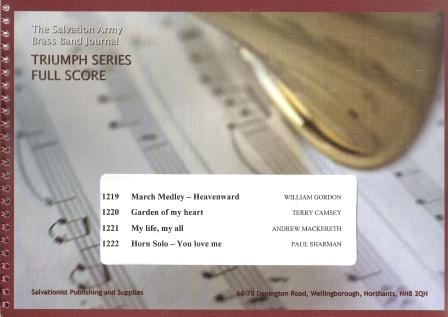
Triumph Series Band Journal November 2011 Numbers 1219-1222
No.1219 March Medley - Heavenward (William Gordon)A variety of songs are used in this up-tempo march medley which potrays the celebration of a life looking forward to an eternity in Heaven. The tunes used are 'When we all get to Heaven', 'When the roll is called up yonder' and 'We shall win'.No.1220 Garden of my heart (Terry Camsey)The publication of this music is, in a small part, a fitting tribute to Major Terry Camsey who was Promoted to Glory in June 2011. The title is taken from the refrain from a much-loved Sidney Cox song; 'Jesus, Jesus, Lily of the valley, Bloom in all thy beauty in the garden of my heart'.No.1221 My life, my all (Andrew Mackereth)This selection attempts to emphasise the personal nature of Christian commitment hence the emphasis given to the words 'my' and 'I' in the songs chosen. The tunes 'Rockingham', 'All I have I am bringing to thee' and 'At thy feet I bow adoring' are included.No.1222 Tenor Horn Solo - You love me (Brian Willetts arr. Paul Sharman)This arrangement was made at the request of David Lynch, Solo Horn player in The International Staff Band. Originally published in April 1993, the song speaks of the fact that, despite the wonder and vastness of God's creation, he still loves each one of us individually.
Estimated dispatch 7-14 working days
-
 £34.95
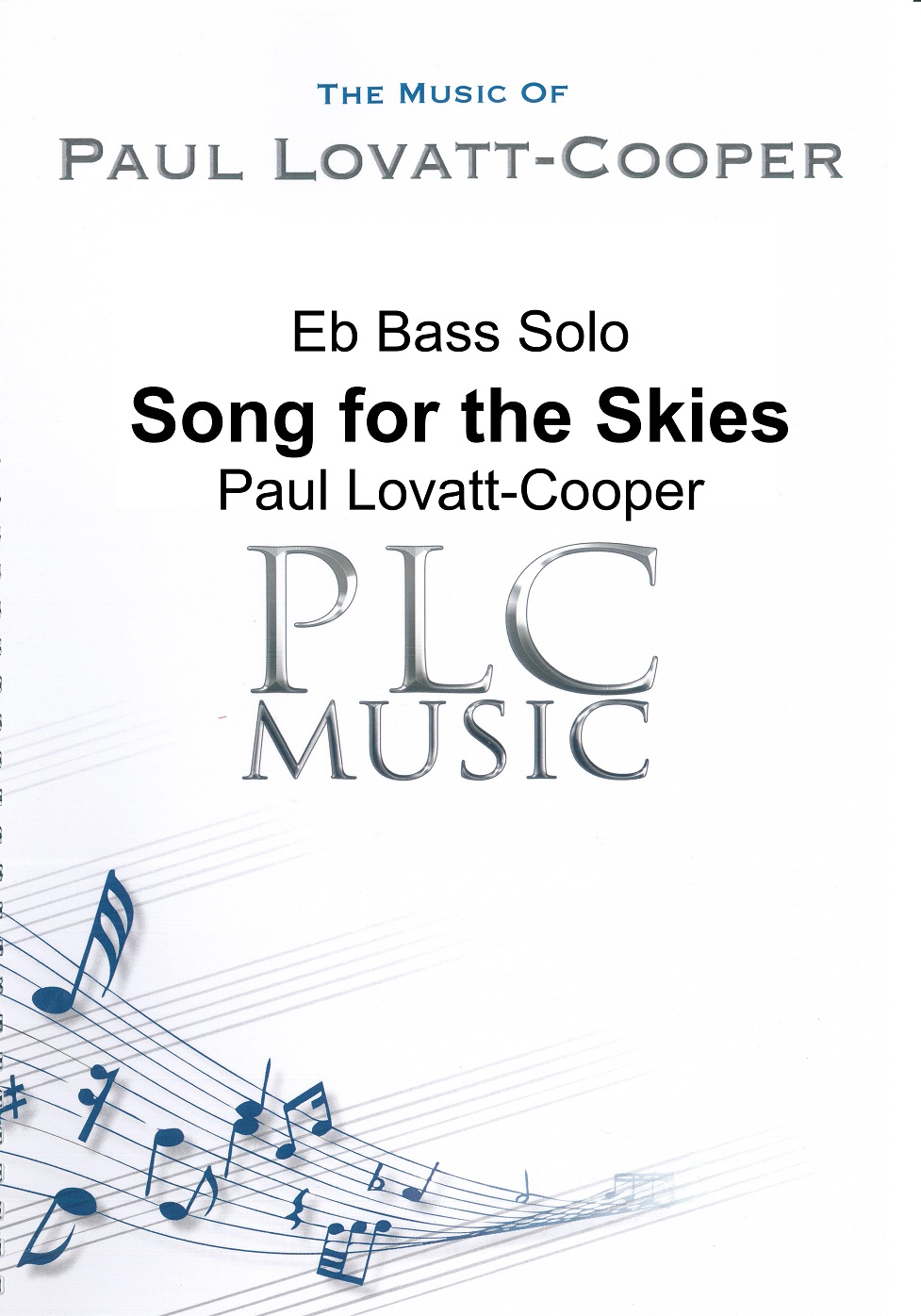
Song for the Skies (Eb Bass Solo with Brass Band - Score and Parts)
Song for the Skies was commissioned by Tuba virtuoso Les Neish and was given its world premier on the December 9th 2010 with the James Madison University Brass Band in Harrisonburg, Virginia, USA.Les asked me to compose a slow melody that highlights the wonderful sonorous sound of the Tuba. I am a big fan of Les and of the instrument and knowing the capabilities of Les as a soloist I wanted to experiment with the range and colour of the instrument in this solo.After a warm introduction from the ensemble the soloist enters almost timeless over the muted cornets. The melody when it is first heard has a somewhat haunting Celtic feel to it. It is intentionally marked as con rubato so that the soloist can really put their own musical stamp on the music. As the haunting melody repeats again this time in a change of key the accompaniment takes more of a role within the piece of music performing counter melodies within this second section.The middle of the piece introduces a new secondary melodic device that serves as an introduction to the original melody played in all its glory by the ensemble. This dies away to leave the second half of the melody in the euphoniums and baritones as the soloist plays a soaring counter melody in the highest register of the instrument.The piece starts to return home with a recapitulation of the introduction followed by the second part of the original melody by the soloist. After a momentary reflective solo from the soloist the introduction is used for a final time before the tuba guides us home to conclude.For the soloist, there are a number of occasions where the opportunity to play in the upper register of the instrument arises. However, I have also given the opportunity for the soloist to play various passages down the octave so it suits the performers playing style and range.Song for the Skies is very simple yet beautiful and I feel it suits the playing of the Eb Tuba perfectly. I hope you enjoy performing it.Paul Lovatt-Cooper
Estimated dispatch 7-14 working days
 View Music