
Results
-
 £15.00
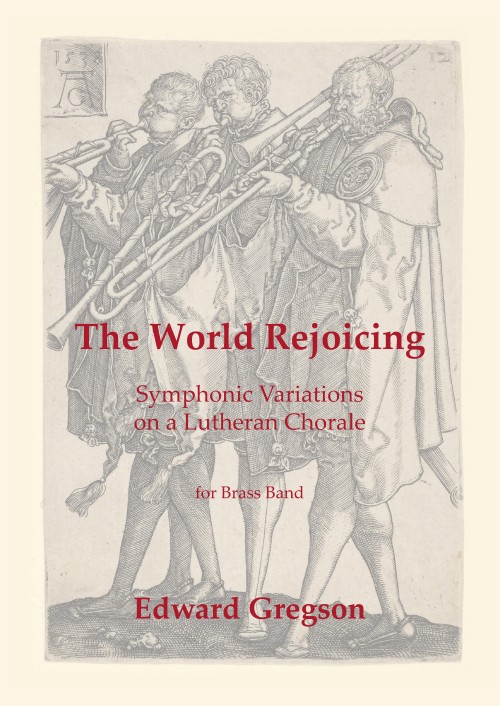
The World Rejoicing (Brass Band - Study Score) - Gregson, Edward
The World Rejoicing was commissioned by the National Brass Band Associations of Belgium, Netherlands, Norway, Switzerland, and the British Open, as the test piece for their competitions in 2020/21. Although the work was completed in 2019, the pandemic of 2020 meant that these competitions were postponed until 2021/22. The premiere took place in September 2021 at Symphony Hall, Birmingham, UK.In searching for a common link between the brass band traditions of the various European countries that commissioned this work, I considered the fact that hymns have always played an important role in the relationship that brass bands have with their particular communities; and thus I turned to a well- known Lutheran chorale, Nun danket alle Gott (Now thank we all our God), written around 1636 by Martin Rinkart, with the melody attributed to Johann Cruger. A number of composers have incorporated this chorale into their music, most famously J.S. Bach in his Cantatas no. 79 and 192, and Mendelssohn in the Lobsegang movement of his 2nd Symphony (the harmonisation of which is usually used when this hymn is sung).It seemed fitting therefore for me to return to a compositional form I have used many times before (Variations) and to write a work based on this hymn. I have used it in a similar way to that which I employed in my Variations on Laudate Dominum of 1976 - that is, rather than writing a set of variations using elaborations of the complete tune, I have taken various phrases from the chorale and used them within the context of other musical material, applying an overall symphonic process of continuous variation and development. The structure, or sub-divisions of the work, which is through composed and plays without a break, is as follows:Prelude, Capriccio, La Danza 1, Processional, La Danza 2, Arias and Duets, Fuga Burlesca, Chorale, and Postlude.The work, which is around 16 minutes in length, is also partly autobiographical - in the manner say of Strauss's Ein Heldenleben - in that I have incorporated into the score brief quotations from many of my other major works for brass band. In that respect, The World Rejoicing sums up a particular facet of my life as a composer, and reflects the admiration I have always had for what is surely one of the great amateur music-making traditions in the world.Duration: 16.00
Estimated dispatch 7-14 working days
-
 £88.00
Bass Trombone Concerto (Bass Trombone Solo with Brass Band - Score and Parts) - Brubeck, Christopher
"As a bass trombonist, I spent many years of my adolescence playing in youth orchestras, engaging in musical daydreams. I would visualize myself jumping up from the back of the orchestra to unleash improvisations much to the conductor's horror. The resultant three-movement, thirteen-minute work has enjoyed a robust life with performances by notable orchestras all around the world. Happily, the concerto works well as a recital piece, with many accomplished college players having won concerto competitions performing it. Jazz elements were inescapable, and realizing my old nightmare/dream, quite a bit of the trombone solo is meant to be improvised. I made a recording of the concerto with the London Symphony Orchestra, which was included on a CD called Bach to Brubeck released on Koch International Classics. Having already become popular as a bass trombone work with orchestra accompaniment, renowned British Bass Trombonist and publisher Roger Argente suggested he release a special Brass Band arrangement of my concerto. Roger knew the piece well because years ago he played the European premiere of the concerto with the Royal Philharmonic Orchestra at the Royal Albert Hall." - Chris Brubeck. Duration: 13.00. Suitable for 1st Section Bands and above.
Estimated dispatch 7-14 working days
-
 £94.95
Machine (Brass Band - Score and Parts) - Dobson, Simon
Machine, was commissioned by the Salvation Army Trading Company for the National Youth Brass Band of Great Britain.The work speaks of the perils of the fast fashion industry, the part it plays in our current understanding of late-stage capitalism and it's complicity in the destruction wrought on our one home planet. It also seeks to portray the incredible efforts of the Salvation Army in their quest to slow the fast fashion industry and recycle clothing in the most innovative and progressive ways.The work is through composed and comprises five movements.Movement 1: The great Machine. The band is placed into 8 groups of three (expect tubas, in their normal position as a 4), who stand in specific places on the stage. This will create machine like antiphonal movement in the written music. The great Machine in question is the fast fashion industry, in all its chaos, seeming grandeur and relentless momentum.Movement 2: Mode phmre is fast, angular and quirky, a nod to the perilous speed and waste of the fast fashion industry (the movement title is the French for fast fashion).Movement 3: A planet to treasure (for DA) is a love letter to our home planet and its finite resources and as well as the beauty of the natural world, which unfortunately, we are destroying (hence the dedication to David Attenborough on his 100th year).Movement 4: The wheels keep turning, returns to the fast, angular, almost unstoppable grasp of capitalism and the damaging structures it promotes.Movement 5: Recycle, re-use, mirrors the opening (though without stage directions) in reference to the cyclic nature of fast fashion and the wonderful work that The Salvation Army do in trying to halt this system.
Estimated dispatch 7-14 working days
-
 £44.95
Machine (Brass Band - Score only) - Dobson, Simon
Machine, was commissioned by the Salvation Army Trading Company for the National Youth Brass Band of Great Britain.The work speaks of the perils of the fast fashion industry, the part it plays in our current understanding of late-stage capitalism and it's complicity in the destruction wrought on our one home planet. It also seeks to portray the incredible efforts of the Salvation Army in their quest to slow the fast fashion industry and recycle clothing in the most innovative and progressive ways.The work is through composed and comprises five movements.Movement 1: The great Machine. The band is placed into 8 groups of three (expect tubas, in their normal position as a 4), who stand in specific places on the stage. This will create machine like antiphonal movement in the written music. The great Machine in question is the fast fashion industry, in all its chaos, seeming grandeur and relentless momentum.Movement 2: Mode phmre is fast, angular and quirky, a nod to the perilous speed and waste of the fast fashion industry (the movement title is the French for fast fashion).Movement 3: A planet to treasure (for DA) is a love letter to our home planet and its finite resources and as well as the beauty of the natural world, which unfortunately, we are destroying (hence the dedication to David Attenborough on his 100th year).Movement 4: The wheels keep turning, returns to the fast, angular, almost unstoppable grasp of capitalism and the damaging structures it promotes.Movement 5: Recycle, re-use, mirrors the opening (though without stage directions) in reference to the cyclic nature of fast fashion and the wonderful work that The Salvation Army do in trying to halt this system.
Estimated dispatch 7-14 working days
-
 £74.95
Aspects of Adiemus (Brass Band - Score and Parts) - Jenkins, Karl - Graham, Peter
Aspects of Adiemus is a collection from one of the world's most popular composers, Karl Jenkins. Adiemus, literally translated, means 'we will draw near' and represents a musical language which can be heard on five award winning albums from the composer.Since Adiemus has risen in popularity around the world, it has become a growing entity meaning many different things to many different people. Vocally, the spread of influence grows wider all the time, taking in Arabic and African sounds as well as Celtic and ecclesiastical ones. The percussion too has expanded using Indian, Middle Eastern, Japanese, Chinese and even Australian instrumentation.The evolving nature of Adiemus has meant that it has been difficult to categorise. New age, classical crossover, world music, even pop. Karl sees this as a good sign: To me, Adiemus transcends labels. The fact that it reaches people of different backgrounds, faiths and cultures gives it a universal appeal which is special. The compositions can be spiritual, religious, meditative - it's open to move people in any away they choose to experience.Ironically, the Adiemus project got off the ground initially due to a television commercial for an airline. Karl Jenkins explains, I'd been toying with a new idea, completely separate to my work in advertising, but at this time, Jenkins Ratledge were commissioned to come up with the music for an airline commercial. We presented the client with a demonstration tape of one of my completed compositions and they loved it.That composition became known as Adiemus. The music for the airline commercial was aired and immediately drew interest from the public. Karl: It's ironic that a piece of music not originally intended for a TV commercial should end up on a TV commercial, and that this music became the springboard for the success of the Adiemus project.Expertly arranged by Peter Graham, Aspects of Adiemus features the eponymous Adiemus, an uplifting and instantly recognisable opener. Chorale - Za Ma Ba and Chorale - Vocalise are songs of sanctuary, the latter featuring a chamber group from within the band. The vibrant Song of the Spirit is a cornet feature, and the finale, Song of the Plains combines intense rhythmic energy with tribal harmonies. Duration is variable depending on movement selection and optional cuts.Duration: 20.00
Estimated dispatch 7-14 working days
-
 £94.95
An Age of Kings (Mezzo-Soprano Solo with Brass Band and optional choir - Score and Parts) - Gregson, Edward
The origins of this work date back to 1988, when I was commissioned by the Royal Shakespeare Company to write the music for The Plantagenets trilogy, directed by Adrian Noble in Stratford-upon-Avon. These plays take us from the death of Henry V to the death of Richard III. Later, in 1991, I wrote the music for Henry IV parts 1 and 2, again in Stratford. All of these plays are concerned with the struggle for the throne, and they portray one of the most turbulent periods in the history of the British monarchy.Much of the music used in these productions was adapted into two large symphonic suites for wind band - The Sword and the Crown (1991) and The Kings Go Forth (1996). An Age of Kings is a new version for brass band incorporating music from both the symphonic suites for wind band. It was specially composed for a recording made by the Black Dyke Band, conducted by Nicholas Childs, in 2004.An Age of Kings is music on a large-scale canvas, scored for augmented brass band, with the addition of harp, piano, mezzo-soprano solo, male chorus, as well as two off-stage trumpets. The music is also organized on a large-scale structure, in three movements, which play without a break - "Church and State", "At the Welsh Court", and "Battle Music and Hymn of Thanksgiving".The first movement, "Church and State", opens with a brief fanfare for two antiphonal trumpets (off-stage), but this only acts as a preface to a Requiem aeternam (the death of Henry V) before changing mood to the English army on the march to France; this subsides into a French victory march, but with the English army music returning in counterpoint. A brief reminder of the Requiem music leads to the triumphal music for Richard Plantagenet, Duke of York, father of Edward IV and Richard III (the opening fanfare transformed). However, the mood changes dramatically once again, with the horrors of war being portrayed in the darkly-drawn Dies Irae and Dance of Death, leading to the final section of the first movement, a funeral march for Henry VI.The second movement, "At the Welsh Court", takes music from the Welsh Court in Henry IV part 1 with a simple Welsh folk tune sung by mezzo-soprano to the inevitable accompaniment of a harp. This love song is interrupted by distant fanfares, forewarning of battles to come. However, the folk song returns with variation in the musical fabric. The movement ends as it began with off-stage horn and gentle percussion.The final movement, "Battle Music and Hymn of Thanksgiving", starts with two sets of antiphonally placed timpani, drums and tam-tam, portraying the 'war machine' and savagery of battle. Trumpet fanfares and horn calls herald an heroic battle theme which, by the end of the movement, transforms itself into a triumphant hymn for Henry IV's defeat of the rebellious forces.- Edward GregsonDuration - 22'00"Optional TTBB available separately.
Estimated dispatch 7-14 working days
-
 £59.95
Voices of Youth (Brass Band - Score and Parts) - Gregson, Edward
The suite Voices of Youth is one of Gregson's earliest brass band compositions, written while he was still a student at the Royal Academy of Music in London. Voices of Youth was commissioned by the National Youth Brass Band of Great Britain and was premiered by them under the baton of Geoffrey Brand.The work has three movements:Nobility of Youth (Duration: 4.00)Sadness and Tenderness (Duration: 2.30)Gaiety (Duration: 2.45)In Nobility of Youth there are the rich sonorities beloved of Salvationist composers such as Eric Ball and, particularly, Ray Steadman Allen, whose music he admired. The modal contour of the melodies here and at the climax of the slow movement Sadness and Tenderness reveal lessons well learned from Holst and Vaughan Williams. Gaiety is probably the most interesting amalgam of all. Beginning in the harmonic world of Gilbert Vinter - whose influence Gregson readily acknowledges at this time - the music is transformed into a bravura waltz of which Percy Grainger might have been proud. It then veers off via a contrapuntal episode of academic correctness, into a coda that takes us into more adventurous harmonic realms.Duration: 10.00
Estimated dispatch 7-14 working days
-
 £60.00
From the Shores of the Mighty Pacific (Cornet Solo with Brass Band - Score and Parts) - Clarke, Herbert L. - Wilkinson, Keith M.
Cornet Solo with Brass BandHerbert L. Clarke (1867 - 1945) is regarded by many as one of the finest cornet players of all time, noted not only for his amazing technique but also for his warm, lyrical tone. He has left a multitude of cornet solos as well as collections of studies which are still very widely used. He was a member of The Sousa Band briefly in 1893 and then from 1898 to 1917 where he was not only the distinguished cornet soloist but also became assistant director.From The Shores Of The Mighty Pacific is an all-time favourite rondo-caprice cornet solo and was first published in 1912. A brass band arrangement was requested by Chris Lichtler, principal cornet of Brass Band of the Western Reserve, musical director Dr. Keith M. Wilkinson. Chris has performed it many times with BBWR and it was recorded by them on the CD, Without Reserve!.
Estimated dispatch 7-14 working days
-
 £27.00
Auld Lang Syne (Brass Band - Score and Parts) - Wilkinson, Keith M.
It is a tradition in most English-speaking countries to sing this song at the stroke of midnight on New Year's Eve to usher in the New Year. The words are at least partially written by Robert Burns and the words "Auld Lang Syne" literally mean "old long ago" or "the good old days", providing a moment of reflection before moving forwards into the New Year.The tubular bells, although pitched, sound midnight when they enter at bar 10.This arrangement was prepared for Brass Band of the Western Reserve, musical director Keith M Wilkinson, to perform at First Night, Akron, Ohio, December 31st, 2007. The following choreography is suggested:Commence the performance with all the cornets scattered around the auditorium.At the end of bar 18 invite the audience to sing along with the band.At bar 27 the cornets move to stand in front of the other members of the band to lead to the stirring conclusion. Should auld acquaintance be forgot and never brought to mind?Should auld acquaintance be forgot and days of auld lang syne?For auld lang syne, my dear, for auld lang syne,We'll take a cup of kindness yet, for auld lang syne.
Estimated dispatch 7-14 working days
-
 £59.99
Almshouse Street Blues (Brass Band - Score and Parts) - Sparke, Philip
In 2007 Philip Sparke was appointed composer-in-residence to Monmouth School, situated on the Welsh/English border. The school, which has a venerable history dating back to 1614, has a thriving music department which boasts two concert bands, in co-operation with the nearby Haberdashers' Monmouth School for Girls, and a brass band.This exciting and innovative appointment involved three visits by the composer during the year as well as the commissioning of a new piece for each of the bands, all of which were premiered in a concert at the end of the year.Almshouse Street Blues was written for the brass band, whose members were allowed to vote for which type of piece they would get! Monmouth School is based in Almshouse Street and the town has a thriving summer festival which, alongside blues bands, features a wide variety of music including jazz, soul, rock and bangra.Duration: 4.45
Estimated dispatch 7-14 working days
 View Music