
Results
-
£105.00
Danceries (Set II) - Kenneth Hesketh
Danceries Set II, arranged for brass band, was first commission by Keith Allen for the Birmingham Symphonic Winds. This second set of Danceries continues the format, established in the popular Danceries (Set I), of using tunes and dances from Playford's Dancing Master (17th century) to form the basis of an extended dancesuite. In this set, the melodies have become more abstracted and project only a distant echo of their original forms. As before, each movement is self-contained, colourful and direct, with its own distinct mood.The outer movements - Jennie's Bawbee and Peascod's Galliarda - share driving percussion with a military air. Tom Tinker's Toye and Heart's Ease (movements two and three) are both settings of original melodies. All movements are more extended than in the first set, with a freer use and approach to the material; melodies now occur in various keys and are supported by a greater variety of harmonic colouring. The result is a richer, even more exhilarating set of dances.
In Stock: Estimated dispatch 1-3 working days
-
£45.00
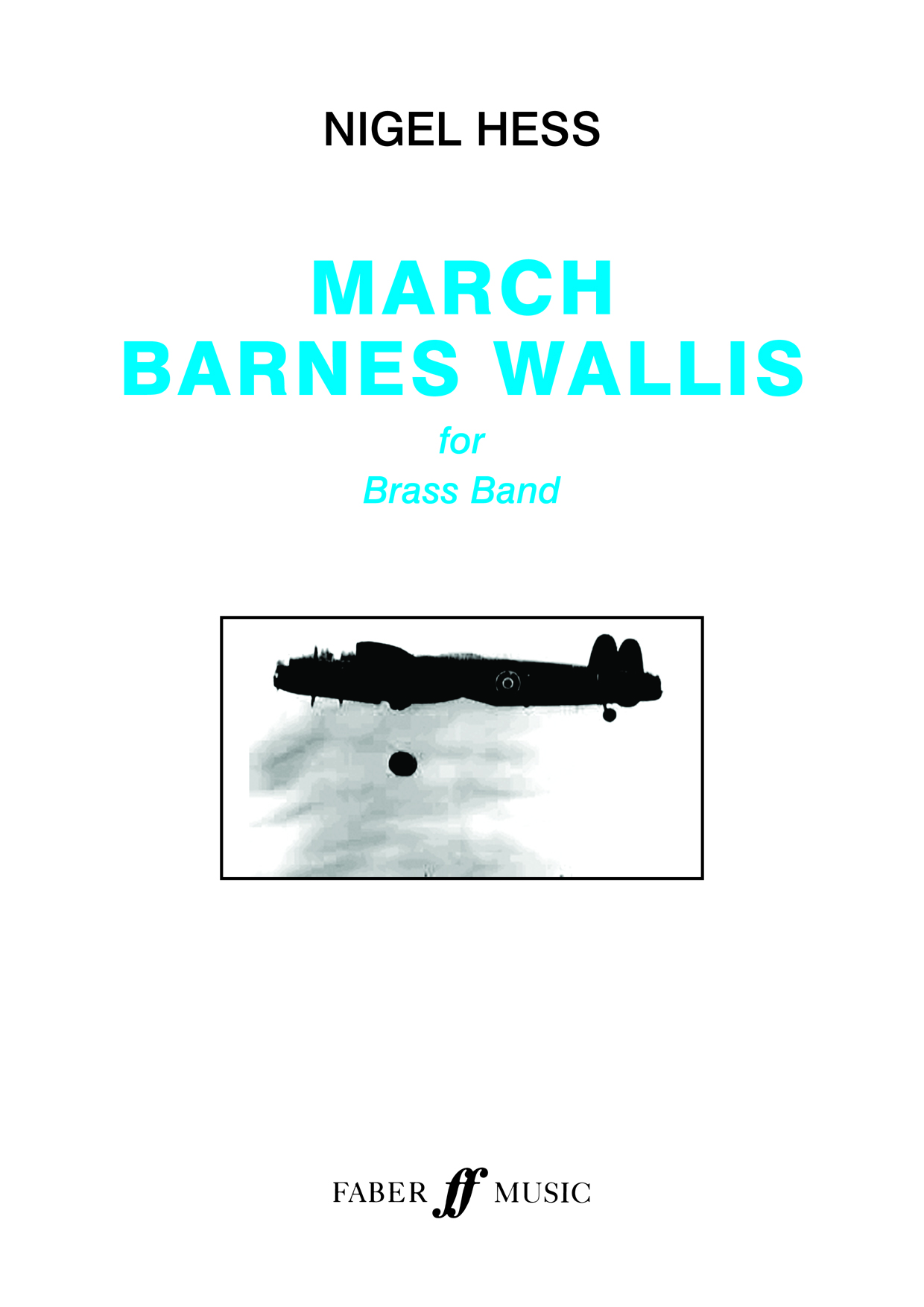
March Barnes Wallis - Nigel Hess
March Barnes Wallis was commissioned by Royal Air Force Music Services to commemorate the 70th anniversary of the famous Dambuster's raid and received its first performance on BBC Radio 2's Friday Night is Music Night, broadcast live from Biggin Hill Airport on 17 June 2013 by the Central Band of the RAF, Director of Music Wing Commander Duncan Stubbs.Additional transposed parts are available to download from the website.
In Stock: Estimated dispatch 1-3 working days
-
£85.00
Freaks! - Gavin Higgins
Freaks! was written for Lisa Sarasini in 2006 and first performed by her with Zone One Brass at the Royal College of Music, London. This tuneful and flamboyant showpiece was inspired by the Tod Browning film of the same name. The 1932 black and white cult classic was banned for many years due to its controversial morality issues and lead characters - real life side show 'freaks'. It is one of the most bizarre things to have ever come out of Hollywood. Gavin Higgins' virtuoso trombone solo is programmatic in style, full of humour with a sinister undercurrent, and is broken into seven short scenes: Introduction Roll up... See the Freaks The Amazing Cleopatra - Queen of the Air Gooble Gobble one of us - The Wedding Party The Fall of Cleopatra The Freaks Take Revenge Cleopatra - The Duck Lady
In Stock: Estimated dispatch 1-3 working days
-
 £59.95
Bonnie Northumbria - Brass Band - LM786
COMPOSER: Laurie JohnstonProgramme NotesNorthumberland, or Northumbria as it is also known, is the most northern county in England and has magnificent and stunning landscapes just waiting to be explored. Filled with mystical castles, atmospheric ruins and historical sites and edged by spectacular coastal scenery, there is something wonderful to see at every turn. The Devils Causeway passes through Northumbria and reaches Berwick upon Tweed at the coast. Walkers and cyclists can also take the Coast and Castles Cycle Route or the North Sea Trail which journey through some of the most beautiful scenery along the way.The Blaydon Races is aGeordiefolk songwritten in the 19th century byGeordie Ridley, in a style deriving frommusic hall. It is regarded by many as the unofficialanthemofTynesideand is frequentlysungby supporters ofNewcastle United Football ClubandNewcastle Falconsrugby club.Blaydonis a small town inGateshead, situated about 4 miles (6.4km) fromNewcastle upon Tyne, inNorth East England. The race used to take place on the Stella Haugh 1 mile (1.6km) west of Blaydon.Stella South Power Station(demolished in 1995) was built on the site of the track in the early 1950s, after the races had stopped taking place in 1916.Water of Tyne (sometimes rendered as The Waters of Tyne) is a folk song (Roud number1364) from the north-east of England. The song is sung by a girl or woman lamenting the fact that her paramour is on the opposite bank of theRiver Tyne. Sleeve notes to Michael Hunt's recording of Tyneside songs states that "the ferry is believed to be that atHaughton Castleon theNorth Tyne". Alternatively the "rough river" in the last line may indicate a point further downstream, possiblyTynemouth.The song was collected byJohn Bellin 1810 and published two years later inRhymes of Northern Bards.The Keel Row is a traditional Tyneside folk song evoking the life and work of thekeelmenofNewcastle upon Tyne. A closely related song was first published in aScottishcollection of the 1770s, but may be considerably older, and it is unclear whether the tune is Scottish or English in origin.The opening lines of the song set it inSandgate, that part of the quayside overlooking the River Tyne to the east of the city centre where the keelmen lived and which is still overlooked by theKeelmen's Hospital.Versions of the song appear in both England and Scotland, with Scottish versions referring tothe Canongaterather than Sandgate. The earliest printing was in the 1770s inEdinburghin A Collection of Favourite Scots Tunes, edited by Charles Maclean, though the tune was also found in several late eighteenth-century English manuscript collections. As the term "keel" was used both sides of the border, it has not been determined which version was the original, althoughFrank Kidsonsurmised that like many other songs collected by Maclean it may originally have been aJacobiteair from the time of the1745 rebellion. Some versions of the song make reference to a "blue bonnet[...] with a snowy rose upon it", a clear attempt to evoke Jacobite symbolism, whether dating from 1745 or not.Kidson, however, also noted that he had found the tune of The Keel Row associated with an early dance called "The Yorkshire Lad" as early as 1748.By the 19th century the tune was well associated with the River Tyne; a few years before the 1850s the keelmen had met yearly to celebrate the founding of the Keelmen's Hospital, perambulating the town to the accompaniment of bands playing The Keel Row.Dance To Thy Daddyis a traditional Englishfolksong, originating inNorth East England. An early source for the lyrics, Joseph Robson's "Songs of the bards of the Tyne", published 1849, can be found on the Farne archive. In Farne's notes to the song, it is stated that these lyrics were written by William Watson around 1826.
In Stock: Estimated dispatch 3-5 working days
-
 £76.00
A Spring Lullaby - Andrew Pearce
During the past few years, Andrew Pearce enjoyed a fruitful collaboration with Phillip Cobb, principal trumpet of the London Symphony Orchestra, composing such works as The Maestro and Interlude for his album in 2012. Later Cobb invited Pearce to compose a slow melody, accompanied by the Central Band of the Royal Air Force for Cobb's upcoming album, displaying his softer, expressive side on flugelhorn. This song-like, warm lilting lullaby reflects on the joy of life.
Estimated dispatch 10-14 working days
-
 £65.00
The Basic Elements - Dick van Heuvel
In this rather simple but extremely well sounding suite in four parts, the Dutch composer Dick van Heuvel has made a musical evocation of the four basic elements of nature, namely earth, air, water and fire. The composition is written for five parts plus percussion, so here we have another fine composition for flexible instrumentation that can be played already by small bands.
Estimated dispatch 10-14 working days
-
 £50.00
Mary Young and Fair - Patrick Millstone
This traditional Scottish folksong tells the story of Mary and her lover. Impressed by her young and charming figure, he sings his love to her. No doubt, this love ballad will make us daydream. Patrick Millstone wrote a fine and attractive arrangement of this Highland air. A composition that will bring peace and quiet in your next concert program.
Estimated dispatch 10-14 working days
-
 £71.00
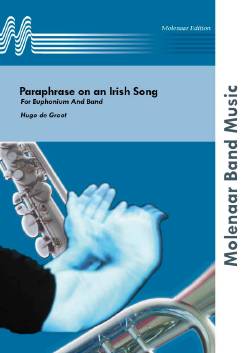
Paraphrase on an Irish Song - Hugo de Groot
The traditional Irish melody "Londonderry Air" has been taken by dutch composer Hugo de Groot and used as the theme for this rich and singing composition
Estimated dispatch 10-14 working days
-
 £35.00
Ariel
DescriptionAll hail, great master! Grave sir, hail! I come To answer thy best pleasure, be 't to fly, To swim, to dive into the fire, to ride On the curled cloud. To thy strong bidding, task Ariel and all his quality. - William Shakespeare: The Tempest, Act 1, Scene 2Ariel was written for the Hammonds Band to open their programme at the 2019 Brass in Concert Championships at The Sage Concert Hall in Gateshead, where it received its premiere. The title is taken from the character in Shakespeare's play 'The Tempest'. Ariel is an immensely powerful "air spirit" or demon bound to serve Prospero, the exiled Duke of Milan, after being released by Prospero from imprisonment in a tree. In the play Ariel's magical abilities are used to help Prospero revenge himself on his enemies and reclaim his dukedom, whereupon Ariel finally regains his freedom.You can hear an audio preview and follow the score below: Performance notes:The cornets and horns are split into two "choirs" to be placed left and right of the band. It may be possible for the choirs to play their opening flourish offstage, and the optional repeated sections in the opening are to accommodate stage movement if required. Trombones form a third "choir" which should ideally stand centrally between basses and percussion, and the euphoniums and baritones should sit in front of the basses. The work requires four percussionists, although if four are not available the 2nd part may be omitted.Percussion 1: Kit - bass drum, snare, 3 x toms, hi-hat, suspended cymbal - and 3 x temple blocksPercussion 2: Tam tam and orchestral bass drum.Percussion 3: Glockenspiel and timpaniPercussion 4: Tubular bellsSoprano, solo cornets and 3rd cornets require cup mutes. Solo trombone requires a cup mute, second trombone requires a metal straight mute.
Estimated dispatch 7-14 working days
-
 £15.00
LeFay's Mirage
DescriptionThe "mirage" of the title refers to an optical effect called a fata morgana, often seen in a narrow band right above the horizon. It is an Italian term named after the Arthurian sorceress Morgan le Fay, from a belief that these mirages were fairy castles in the air or false land created by her witchcraft to lure sailors to their deaths.Fata Morgana mirages significantly distort the object or objects on which they are based, often such that the object is completely unrecognizable. A Fata Morgana may be seen on land or at sea, in polar regions, or in deserts. It may involve almost any kind of distant object, including boats, islands, and the coastline.Music often performs the same tricks - the original material is inverted, reflected and changed until it becomes something almost entirely new. This work is in two main sections, slow and fast, separated by a virtuoso cadenza with the material in the second part being a distorted reflection of that in the first. As befits a work commissioned to show off a soloist's range and ability, the work is highly challenging technically and covers the full range of the tenor horn.Where the sustain pedal is required by the music, this is indicated in the piano part; pedalling elsewhere is at the player's discretion.
Estimated dispatch 7-14 working days
 Listen to MP3
 View Music