
Results
-
 £64.00
Three Spanish Impressions (Score and Parts)
Three Spanish Impressions originally were part of a large, single movement work called " SPAIN" Whilst happy with the content of the work, I realised that it was rather unwieldy and a bit too long, so, with the publishers blessing, created a shorter suite from the existing material.The brooding and repetitive opening movement takes its mood perhaps from the Miles Davis/Gil Evans album "Sketches of Spain", albeit in a less stringent harmonic language. The middle movement is a delicate and fragile waltz, with shades of a romance within, and the finale, a colourful and robust fandango, also contains a lyrical heart!The thematic material, whilst written very much as a pastiche of the music of Spain, is original, and the accent is firmly on melody and musicianship!Alan FernieJune 2007
Estimated dispatch 7-14 working days
-
 £24.00
Three Spanish Impressions (Score Only)
Three Spanish Impressions originally were part of a large, single movement work called " SPAIN" Whilst happy with the content of the work, I realised that it was rather unwieldy and a bit too long, so, with the publishers blessing, created a shorter suite from the existing material.The brooding and repetitive opening movement takes its mood perhaps from the Miles Davis/Gil Evans album "Sketches of Spain", albeit in a less stringent harmonic language. The middle movement is a delicate and fragile waltz, with shades of a romance within, and the finale, a colourful and robust fandango, also contains a lyrical heart!The thematic material, whilst written very much as a pastiche of the music of Spain, is original, and the accent is firmly on melody and musicianship!Alan FernieJune 2007
Estimated dispatch 7-14 working days
-
 £74.95
Variations on an Enigma (Score and Parts)
Variations on an Enigma was commissioned by Howard Snell for the Desford Colliery Band and first performed by them in Gillingham, Dorset, England in September 1986.The 'Enigma' is a short snatch of a phrase taken from a well-known brass band test piece - a phrase which caught the imagination of the composer who took it as the basis of a sort of concerto for band with each section featured in turn. First the cornets have their turn, with a 'moto perpetuo', and they are followed by the horns and flugel whose variation is delicate and decorative. Trombones follow, each having there own tune in turn and then combining them together. Euphoniums and baritones have an expressive funeral march which is interrupted by percussion and basses who share a rhythmic, syncopated variation. A climax is reached and this is followed by a fugue (based on the theme) against which snatches of the preceding variations appear. The fugue heralds what turns out to be the theme on which all the variations are based, appearing in full at last, whose first five notes are derived from the 'enigma' theme. The piece ends with an emphatic final statement by the timpani.
Estimated dispatch 7-14 working days
-
 £37.95
Variations on an Enigma (Score Only)
Variations on an Enigma was commissioned by Howard Snell for the Desford Colliery Band and first performed by them in Gillingham, Dorset, England in September 1986.The 'Enigma' is a short snatch of a phrase taken from a well-known brass band test piece - a phrase which caught the imagination of the composer who took it as the basis of a sort of concerto for band with each section featured in turn. First the cornets have their turn, with a 'moto perpetuo', and they are followed by the horns and flugel whose variation is delicate and decorative. Trombones follow, each having there own tune in turn and then combining them together. Euphoniums and baritones have an expressive funeral march which is interrupted by percussion and basses who share a rhythmic, syncopated variation. A climax is reached and this is followed by a fugue (based on the theme) against which snatches of the preceding variations appear. The fugue heralds what turns out to be the theme on which all the variations are based, appearing in full at last, whose first five notes are derived from the 'enigma' theme. The piece ends with an emphatic final statement by the timpani.
Estimated dispatch 7-14 working days
-
 £38.95
Unity Series Band Journal - Numbers 542 - 545, June 2025
542: Exalted (Daniel Elson)An up-beat arrangement of the worship chorus Hosanna in the highest (S.A.S.B. 366). The piece features a relaxed, flowing style with syncopated rhythms and dynamic contrasts.543: Angels Rock (Samuel Shelley) This rhythmic arrangement references Hark! the herald angels sing (C.C. 38) and provides an easily accessible, modern arrangement of a well-known carol.544: Carol Arrangement - Little Jesus, sweetly sleep (David Wright)A beautiful two-verse setting of The rocking carol, originally published in 1920, which is known for its gentle, understated style with an emphasis on balance and intonation.545: We shall come rejoicing (Andrew Mackereth) A straightforward medley of harvest favourites, featuring dynamic contrasts, call and response figures, and a nostalgic reference, with a focus on harmonic consistency.
Estimated dispatch 7-14 working days
-
 £34.95
Light Song (Brass Band - Score and Parts)
This energetic arrangement was written for the Canadian Staff Band's visit to Los Angeles, California, USA, in 2016, to participate in the first ever gathering of five top North American Salvation Army bands. Two well-known songs are given an atypical stylistic treatment, featuring some unusual harmonic and metric variations to keep both players and listeners 'on their toes'.The music itself is a study in contrasts, starting with the dynamics in the whole tone scalic figures in the opening bars. The melody Jesus is my light (T.B. 709) is used with changing time-signatures along with a soft, yet rhythmic approach to the tune Walk in the light (T.B. 909). The work finished with a bright and energetic ending.
Estimated dispatch 7-14 working days
-
 £34.95
Boundless Spirit (Brass Band - Score and Parts)
This medley contains highlights from music the composer wrote for the opening event of Boundless, The Salvation Army's International Congress held at London's O2 Arena in 2015. The work features original melodies but also recognisable tunes with a global flavour; Moscow (T.B. 198), Europe (T.B. 367), Calabar (T.B. 362), They shall come from the east (T.B. 887), The world for God (T.B. 876) and Happy Song (T.B. 644) which calls to mind the words 'There's salvation for the world'. The objective of the piece is to celebrate the diversity of The Salvation Army around the world through a variety of music styles.
Estimated dispatch 7-14 working days
-
 £15.99
Brass Essentials - An Practice Companion (for all treble clef instruments)
Brass Essentials: A Practice Companion helps you organise your daily practice by setting out a regular daily routine.The book is laid out in a clear and precise way beginning with several pages of Warm ups before moving on to Scales and Arpeggios. When the embouchure is relaxed and working well a comprehensive Technical section helps develop and maintain a solid technique. This includes Flexibilities, Articulation, Finger Exercises, Range Expanding and Stamina.There are brief but informative notes heading each section to guide you through your practice, together with suggestions on how much time to spend on each element. Whether you are an aspiring young brass player, a dedicated amateur, conservatoire student or professional this book is a valuable tool so that you can focus on every aspect of your playing.The Practice Companion can also work in conjunction with the Arban Companion to vary your practice diet.
Estimated dispatch 7-14 working days
-
 £95.00
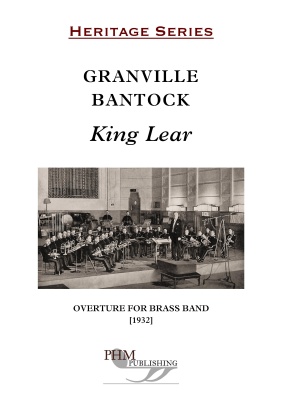
King Lear (Brass Band - Score and Parts)
Sir Granville Bantock (1868 - 1946) composed the second of his five major brass band work for Callender's Cableworks Band, completing the commission on 30 November 1932. Based in the Thames-side district of Belvedere near Erith, the band was active between 1898 and 1961. The works band of the Callender Cable & Construction Co. Ltd, it was at the peak of its popularity during the 1930s and was a frequent broadcaster on the radio. The band employed an in-house arranger and played saxophones in its lighter material. King Lear was one of the band's major commissions and was not published in Bantock's lifetime. The manuscript score and parts were thought to be lost for decades, but were found in the library of the Haydock Band (Lancashire), which had inherited part of Callender's library of manuscripts material and bespoke arrangements after it has been transferred to nearby Prescott Cables Band after Callender's Cable Works closed.King Lear is a substantial work, in essence a dramatic tone poem in the romantic Tchaikovskian manner, presenting a series of character portraits of the foolish old king and his three daughters, Goneril, Regan and Cordelia. The music is dramatic and lyrical by turns, with the most generous lyrical episode revealing perhaps the warm-hearted Cordelia. An expansive melody that flows from this is brought back towards the end as the main climax of the work.In 2001, Bantock's score was recorded by the University of Salford Brass Band, conducted by Dr. Roy Newsome. The original is serviceable, but in comparison with the orchestral version he made in 1936 (part of which was recorded on a Paxton 78 rpm) and later brass band scores, performing editions of which were prepared by others, it lacks colour and range typical of Bantock's orchestral work. Above all it lacks percussion, which can be heard on the recorded extract. With the kind permission of the Bantock Estate, I have prepared a performing edition for publication that incorporates percussion, derived from the orchestral recording and added editorially in similar manner elsewhere. I have revoiced some of the low- lying instrumental parts to present the material in more comfortable ranges. Editorial interventions more elaborate than revoicing the original text have been identified as cue notes.- Paul HindmarshDuration: 15.00
Estimated dispatch 7-14 working days
-
£40.00
King Lear (Brass Band - Score only)
Sir Granville Bantock (1868 - 1946) composed the second of his five major brass band work for Callender's Cableworks Band, completing the commission on 30 November 1932. Based in the Thames-side district of Belvedere near Erith, the band was active between 1898 and 1961. The works band of the Callender Cable & Construction Co. Ltd, it was at the peak of its popularity during the 1930s and was a frequent broadcaster on the radio. The band employed an in-house arranger and played saxophones in its lighter material. King Lear was one of the band's major commissions and was not published in Bantock's lifetime. The manuscript score and parts were thought to be lost for decades, but were found in the library of the Haydock Band (Lancashire), which had inherited part of Callender's library of manuscripts material and bespoke arrangements after it has been transferred to nearby Prescott Cables Band after Callender's Cable Works closed.King Lear is a substantial work, in essence a dramatic tone poem in the romantic Tchaikovskian manner, presenting a series of character portraits of the foolish old king and his three daughters, Goneril, Regan and Cordelia. The music is dramatic and lyrical by turns, with the most generous lyrical episode revealing perhaps the warm-hearted Cordelia. An expansive melody that flows from this is brought back towards the end as the main climax of the work.In 2001, Bantock's score was recorded by the University of Salford Brass Band, conducted by Dr. Roy Newsome. The original is serviceable, but in comparison with the orchestral version he made in 1936 (part of which was recorded on a Paxton 78 rpm) and later brass band scores, performing editions of which were prepared by others, it lacks colour and range typical of Bantock's orchestral work. Above all it lacks percussion, which can be heard on the recorded extract. With the kind permission of the Bantock Estate, I have prepared a performing edition for publication that incorporates percussion, derived from the orchestral recording and added editorially in similar manner elsewhere. I have revoiced some of the low- lying instrumental parts to present the material in more comfortable ranges. Editorial interventions more elaborate than revoicing the original text have been identified as cue notes.- Paul HindmarshDuration: 15.00
Estimated dispatch 7-14 working days