
Results
-
£45.00
The Rings of Saturn - Harper, P
This piece attempts to convey the vastness of time, space and the universe, and mankind's miniscule and fleeting existence within it. It features lyrical solos for solo cornet, repiano and flugel horn, placed spatially in the performance space.Click here to listen to a short excerpt2nd Section +Duration 5 mins
In Stock: Estimated dispatch 1-3 working days
-
£22.50
The Rings of Saturn (Score) - Harper, P
This piece attempts to convey the vastness of time, space and the universe, and mankind's miniscule and fleeting existence within it. It features lyrical solos for solo cornet, repiano and flugel horn, placed spatially in the performance space.Click here to listen to a short excerpt2nd Section +Duration 4 mins
In Stock: Estimated dispatch 1-3 working days
-
 £70.00
General Series Band Journal December 2017 Numbers 2174-2177
Festival March - Stowmarket 125 (Steven Ponsford)This festival march is traditional in style, abounds in energy and features the lesser known chorus 'In that city built four square' which the corps at Stowmarket have featured through the years.At the cross (Paul Sharman)This meditation was originally written for the Disciples of the Cross commissioning and features 'To thy cross, I come Lord', 'At the cross where I first saw the light' and other melodic references to 'The Cross of Christ' are also found within.Flugel Horn Solo How deep the fathers love (Andrew Mackereth)The beautiful contemporary song has been set in a developed Flugel Horn Solo which should have an instant appeal to both soloist and band.Evry time I feel the spirit (Dean Jones)The classic spiritual is given an up-tempo feel and has been featured by the International Staff Band in recent programmes.
Estimated dispatch 7-14 working days
-
 £19.95
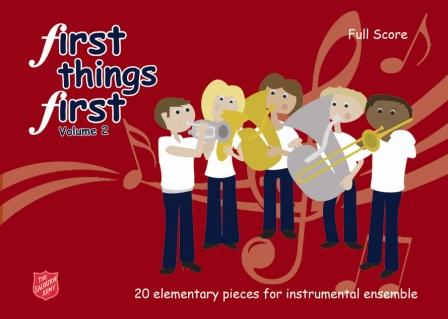
First Things First Vol.2 Full Score
Following the success of Volume 1, here is Volume 2 containing 20 new pieces:Chorus Arrangement - Clap your Hands (Derick Kane)Easter Intrada (Nicholas Samuel)Father, we adore you ((Ralph Pearce)March - Give thanks to the Lord (Trevor Davis)Happy all the time (Martin Cordner)March - Hold On! (Erik Silfverberg)Holy Ground (Trevor Davis)Prelude - In this place (Nicholas Samuel)Marching Saints (Ralph Pearce)New Life (Ray Steadman-Allen)Intrada - O come. all ye faithful (Andrew Blyth)Send the Fire! (Erik Silfverberg)Soon and very soon (Derick Kane)March - Stand up for Jesus (Noel Jones)Song Arrangement - Thank You! ((Andrew Blyth)The Lord's my shepherd (Ray Steadman-Allen)There is a redeemer (Dean Jones)We give thanks (Ralph Pearce)Winter's Rock! (Andrew Blyth)Wonderful Lord (Martin Cordner)
Estimated dispatch 7-14 working days
-
 £44.95
Judd: Euphony
Previously only available in manuscript form, this euphonium solo with brass band accompaniment is now available in printed format. Euphony (meaning a pleasant, sweet sound) is based on the tunes of Sidney Cox with material taken from the songs; 'He found me', 'This one thing I know', 'You can tell out the sweet story' and 'Deep and wide'. At the time of writing, the composer remarked; 'The euphonium is often associated with melodies and harmonies that lend themselves to pleasing sounds'. That is true of this solo but it also presents considerable technical challenges for the soloist in terms of range and technique.
Estimated dispatch 7-14 working days
-
 £24.95
Judd: Of Whom I Sing
The original, Jeg elsker Dig, is a plaintive love song for voice and piano with words by Hans Christian Anderson; 'You have become thought of my thought, you are my heart's first love. I love you, as no one here on earth, I shall love you through time and eternity!'
Estimated dispatch 7-14 working days
-
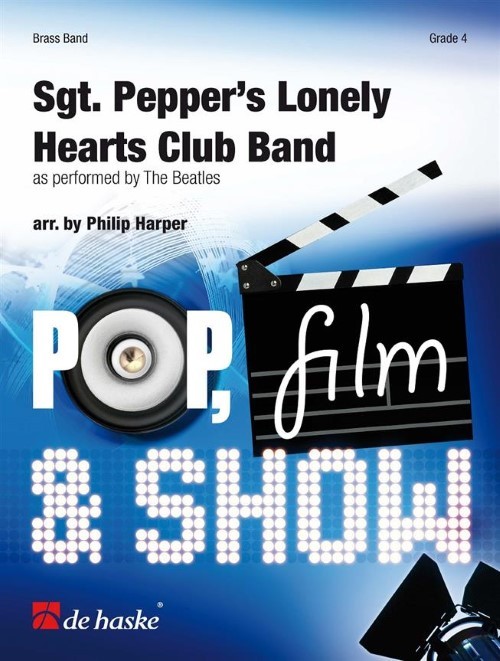 £54.99
Sgt. Pepper's Lonely Hearts Club Band (Brass Band - Score and Parts) - Lennon & McCartney - Harper, Philip
Sgt. Pepper's Lonely Hearts Club Band is the most famous album by The Beatles, and perhaps of all time. When it came out in 1967 it was remarkable not only for its many great songs, but also because of the innovative recording techniques that were used on the record for the very first time, setting a new standard for many decades to come. Conductor, arranger and composer Philip Harper is a huge Beatles fan himself and had a great time creating this grade 4 arrangement!
Estimated dispatch 7-14 working days
-
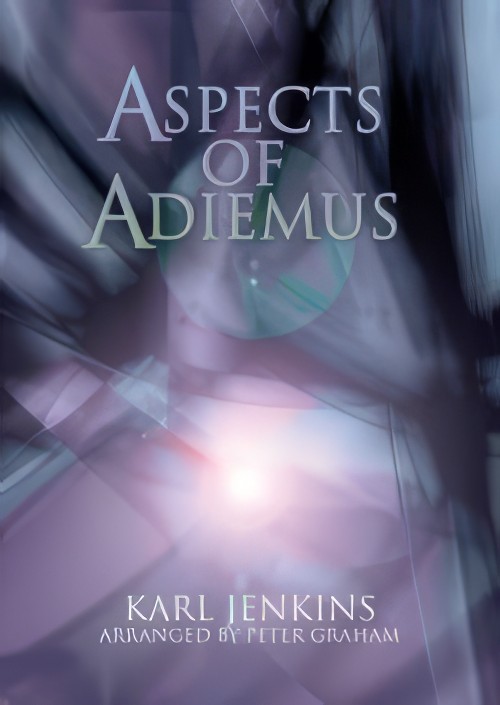 £74.95
Aspects of Adiemus (Brass Band - Score and Parts) - Jenkins, Karl - Graham, Peter
Aspects of Adiemus is a collection from one of the world's most popular composers, Karl Jenkins. Adiemus, literally translated, means 'we will draw near' and represents a musical language which can be heard on five award winning albums from the composer.Since Adiemus has risen in popularity around the world, it has become a growing entity meaning many different things to many different people. Vocally, the spread of influence grows wider all the time, taking in Arabic and African sounds as well as Celtic and ecclesiastical ones. The percussion too has expanded using Indian, Middle Eastern, Japanese, Chinese and even Australian instrumentation.The evolving nature of Adiemus has meant that it has been difficult to categorise. New age, classical crossover, world music, even pop. Karl sees this as a good sign: To me, Adiemus transcends labels. The fact that it reaches people of different backgrounds, faiths and cultures gives it a universal appeal which is special. The compositions can be spiritual, religious, meditative - it's open to move people in any away they choose to experience.Ironically, the Adiemus project got off the ground initially due to a television commercial for an airline. Karl Jenkins explains, I'd been toying with a new idea, completely separate to my work in advertising, but at this time, Jenkins Ratledge were commissioned to come up with the music for an airline commercial. We presented the client with a demonstration tape of one of my completed compositions and they loved it.That composition became known as Adiemus. The music for the airline commercial was aired and immediately drew interest from the public. Karl: It's ironic that a piece of music not originally intended for a TV commercial should end up on a TV commercial, and that this music became the springboard for the success of the Adiemus project.Expertly arranged by Peter Graham, Aspects of Adiemus features the eponymous Adiemus, an uplifting and instantly recognisable opener. Chorale - Za Ma Ba and Chorale - Vocalise are songs of sanctuary, the latter featuring a chamber group from within the band. The vibrant Song of the Spirit is a cornet feature, and the finale, Song of the Plains combines intense rhythmic energy with tribal harmonies. Duration is variable depending on movement selection and optional cuts.Duration: 20.00
Estimated dispatch 7-14 working days
-
 £89.95
TRUMPETS OF THE ANGELS - 2016 Edition (Gregson) (Brass Band - Score and Parts) - Gregson, Edward
The Trumpets of the Angels is a large-scale work, scored for seven solo trumpets (or cornets), brass band and percussion (deploying 'dark' instruments such as three tam-tams, bass drum and two sets of timpani). The genesis of the work is a quotation from the Book of Revelation ... and I saw the seven angels which stood before God; and to them were given seven trumpets.Thus the idea behind the work is highly dramatic and I have tried to achieve this by the spatial deployment of seven solo trumpets around the band. Trumpet 7 remains separate from the band throughout and, indeed, has the most dramatic and extended cadenza, representing the words of the seventh angel ... and time shall be no more.The work opens with a four-note motif announced by off-stage horns and baritones and answered by fanfare figures on four solo trumpets. In turn, each then play cadenzas before joining together, independently playing their own music. This leads to a sung Kyrie Eleison with accompanying solos for Flugel Horn and Baritone, after which we hear the entry of solo trumpets 5 and 6 with music that is more urgent and rhythmic, describing the Horsemen of the Apocalypse.The music reaches another climax, more intense this time, with the horns and baritones (now on-stage) again sounding the transformed motif, before subsiding into what might be described as a lament of humanity - slow, yearning music, which builds from low to high, from soft to loud, with a melody that is both simple and poignant. At its climax, Trumpet 7 makes a dramatic entry, playing the opening four-note motif, but expanded to almost three octaves. This cadenza (to the partial accompaniment of 3 tam-tams, representing the Holy Trinity) introduces new material and foreshadows the ensuing Scherzo, introduced by antiphonal timpani before the band enters with music that is fast and foreboding. Despite the somewhat desolate and 'unstable' mood of this music, it slowly moves towards an optimistic conclusion, transforming the 'humanity' music into an affirmative and triumphant statement.The original version of The Trumpets of the Angels was commissioned by the Fodens Band for their centenary concert at The Bridgewater Hall, Manchester, in 2000, and contained an important part for organ. In 2015 I was asked by Nicholas Childs to create a New Performing Edition for the Black Dyke Band; without organ, and including newly composed material. This New Performing Edition was given its first performance at the European Brass Band Festival in Lille in April 2016. The work is dedicated In tribute to Olivier Messiaen.- Edward Gregson
Estimated dispatch 7-14 working days
-
£44.95
TRUMPETS OF THE ANGELS - 2016 Edition (Gregson) (Brass Band - Score only) - Gregson, Edward
The Trumpets of the Angels is a large-scale work, scored for seven solo trumpets (or cornets), brass band and percussion (deploying 'dark' instruments such as three tam-tams, bass drum and two sets of timpani). The genesis of the work is a quotation from the Book of Revelation ... and I saw the seven angels which stood before God; and to them were given seven trumpets.Thus the idea behind the work is highly dramatic and I have tried to achieve this by the spatial deployment of seven solo trumpets around the band. Trumpet 7 remains separate from the band throughout and, indeed, has the most dramatic and extended cadenza, representing the words of the seventh angel ... and time shall be no more.The work opens with a four-note motif announced by off-stage horns and baritones and answered by fanfare figures on four solo trumpets. In turn, each then play cadenzas before joining together, independently playing their own music. This leads to a sung Kyrie Eleison with accompanying solos for Flugel Horn and Baritone, after which we hear the entry of solo trumpets 5 and 6 with music that is more urgent and rhythmic, describing the Horsemen of the Apocalypse.The music reaches another climax, more intense this time, with the horns and baritones (now on-stage) again sounding the transformed motif, before subsiding into what might be described as a lament of humanity - slow, yearning music, which builds from low to high, from soft to loud, with a melody that is both simple and poignant. At its climax, Trumpet 7 makes a dramatic entry, playing the opening four-note motif, but expanded to almost three octaves. This cadenza (to the partial accompaniment of 3 tam-tams, representing the Holy Trinity) introduces new material and foreshadows the ensuing Scherzo, introduced by antiphonal timpani before the band enters with music that is fast and foreboding. Despite the somewhat desolate and 'unstable' mood of this music, it slowly moves towards an optimistic conclusion, transforming the 'humanity' music into an affirmative and triumphant statement.The original version of The Trumpets of the Angels was commissioned by the Fodens Band for their centenary concert at The Bridgewater Hall, Manchester, in 2000, and contained an important part for organ. In 2015 I was asked by Nicholas Childs to create a New Performing Edition for the Black Dyke Band; without organ, and including newly composed material. This New Performing Edition was given its first performance at the European Brass Band Festival in Lille in April 2016. The work is dedicated In tribute to Olivier Messiaen.- Edward Gregson
Estimated dispatch 7-14 working days
 View Music