
Results
-
£75.00
Nightglow (Bra) - Ben Hollings
The young British composer Ben Hollings found his inspiration for 'Nightglow' during a night out in the open air. The work is inspired by a nocturnal celestial scene in which the scattered stars, comets, galaxies and other astronomical elements create a warm 'nocturnal glow' in the darkness of space. A beautiful slow work for any band!
Estimated dispatch 7-14 working days
-
£64.95
Proverbially
Proverbially is a concertino for euphonium and brass band composed for Glenn Van Looy. The piece is structured in three individual movements, each around 3 minutes. Each movement is based on a particular modern proverb: Between the Lines, inspired by the phrase, reading between the lines; Red Sky, inspired by the proverb, red sky at night, shepherd's delight; A Stitch in Time, inspired by the proverb, a stitch in time saves nine.
Estimated dispatch 7-14 working days
-
 £27.00
Auld Lang Syne (Brass Band - Score and Parts)
It is a tradition in most English-speaking countries to sing this song at the stroke of midnight on New Year's Eve to usher in the New Year. The words are at least partially written by Robert Burns and the words "Auld Lang Syne" literally mean "old long ago" or "the good old days", providing a moment of reflection before moving forwards into the New Year.The tubular bells, although pitched, sound midnight when they enter at bar 10.This arrangement was prepared for Brass Band of the Western Reserve, musical director Keith M Wilkinson, to perform at First Night, Akron, Ohio, December 31st, 2007. The following choreography is suggested:Commence the performance with all the cornets scattered around the auditorium.At the end of bar 18 invite the audience to sing along with the band.At bar 27 the cornets move to stand in front of the other members of the band to lead to the stirring conclusion. Should auld acquaintance be forgot and never brought to mind?Should auld acquaintance be forgot and days of auld lang syne?For auld lang syne, my dear, for auld lang syne,We'll take a cup of kindness yet, for auld lang syne.
Estimated dispatch 7-14 working days
-
£33.00
On the Inside - Caswell, A - Broadbent, D
The theme song from the Australian soap opera 'Prisoner: Cell Block H'.This was a huge hit in the late 80s when millions would tune in to watcht he late night show. The theme song written by Allan Caswell and performed by Lynne Hamilton reached number three on the UK singles chart in 1989.
In Stock: Estimated dispatch 1-3 working days
-
£103.00
Sviskemedley - Various - Torstein Aagaard-Nilsen
Torstein Aagaard-Nilsen wrote this medley to the 1992-93 Concert season for trumpeter Helge Haukas of The Norwegian Defence Band region West located in Bergen (today Norwegian Navy Band Bergen).Haukas choose thee titles in the "Sweet Trumpet" style suitable for any Entertainment concert. The result was this "Trumpet Sweets" medley consisting of the following three melodies:1. Gotlandsk sommernatt (A Summer night in Gotland)2. Estrellita3. Can't help falling in Love
Publisher Closed for Holidays. Est Delivery 13-14th Aug
-
£24.50
Festive Intrada - Bill Willis
FESTIVE INTRADAThis is a lively opener using the well know Christmas tunes of Silent Night and O Come, All Ye FaithfulAfter a bright opening, Silent Night comes in at letter B from Solo Cornets and Soprano followed by the Horns and back to the Cornets. This leads into a brief reference to O Come, All Ye Faithful from the Trombones before the full tune appears at letter C. Care with the syncopated rhythms to ensure the momentum is maintained. As the piece concludes, Silent Night returns, with a bar of Deck the Halls thrown in for good measure leading to a bright ending.
In Stock: Estimated dispatch 1-3 working days
-
£37.50
Brass Monkey's Christmas - Gavin Somerset
With so many bands now using the Brass Monkeys publications with their training bands, this latest release of the 'Brass Monkeys' series is our largest to date and includes a variety of works from the festive season. In this substantial publication of music, simple carols are included that can be performed to accompany an audience singing, or as standalone items. Some novelty choices of music have been included too. The 'Little Drummer Boy' is designed to give your budding percussionist the limelight they've craved all year around, whilst 'O Holy Night' will teach your front row the importance of the 12/8 time signature. Of course, no Christmas compilation would be complete without 'Jingle Bells' & 'We Wish You A Merry Christmas'. This publication will ensure your Brass Monkeys are not left out in the cold this Christmas! Music included is...AWAY IN A MANGER (Cradle Song)HARK, THE HEARALD ANGELS SING (Mendlesshon)LITTLE DRUMMER BOY (Carol Of The Drum) aA" playable without percussionIN THE BLEAK MIDWINTER (Cranham)JINGLE BELLSWHILE SHEPHARDS WATCHED (Winchester Old)O HOLY NIGHTWE WISH YOU A MERRY CHRISTMAS
In Stock: Estimated dispatch 1-3 working days
-
 £24.50
Christmas Jig - Naomi Styles
With a different take on the traditional Christmas medley, this jolly selection takes several well-known Christmas carols written in 6/8 time and puts them in the style of a gleeful jig. Featuring In Dulci Jubilo, On Christmas Night, I Saw Three Ships, Christ was Born on Christmas Day & Here we Come a-Wassailing, the piece is a great workout for the band, whilst audiences will struggle to remain still throughout in this lively piece.
In Stock: Estimated dispatch 1-3 working days
-
£37.50
Brass Monkey's Classical - Gavin Somerset
This release from the 'Brass Monkeys' series introduces your training band to some of the best-loved classical music around. Each piece contains a different challenge and something new to learn. With an opening from Clarke, marches from Tchaikovsky & Elgar, a lullaby from Brahms and memorable music from Dvorak & Holst, this is the perfect way for your learners to start playing some of the world's most famous melodies. The music in this publication is also a great way for your training band to join in on concerts with the senior band. This final item, 'Jupiter' from Holst's 'The Planets' has as well as the main melody, an optional, slightly more difficult section so the players have something to work towards even after conquering the main bulk of the work. Music included isaATRUMPET VOLUNTARY (Prince Of Denmark's March)MARCH SLAVEGOOD EVENING, GOOD NIGHT (Brahms' Lullaby)LARGO (From The 'New World Symphony')POMP & CIRCUMSTANCE No.1 (Land Of Hope & Glory)JUPITER (From 'The Planets')
In Stock: Estimated dispatch 1-3 working days
-
 £29.50
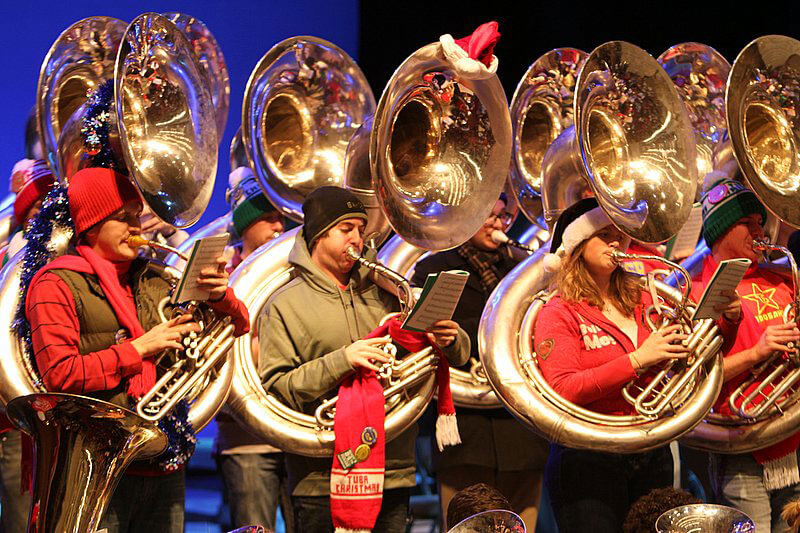
An Oompah Christmas - Trad - Len Jenkins
Described as "Rhythmic Seasonal Sillyness", this smashing arrangement throws together a mixture of well known Christmas melodies (Noel, Silent Night, Schneewalzer) as well as some other surprises, wrapped up in a toe tapping waltz style, all finished off with a rendition of "We Wish You A Merry Christmas". Perfect anywhere on a Christmas program and makes a great finale item.
In Stock: Estimated dispatch 1-3 working days

 View Music
 Listen to MP3