
Results
-
 £25.00
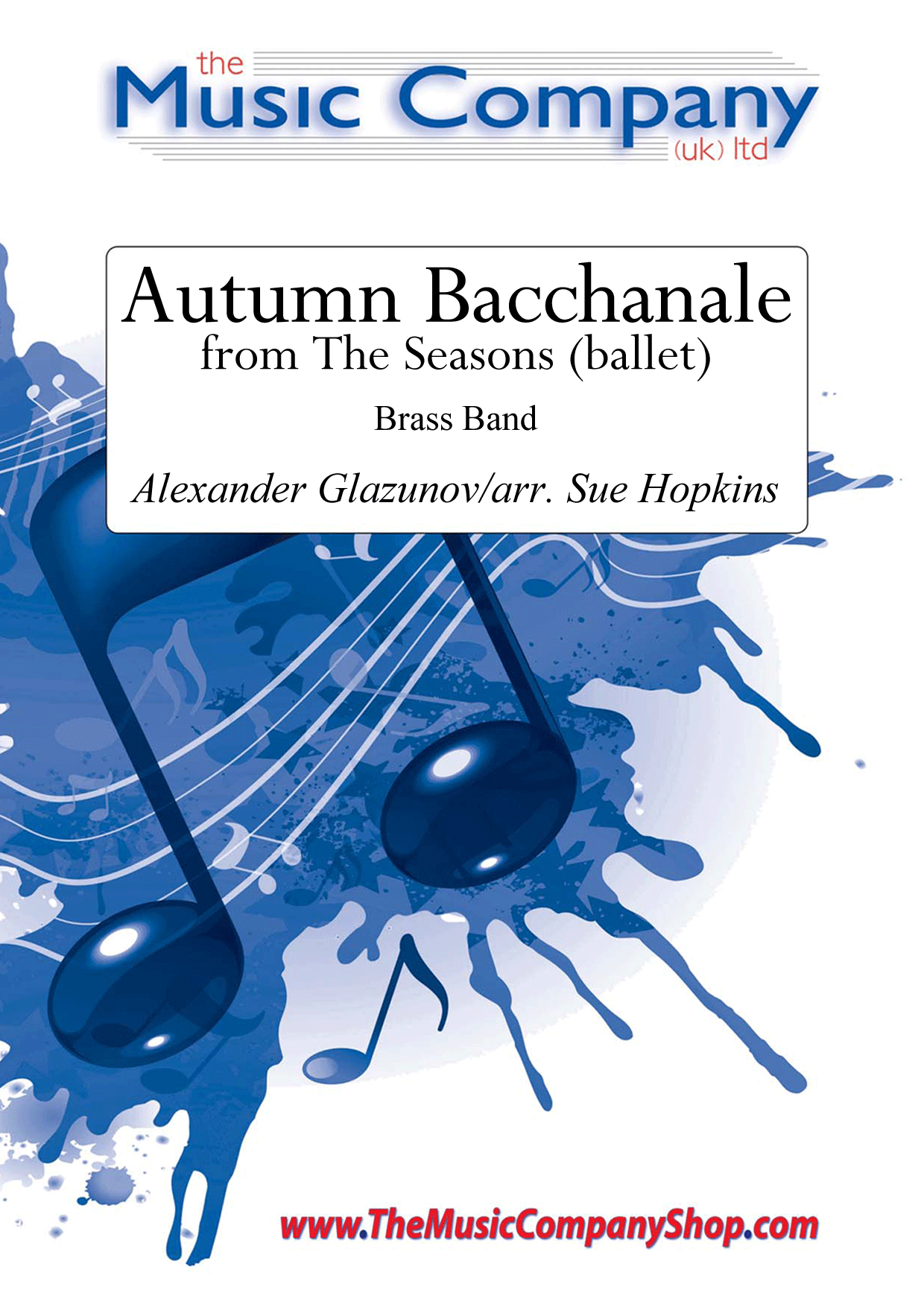
Autumn Bacchanale (from The Seasons) - Alexander Glazunov
A lively, joyous item, ideal as a light interlude in any concert and especially appropriate for late season/Christmas themed events with its jaunty, positive sounds. Sue Hopkins has shown great creativity in crafting this arrangement of Glazunov's 'Autumn' movement, a bacchanale from his ballet The Seasons, hence its fondly referenced title of Autumn Bacchanale.Alexander Glazunov (1865 - 1936) was a Russian composer, music teacher and conductor. He was a child prodigy and was taught privately byRimsky-Korsakov, who said Glazunov's musical progress did not increase day by day but hour by hour. He began composing at age eleven and wrote his first symphony at age 16 in 1881 and it was premiered one year later.His ballet The Seasonswas first performed by the Imperial Ballet in St Petersburg on 20 February 1900 and was choreographed by Marius Petipa.It was written in one act and four scenes, and this piece represents the moment when all The Seasons take part in a glorious dance while leaves from autumn trees rain upon their merriment.
In Stock: Estimated dispatch 3-5 working days
-
 £15.99
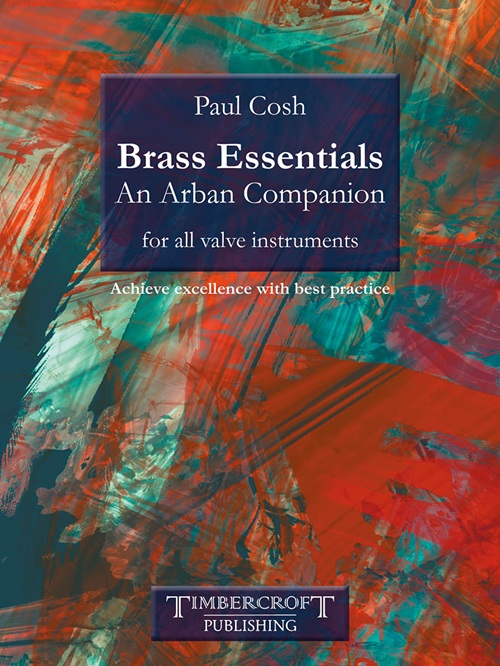
Brass Essentials - An Arban Companion (for all valve instruments)
Brass Essentials: An Arban Companion works through the Arban Cornet Method in the sequence that the excerpts appear in the original publication. It is not a method in itself, but a way to address the building blocks of a solid technique - good sound, good intonation, developing technical skills and applying rhythmic accuracy. It is suitable for all valve instruments.Simply choose which of the sections applies to the issues you are facing in your playing at any given time. Advice is given at the head of each section on how to deal with the technical processes involved for that particular area of practice as well as suggestions on rehearsal and performance tempi.A regular approach to the most basic aspects of playing a brass instrument will help maintain a strong technique whilst addressing any problems that may occur during your playing life, as they do from time to time. It can also provide a regular practice diet that will encourage real attention to detail.Brass Essentials: An Arban Companion can be used as a resource for teachers helping players starting out on their musical journey, but also performers at any point in their musical life as a back-to-basics approach is often the way forward when dealing with playing issues. The overriding principle is that every note counts!Section Headings : Set-Up, Articulation and Sound; Light Articulations; Syncopation, Spacing and Rhythm; Single Tonguing; Controlled Slurring Technique; Running Scales and Chromatics; Breathing, Shaping and Phrasing; Arpeggios, Dominant Sevenths and Diminished Sevenths; Triple Tonguing; Double Tonguing; The Studies
Estimated dispatch 7-14 working days
-
 £59.95
Judd: My Strength My Tower - Contest Version
This music consists of a theme followed by five extensive variations. The theme is the composer's own tune set to the words, 'Thee will I love, my strength, my tower', a hymn by Johann Scheffler translated by John Wesley. A strong modal flavour is characteristic of the theme. Variation 1 This is a light and graceful variation with a good deal of imitative writing. It leads, without a break, into the next variation. Variation 2 Fire and ferocity are asked for in the course of this variation. Variation 3 This variation demonstrates the original approach of the composer. Solo lines for cornet and euphonium are included with their arabesques and arpeggii. Variation 4 Taking the form of a passacaglia, the 'ground' is given out at once by the basses. Fragments of the 'ground', plain or decorated, are combined and used in a number of ways, revealing the composer's mastery of counterpoint. Variation 5 The briskly moving and scintillating final variation abounds in sudden variations of dynamic. The tempo remains constant until an increase is called for in the coda. This 'contest' version has been prepared by Brian Bowen who was asked to re-work the percussion part and introduce a repiano cornet part (Salvation Army band publications do not, in general, have a part for repiano cornet).
Estimated dispatch 7-14 working days
-
£59.95
MY STRENGTH, MY TOWER Rhapsodic Variations (Brass Band Set) - Dean Goffin
This music consists of a theme followed by five extensive variations. The theme is the composer's own tune set to the words, 'Thee will I love, my strength, my tower', a hymn by Johann Scheffler translated by John Wesley. A strong modal flavour is characteristic of the theme. Variation 1: This is a light and graceful variation with a good deal of imitative writing. It leads, without a break, into the next variation. Variation 2: Fire and ferocity are asked for in the course of this variation. Variation 3: This variation demonstrates the original approach of the composer. Solo lines for cornet and euphonium are included with their arabesques and arpeggii. Variation 4: Taking the form of a passacaglia, the 'ground' is given out at once by the basses. Fragments of the 'ground', plain or decorated, are combined and used in a number of ways, revealing the composer's mastery of counterpoint. Variation 5: The briskly moving and scintillating final variation abounds in sudden variations of dynamic. The tempo remains constant until an increase is called for in the coda. This 'contest' version has been prepared by Brian Bowen who was asked to re-work the percussion part and introduce a repiano cornet part (Salvation Army band publications do not, in general, have a part for repiano cornet).
Estimated dispatch 7-14 working days
-
 £38.95
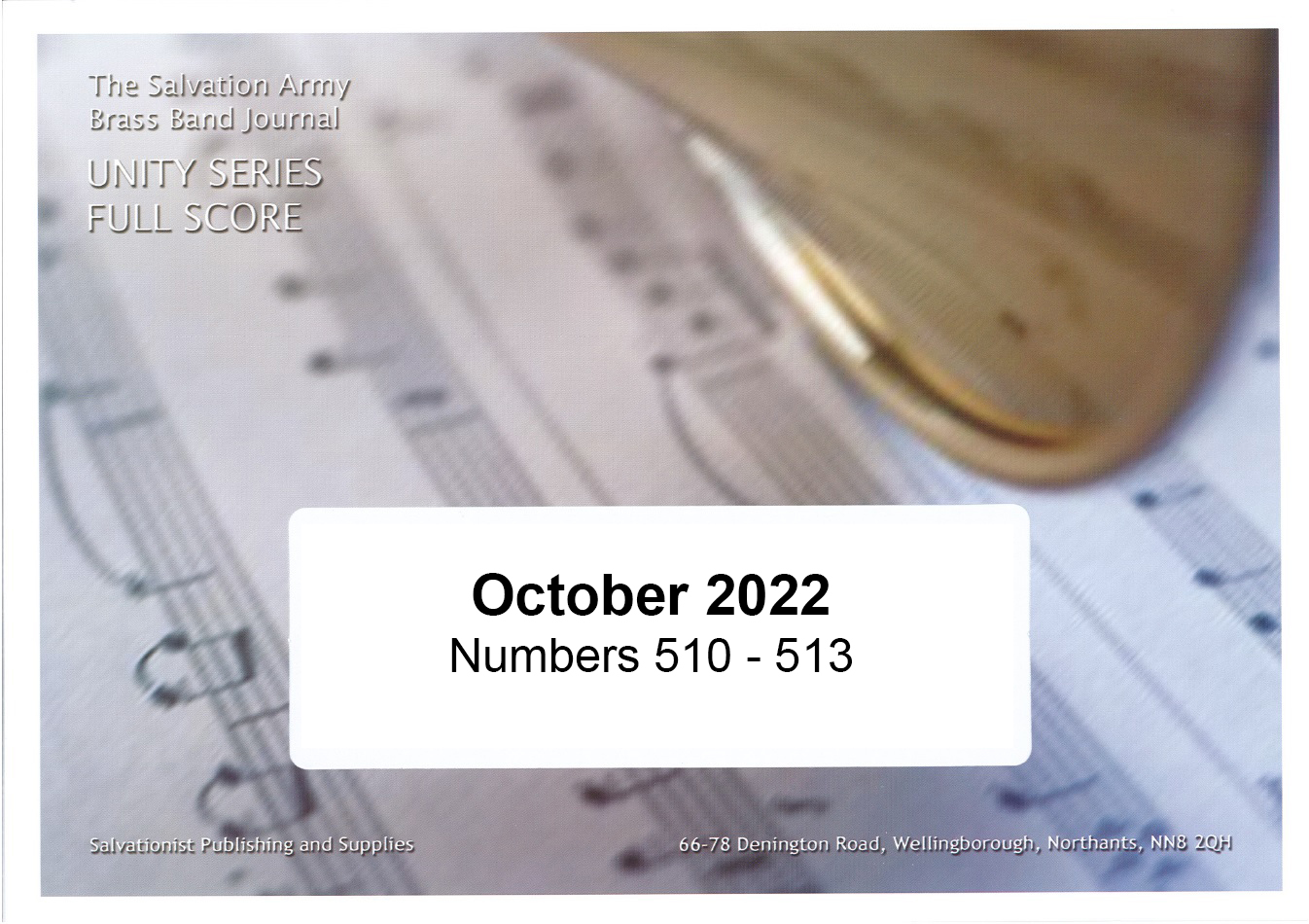
Unity Series Band Journal - Numbers 510 - 513, October 2022
510: March - There is a fountain (Zachary Docter)This bright and cheerful march takes two songs as its basis; Jesus loves me! This I know (S.A.S.B. 807) and There is a fountain (S.A.S.B 202).511: Shine, Jesus, shine (Marcus Venables)While this piece was originally written for young people at a summer music camp in Canada, the piece is a light programme item suitable for smaller ensembles of any age.512: My Trust (Alan Williams)This setting is based on the simple chorus In thee, O Lord, do I put my trust (S.A.S.B 594). Ordinarily heard in 3/4 times, this 4/4 version of the tune has the space for reflection written into the notation.513: Power in the blood (Martyn Thomas)This is a blues/rock arrangement of the traditional hymn Would you be free from your burden of sin? (S.A.S.B 451). It can be used as a stand-alone piece or equally well as an accompaniment for congregational singing.
Estimated dispatch 7-14 working days
-
 £38.95
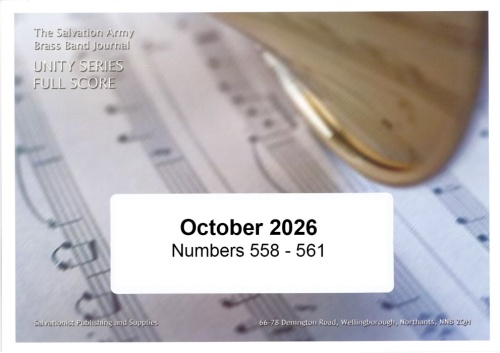
Unity Series Band Journal - Numbers 558 - 561, October 2026
558: Jesus is the winner! (Samuel Ekong)Jesus is the Winner is the publishing debut of Samuel Ekong, Band Secretary at Abuja Central Corps in the Nigeria Territory. Based on a popular song associated with renowned worship leader Ron Kenoly, this arrangement centres on the infectious chorus, "Jesus is the winner man". While the original song was performed in a reggae style, Ekong has reimagined it with a lively swing feel, creating a joyful and accessible work for brass band. Full of rhythmic energy and uplifting spirit, the arrangement encourages a light, buoyant approach throughout and offers an engaging concert item that is sure to be enjoyed by performers and audiences alike.559: Festival Arrangement - Hearts Ablaze (Marcus Venables)Written at the request of Jonathan Evans for Sale Salvation Army Band, Hearts Ablaze is based on the popular contemporary worship song Build Your Kingdom Here that has become especially significant within the corps. The music captures the passion, prayer and enthusiasm of its message, combining bold opening statements with lyrical moments and energetic rhythmic drive. After introducing the familiar melody, the work develops into a vibrant celebration built around the song's call: "Set your Church on fire... Build your kingdom here, we pray." Uplifting and engaging throughout, the piece offers both performers and audiences a joyful and inspiring musical experience.560: Cornet Solo - Soul Saver (Ian Robinson)Based on the well-known chorus Thank You, Lord, for Saving My Soul by Seth and Bessie Sykes, this solo is a heartfelt expression of gratitude for God's gift of salvation. The familiar melody is presented in an expressive setting that allows the soloist to communicate the simple yet powerful message of the song. Contrasting lyrical passages, rich harmonic colours and moments of gentle brilliance combine to create an engaging musical journey. Throughout, the focus remains on the chorus's timeless theme of thanksgiving, making this a moving and devotional addition to the brass band solo repertoire.561: Chorus Selection - God's Presence (Howard Davies)God's Presence by Major Howard Davies combines three well-known songs that explore the believer's walk with God. The selection includes Philip P. Bliss's Let the lower lights be burning, Charles H. Fillmore's O I love him, and the familiar Salvation Army chorus God is with us all the time (S.A.S.B. 1028). Each melody expresses a different aspect of Christian faith, from witness and devotion to the assurance of God's presence. Suitable as both a concert item and a congregational feature, this accessible arrangement offers warmth, variety and a clear spiritual message for performers and audiences alike.
Estimated dispatch 7-14 working days
-
 £45.00
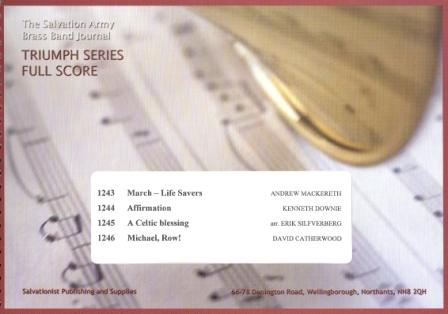
Triumph Series Band Journal November 2013 Numbers 1243-1246
No. 1243 March - Life Savers (Andrew Mackareth)This march was written for the band weekend at Belfast Citadel and incorporates the tune Jesus Saves (T.B. 703)No. 1244 Affirmation (Kenneth Downie)The title comes from the affirming tone of the chorus on which the music is built, He is the Lord, which itself is inspired by Phillippians, chapter 2. The chorus does not appear in its entirety at any point, but is obvious to a greater or lesser extent, in the texture of the music.No. 1245 A Celtic Blessing (arr. Erik Silfverberg)This is a simple arrangement of c Celtic traditional tune used to the lyrics of the familiar blessing:May the road rise to meet you,May the wind be always at your back,May the sun shine warm upon your face,The rain fall soft upon your fields,Until we meet again,May God hold you in the palm of his hand.No. 1246 Michael, Row! (David Catherwood)This arrangement of the traditional chous, 'Michael, row the boat ashore' (T.B. 285), is in a light swing style and also incorporates the tunes, 'Love lifted me' (T.B. 725) and 'Will uour anchor hold?' (T.B. 60).
Estimated dispatch 7-14 working days
-
 £54.20
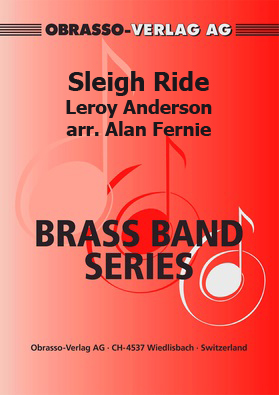
Sleigh Ride
This popular work was originally written for light orchestra during a heatwave in July 1946! Lyrics about a person who would like to ride in a sleigh on a winter's day were written by Mitchell Parish in 1950.
Estimated dispatch 7-14 working days
-
 £29.95
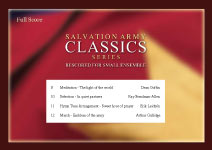
Salvation Army Classics 9-12 for Small Ensemble
Salvation Army Classics arranged for Smaller Ensembles Series 9 - 12Meditation - The Light of the WorldSelection - In Quiet PasturesHymn Tune Arrangement - Sweet Hour of PrayerMarch - Emblem of the Army This series features pieces that have been rescored for Unity Series (five-part) scoring.PART I 1st Cornet BbPART II 2nd Cornet Bb and 1st Horn EbPART III 2nd Horn Eb and Baritone or Trombone BbPART IV Euphonium BbPART V Bass Eb and Bass BbThese transcriptions have been carried out in such a way to facilitate the addition of any original parts that may be available.Where relevant, suggestions are made for a variation in tone colour (i.e. 2nd Cornet, Flugel, Baritone, Trombone) as well asthe occasional opportunity for rest.
Estimated dispatch 7-14 working days
-
 £45.00
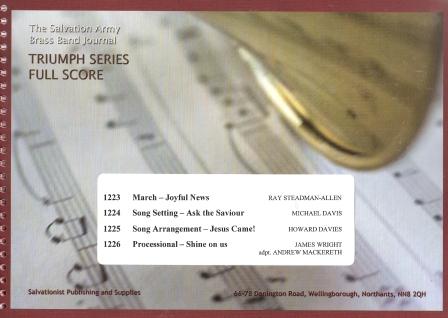
Triumph Series Band Journal March 2012 Numbers 1223-1226
No.1223 March - Joyful News (Ray Steadman-Allen)the composer freeli admits that it was probably 'doodling' on the piano that prompted this march! The title is linked to one of the incorporated tunes, 'My bonnie lies over the ocean' which, in The Salvation Army, is linked to the words, 'God's love is as high as the heavens'. In style, the march has a light swing feel.No.1224 Song Setting - Ask the Saviour (Michael Davis)A setting of the well-known melody, 'Yield not to temptation'.No.1225 Song Arrangement - Jesus Came! (Howard Davis)An arrangement of an old Salvation Army song, 'Jesus came with peace to me, His strong arm was stretched to me, Then my burden took from me - My Saviour'.No.1226 Processional - Shine on us (James Wright adapted by Andrew Mackereth)This bolero-style setting of Michael W Smith's anthem was originally made for s wedding at Sheffield Citadel. It was subsequently adapted for use at the Belfast Temple Music School when players entered the arena in groups, through several entrances, playing from memory.
Estimated dispatch 7-14 working days